Traditional witch, diviner, and spirit-worker from the Balkans. Fascinated with folk magic, grimoires, saints, devils, necromancy, Quimbanda, traditional astrology and dragons.
At long last, here is an offering two and a half years in the making, born of discipline, love, veneration, and deep, sorcerous hunger. In the holy names of Saints Cyprian and Justina of Antioch, the magician and exorcist, warlock and virgin, theurge and mystic, the nail of command and the palm of cunning—here are a pair of tools for the discerning karcist following in the legacy of these mightiest of exemplars.
It is no secret that these blessed martyrs are some of my most intimate and long lasting patrons, with much of my personal and professional life being dedicated to the exploration and study of their mysteries. As I am presently wrapping up a crucial project I have undertaken in their honour, it felt right to finally put out into the world a pair of magical fetishes created in reflection and fulfillment of this very journey, from the very pilgrimage Key and I undertook which resulted in us being forever changed on Aphrodite’s shores, to the thousands upon thousands of prayers collected upon each gathering of knowledge and communion. Whether you’re a devoted follower of Sts. Cyprian and Justina looking to establish a deeper relationship with them, or a karcist looking to harness Cyprian’s authority over magic and Justina’s capacity to unmake its very fabric, this pairing is born of their mutual inseparability in power and wisdom. Drawing on my training and initiation into several forms of Balkan folk Orthodox cunning crafts and oral charming traditions, as well as personal study under Orthodox folk practitioners who venerate Sts. Cyprian and Justina, both the prayer rope and the horn charm were crafted with the aim of sharing some of the potent magics that went into all the adventure and training these saints have opened the roads to across my travels.
The Virgin’s Tears Prayer Rope
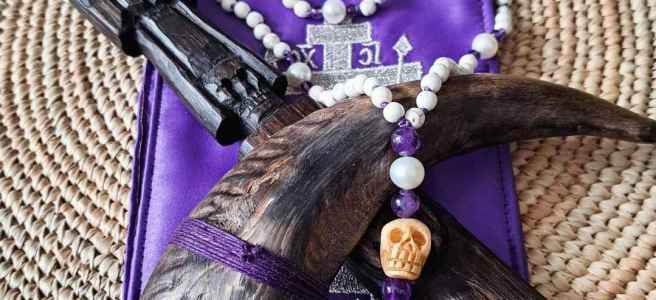
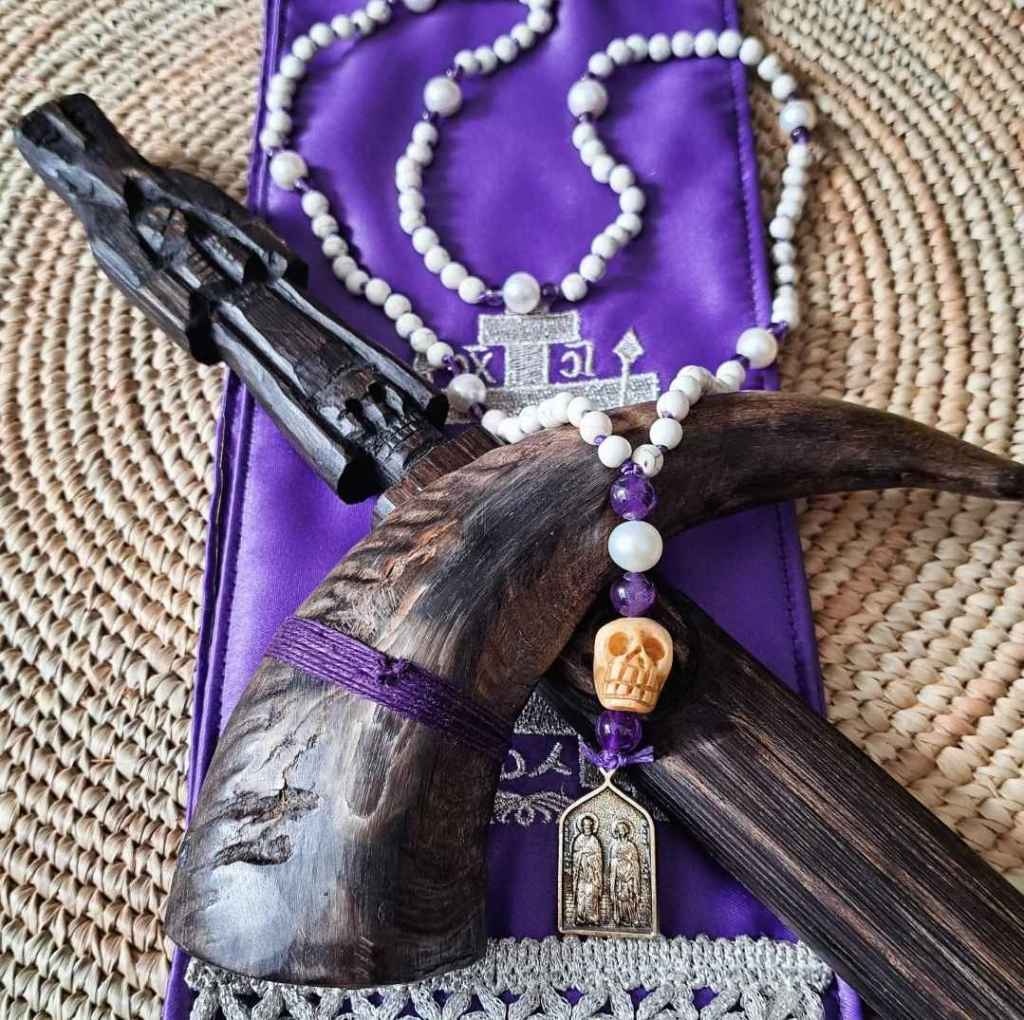
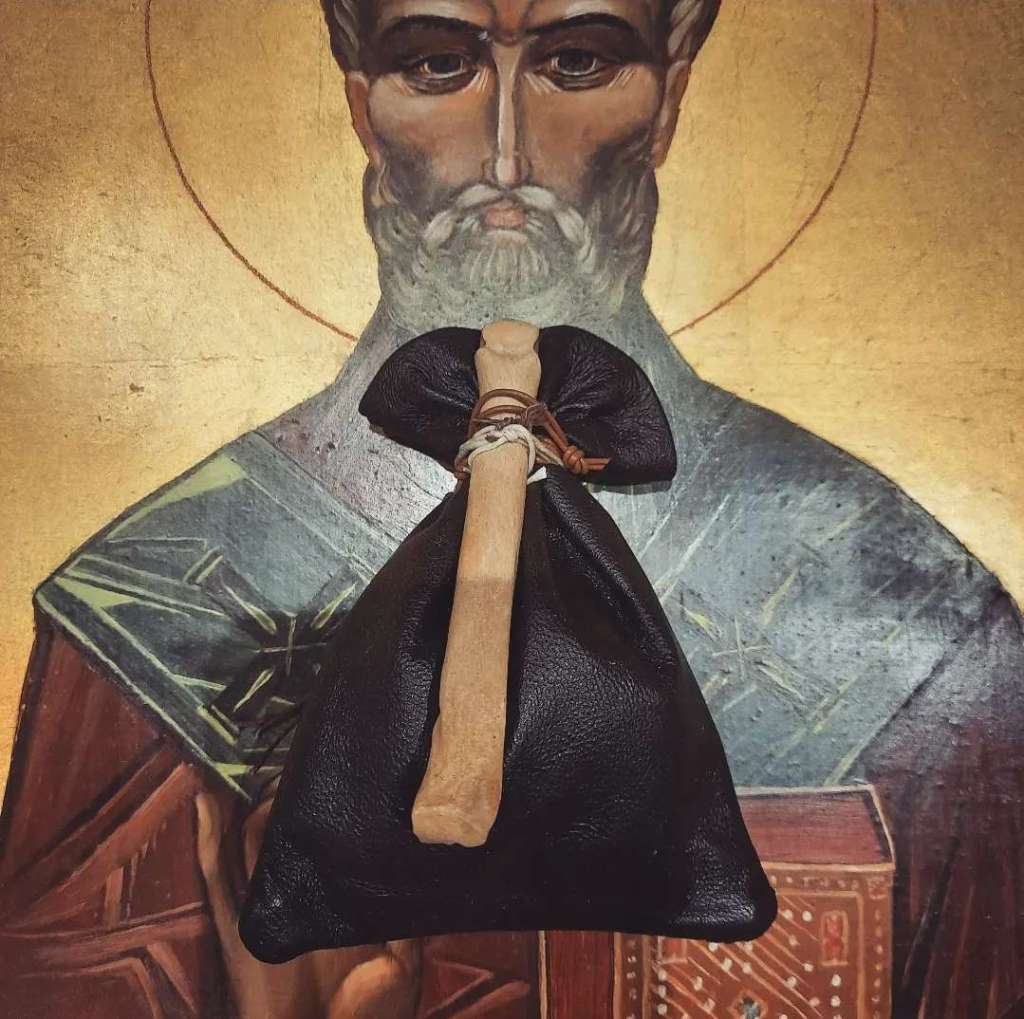
The prayer rope adorning a charm and consecrated chonta wood staff.
While Cyprian’s appeal among magicians may allow his fame to at times overshadow his counterpart, it is Justina’s power that ultimately vanquished him, her exorcisms that sent back his spirits in the Confessio Cypriani, and by her grace that he came to find his eventual sanctuary within the crimson gash of martyrdom and the gleaming crown of sainthood. The holy pair are ever inseparable within Orthodox iconography, always depicted together side by side in their proselytization; their charms, spells, oil recipes, and prayers tying their fates to each other, his salvation into her dexterous hands, and her mysteries within his sinistral embrace.
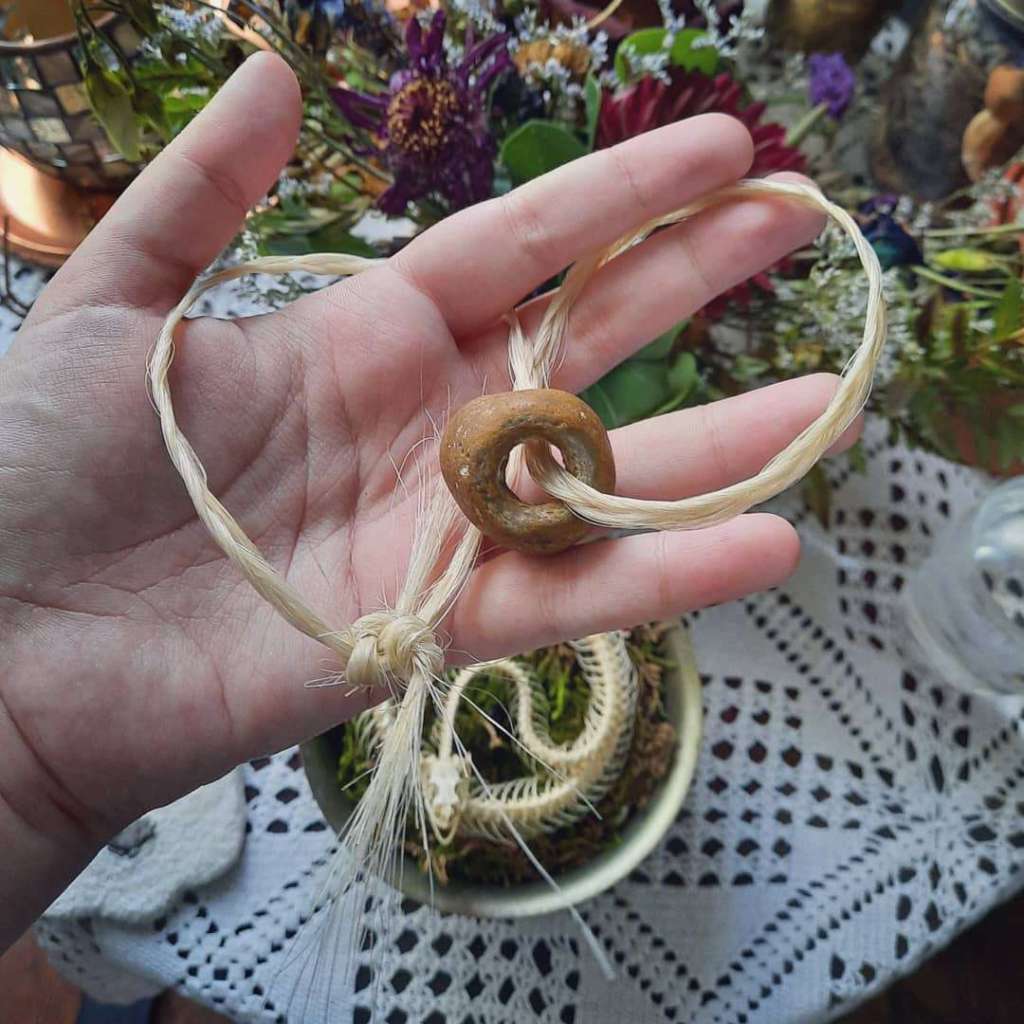
This Orthodox style prayer rope was crafted in the aim of venerating the pair through the access point of St. Justina’s all-conquering prayers. An overtly Christian tool, it is designed with the Orthodox prayer rope in mind, albeit with the spacers featuring in such a way that it could be easily adopted to the use of the Catholic rosary. The main beads are howlites, woven between knots of purple (the bishop’s colour), each anointed with holy oil gathered from The Holy Monastery of Saints Cyprian and Justina in Fili, Greece. Large, authentic freshwater pearls—memories of Justina’s purity, vanquishing tears, and a marker of certain Balkan folk Orthodox mysteries relating to her magic—form the spacers, washed in holy water gathered from the font in the Church of Saints Cyprian and Justina in Meniko, Cyprus. Both churches were visited during their Orthodox feast days (on the different old and revised Julian calendars, allowing for them to be attended in the same month), and as such the materia was gathered during their very masses. Each pearl is also nestled between amethysts fed a black rooster on the Catholic feast, empowering them with the sacrifice of martyrdom and a calling out to Cyprian’s famed sorcery. The rope connects through a bone skull, itself anointed in an oil of sorcerous insight, the recipe given to me by a Croatian folk practitioner who works primarily with the two saints, and terminates in a small icon also purchased in Greece.
Woven together under the auspices of the virgin, this prayer rope is consecrated for the binding and elevation of spirits. Consecrated primarily through St. Justina’s purity and power, with flashes of St. Cyprian’s cunning woven throughout in the reddened amethysts, this tool channels the saints in their ability to tame, command, and civilize spirits, as well as in Justina’s capacity to break all enchantments. It is suitable for any and all prayers, including liturgies to the holy pair (as well as any other intercessory spirit, Christian or otherwise), the counting of mantras, and the building of power. It may be draped over candles, activated spell remnants, and the vessels of spirits to impose your petitions, increase the potency of workings, or to break a particular curse, crossed condition, or evil eye over an object belonging to or picture of a victim.
These prayer ropes are especially adept at removing the magic other sorcerers have cast. Simply uttering the Jesus Prayer over each bead, placing it over a glass of water and a white candle anointed with holy oil, and then consuming the water once the candle is burnt is enough to cleanse off most enchantments. If you feel the persistent snag of an evil eye or jealous gaze, or would like additional protection when venturing into the public, you may wrap the prayer rope around your left hand (the traditional way of carrying them when not being used) or wear it over your head as a necklace. When dabbling with infernal spirits, the restless dead, and those beings for whom vampirism is a primary nature, call on St. Justina’s aid and place the rope over your head to bestow her pearlescent caul of protection over you. The clever karcist will find many ways to drape this tool over goetic vessels, the sigils of disagreeable spirits, and dirt and materia collected from places of great violence in order to make their spirits hospitable to their commands.
There are nine available for purchase, either individually or as part of the bundle below.
All prayer ropes have sold out!
The Sorcerer’s Goat Horn Fetish
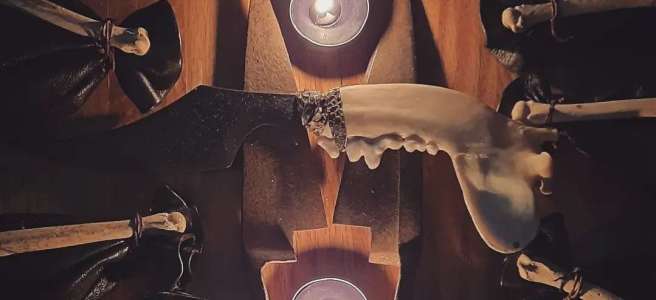
Twelve horns for the twelve disciples of Christ and the twelve students of the Black School, the thirteenth laid before the feet of St. Cyprian.
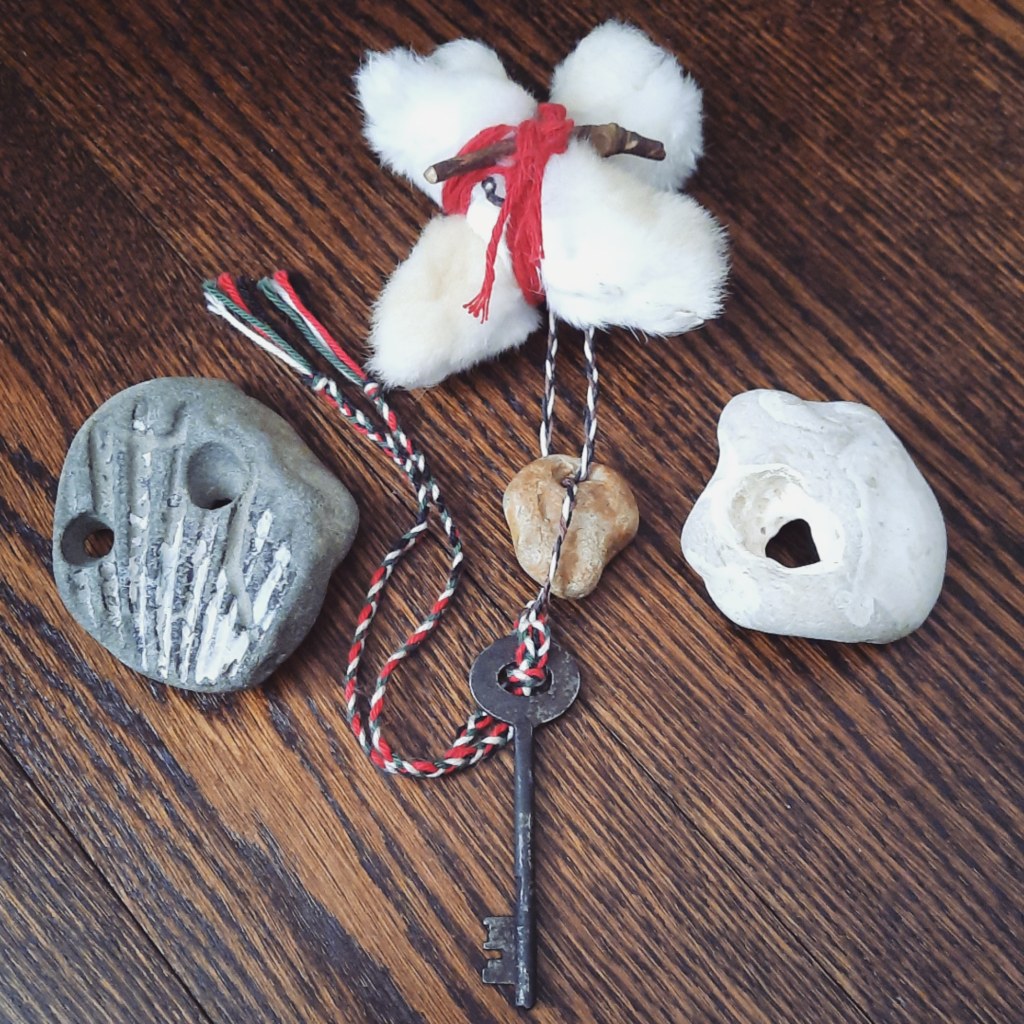
Just as the ropes were consecrated primarily through St. Justina, with flashes and empowerments laid by her companion, here their roles exchange in the creation of twelve horn fetishes. Each goat horn is filled with a matrix that has been worked on for three consecutive years of veneration, with the middle year being when the masses were attended in their monasteries in the Mediterranean. While the full list cannot be revealed, a small sample of the materia included are: dirt from three churches dedicated to Cyprian and Justina from three different countries, dirt from nine churches visited over the nine days of the Cyprians (the novena between Cyprian of Carthage and Cyprian of Antioch’s Catholic feasts), dirt from nine cemetery gates, dirt from nine priests, dirt from nine nuns, dirt from nine bishops, dirt from the grave of a dead sorcerer who worked with St. Cyprian in life, black rooster, black cat, black toad, serpent and goat materia, tears collected from their enshrined icons within an Orthodox church dedicated to them, horseshoe nails dipped in oils dedicated to Cyprian’s sorcery, an entire burnt Livro de São Cipriano, the same amethysts and pearls featured on the prayer rope, and much more.
Each portion was prayed over, offered to, and judiciously enchanted over countless nights, receiving a final consecration on Orthodox Epiphany of this year. While the base prayers and manners of conjuration were carried out in a folk Orthodox manner, these horns draw on a wide breath of Cyprianic study across traditions, including the Spanish and Portuguese Ciprianillos, Norwegian prayers from the Svartkonstböcker, and the saint’s presence in my lineage of Quimbanda. With each step requiring multiple passes in divination to be approved, these charms are some of the more complex that I’ve worked on, and it is a true pride and joy to share them. The horn shape and casing of black beeswax, pearl, and nazar beads were taken in inspiration from patuá technology, and while these charms are not themselves patuá strictly, they invoke my training in their creation as a part of my dedication to expressing my care for these saints in all the traditions that I know them in. Just as the amethysts flag Cyprian in the prayer ropes, the Nazars and pearls flag Justina here, always calling one with the other in each incarnation.
These fetishes are exceptionally versatile. Ultimately, they are consecrated for the purpose of opening roads into spiritual and sorcerous initiation—to bring their owners closer to new opportunities of study, meeting with potential mentors across traditions, the opening of roads to hidden opportunities for magical training, and the ability to travel widely in pursuit of wisdom. Inside each horn is a physical testimony to the studies I was able to undertake through the blessing and permission of many mentors across countries and cultural settings. Drawing on the legend of St. Cyprian as the chief exemplar of a Mediterranean sorcerer, who had sampled the offerings of countless mystery schools and lineages, these horns are made in dedication to Cyprian the eternal student of theurgy and thaumaturgy. On their own, even without direct use, they work to expand your network of reliable and competent contacts for the gathering of knowledge, resources, rare materia, affordable travel, and channels of communication. Simply speak your intentions into the open face where the Nazar lies and place it down by a shot of liquor (whiskey, gin, and brandy preferred) and a candle (white, red, or purple preferred if not beeswax) once a month to nourish its passive road opening, or increase it manyfold by making this offering daily and praying.
Additionally, the charms may be placed by your shrine to the saints to empower their presence, held to your mouth like a speaker to command spirits—or relay messages to the minds and dreams of others while enchanting them in ceremony—used as a wand when held point forward, and placed over other workings to empower them ever further under the auspices of St. Cyprian. While their passive benefit already is one which pierces the threads of fate to continually gather initiatory experiences, knowledge, and opportunities to you, the manner in which they may be actively engaged with in sorcery are fairly limitless. The dirt of the sorcerer who once worked with St. Cyprian within the horn acts as the “master” of all the nuns, priests, and bishops within, creating a choir that prays with and for your magical success in all your tasks. Speak into its mouth freely and allow the tears of Cyprian and Justina to shield, bolster, and purify your commands, straightening your wording and hesitation and projecting forth the ultimate authority in your workings. Even if you may swallow your tongue or stutter an utterance, the holy and sorcerous dead within will join you in their ceaseless prayer, maximizing your efforts and bolstering each petition to further compound their manifestation into reality. You do not need to be a devotee of Sts. Cyprian and Justina to work with these horns; they will lend their power to any who possess them—as well as the boldness to carve out a more potent, adventurous, and magically vibrant life.
There are nine available for purchase, each individually or as a part of the bundle below.
The prayer rope and horn together before the saints.
All goat-horns are now sold. Thank you so much for your support!
In the name of the holy martyrs Cyprian and Justina of Antioch, swift helpers of all who approach them, guide us and protect us against all enemies visible and invisible, grant us the power to resist our temptations, and in the hour of our end be our aid and lead us to victory so that we may be honoured and celebrated amongst the saints, unto the ages of ages. Amen.
On behalf of Key and myself, we truly cannot thank you all enough for your overwhelming support of our first foray into providing a group ritual service. With your generous support, we were able to raise over $2000 USD for our Cabula‘s furnace, all while giving back to the wonderful people who listen along to our podcast and follow our various lectures and online offerings.
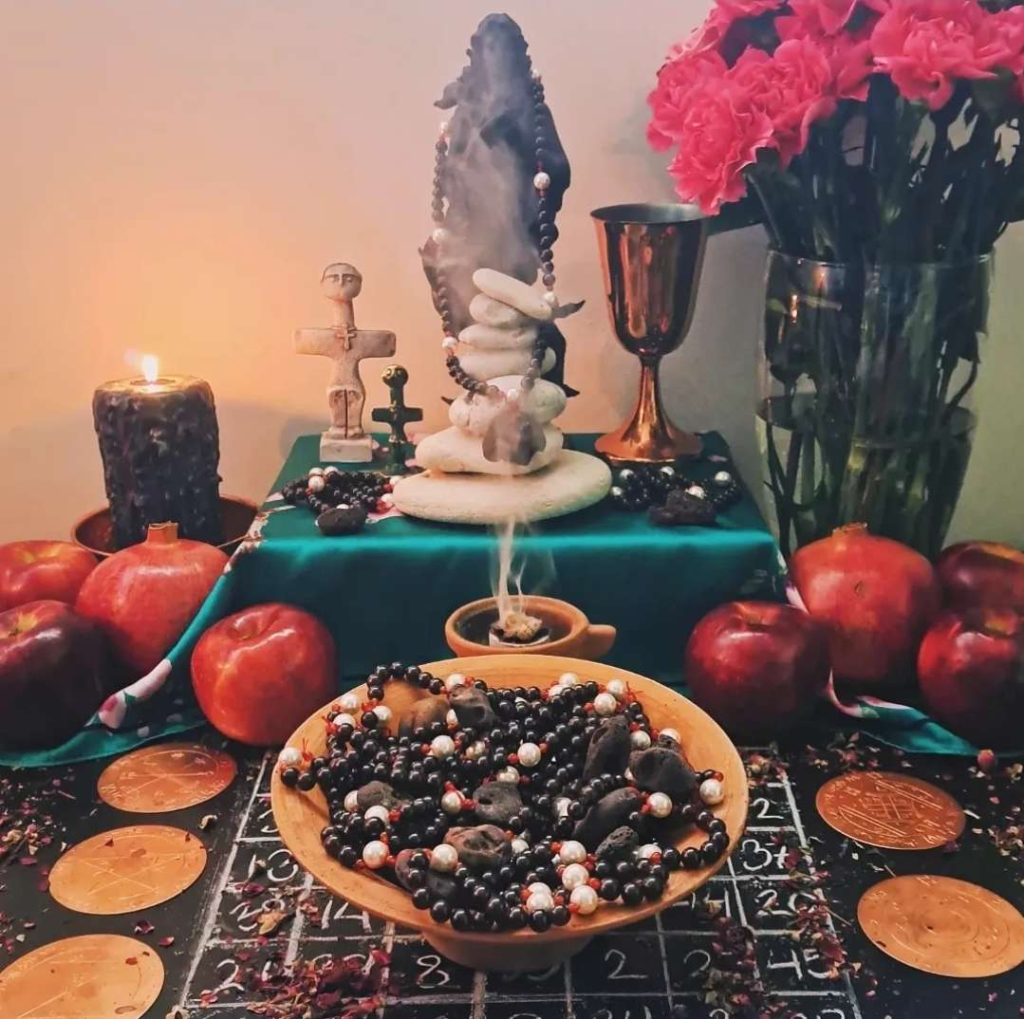
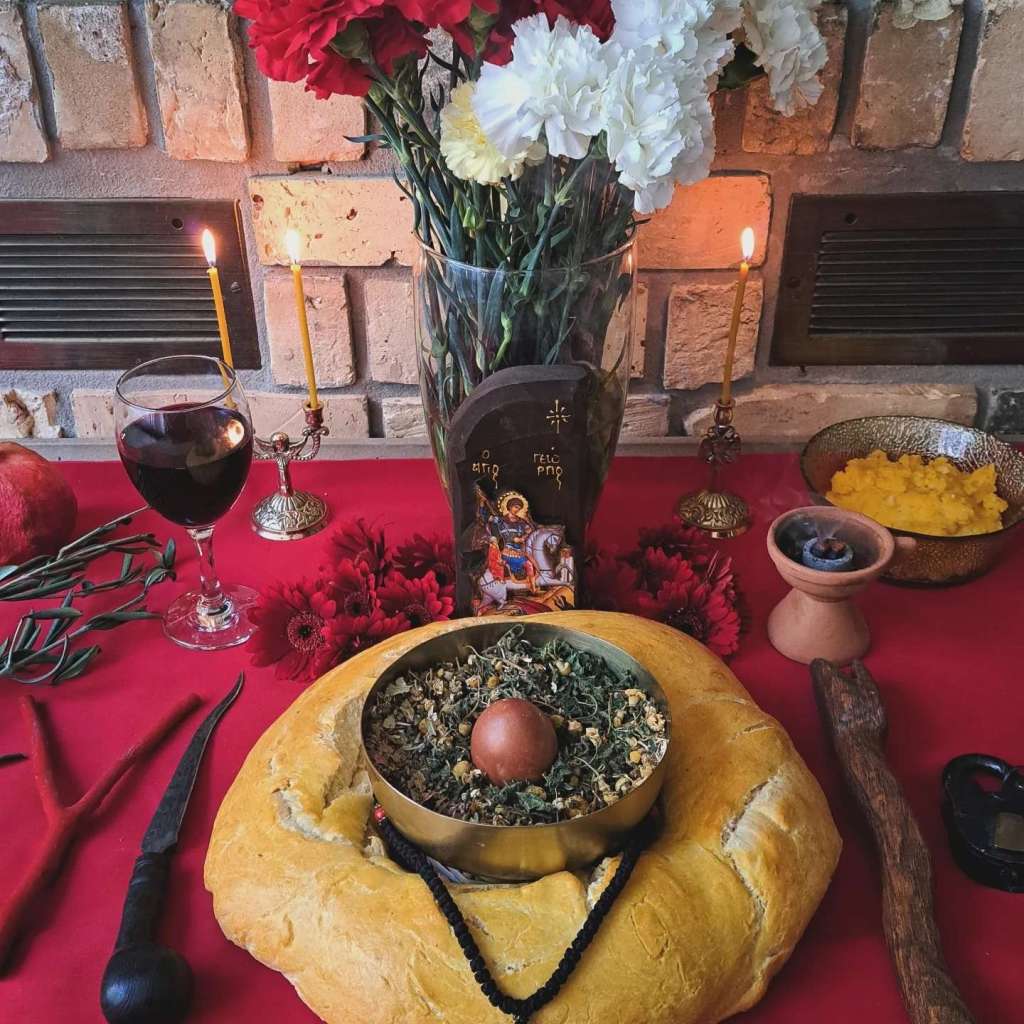
As promised, we wanted to share a brief recap of the workings as we completed them. On my end, I and a good friend and fellow practitioner of folk Orthodox magic, Maria (recently featured on The Frightful Howls!) put together slava bread, koljivo, red wine, and baklava for Sveti Nikola before one of the several icons I have for him as the patron saint of my patrilineal grandmother’s family. For the over a hundred people who participated in the rite, I prepared one pure beeswax candle for each name, which I wrote across a piece of paper and anointed with holy oil, prosperity oil, and a protection oil specifically made to avert the Evil Eye. Crossing the names with a longform prayer to St. Nicholas in Serbian, I placed it at the bottom of a large, terra-cotta dish and filled it with Thursday Salt, flour, sorcerous powders of prosperity, and multiple kinds of grains to nourish the saint and his horse on their journey to fulfill each spoken and unspoken desire.
Sfinga’s table laid for St. Nicholas.
Each candle was individually anointed with the same combination of oils and placed within the dish, with a separate name spoken over each as they were lit. Maria and I stood vigil over the flames until the last extinguished, scorching the flour mixture until it was the same texture and appearance as the Thursday Salt. We then emptied out the bowl into a cloth bundle, over which we laid the bread and petition, and tied it up to be taken to church. After the mixture heard the mass, a bean divination was performed to elect where it should be buried for the greatest efficiency in manifestation, with the answer generated being by a riverbed. The day after Nikoljdan proper, I carried the bundle to the very same river I had consecrated all my tools for the Tuba Veneris, and let it lie there with an additional helping of rakija, incense, and prayer.
Sfinga’s candles reducing into the powder.
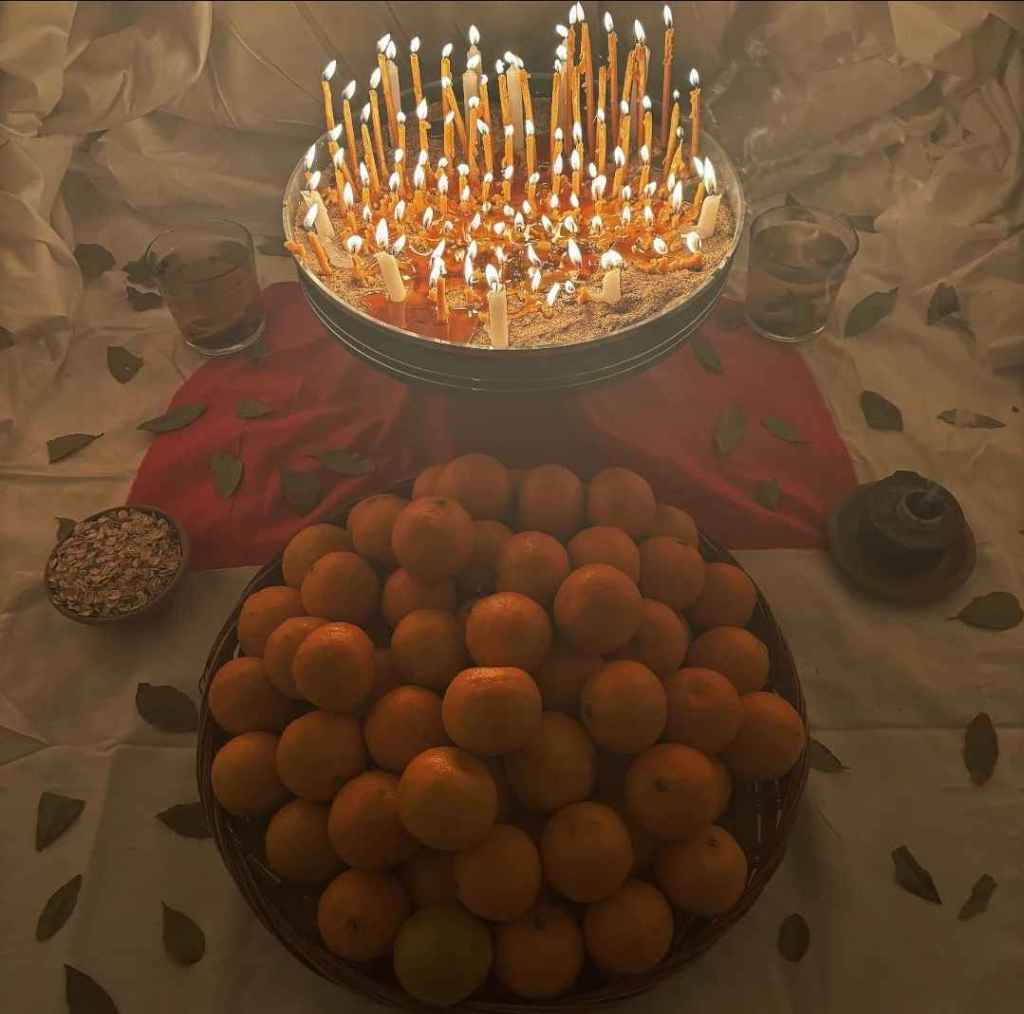
On Key’s end, he prepared a wash of fresh and dried citrus peels, cloves, star anise, cinnamon sticks, bay leaves inscribed with prayers, and allspice berries by boiling them all together, and allowed the aromatics to fumigate the candles used for the rite. This water was then allowed to cool, and mixed with holy water taken from three churches. A portion of this water was then used to wash the items on the shrine, the offerings of fruit, and the candles in the names of each respective donor, while the remaining two portions were divided into glasses and offered after receiving additional prayers and blessings to serve as vessels of refreshment and direction to the spirits inevitably called by the offering.
Key’s table set for St. Nicholas.
Key then hydrated a fireproof basin full of sand with another blend of holy waters from three churches, orange blossom water, and a splash of the herbal wash, then prayed over it a rosary dedicated to St. Nicholas, asking for his intercession. Each candle was then lit, naming each donor while doing so, then placed in the basin after pausing to interpret the omens that emerged from the candle as it pertained to each person’s condition. Appropriate oral formulas or prayers were offered to overcome corresponding blockages, uncross conditions, or wash away other forms of spiritual detritus.
Oats were then offered to provide sustenance to St. Nicholas’ horse, such that it may have the strength to bear each patron forward along their desired path, and the fruit offered before the saint with a prayer that he confer blessings of foresight, clarity, and prosperity on each patron. Incense was also offered to the Saint and the spirits present, and vigil was kept over the candles as further omens for the collective were observed and individual candles were maintained with additional remedies.
The candles burning down, each with their personal petition.
Each successive candle built off of the momentum of the last, eventually feeding into the sensation of the blustering squalls that drive the ships patroned by this saint forward, until the enchantment itself was caught by this wind and carried forth to each recipient.
Once our work was complete, we sent all the proceeds raised by the working to our Cabula, and gave the good Saint one final battery of prayers in thanks for his swift intercession, praising him for his good works and petitioning him once more over to elevate the wealth, prosperity, and luck of all those who submitted their names and the names of their loved ones to our group ritual. We are truly so grateful to each and every one of you who contributed to this first group offering, and look forward to offering more in the future for more good causes!
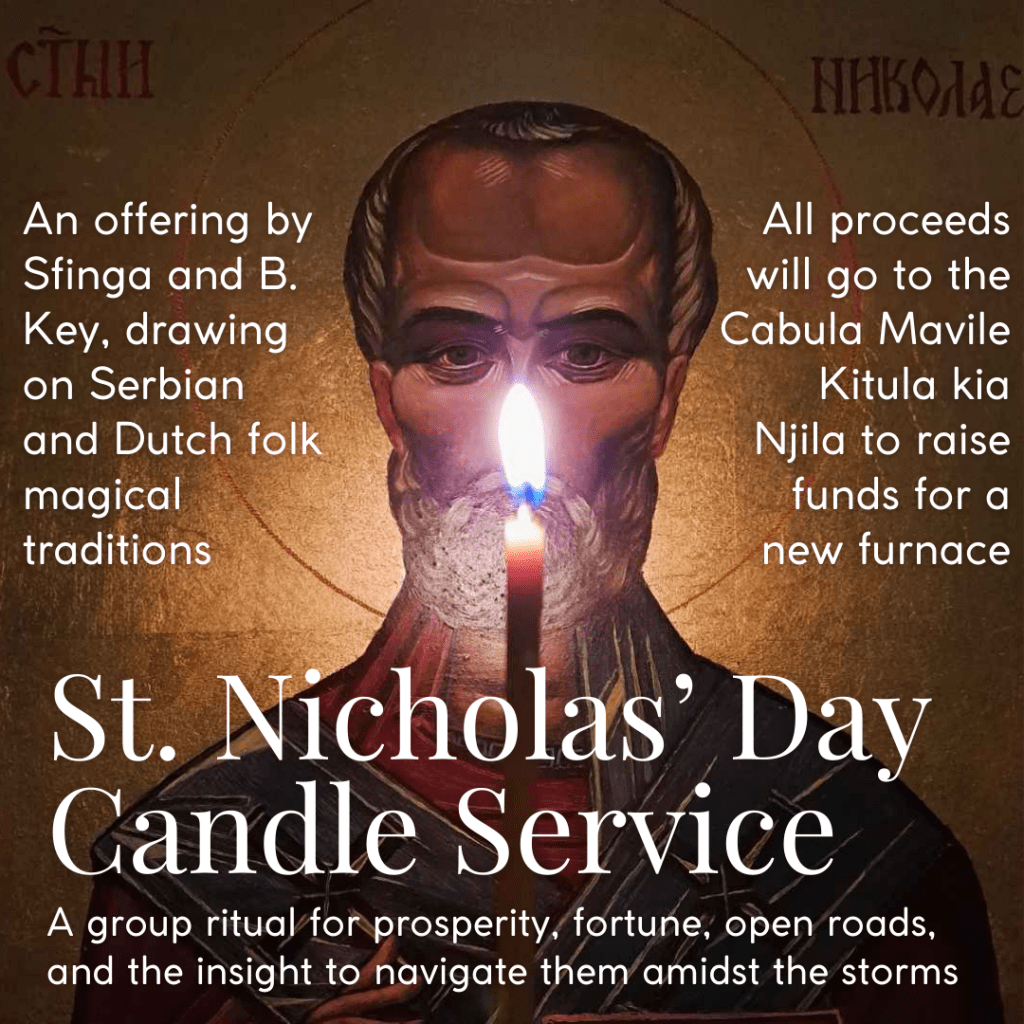
In honour of the holiday season, and the continual procession of some of the most important feasts and saint days shared in common by all three of our cultural backgrounds and magical services, we’re pleased to announce a special candle service held by Sfinga and B. Key on the Serbian Orthodox slava of Nikoljdan: St. Nicholas’ Day.
Recently on our podcast, The Frightful Howls You May Hear, myself and Key interviewed their Tata in Quimbanda de Angola, Tata Apokan (Jesse Hathaway Diaz), on the ins and outs of initiation, priesthood, and what it means to commit to a lifelong study in an oral tradition, especially in matters of co-creating community alongside elders and spirits alike. This was an exceptionally special episode to the both of our hearts and we’re absolutely delighted to continue having our Tata back on the podcast for many more to come! With the winter season fast approaching, and our temple in need of a new furnace, we wanted to contribute to our Cabula and our beautiful community at The Frightful Howls alike by offering our very first candle service fundraiser, in honour of an important saint at the heart of all of our practices.
By donating to this candle service, you will receive two workings performed on your behalf, or on the behalf of the person you wish to name: a prosperity ritual from myself, Sfinga, steeped in the association of Sveti Nikola as the Gospodar Vukova (Master of the Wolves), drawing on Serbian folk magical techniques, and a road opening and insight ritual from B. Key, drawing on Dutch folk magic and sailing lore. Combined under the auspices of the Serbian Orthodox slava of Nikoljdan on December 19th, both rites will be cast for you to bring fortune, as well as the clarity and vision to acquire and maintain it.
With St. Nicholas being perhaps the most important and celebrated slava in Serbia, it is no surprise that his cult inherited many of the qualities of the pre-Christian Dabog, the chthonic deity of healing, magic, death, wolves, mining, watermills, agriculture, and far more. Just as St. George, St. Michael, St. Sava, and St. Demetrius inherited many of the same qualities of Dabog through the cult of the Master of the Wolves, so too did St. Nicholas most prominently, as explored by the great ethnologist Veselin Čajkanović in his important work O srpskom vrhovnom Bogu. His cult is well-known throughout the Balkans and across its many religions, heralding reflections on divination, prosperity, travel, and seafaring.
It is these aspects that will be highlighted and honoured in my portion of the service. Each donation will allow you to submit your own name or the name of a loved one to the ritual, which will comprise of an offering of koljivo, slava bread, and red wine presented to the saint in the traditional manner of a Krsna slava, and a pure beeswax candle anointed with holy oil, prosperity oil, and protection oil. Each name will be added to the group petition and burned down into ash, which will be added to a charm of Thursday salt, holy bread, dirts from various Orthodox and Catholic churches of St. Nicholas from across the Balkans, and key powders prepared for this purpose. Once completed, the bundle will be taken to a mass for further blessing and then interred safely in one of three potential places of power, as bean divination performed on the feast proper will elect.
Key will draw on his own knowledge of Dutch folk magic and seafaring magics to open the roads to that same prosperity and grant the insight and divinatory ability to capture, retain, and protect the blessings to come in the New Year. Each name will be etched into candles fumigated with and asperged by an aromatic wash of citrus, clove, anise, holy water, world currencies, and other herbs for insight and security of received boons, blessed with prayers and recited formulas for the same purpose. Each candle will be presented to the shrine alongside an offering of citrus fruit to recollect the gold St. Nicholas so famously distributed in order to avert an unlucky future, and various grains associated with prosperity, diversion of misfortune, and a gentle nourishment of the senses, as to match the provisions of his journey by sea and to strengthen his guiding horse before travelling the road ahead. All of the edible components will then be donated to a nearby food bank in his name to continue this charity and distribute this enchantment to the world.
An Instagram post containing pictures and our reflections on the ritual will go live in the days following the feast so that all who participate may have a record of its completion.
All proceeds will go directly to our Cabula. We hope that this intersection of our traditions and communities serves you well in your New Year’s petitions and plans, and provides an ample boost to all you seek to grow and harvest in the coming months!
Our sincerest, heartfelt thanks to everyone who donated to this fundraiser! We not only met but exceeded our initial goal by double! A follow up post on the ritual as it was executed will be posted in the coming days. We’re so grateful to each and every one of you who contributed to this first group offering.
To say that this has been a long time in the making would be a perilous understatement. Key and I have teased and hinted at this undertaking for over half a year, at various points ruminating on if it was the right time or not to release our offerings into the world, and at each turn being rejected swiftly in divination. The spirits that have guided our hands and hearts have continually asked for more—the Venusian increase, the love-struck outpouring, the tremendous and awe-inspiring chorus of muses lilting in heart-song—reminding us to never shy or shrink away from the importance of our toiling. What began as a decision born of serendipitous chance had, after all, become a sacred pilgrimage; and what we brought back from those shores was an experience that fundamentally reconstituted us at our cores.
For our thirtieth episode of The Frightful Howls You May Hear, Salt interviews Key and I about what it was like travel to the Sanctuary of Aphrodite Paphia—the single most holy site of Aphrodite in the world, being a place of pilgrimage for countless cultures across centuries—as well as the Petra tou Romiou or “Aphrodite’s Rock,” being the place of her legendary birth within the foam. Even as we could only share but a fraction of the full experience—the rest being subject to the taboos of secrecy placed upon us by the spirits we encountered—we were utterly delighted to at last unveil a portion of what made this pilgrimage so special. Far from a simple touristic joust, our experience of the Heavenly Queen transformed us beyond every measure, elated us to tears, humbled us to our knees, and pacted us to a worship that will endure for the rest of our days. While Key and I are no strangers to visiting sacred sites and places of power—having spent the last several years being ready travel companions as best friends across countries—we have never hesitated once over the past six months to declare to ourselves and others that this was the single most illuminating and transformative experience across all our adventures.
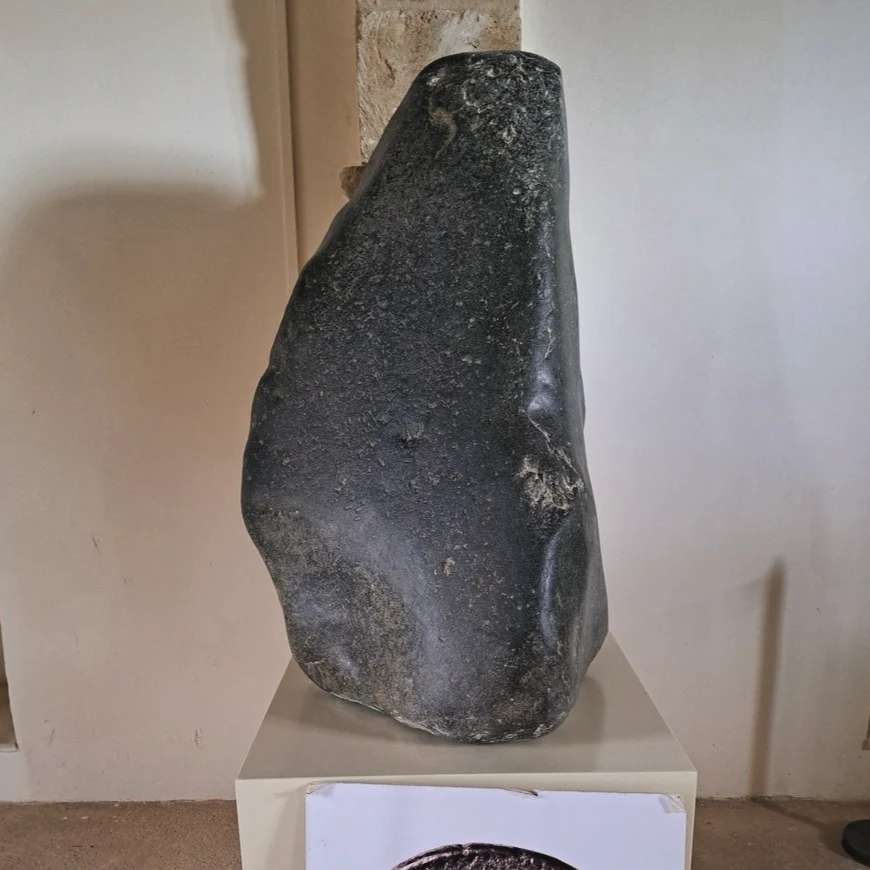
The Baetyl of Aphrodite: the aniconic site of her cultic worship in Paphos.
The blessed rain that purified us, the hymns we sang at her Sanctuary, the museum guard witnessing the manifestation of the Goddess through the light of the clouds parting and celebrating with us that “She had come,” the voices we heard within the airs swirling her Baetyl, the second physical manifestation at the beach, and everything that occurred in between—all this, to our capability under the necessity of secrecy and privacy as directed by spirits, we go into at various points throughout the episode. If you’re interested in hearing us attempt to even begin to grasp at the significance of what this was for us, we kindly invite you to give the episode a listen. It contains our usual mischief and humour as we process a story we’ve told many friends and ritual elders over the past half year, but also a lot of vulnerability at the humbling manifestations that we bore witness to, and the deep sense of honour and privilege we feel in being able to share a portion of this experience with our kind listeners and supporters.
Aphrodite’s Rock, illuminated by the sun. We took this photograph after having collected our seventh hagstone.
Those on our Patreon (and especially our Patreon’s new Discord server) have seen plenty of hints and previews over the past little while of the collection Key and I have been toiling over ceaselessly since we returned to our homes last year. Every Friday of every month since the mid-fall, he and I have given of ourselves our fullest effort to a series of offerings to share with the world a distillation of that experience. One of our many agreements we forged with the spirit intercessors and intermediaries we encountered was to share the love of our friendship, love of this experience, love for this Goddess, and Love as the force which binds all together as the rapturous intrusion and fermentation of reality; that while some aspects must be kept sub rosa by necessity and by design, the nature of beauty and love is to unfold as the rose does. These violent blossoms must yet germinate their delights within the maws of desire, enfleshed in promise and fulfilled in need.
While the frenzied touch of the Goddess of Love and Beauty kept us restless, pushing us onward to continue perfecting formulas and negotiating pacts, the spirits that guided us throughout this journey (including those who returned home with us from those shores) kept a steady beat to our toiling. The three of us—Salt, Key, and I all—have intimately shared with each other the aspects of the most transformative and incredible spirit-experiences we’ve encountered across our traditions and the stories of our lives, especially as we’ve deepened the immense friendship between us. Yet so rarely are even a portion of these stories allowed to be public in any capacity. At the same time, it also struck us as only appropriate that, in cultivating this burgeoning veneration of Aphrodite in light of all that She had wrought for us on this journey—so suddenly and remarkably cleaving into our lives and reaching into the pits of our natures to wrestle forth our deepest desires to the forefront—it was only appropriate that we allow for some of that vulnerability to be shared beyond words, even beyond writing: but in offerings of the spiritual essence itself.
This was always our heartfelt desire with this Foam-born Aphrodite collection, named in tribute to She who made it possible. While we will certainly create many more offerings in the future with respect to Aphrodite, the spirits of the Tuba Veneris, the angel Anael, and all the powers under the All and Many that is Venus Herself, this gathering here is made both limited and special in the truest senses of the words through the pilgrimage and its theophanies. Key was in charge of the majority of the creations and carried out his work with the diligence and attention to detail of a master artisan. My chief role was to bring about the circumstances that would allow a troupe of Venusian daimones to become bonded to a series of hagstones as their desired vessels, such that some of the very nymphs in service to the Goddess may become familiars to those most in need of their service and companionship.
The view of the beach and Aphrodite’s Rock from atop the slope.
Locals we spoke to in Paphos continually emphasized that when Aphrodite arose, fully-formed, from the foam of the sea, she was carried to the coast by myriad nymph beings that guided her from her rock to the beach. We continued to find stones in the shape of slippers amidst the waters as we swam, which a number of locals told us were the “shoes” of these spirits. After making our offerings, singing to the Goddess, saluting the many spirits of shorelines and beaches we already hold pacts with, and completing the end of our pilgrimage by swimming three times around the Rock itself (said to grant blessings of long-life, beauty, and love upon all who embark on this venture), we fell into deep trance, encountering some of these spirits that guided us back towards the beach as we swam.
What awaited us at the coast was, without exaggeration, as startling as the sight of the clouds parting to the light of a woman’s form before us and the guard in the Sanctuary. Once we returned to where we had left our offerings under the large boulder on the edge, we were approached by an otherworldly beautiful woman with dark, curly hair and a splendorous garnet-red dress. This was one of those encounters which no description could do justice. Everything about her appearance, gait, composure, and ominous gaze—penetrating yet distant, awe-inspiring yet familiar, ferocious yet docile—left the both of us so speechless we were unable to even muster a polite greeting. Her bare feet appeared to effortlessly glide across the pebbles, undisturbed by their rough edges, until she was just a step away from embracing me. My voice was so caught in my throat that I could not even manage the simplest utterance. Instead, she suddenly grasped my hand and impressed in it a stone—the same deep garnet-red as her dress. She did not respond to my breathless attempts to thank her in Greek and in English, physically vanishing around the bend of the stones as Key and I attempted to follow her. Only upon closer inspection later did I realize that its shape physically resembles the coastline from the Sanctuary to the beach itself.
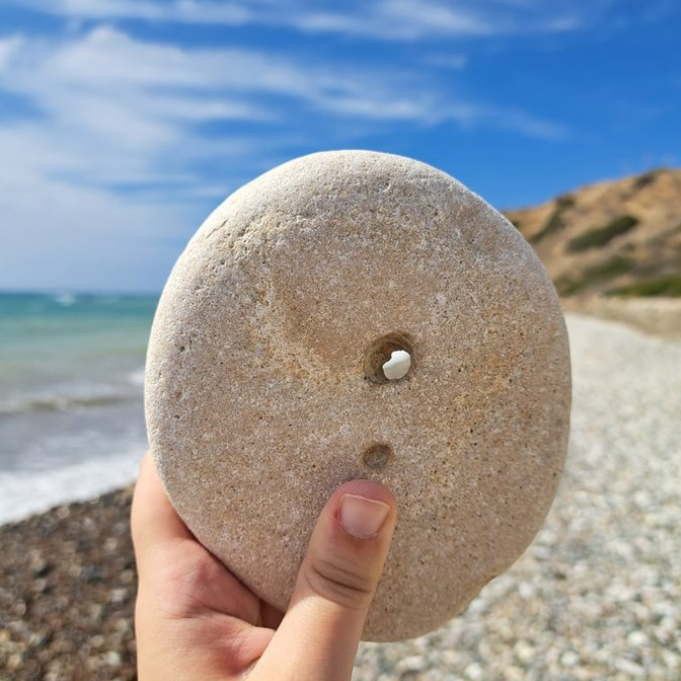
It was after this encounter that Key and I collected the seven smooth, flat hagstones that would become our own “Baetyl”. While there are no shortage of excellent statues of Aphrodite across Cyprus’ many beautiful shops, we were so moved by the aniconic representation of the Goddess at her Sanctuary that as soon as we found seven (and no more, at that, than her sacred number) hagstones, we knew that this would be our shared representation of Her for the rest of our days. Even their holes perfectly overlap each other, allowing water to flow freely through the cairn. Throughout our pacing along the beach, the nymphs that guided us continually inoculated us with their designs; that some wished to accompany us as daimones and intercessory oracles for the Goddess and her pact, while others sought to pass through our hands and into the company of others still.
The first and largest of the stones.
We took this charge sincerely and with extreme conviction. Even on our breathless ride back to the capital where we were staying, Key and I could not help ourselves but begin to urgently brainstorm how to begin to share some of this bounty with other devotees and sorcerers as we had been directed to.
In our bags I had carried with us a number of hagstones we had collected from our journey. Cyprus was not our first destination, nor would it be our last during this month of travel, and while our reasons for going together were more for work than for pleasure, after this crucial point we began to finally grasp back towards the hands of the spirits that had guided us along the way, with the serpents’ eggs of these holed stones being vital points of germination on the path. The spirits tasked us with bathing the set they had selected from amongst the whole within the very waters between the boulder and the Rock as the first of many steps which would come to dominate my own life over the next half year; a love letter written in wooing desire to bring those same delicate feet over countless many shores home.
The Eyes of Nepherieri
It is no exaggeration for me to say that I spent every Friday toiling over these since I returned home. I had such designs in my own mind for how the shape they could take. The spirits insisted that the hagstones had to be their true seats, outlining for me an entire regimen of how to enliven them as their hearts. In my eagerness, I imagined charm bags wrapped in animal skins and adorned with feathers and beads, only to be swiftly redirected in divination and in dream alike to what they unveiled and insisted upon: prayer ropes. The more I attempted to negotiate the aesthetics I had in mind, the more they insisted upon simple luxury: garnets the colour of the stone the woman gave me (and the colour the hagstones themselves would turn after consecration), mother of pearl in honour of the shell protecting Aphrodite’s feet, and carnelian for her fire, her light, her sighs, her kisses. Seven by seven, her number, and the number which continually revealed itself to us along each stretch of our pilgrimage. Firm in the weight of the beads yet light in their manipulation—these spirits wish to be prayed with to the Goddess, to send each intonation of vowels, each gasp of joy, each tear of grief and longing, each prayer for liberation and recognition in the arms and gaze of Another through their circuit and back through the hole that is the womb of possibility. To be wrapped around the wrist and pressed into the palm, to have yearnings hissed through the gaps and folded directly over spells, to be draped over statues, candles, and workings to empower them with not only the bonds they will forge with their eventual keepers, but everything we were able to pour of ourselves from our experience into their grasps.
The hagstone cairn that is our private Baetyl of the Goddess, looking over the Eyes of Nepherieri.
Deceptively simple as their designs ended up being, the process of ensouling these fetish-vessels was anything but. Named the Eyes of Nepherieri in tribute to the secret name given in PGM IV. 1265–74, to be intoned internally seven times in order to instill love in another, they were the sole focus of my spiritual labours every Friday for the last two seasons.
It is difficult for me to even begin to illustrate how much effort went into their consecration. With many details having to be kept private for the sake of the spirits involved, what I can reveal is that they received such attention and reverence that they consumed a full calendar month’s worth of continuous effort. They were fed white doves, sat within the blood within a copper vessel until they were dyed red, then macerated in additional red wine, sorcerous oils capturing a Venus Rising in Pisces election that Salt had procured for us, tears shed during declarations of love, dirts collected from famous lovers who were buried together as well as serpent holes within the Sanctuary, and pomegranate seeds collected from the pilgrimage. Each had to be hung upon the branches of seven different trees, all divined upon and associated with the worlds of nymphs, faery beings, and otherworldly passage, and buried under seven different holy mounds and mountains chosen for their own historic importance to the same across the Balkans, Mediterranean, and North America. Each tree and place of power was placated with regular offerings, and, once the stones were retrieved, presented with a communal meal which was then also shared with those in need.
One Eye among the many.
Their final gasping breath of life was given to them through a commingling of sea water collected from Aphrodite’s beach and holy spring water from a mountain dedicated to St. Petka, each poured through the seven hagstones of the main cairn and into their individual mouths. As the water passed through the gates, it was impressed upon me a notion I was all too familiar with from my own work with the Libellus Veneri Nigro Sacer: that the Queen of All claims ultimate victory over every planet and every sphere. Just as light travels from Saturn to Luna to Terra, so Venus claims her rulership over all of germination, placing herself as regent of every sphere of the chain of being. I am genuinely proud of these and feel so humbled and moved that I am able to share them with those who would claim them. Their spirits have passed every “check” of manifestation, ability, and fealty I have asked of them with flying colours, giving unto me individual nicknames that I will provide with those who will take them in; their true names will be revealed only directly from spirit to sorcerer once they are in their destined hands. They will be sent nestled within red velvet pouches filled with rose petals and bits of the Venus Rising in Pisces powder I crafted with Salt’s erudite election, along with instructions sent electronically on how to care for them and work with these incredible allies.
Forty-nine garnets by forty-nine prayers, kissing the womb that unites them.
If you are interested in welcoming one of these unparalleled spirits into your court, I ask that you divine first with whatever method is most appropriate—even a simple nature augury—to see if this would be welcomed by your spirits. They are priced similarly to astrologically elected talismanic jewelry on the advice of many kind astrologer-magicians, not only a reflection of the work that went into ensouling them, but also because the experience they capture beyond the translation of a pact between daimon and sorcerer is not one that we can reproduce in any meaningful way again, even if we ever find the time and ability to embark on a similar pilgrimage in the future. Our dear friend Sasha Ravitch had this to say in our Patreon Discord recently, which touched Key and I profoundly to have our efforts be witnessed so nakedly by another seer and companion of the Others:
One of the things I am struck by is how nothing like this series, nor any item in this series, has ever existed before, nor will ever exist again. It cannot be replicated – not just the creation of the materia and the devotions, but also the literal pilgrimage, the literal appearance of the goddess, the availability at the site of the materia that was to be collected and utilized. This surpasses any astrological magical Venus election. It bypasses all need for those boundaries or rules because the Goddess herself gave her flesh to the work.
If one of these nymphs calls to you, it would be my sincerest honour to assist you in facilitating this pact. May their gentle hands and fleet-footed gait empower you to the fullest experiences of a relationship with the Goddess Herself, and enchant every relationship and expression of love henceforth.
All Eyes of Nepherieri are sold out! Thank you for your patronage!
The Oil of Nepherieri
The Oil receiving its final consecration.
This is Key’s flagship offering for our bounty, an oil he has described on numerous occasions as an attempt to create a liquid personification of the blessings he bore witness to at Her holy site. Structured around historically attested offerings to Aphrodite, this oil also draws additional inspiration from Agrippa’s Three Books of Occult Philosophy, especially Book One, Chapter 28: What things are under the power of Venus, and are called Venereal.
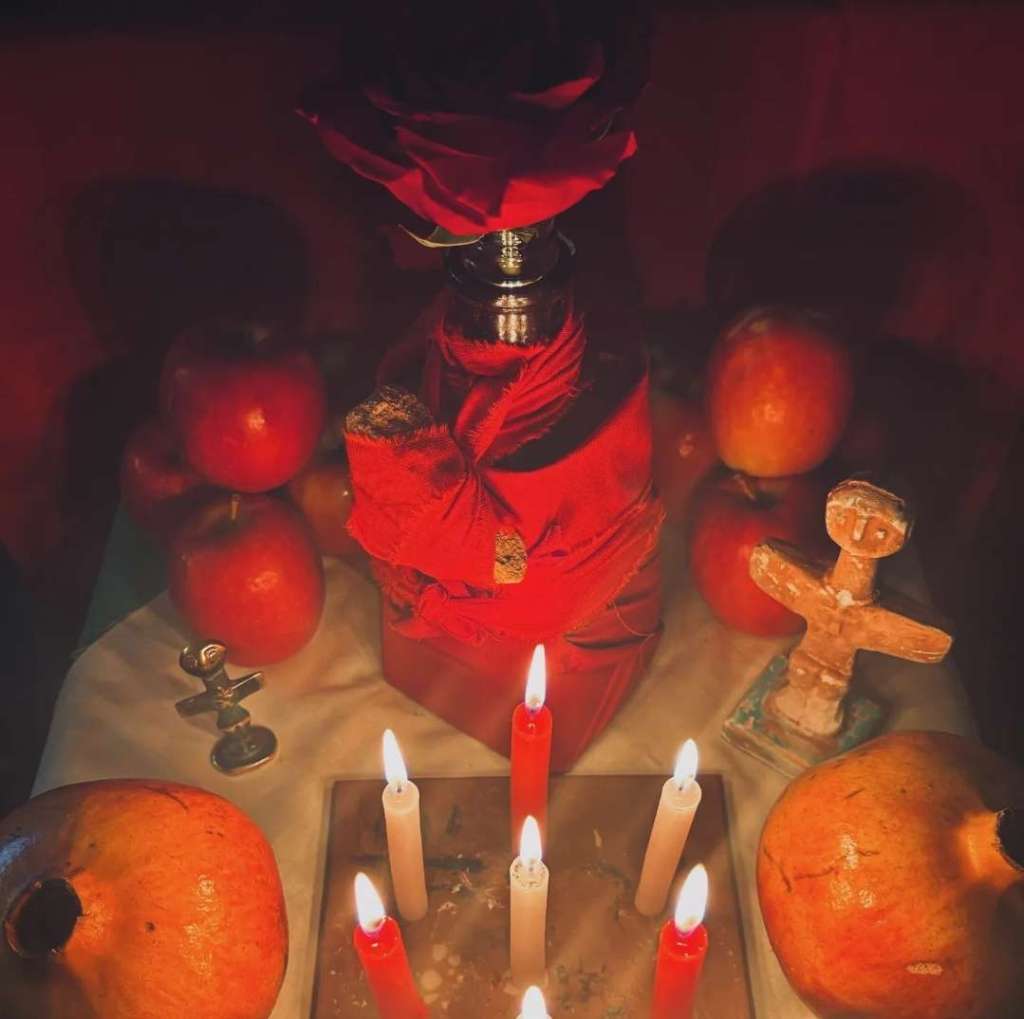
Built off a foundation of apples and pomegranates gathered from her Sanctuary in Paphos, then dried, reduced to powder, and infused (some hot and some cold depending on the need of the spirits), this oil is itself a living spirit. It may be spoken to, prayed with, and used in any manner as befits the Queen on High. Its birth required immense attention and care, from the ways in which each herbal ally was freshly harvested by hand and by copper, to how each rose and myrtle bush was offered to and sung with. A powder made of the white doves given to the Goddess was added alongside countless other ingredients which must remain unnamed. The vessel of this oil was treated with just as much care as the contents, joining body and spirit in the sighs of incarnation and the joy of life. It was clothed with red and affixed with stones gathered from the temple as a calling to Aphrodite as Kythere (“the red one”), as attested in PGM IV. 2891–2942, and as Kythira; a purported birthplace of the goddess or alternative destination the nymphs carried her to in her most heavenly form. The red cloth itself was extensively consecrated, having seven feasts laid upon it and seven forms of love graced into its folds before it was ready to wrap the mother bottle in its embrace. Countless votive acts were performed to the bottle to ensure it was prepared to contain the essence of Key’s reflection upon his own devotion and experience at the temple.
The bottle you receive should be enshrined and treated as a cultic object of its own. It will be wrapped in its own cloth and act as its own mother bottle, an offering of the liquid form of the Goddess’ blessing. Use it in any manner of working you can imagine, to cultivate Her presence, to anoint your body and the bodies of others, to give unto spirits and to forge their pacts under Her gaze. This is not an oil designed only for the usual reasons of love, sex, beauty, fertility, and so on—there are incredible astrological elections and traditional recipes and formulas across the traditions we are initiated and trained in that can produce oils that work brilliantly for these goals instead. Rather, it is an offering of the Goddess unto the Goddess, forging a relationship between user and spirit directly. Include it in your own fetish vessels and add it to ropes that will tie together the pacts you will forge with even the most capricious of spirits. If you would like to use it for the everyday needs of sorcery and conjure, we recommend that you add seven drops to olive oil you pray Her hymns over to create a new mother bottle specifically for more regular engagement with practical magic.
Oil of Nepherieri
1 fluid ounce / 30 milliliter amber glass dropper bottle, draped in red cloth and secured as a devotional object of ritual use. Price includes shipping. Created by B. Key.
$220.00
Balm of Eros
Tins poured in submission and in domination.
The first of a trinity of offerings Key created in honour of the three most famous forms of love: Eros, Agape, and Philia. The Balm of Eros uses the Oil of Nepherieri as its main oil base, to which were added rose petals and thorns alike, lavender, red clover, damiana, kava, ashwagandha, skullcap, vanilla, a small portion of the dove powder, and dyer’s alkanet to turn the beeswax pink. There is a dream-like, opium haze to its kiss, liberating inhibitions and indulging the smooth, passionate glide of stripping silk, unveiled prowess, coy submission, and lurid command.
Having received extensive consecration and laboratory testing, these balms may be used to strengthen sexual and romantic bonds through mutual anointing over the skin, enhance the sensitivity of skin to touch, allow for more pleasurable and physical experiences with spirit lovers, heal minor cuts and bruises incurred through rougher, passionate play, and much more. They are also especially designed to make the clients of sex workers more docile, pliable, obedient to directions, and swifter to part with money.
Balm of Eros is sold out! Thank you for your patronage!
Tincture of Agape
A small vial of the tincture, gold as honey.
A gift unto the gods, this tincture was crafted with a number of coalescing goals in mind: to instill a benevolent blessing of overwhelming purity and the sensation of divine presence, to improve the intellect, to heighten spirit communion, and to make oneself friendly to spirits (especially those that are the least friendly of all) chief among them. Many herbal pacts were forged on behalf of this tincture, including hand-foraged motherwort as the base, hyssop, lemon balm, lavender, and more. Each individual vial was blessed with a mouse’s paw—taken from one acquired by a spirit at a three-way crossroad—to be as the gentle hand which removes the needle from the lion’s paw, ensuring that one’s humanity has a less abrasive effect to those spirits to whom we smell foully towards, and securing immediate communion between what was once stranger to become now beloved friend. In this way, this is also an incredible ally in repairing broken pacts, frayed bonds, and in allowing forgiveness to give way to lasting harmony.
In creating this tincture, we were both reminded of how deeply it is that love and beauty and the delights of this Goddess—so profoundly worshipped and so deeply called out to even to this day in her many forms and faces—is quite literally the force which makes all the stars in the sky shine and the world itself rotate on its axis, yet it is tragically what we often feel most guilty about claiming for ourselves and owning our own desires for. Our spirits have reminded us that our relationship to being seen and held by love’s embrace—romantic, platonic, or otherwise—is as necessary as breathing, yet so often we are taught it is something to fight for to become worthy of. This tincture is also an offering unto the mysteries of healing, rectification, and right alignment with the reception of love into one’s life, and that perilous and frightening as that journey may be, we never truly walk it alone.
While Key is proud of all of his offerings, this one holds a special place in his retinue for how potent its effects were upon testing. Even the very motherwort that was freshly wild harvested for this tincture was found through the assistance of the Eye of Nepherieri’s nymphs, who led Key directly through a bath of newly-blooming blue flowers into a grove pregnant with the herb. Deploy to approach the distant, to bridge gaps of understanding, to forge new bonds in impossible circumstances, and to urge ephemeral and cautious spirits rush to be present in communion.
Tincture of Agape
1 fluid ounce / 30 millilitre amber glass dropper bottle, crafted with utmost devotion. Price includes shipping. Created by B. Key.
$150.00
Oil of Philia
Where there is one, may there be many.
The Oil of Friendship was born of a desire to strengthen all forms of platonic love. This oil is especially adept at finding new friends and colleagues, repairing familial problems and rifts to create peaceful homes, bring like-minded people into your fold to become fast and immediate friends, and protect existing agreements between parties. The oil is heavily strained and kept as sterile as the olive oil in one’s kitchen, especially that a drop may be incorporated in cooking without anyone being the wiser. Rub on the body, add to food, anoint on mirrors, and use in any way directed by your spirits to find, keep, stoke, and promote lasting harmony and exhilarating, adventurous, flourishing love among found and originating family alike.
For the majority of this oil’s consecration, it was not a fluid that was being addressed, but an empty bottle; slowly filled with words, sighs, blessings, incense smoke, and washed with seven veils of enchanted waters. Expressions of gratitude and love to friends were whispered daily for half a year into its mouth, perfumed with incense and bathed in elected and captured stellar milk. Once the oil was added, the effect was immediate and undeniable, setting instantly into the cushion of affection laid within.
Oil of Philia is sold out! Thank you for your patronage!
Star of Aphrodite Incense
An offering among offerings, to Her on High.
This is an incense which Key laboured over for months until he managed to achieve a smell identical to the fragrance we caught at the Sanctuary. When the Goddess appeared before us, this was the scent which permeated the temple. The smell it releases is utterly remarkable; rich and lofty, sensuous and spellbinding, lurid and elevated. The recipe draws heavily on PGM IV. 2891–2942, the Love spell of attraction which includes an “offering to the star of Aphrodite” composed of white dove’s blood and fat, untreated myrrh, and parched wormwood. Many other floral and herbal notes were added to this base until the scent was exact.
Use to manifest spirits tangibly, to call down divinities, to ensure intercessory spirits transmit your prayers to the ears of the Gods, to procure folkloric love, and call to the Mysteries.
Star of Aphrodite Incense is sold out! Thank you for your patronage!
Pigment of Venus
The hue of her embrace.
A pigment born of the kiss of copper, in honour of the relationship between the Goddess and this most sacred metal which harvested all the herbs of the collection. Key’s love of alchemy and his own background as a chemist led him to create a pigment replicating the colour of the waters themselves. Combine with oil to create a paint for sigils, seals, decorating statues, inscribing walls and pieces of art, and folding into the cracks of broken items to restore them anew.
Pigment of Venus is sold out! Thank you for your patronage!
Stele of Aphrodite
The famous Stele from the PGM.
The Stele of Aphrodite from PGM VII. 215–18, for friendship, favour, and success. These were cut from tin-plated steel and engraved with a bronze stylus, then reinforced with an engraving tool. They are sturdier than regular tin and can be placed within a wallet for easy carrying. These are a more affordable choice of talisman for everyday wear and use. In addition to following the PGM faithfully, these have been consecrated using the Star of Aphrodite incense, Venus Rising in Pisces incense, and left under the care of the Eyes of Nepherieri for additional potency. They have been tested extensively and have generated luck, fortune, wealth, soothed anger, courted deeper friendship, and propelled forward a feeling of control and peace within the turbulence of changing fortunes, that luck ever be by one’s side.
Beyond carrying them in wallets or on one’s person, they can be put in the bottom of boxes and jars as the core to prosperity vessels, given to spirits that preside over your luck/fortune/money, placed over petitions or under them with a candle burning over the top to nurture the arrival of soul-mate like friends, tied up in string to business cards so that they can persuade a boss or hiring manager to adore you without becoming too obsessed or attached, and far more. We highly encourage experimentation with these as they are a truly “super-charged” version of this reliable charm!
All Steles of Aphrodite are sold out. Thank you for your patronage!
Shields of the Sanctuary
Sherds gathered from the pilgrimage.
This famous and much-loved charm from PGM XXXVI. 256–64 protects against nightmares, spiritual assailants, curses/malefica, and physical harm. It is recommended that you hide these within your home or bury them somewhere on your property. What makes these amulets special beyond its usual formulation is that they are born of three-sided pot sherds gathered from crossroads that we found along the pilgrimage route around the Sanctuary. There are an incredibly limited amount of only seven sherds, each of which will be inscribed with your name in myrrh ink, consecrated before our shrines, perfumed in the Star of Aphrodite incense, and anointed with the Oil of Nepherieri. As such, these are especially precious and will be custom made for each individual client. If you claim one of these, please include in your notes if you would like your name to be different from the one on your purchase receipt.
All Shields of the Sanctuary are sold out. Thank you for your patronage!
None of the recipes and items will ever be in stock again once they are out, as they required the unique combination of the pilgrimage and its blessings to craft. Key and I were privileged to see many ancient temples and cultic sites across Dalmatia and the Mediterranean, including in Greece itself along our dealings. It would be our privilege and hope to be able to embark on such a journey again one day, immeasurably so with Salt in our company as well when our busy schedules afford it. Yet it was specifically in Paphos that an experience of this magnitude bore itself to us. We would not dare suppose that anything similar might happen again if and when we next find ourselves on those incredible shores. It is the unique confluence of the witnessing of the Goddess, the blessings with unfolded, physical manifestations of the path, and omens which hounded us at every turn that led to this limited collection, born of our deepest devotions. It would be our utmost honour and privilege to share our love and the love of this work and its spirits with you.
All prices include shipping. If purchasing multiple items, please note that each will ship from the individual who had created them, so you will receive two packages if acquiring offerings from Sfinga and B. Key together. Please allow for seven business days to ship your orders, as each undergoes an additional blessing before being sent.
May the heavenly, illustrious, laughter-loving Queen illuminate futures of loves untold, of passion thought only to exist in stories, and of fulfilled desire for companionship to be born of true perception. As She crests over the horizon, may your fulfilment surge to meet Her.
By the red cape of the soldier-martyr, By the red wings of the adversary underfoot, By the red-drenched spear piercing its maw,
The Charms of the Victory-bearer are born, baptized, and bled.
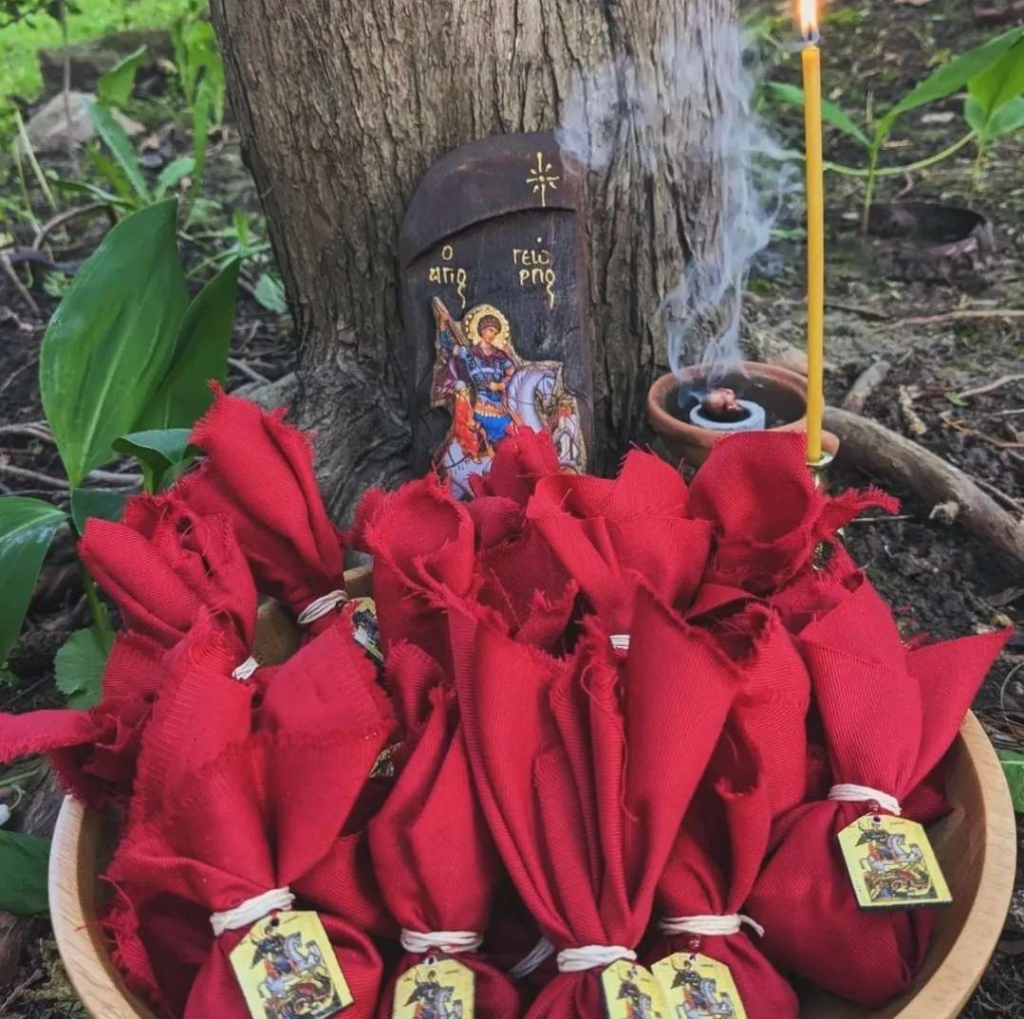
The charms at the foot of a pacted tree.
These potent bundles were first birthed on May 6th, the Orthodox feast of St. George, which this year happened to be the day immediately following Easter. I’ve much joked with friends about how much “longer” Lent felt this year in light of Easter being May 5th, but this too came with its own advantages. That the eve of Đurđevdan (St. George’s Day) was itself Easter provided the perfect folkloric confluence for a number of the key ingredients which went into crafting these sorcerous allies—fleetfooted, valiant, and unrelenting as the martyr himself.
Having collected the necessary herbs either on the eve or at dawn on the feast proper, retrieving each with the appropriate offering left in turn and through the auspices of a bajalica or basma (oral charm) specifically used on St. George’s Day for those very plants themselves, I began the core powder within the first hours of the feast. The shell of first red egg of Easter—a prized ingredient within the Balkan folk tradition—was crumbled and left to soak among the blood clots of an offered rooster, consecrated with the Jesus Prayer and given veneration through Good Friday, Holy Saturday, and Easter Sunday all. On the martyr’s day proper, I baked the kravaj or kravajče, a solar bread intended to mimic the wreaths which would crown cattle for protection, the first sacrificial lamb for protection, and the milk buckets that would receive the first milking of St. George’s Day for fertility. Across numerous villages, and most famously recorded in Vrtovac—a village in Serbia that has been much-studied for its detailed St. George’s Day customs of sacrifice and fertility magic—this bread would be wrapped in geranium, sprinkled with salt, and placed by the nearest river as an offering; or alternatively divided up amongst anthills so that the ants themselves may “lock up” the fertility gathered to protect it from negativity and the Evil Eye.
At the same time, bread baked specifically for a saint’s feast is itself a powerful fetish to be used in the creation of charms. I was trained to add a little piece to each charm I make (a ritual bread that was prayed over for many hours was a key component in the Master of the Wolves charms we released last year), and this case was no different. The rest of the kravaj was divided up between spirits, friends, anthills, tree hollows, the dead, and a river, each with a corresponding oral charm spoken over the piece as Thursday Salt was sprinkled over its resting place, tied to its post with white horse’s hair.
As an additional offering to the martyr and the spirits of his entourage, I cooked belmuž—a sheep’s cheese cornmeal porridge—and gave portions to each of my assisting familiars and to the holy saint himself. The banquet was laid over a red cloth that was consecrated as his cape, fumigated in red Orthodox St. George’s incense I brought back with me from my last trip to Greece, and sprinkled with wine, rooster blood, sheep’s milk, and holy water with sprigs of basil and plantain. When the time came to make the charms themselves, it was this cloth that was divided into the 21 squares that would host the cores birthed on his feast.
The feast given unto St. George.
Herbal materia, both freshly gathered and dried from previous corresponding saint feasts, were combined within a vessel along with personal fixed star powders made in my tradition, specific dirts corresponding with the nature of these charms, and the first red egg of Easter, which had itself undergone numerous rituals upon Christ’s rebirth. As the serpents of Aldebaran and Regulus were massaged for their dew, so too were the armies of St. George supplicated, in memory of his eternal triumph over the aždaja and his folkloric allyship with the zmaj. Propitiating the saint and the gods he masks alike, the raw powder was left incubate within the kravaj, veiled by his bloodied cloak against the glare of any stars not pacted to this working.
Finally, once the raw bundles passed their requisite three omens of manifestation—that they were indeed alive and bringing victory unto their bearers—I was given license by my spirits to bind them still. All three of us at With Cunning & Command and The Frightful Howls You May Hear take efficacy and results extremely seriously; nothing we offer to the world can be sold before it has succeeded in its tests of fealty and power. The trials these cores underwent were in line with their intended use: the overcoming of obstacles, the germination of fertility, the destruction of nightmares, the evil eye, and any other such spiritual malady, and the ultimate triumph of their carrier in matters of competition. Be they deployed for the protection of fertility (in matters of one’s own, those of animals and plants, or even those of other magical workings so that they may bear fruit), the defeat of enemies in matters where only one may prevail, or the destruction of jealous gazes, lingering spirits with ill intentions, or stray miasma and malefica brought home underfoot, the Charms of the Victory-bearer are the white-hot flash of the spear, the crack of the celestial whip, the hooves of the thundering hero-steed crushing each viper before it ever slinks across the threshold.
The base mixture includes allies such as basil, linden, geranium, nettle, chamomile, plantain, dandelion, and many other potent herbs collected in the dark such that they cannot be named. Dirts from the graves of 23 soldiers, 23 anthills, and 23 crossroads, as well as dirt from the village Başköy/Potamia where St. George was said to have been born, are combined with powders of Aldebaran and Regulus created in a manner taught to me in my tradition, as well as a more conventional Sun in Aries powder elected by Salt. Serpent bone, St. George incense, white beans from a chart that approved these charms with the most blessed omen of the Three Stars, and many more implements made their way into the bundles, which were then tied with red thread, a piece of carnelian, and a small pocket icon of St. George, finally bound over with white waxed linen thread. Each knot had the appropriate oral charm breathed into it, an offering of air bestowed as the final gift before they were once again perfumed in incense and left to breathe the sunlight for the first time since the feast.
Having received countless prayers, rich offerings, and diligent attention to omens, auguries, and folkloric expressions of St. George’s might in nature, these charms are finally available for purchase. They may be kept in one’s backpack or purse, nestled in their place of work, placed by the hearth or on appropriate shrines, or hung by the main door to your home. Give them a candle (white, red, or beeswax) and a shot of vodka, brandy, or whiskey once a month, preferably on the full moon to keep them refreshed and spry. These are workhorses and soldiers, aggressively targeting areas of weakness and conquering obstacles in your path. If you have an enemy you need to triumph over, or are looking to be the victor selected from among a pool of candidates, place the charm with a lit candle over a copy of your application with your petition written over it in red. Tuck the charm by your pillow or hang it over your bed to protect against nightmares and vampiric spirits, or to assist in conception and sexual virility. Gift the bundle to your protective spirits to act as arms for them, becoming a battery of power for them to wield against disease, poverty, malefica, and loss in the pursuit of securing steadfast agency.
If you’d like to purchase one for yourself, please click the link below. Shipping is included within the price. They will be mailed out within a week of purchase and a tracking code will be e-mailed to the PayPal address used to buy them.
All St. George’s Charms of the Victory-bearer are sold out. Thank you for your patronage!
It is not my hand that cuts these cords, but the hand of St. George upon his holiest day. Amen, amen, amen.
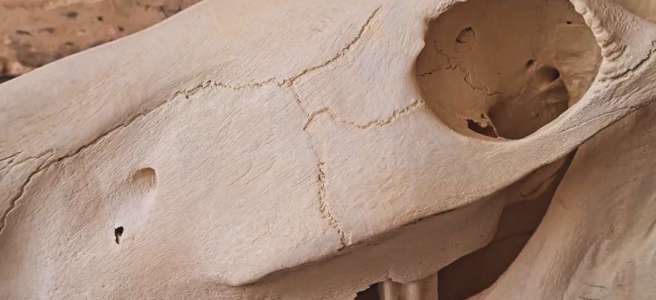
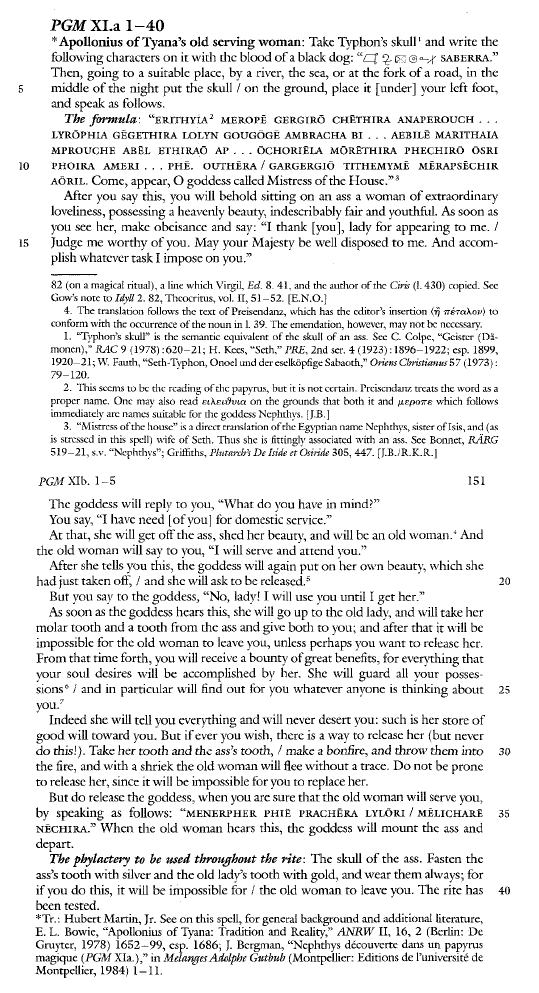
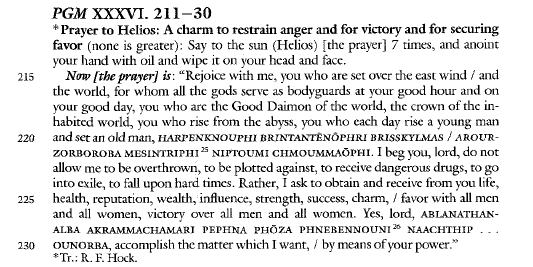
Over a year ago, Key wrote an excellent reflection on his experiences performing PGM XI.a 1–40: a conjuration of a familiar spirit that serves the household, captioned as “Apollonius of Tyana’s Old Serving Woman” in the Betz PGM collection. The three of us, along with and a few friends interested in the ritual, pitched in to procure a donkey’s skull and the blood of a black dog—the necessary materia for the consecration of the phylactery that serves to conjure the goddess Nephthys, so that she may grant the titular paredros spirit of the rite. Shortly after obtaining his own familiar, as well as additional ones for friends who happened to be visiting him at the time, Key shipped the skull along to Salt and I’s home, ready for the next installment for “The Sisterhood of the Travelling Donkey”. Our plan was to continue sending the skull around, each household obtaining their tooth (the vessel for the paredros), until it eventually made its way back to us to be permanently enshrined by the hearth at our combined home.
Since the skull’s arrival at our doorstep, Salt and I came to increasingly notice its surging awareness. While it is the teeth obtained from the old woman and the donkey that are truly the vessels and proofs of pact, the phylactery of the skull had clearly come to be endowed with its own numinous presence and alignment throughout its repeated use. Even without the conjuration being actively performed—and in the case of its use, even after the dismissal of the goddess—it was clear that some portion of Nephthys’ power remained within the skull, and that this was a holy object. When not in use, we kept it veiled in linen, treating it with the utmost respect as befitted an image of the mighty queen and her consort, the mighty lord Set. Salt and I specifically have, since before we even met and became a couple, long held fast a religious devotion to various Netjeru (Ancient Egyptian divinities), and so the phylactery had an additional layer of significance for us in our private observances.
The skull atop its linen veil by the hearth.
Over the year, we’ve hosted many friends who have visited for various lengths of time to hang out, cook incredible meals, and get up to plenty of sorcerous adventures. In most cases, we actually got up to so many different projects that I had to draft an entire Google doc itinerary of planetary hours, elections, and roadmaps for where we’d go to gather what materia and what we had to enchant for at which time. In each moment, we intentionally tried to carve out a time to allow them to have their own midnight jaunt with the phylactery, especially as these were the very same folks who helped pitch in for its obtainment from the beginning. Yet an omen always arose for why it was not yet appropriate, even if temporally it would have been convenient for us all (shipping a donkey skull around is not fun!). In one case, we were about 20 minutes to the midnight hour, all dressed up with the wrapped skull in an IKEA tote, ritual printed off and candles for illumination at the ready, when I suddenly felt a distinct and knowing pang that led me to consult one of my closest spirits with their divinatory oracle about the matter, only to be told to call the rite off. The messages varied in each instance. Sometimes it was that our comportment was not sufficiently pure, in that even if we had all showered and donned clean clothes, something about our moods, excitement, earlier festivities of partying and revelry, or even the stench of the witchcraft we had been engaging in lingered still, rendering conjuring the goddess inappropriate. In other cases, the reasoning was even more nebulous, yet still felt by all. There was never any disappointment with regards to the timing—all present agreed something was “off” and that the skull phylactery would not consent to us proceeding with the ritual.
Naturally, I decided it would be better to ship it along immediately to keep the chain going, yet even this was interrupted. I could not shake that I should not yet part with the skull, and that there was still something left to do, or at the very least that it required some fulfillment still before being sent away on its long journey around and then back to us. Divination continued to advise for patience, as well as the completion of oaths already undertaken. I meditated for some time on what this may be, and continued to feel a nagging impulse that something about this entire scheme had to do with Salt in particular. Yet, the tooth we procured is to be shared between us, for our good lady paredros serves our combined household in which we live. We knew from the beginning that he would not be soliciting another, so what exactly was missing?
The answer came to us in vision in a truly illuminating and instructive fashion. Some time ago, Salt decided that he should procure a familiar from this ritual for his mother back in England and send her the tooth to assist her. By rank, she had to be next in line before any other. In other words, while sometimes the “vibe” was genuinely too off to proceed with the purity requirements of the ritual, the reason why we kept feeling as if we could not ship the skull yet to its next destination regardless was this essential matter in household authority. Before the goddess’ phylactery could impart its next boon, its blessing must first be addressed to the very person who kept Salt’s house throughout his childhood.
With this complete, the skull is now free to travel to its next keeper, passing all the necessary checks in omens and auguries. In addition to sharing our own experiences with the ritual (and again affirm its efficacy and usefulness to those discerning karcists interested in attempting it themselves), we wanted to give an example report of how the nature of the rite itself is imprinted in the very ethics of how it is conducted. If an agreement has been made to share a skull between sorcerers, and one of its intended beneficiaries is one of their mothers, then by rank she must inherently go immediately. Since the skull is ultimately going to remain with us once it has completed its circuit, Salt and I were planning on carrying out this additional rite then and giving it to her in person when we next visited, but the phylactery’s numinous awareness was adamant that the essential order of the proceedings must honour her first. As the paredros granted participates in the domestic mysteries, it is only right to address first whomever has played an essential role in one’s own life in such a manner, if they themselves are one of the intended recipients of the rite, regardless of the temporal proceedings of our visitations.
Without further ado, below you’ll find the accounts of what our individual experiences of performing the rite are—myself and Salt together for our own assistant spirit, and Salt’s when he conducted this another time.
When the night came for Salt and I to accomplish this undertaking, we first began by ensuring we were clean, freshly showered, and wearing new clothes. I printed off a copy of the ritual as it appears in Betz from the composite screenshot in Key’s post and prepared some candles and a candle holder so that we would have the light necessary to read it in the dark. With the skull wrapped tight in hand, we made our way to the middle of a three way crossroads, unveiled the donkey at the center of the fork, and lit the candle. I had my left foot over the skull as instructed, while Salt held onto me with the same glyphs beneath him.
Key’s experience with the ritual matched the level of intense manifestations and physical omens I witnessed in my own working of PGM IV. 3086–3124: The Oracle of Kronos. While none of us are strangers to those kinds of manifestations across our individual and shared traditions, they never cease to fill us with wonder and awe when they do occur. From the beginning of the first recitation of the formula, Salt and I immediately saw the otherwise still night air whip up into a frenzy of howling winds. The more we chanted, the more it screeched, shaking the trees and forcing us to continually shield the candle flame with our bodies so that we could read from the text. We saw the goddess appear top her donkey midway through the second repetition, swiftly appearing in all her brilliance, beauty, and divine splendor. Salt and I were stunned into silence by her theophany, bowing our heads swiftly at the sight of the beautiful young maiden sat atop her steed, her skin a vibrant gold and her hair extending into the night sky in streaks of lapis, jet, and labradorite.
An image of the rite as it appears in the Betz translation, pages 150–1.
The dialogue proceeded roughly as the text describes. We stuck to the script, replying as the rite advises. When the goddess dismounted her steed (which appeared to us black with glowing red eyes, evocative of her husband Set), the light that illuminated her from within shifted, her skin sloughing to become that of an old woman, spots forming along her wrinkles, hair turning course and draining of colour. She only took this form momentarily before quickly receding into the shadows, within a blink taking on her earlier form. Scholar Eleni Pachoumi, in her article “Divine Epiphanies of Paredroi in the Greek Magical Papyri“, notes a similarity between the drama of this ritual and a scene from the Gnostic Apocryphon of John, from the Nag Hammadi library. John witnesses an epiphany in which Jesus first appears to him as a splendid youth, then as an old man, then as a servant. In this ritual, Nephthys first appears as a beautiful maiden, then takes the form of a crone herself, before eventually differentiating, emanating the old woman as a familiar spirit to be imparted upon the magician. We implored her to not leave, and that we would keep her until she grants us the old woman, at which point for the first time Salt and I saw the both of them, with the latter emerging from behind the steed of the former, pacing out from behind its tail.
At this point I felt a shift within the skull beneath my feet. While Key found a tooth already manifest outside the cloth as he was carrying the skull to the site of the ritual—somehow emerging from the tightly-bundled phylactery with a supernaturally loud clang on the pavement—we experienced a tooth visibly begin to wiggle and clatter about with the winds. As we gently moved to touch it, the howling air screeched even further, going from whipping from each direction to swirling around us, creating a visible circle of air that continued to lift higher, sending my hair up into the sky while the tunnel flexed towards the heavens. Throughout our dialogue, Salt and I continued to hear the physically audible barking of dogs and the braying of a donkey, as well as a persistent sound of bells ringing in perfect harmony. There was a moment when I thought there must have been several people with incredibly loud and animated dogs walking around at midnight in the middle of nowhere, but it was immediately obvious that there was no one around but us.
Salt knelt down to examine the skull under my foot, and carefully withdrew the wiggling tooth, which emerged easily into his hand. The rite says that the goddess will take from the old woman one of her molar teeth and a tooth from her steed and give both to you, after which it will become impossible for the spirit woman to ever leave you unless you burn the teeth. What we saw was the goddess retrieve these two teeth as described, present them towards towards us, and then merge them from physical apparitions into the body of the donkey’s tooth that had loosened and fell from the skull. Once we were absolutely certain that the pact had been signed, we scryed the tooth together, confirmed the presence of the old woman, and gave the dismissal. The goddess did not waste any time, mounting her donkey immediately and galloping off into the mists beyond the horizon. As soon as this was done, the cacophony of sounds—braying, barking, ringing, howling and all—ceased entirely, returning us to the silent and still expanse of the crossroad.
The next phase was carried out once we had determined the source of the delay. I was not present for this round, rather it was Salt alone who went to the crossroads. From conjuration to dismissal, he completed the ritual in record time, with all the same physical manifestations returning as if there had been no temporal distance at all. While in our first attempt, the tooth that wiggled forth was a molar, here Salt noted that all the teeth were completely fixed, rooted even deeper within the skull as if none of them had ever come loose, save for one incisor in the front that popped out immediately. The goddess made an additional instruction of him, as this was petitioned by him on behalf of a relative as opposed to purely for his own benefit—and especially as he had already solicited a familiar from her collectively as part of our collective domestic realm as a couple. With this agreed upon and sworn, Salt was able to complete the ritual swiftly and return to our home with his prize in hand, ready to be given over to his family.
Now with the skull freed up to go on its merry way to the next sorcerer, the three of us are even more excited to see what results will come of their own explorations. Our pool of experiences has widened to include several attempts now, each showing remarkable consistencies between manifestations, immediate proofs of power, the efficacy of the familiar spirits granted, and the entirely physical and immediately verifiable nature of the ritual’s conjuration. Not only can we vouch for the power of the ritual, we can confidently recommend its reliability through multiple tests.
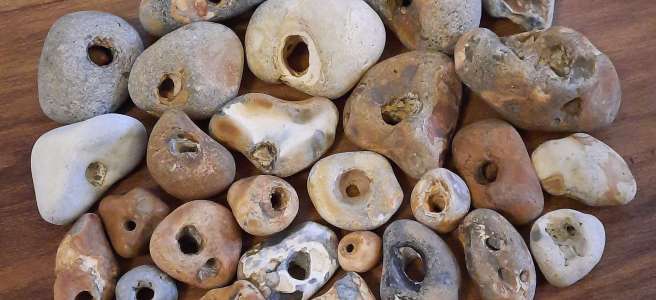
Blessed Feast of the Assumption of the Blessed Virgin Mary to all on the Gregorian Calendar, and Happy Feast of St. Stephen the Protomartyr for those on the Julian! In my neck of the woods, today is Sveti Stefan Vetroviti, as our nickname for St. Stephen is “the Windy” or “the Windswept”, in thanks to his continued syncretism with the god of wind, Stribog. This is a powerful feast of the zduhać, vertovnjak, oblačar, gradobranitelj, and zmajevit čovek class of weather-manipulating healers and sorcerers, given Stribog’s enduring patronage of their arts, through his fatherhood of the Vjetreni Vojvoda spirits and his own fights against the ala, hala, german, and aždaja. Moreover, it is a day not only associated with the collection of hagstones, but their deployment in charms for knotting the wind, protecting livestock, and providing homes for spirits.
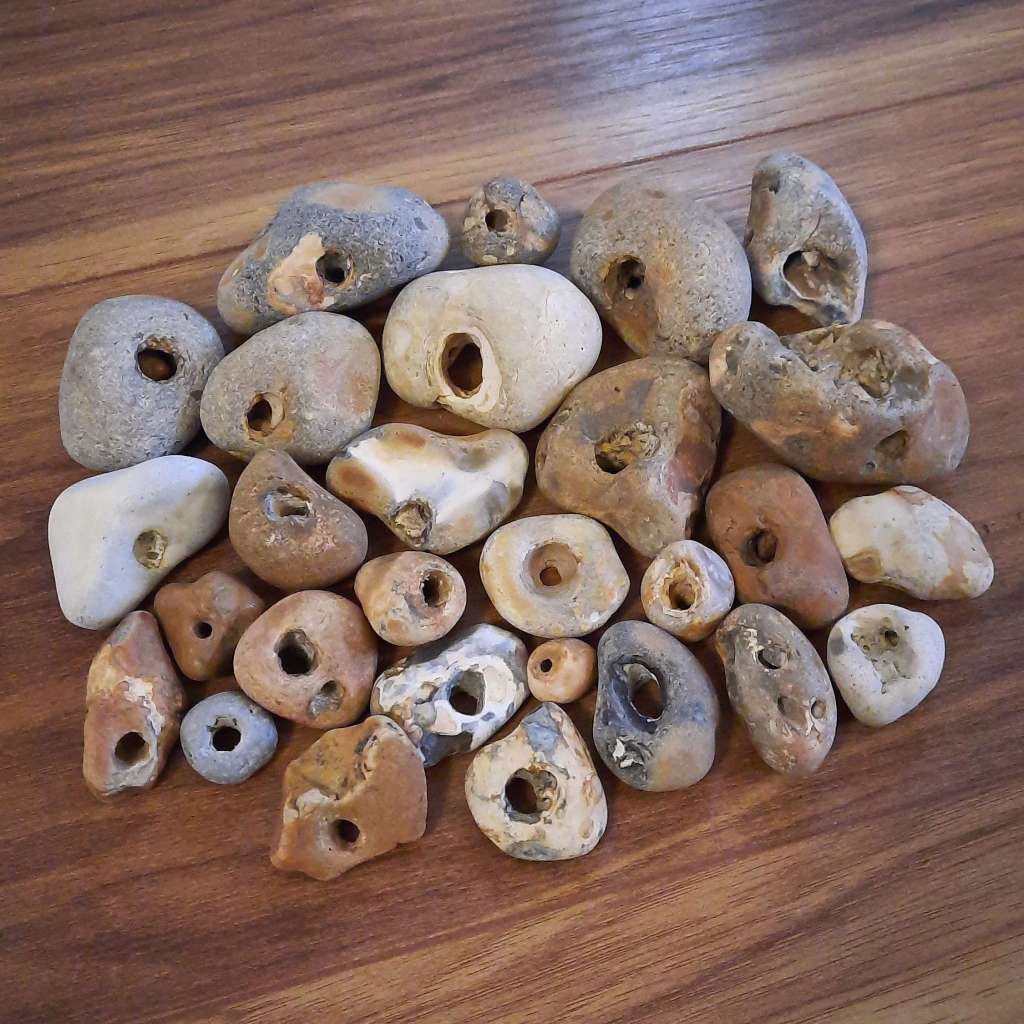
One of our recent episodes on our podcast, The Frightful Howls You May Hear, featured an overview of some of the basic lore around hagstones from the British, Germanic, and Slavic contexts. We’ve been so overwhelmed by the outpouring of support, love, and engagement on the podcast from so many of you; the warm reception and incredible feedback we’ve received has truly nourished us in our creativity and excitement to share more. We are so deeply grateful to everyone who has sent in comments, shared their thoughts on the episodes, and signed up to support our Patreon where we post bonus content such as our show notes, Salt’s incredible monthly astrological almanac, our Q&As, and far more! Over the next few weeks, we hope to share with our readers here on the blog not only a little of what we’ve been up to behind the scenes, but also new offerings to come in the form of courses, mentorships, readings, charms, and far more. It’s truly been a blast for the three of us to share more regularly, via our bi-weekly episodes, aspects of folkloric and magical research we’ve been up to, as well as tidbits of our personal adventures and sorcerous journeys.
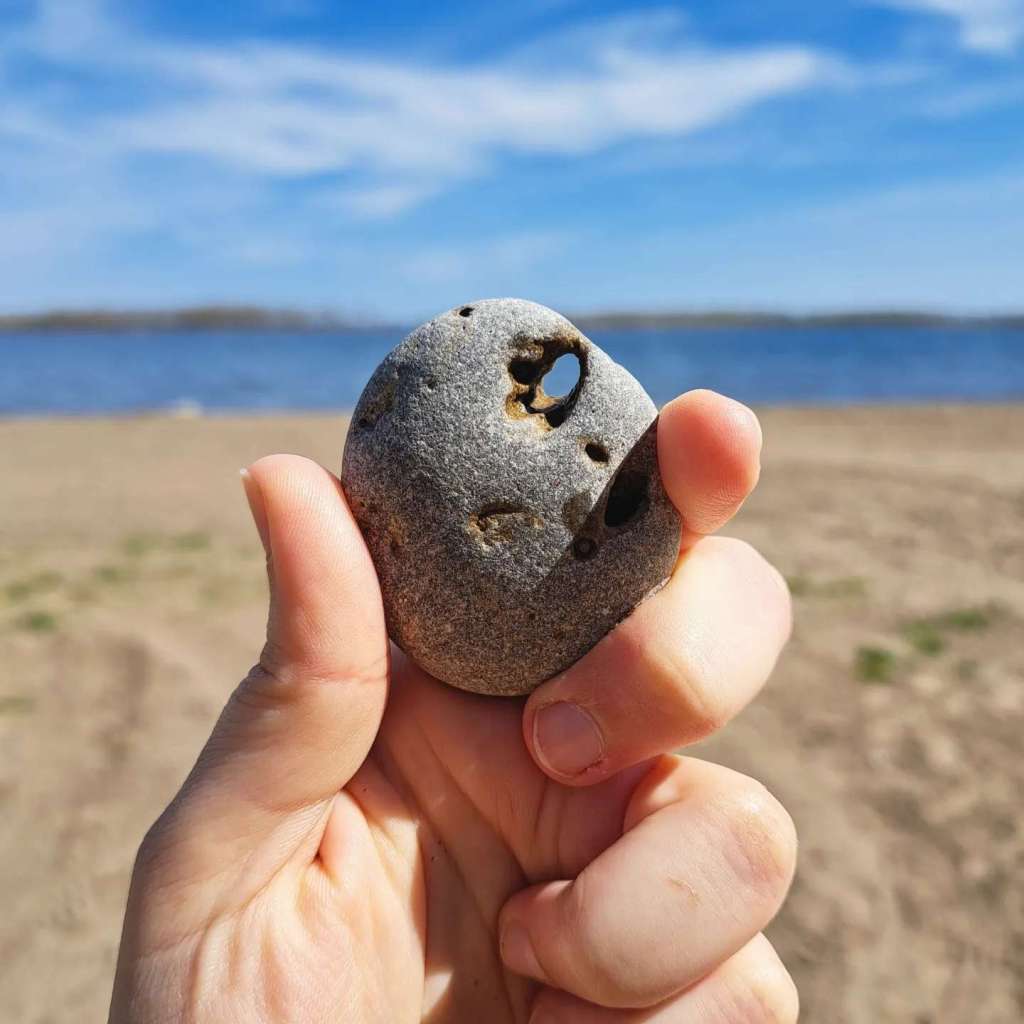
The Hagstone episode (also adding the YouTube link since we only made the channel a few episodes after the launch, and most of our viewers are on Spotify and Apple Music—so for those of you who prefer YT, we’re finally live!) came about while the three of us were scattered over the past two months, travelling for work, spiritual training, conferences, and everything in between. Even on my travels, I had been collecting them where I could see (or, in the case of their hissing, hear) them, and asked Salt and Key if they’d be interested in contributing some German and English sources to an introductory episode on these most reliable of magical companions.
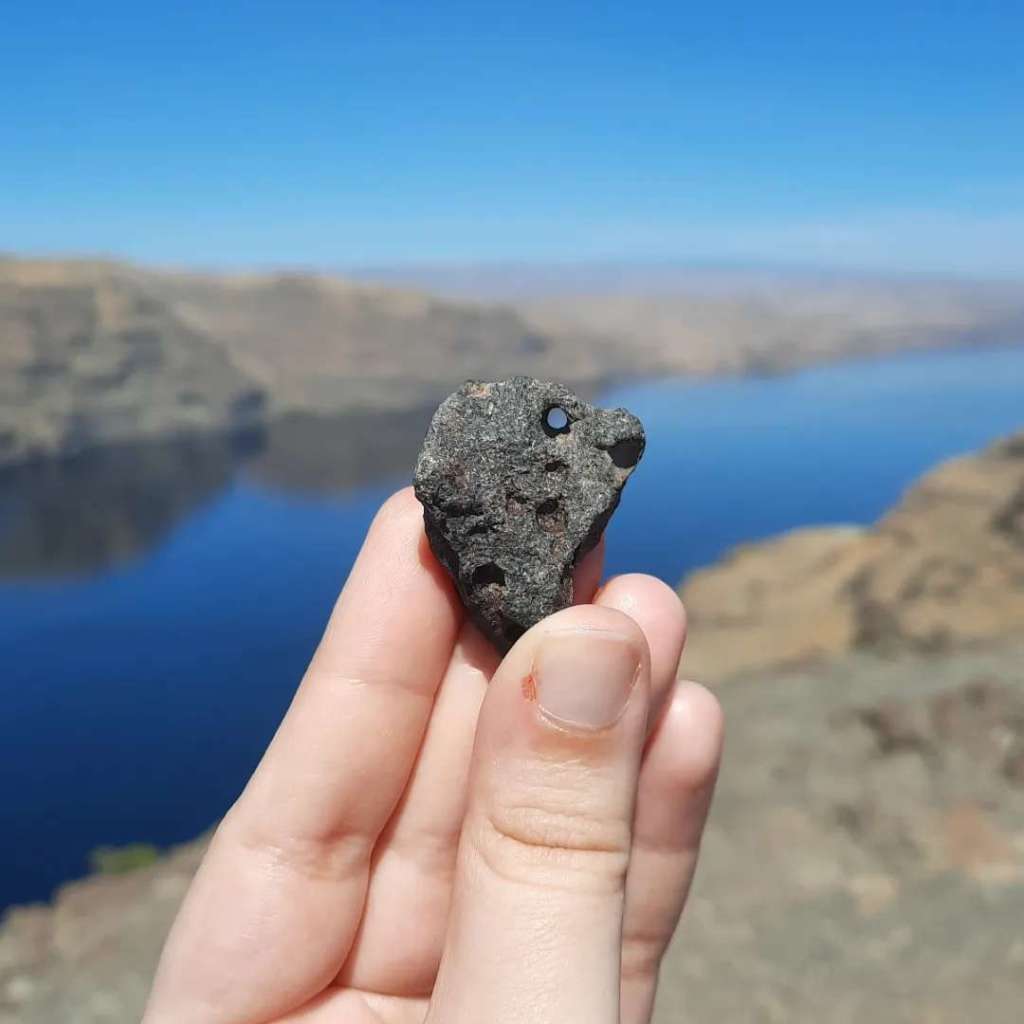
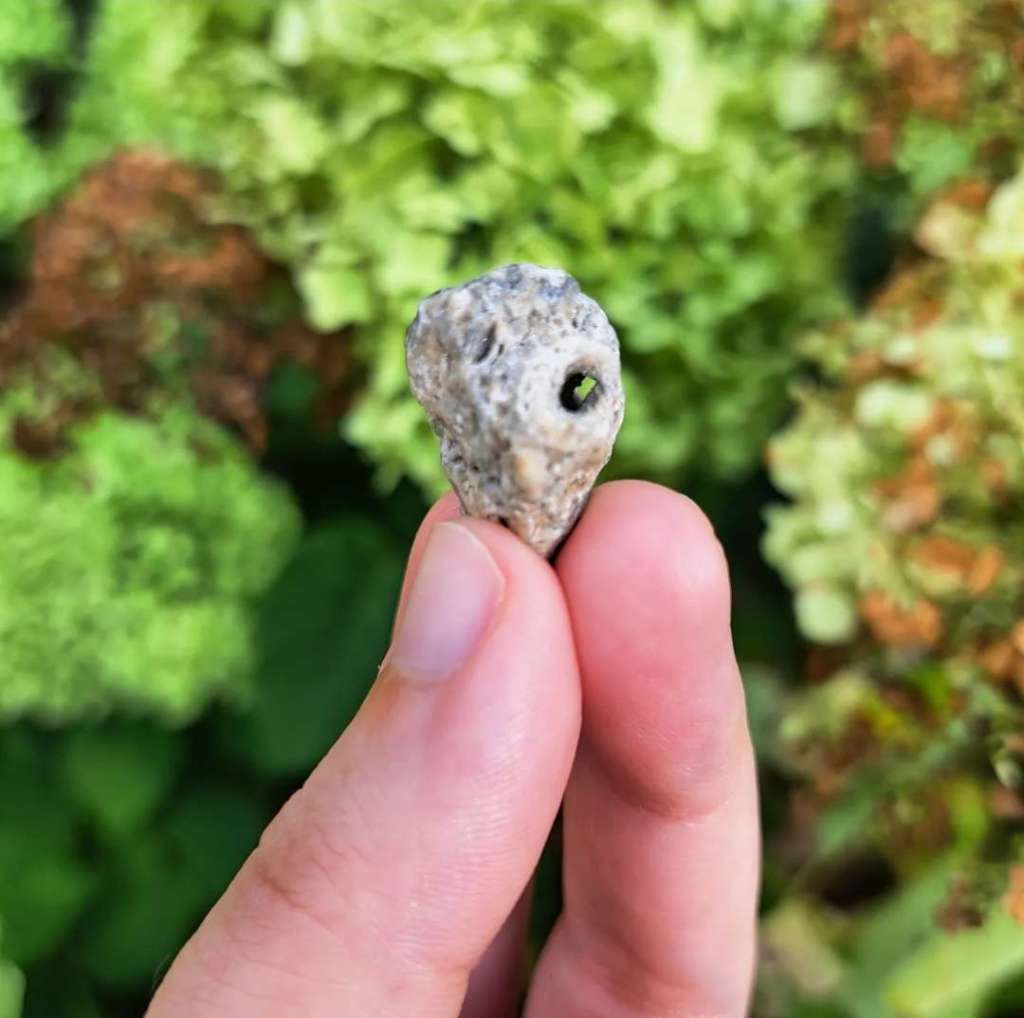
One of several hagstones I found at the Colombia River Gorge recently.
I thought it might be helpful to share some of what we went over in the episode here as well, in honour of Sveti Stefan Vetroviti. While we covered a great many names that holed stones have been referred to across Europe, “hagstone” is the name we’ve all used with each other in English from the beginning, and it’s certainly the one that’s stuck in our common parlance, as well as across occult spaces. That being said, while the list of names is especially long, a sample of our favourites from the episode include mare stones, bitch daughter stones, witch stones, and adder stones in English; Lochsteine, Trutensteine, Schratensteine (see our episode on the Schrat for more on this one!), and Hühnergott in German; and a great many coming from the South Slavic dialects, of which I’ll provide below with their translations from Serbian:
Chicken god (pileći bog)
Identical in meaning to Hühnergott, which itself is believed to be a German neologism form Slavic languages, referring to their use in the protection of livestock and especially chickens by being hung over their coops
Dog’s heart (psećim srcem)
Dog’s god (psećim bogom)
Dog’s luck (pasja sreća)
These dog-related motifs are a reference to Veles, lord of cattle, wolves, agriculture, the wilderness, magic, the chthonic world, and far more
Perun’s arrow (Perunovom strijelom)
Thunderbolt (gromovnikom)
Thunderstone (gromovnički kamen or kamen groma)
These three come from the belief that these stones are formed when Perun, the god of thunder, order, and the heavenly realms, strikes the holes through with his furious lightning
Serpent stone (zmijski kamen)
from the belief that holed stones are black eggs from which basilisks are hatched
Snake’s poison (zmijski otrov)
Serpent’s egg (zmijsko jaje)
Witch’s stone (kamen veštica)
God’s eye (božje oko)
An example collected from a beach.
The uses for holey stones are all but endless. They protect livestock from curses, witches, and being ridden to the point of exhaustion by fairies, heal toothaches, headaches, and all manner of illnesses (in the Balkans, a common technique is to sandwich the afflicted area with a hagstone on either side, and conjure them to pass the pain through them and away, so that they may be disposed of later), ward against nightmares, and allow for the seating and ensoulment of spirits (in my tradition, this is typically done with seven-holed hagstones, which are especially prized). Some cultures recognize classifications of hagstones and their abilities and proclivities based on number of holes (with each having their own uses), whether they are seen as belonging to fire or water (based on their shape and hardness), whether they are male or female (less commonly used, but often having to do with roundness and pointedness), and in which location and weather conditions they were found. I went over a few variations from Slavic speaking countries with regards to these in the episode, though these classifications can become so detailed and so varied that they could take up their own chapbook!
One of our favourite charms that we shared, coming from Reginald Scot’s Discoverie of Witchcraft, is the famous “Man of Might” rhyme:
Tha mon o´ micht, he rade o´nicht wi´ neither swerd ne ferd ne licht. He socht tha mare, he fond tha mare, he bond tha mare wi´ her ain hare. Ond gared her swar by midder-micht she wolde nae mair rid o´ nicht whar ance he rade, thot mon o´ micht.
With the modern English being:
The man of might, he rode all night with neither sword, nor army, nor light. He sought the mare, he found the mare, he bound the mare with her own hair. He made her swear by mothers might that no more would she ride at night where once he, rode that man of might.
A common charm one can make from this cantrip is to braid horse hair (especially white horse hair, given that the “man of might” is none other than St. George in many understandings) through a hagstone while repeatedly uttering the verse, making an offering to your spirits and the good saint immediately after in thanks to empowering this anti-nightmare ward. I’ve made several of these for friends, family, and especially children’s cribs and found them to be exceptionally useful. The one which hangs over my and Salt’s bed is a two-holed hagstone, with the horsehair looping through the topmost hole, and the other being used to assist me to return to my body in dream and spirit flight.
A charm made in this manner using a hagstone I found while travelling.
Indeed, a very similar charm comes to us from the mid-16th century, as recorded by Thomas Blundeville of Norfolk in his The Order of Curing Horses Diseases (1566):
In nomine patris, &c. —-Patris et Filii et Spiritus Sancti Saint George our Ladyes knight, He walked day so did he night, Until he her founde, He her beate and he her bounde, Till truly her trouth she hym plight, That she would not come with the night, There as Saynt George our Ladyes knight Named was three tymes, Saint George.
Holed flint stones were typically hung, like iron, to ward people and horses alike from being ridden by night-mares—in the case of the latter, they could be placed around the manger or the neck of the animal. Blundeville considered this to be a “foolishe charme” that was to be written down while hanging a “flynte stone that hath a hole of his owne”, which was naught but a silly way to con money out of “playne folks purses”. Yet, much like Reginald Scot, in his very disdain he ultimately preserved for us this oral charm in writing, allowing us to make good use of it even now.
Another dreaming protection amulet, made from a hagstone, an iron key, crossed rabbit’s legs, and mandrake root.
While hagstones require no special ritual to make them “work” or to activate their virtues, there exists plenty of folklore with regards to how they should be acquired. J. Geoffrey Dent’s article “The Holed Stone Amulet and Its Uses” (1965) tells us that there is evidence from the South of England of beliefs that hagstones should be received as gifts, or, even better, stolen. Generational stones, that is, those which had been passed on throughout successive owners within a family, all used for the same purpose, are perhaps the most powerful through their repeated victorious efficacies, and presumably all the more potent if stolen. Yet in the Balkans, we repeatedly encounter the lore that hagstones indeed will only properly “activate” and bond with their owner if they are deliberately found within nature by them. I shared a few charms for how to actually go about and acquire them in this way, both with regards to luring them to you, such that spirits reveal their places and that you stumble upon them naturally, as well as how to seize their fortune once they are found in the episode.
Regardless of what you choose to say out loud (for ultimately many of these “charms” are oral prayers passed on that someone may have at some point invented, or, in the case of bajalice, received from a spirit), a good way to hunt them is to take off your left shoe, and walk barefoot along the shore or river while dropping one millet seed from your closed left fist into the ground at each step and repetition of your prayer. In this way, the spirits of the land are petitioned to receive your blessing of fertility, and accept your alm in exchange for revealing your prize.
A collection Salt and I brought home from a trip to Brighton Beach together.
Many of the oral charms we shared ultimately serve the purpose of bonding a stone to you, especially if they are not already claimed by one of your spirits. The three of us have often had the shared experience of bringing home a great many hagstones from a hunt only to find that 2/3rds of them had been immediately spoken for by our spirits, who wanted them for their own ends, vessels, and amulets. I’ve often had to string them in groups of seven, nine, thirteen, or twenty-one as soon as I’ve brought them through my door as a saint or house spirit immediately wanted them placed over an important threshold. In cases in which I’ve bought hagstones over Etsy, specifically because I was searching for particular numbers of holes that a spirit requested, I’ve left them before my spirits in small bird’s nests that I’ve collected for them, such that they can incubate, receive the rays of the sun, and lubricate their hissing through the maws of their gates.
If you listen closely for their hissing, the serpents below may even lead you to them by sidewalks in the cities.
While different aspects of lore disagree on whether or not the thread which hagstones are hung on should be knotted or not, the notion that they should be strung up with natural material (such as wool, linen, or hemp) is fairly universal. If I’m about to use mine to scry, I will often make use of a fairly well-known technique across the Balkans to whisper through the whole what I wish to see while moving it around my left palm with my right index finger. Afterwards, I will breathe through the whole, and place it to my right eye while closing the left, and then scry for the augury—or directly at the sky in the morning to witness the rising star, that it may be captured later within that very stone.
There’s so much more that could be said on their collection, uses, and enchantments, such that we’re already planning the next edition of our hagstone episode series. If there’s anything in particular any of our readers are curious about or would like to be included, please feel free to write to us below, and we’ll do our best to include some tips and folklore on each matter in the next installment! For now, happy hunting, and thank you all so deeply for supporting our podcast!
Happy Walpurgisnacht! The three of us at With Cunning & Command have been working on a secret project we’ve waited for this very witch’s night to finally release out into the darksome wilderness of the hunt: our blog’s brand new companion podcast! The Frightful Howls You May Hear, whose title is an homage to the Grand Grimoire, is a bi-weekly podcast about all manner of magic, occultism, and folklore, from learned traditions of grimoires and astrology to the folkways of traditional witchcraft and herbalism around the globe. Finally putting the voices to our psuedonyms, the three of us will be uploading a new episode every two weeks, ranging from investigative deep-dives into an area of magical and folkloric research to workshopping sorcery, scrying, mediumship, and all sorts of actionable pursuits.
One of our major goals for this podcast, as we go into in our introductory episode, is to put out more content in a more casual manner. We’ve developed a particular tone in our writings on this blog which, while being authentic to our writing styles, is very much a product of both the perfectionism with which we approach what we share, as well as the constraints of privacy and secrecy enforced by our spirits and traditions. As such, what we do write on and explore here are the sorcerous results, field experiments, and magico-religious musings we can reveal, being only a small slice of what we actually get up to on a regular basis. With the podcast, we not only hope to discuss a bit more casually some of our adventures and experiments, but also connect with our beloved readers on a more personable level. We are so continually humbled by all the e-mails our readers send in, reports of your own attempts at some of the grimoiric and folk magical techniques we’ve discussed, and all the love and excitement you’ve shown our talismans, oils, readings, and other product launches (many more of these coming in the future!). The Frightful Howls is both a labour of love and a show of appreciation for your thoughtful engagement, and we hope to be able to learn together with you all on many more folkloric and sorcerous topics as we explore them in a far more casual, light-hearted setting.
We have one (and a half!) new episodes uploaded already:
Episode 1: Toadmen, Horse Jading, and Leapers Between: An exploration of the toad bone rite, horse jading, toadmanry, self-initiations into witchcraft, and the Society of the Horseman’s Grip and Word. Lots of memes and laughs are had, Key wrestles with his past Chumbley phase, Salt delights us with his accents, and I lead the charge on the research while somehow bringing it all back to dragons once again.
If you’d like to give it a listen, head on over to the podcast site or our own blog’s page to see the new episodes. If you’d like to help us further expand the podcast, fund bonus episodes between weeks (available to all), and get access to some cool bonuses, please consider checking out our Patreon! By subscribing to our one (and only!) tier, you get access to our show notes and citations, exclusive monthly Q&As, Salt’s monthly astrological almanac, our herbal lore and magic of the month, and the ability to suggest and vote on future episode topics. Every patron helps us so much and we are so deeply grateful to each and every one of you!
Follow us on Twitter for updates and be sure to check back every two weeks for a new episode.
One of the genres of spells present in the PGM that B. Key and I have always found especially intriguing are those categorized as “charms to restrain anger”. There are a handful of these within the papyri, each containing a combination of one or both of the these components: an oral charm said in front of the person whose wrath you are restraining, and a lead lamella or papyrus stele that is either worn, thrown in a river, or deposited near the target. At this point, I’ve been keeping myself stocked on papyrus, clean linen, and sheets of lead to cut shapes out of for a while in my experiments; all I really needed to give these a test was the opportunity.
I have not had the need of using these charms for myself. Instead, my experiences testing them came from friends who approached me in moments of need, as well as from the handful of clients I regularly work with for matters of operative sorcery. (As an aside, while I am now only taking on new clients for divination, not sorcery, please consider contacting our very own incredibly talented B. Key if you are interested in custom talismans and materia to facilitate your own magical goals.) In order to respect their privacy, I will have to speak vaguely on these matters, omitting the majority of the identifying details. However, with the appropriate permissions given, I thought it might be prudent to write a little on my personal experiences with these charms, which were the most efficacious right off the bat, and which were combined with other workings in order to attain the desired results.
An image of the rite as it appears in the Betz translation, page 143.
In no particular order, let us begin with PGM VII. 940–68, being “A charm to restrain anger and a charm to subject”. Out of the entire miscellany, this is by far the one I have used the most frequently, largely owing to its balance of potency and ease of use.
All one needs is a new sheet of papyrus and some myrrh ink, making it especially easily accessible. I’ve found this charm to be highly reliable both on its own and as a compliment to other workings. With regards to the letters and names of power, I have had success with both the English transliterations and the Greek, and have found no changes in potency either way. The main way in which I have deployed this for others is to include the target’s name in the first space and the client’s in the second (“[…] silence, subordinate, enslave him, [target’s name], to him, [client’s name], and cause him to come under [his] feet”), swapping the pronouns as necessary, and then either further modifying the text to include more precise instructions as to how the target ought to be dominated, or including a full length petition with even more details, seals, sigils, and spiraling names of power on the back.
As the PGM does not state whether this charm is to be kept, disposed, or worn on one’s person, I’ve tried out a number of different ways to incorporate the papyrus once it is complete. In one case, I wrote out a spiraling command in a similar fashion to an incantation or demon-trapping bowl, and placed it within a jar I had filled with the target’s tag locks, along with numerous commanding, compelling, and controlling roots and herbs. I would continue to shake this regularly and burn candles anointed in domination oil over it, repeating both the petition on the back and the “come to me, you who are in the everlasting air […]” conjuration from the papyrus. In that circumstance, I incorporated the charm into this structure as this was for a longer-term working to dominate the client’s competitor. Once my client had won indeed won—and the competitor, a notoriously irritable and arrogant sore loser much prone to vengeful slander, did not make any fuss in their workplace—I buried the remains in an appropriate location chosen by my spirits.
Ultimately, what I’m most pleased about with this charm specifically is that, while these additional incorporations certainly boost its power, it still maintains a consistent efficacy when used alone. I have found that for long-term works of suppressing the pride and abuse of a perpetually-bitter and toxic person, it is best used as the driving component or petition of a greater whole that can be continually fed and prayed over. But for targeting temporary states, quelling heat, and ensuring, for example, that one’s boss overlooks and forgives a mistake, simply performing the charm as it is written in the PGM has proved consistently reliable.
Next up are a group of three charms which are entirely oral: PGM IV. 46–668, PGM LXXIX. 1–7, and PGM LXXX. 1–5.
From page 47.
This charm appears twice in the collection, once here and again at PGM IV. 831–32. The next two charms appear grouped together, and as their translator notes, are the same text written by different scribes. Given that they were both copied more than once, we might assume that they were actually found effective and thereby reproduced. After all, they are far from the only PGM spells numbering so few lines. Of course, there are many reasons as to why they might have been copied like this, but given their repetition, I felt more hopeful that they would work like an oral charm, whose power lies in the command of its utterance.
From page 299.
I have primarily tested PGM LXXIX. 1–7 by incorporating it into workings as a repeatable conjuration. In one instance, I stabbed a skull candle with pins anointed with our friend Mahigan’s Chains of the Siren’s Song Ritual Oil, an oil I’ve much tested under the employ of numerous familiars, while reciting this charm over each, seeing the pins as lances boring into the very parts of the target’s psyche most resistant to the sorcery. The bottom of the candle itself was loaded with a matrix of herbs and capped off with a Fourth Pentacle of Mercury, which grants the ability to “to acquire the understanding and knowledge of all things created, and to seek out and penetrate into hidden things”—and what might be so hidden as another’s mind and innermost thoughts? While this setup has proven to be powerful on its own, I did find that the inclusion of the charm provided a particular kick, gathering and commanding additional ambient spirits. I have also made use of this charm with a simpler skull candle working, in which the oil was slowly and hypnotically massaged into the wax (having already been baptized and crossed as the target, with a piece of their spirit conjured into it) while the charm to restrain the anger was repeated 365 times.
I mentioned earlier that I did not really have any need of these charms for myself. Perhaps the closest I have ever come to truly using one in immediate proximity was actually these very oral charms. During an instance of road rage, in which a belligerent driver in the adjacent lane began to blare his horn and drive recklessly, I locked my gaze onto as much of him as I could see and repeated PGM IV. 46–668 (“Will you dare to raise your mighty spear against Zeus?”) three times. When nothing changed, I switched to PGM LXXIX. 1–7 (which at this point I had memorized thanks to the earlier ritual) and was glad to see the driver indeed calm down—or at the very least, stop his fuming. While I do count this as a success of the latter charm working on its own, I reckon that perhaps an even better way to test it would be to mutter it three times in the spur of the moment when it is most crucial, to nullify swelling anger in its heat. Suffice to say, it is indeed a good thing that this opportunity has not yet presented itself to me.
In the highway example, PGM LXXIX. 1–7 had an effect while PGM IV. 46–668 did not. The latter is not only much shorter, but draws on only one name of power, being Zeus. I imagine that it would make for quite a mighty boast in the heat of battle—not just of weapons, but wits. Imagine being in the middle of a debate and whipping out such a flex under your breath! Some nearby spirit may well be spurred to action, or perhaps the charm could weaponize one’s Eye to affix itself upon their target. I have not used it as thoroughly as the other, though I have found it helpful as a mantra in one Jovian work of protecting a client not be fired by their boss. As additional materia and seals of Jupiter were being employed, this charm found itself all the more useful by its invocation of the mighty Zeus.
From pages 148–149.
The first of our lamellas is PGM IX. 1–14. While the spell itself only mentions engraving the words, target’s name, and image upon a “metal leaf”, the metal in question is not specified. Much as the translators themselves note, I presumed this would be lead, and my daimons and familiars concurred.
I performed this spell precisely as outlined without including it into other workings. While the PGM doesn’t specify what should be done with the lamella afterwards, I decided to bury it at the workplace of the target. Within a week, my client alerted me that not only was the individual in question far more demure, but that they were no longer making snide comments, sabotaging her efforts, or behaving jealously and with constant venom towards her. This was the only time that I made use of this lamella specifically, though I have plenty of ideas for how it could be used in conjunction with further ritual. Much as in the earlier case, I imagine it could be incorporated into further materia, rolled up like a tube and inserted into wax or clay poppets, sewn into cloth talismans, or wrapped in snakeskin and placed in the claw of an owl to be hung and fumigated—both animals being associated with Ananke, a goddess called upon in the conjuration (“[…] I adjure you by the awful Necessity […]”).
Needless to say, I certainly plan on incorporating it into other methodologies in the future with my spirits and see how it lends its power to additional structures of sorcery. What is essential is that the charm itself worked when I needed it to and is perfectly sufficient for the job on its own. Next time the opportunity for using this arises, I will ask my spirits during our initial divination about the matter if they foresee this charm as being sufficient, or if I should further bolster it. This is really how I proceed with any of these—I first consult with my court about whether it would be appropriate to test out the charm in the situation (as opposed to rely on a more tried and true method between us), and then check if they advise any modifications or to proceed as given.
From page 149.
Speaking of charms which I didn’t change in any way, immediately following our previous example is PGM X. 24–35, a spell which allegedly “works all cases”, and not just against enemies, but phobias and nightmares. I am particularly fond of this one as it has such varied applications, being able to restrain not only the anger of others, but one’s fears and anxieties. While the spell specifies the use of gold or silver, I ended up using a sheet of tin to make four copies. All had varying degrees of success, so I can definitely vouch for the efficacy of tin specifically as a substitute. In fact, a friend even drew this out with a bronze stylus on aluminum foil and had it work, so it’s good to know that there are cheaper alternatives available. I plan on eventually making one out of silver just to have as a personal talisman, but for now tin definitely suffices.
I gave my set out to four friends and asked them to carry it on their persons while “pure” (not bleeding, not having recently had sex, etc.). One used hers to prevent nightmares, placing it under her pillow when not menstruating or having recently had sex, and otherwise by the bedside table. She reported to me that she noticed a marked decrease in regular nightmares, with the only ones that she did have appearing to be relevant as omens or indications of something being spiritually amiss. Another friend used hers to literally restrain her own anxiety and tendencies towards self-sabotage. While this of course did not fully resolve the anxiety in a long-term sense, being no substitute for therapy, it did help to contain it in moments of need, such as an important interview. The other two both used theirs for the primary purpose of restraining anger, albeit in both cases preemptively. They carried it to work around problematic colleagues and bosses and noticed a marked difference in their attitudes towards them specifically, but not towards others. It seems that even though one doesn’t engrave their own name upon the lamella, it is linked by the sympathy of being carried or worn to affect most powerfully its bearer. Wrathful coworkers and superiors still exhibited their usual behaviour to others, but ignored and passed over my friends entirely.
From page 269.
The next two charms are written one after the other in their papyrus. The first is PGM XXXVI. 1–34, which is a personal favourite as it calls upon Set-Typhon. The Kemetic Set is a deeply beloved deity for me, being formative in many of my personal experiences and bearing a place of great prominence in my home alongside the Lord of Wisdom, Djehuty. This spell calls on Set to restrain any subject—it is not specifically for anger, but rather works on “everything”. Inscribed by bronze stylus onto a lead sheet, the magician creates an image of Set (I confess mine was much nicer than the one preserved in the book, as I sketched the God more true to his Egyptian iconography) and inscribes the names of power within and around his body.
While I have only made use of this charm twice, it bore the most powerful and immediate result for me out of all of them. I do not doubt that this is at the very least partially owing to my preexisting relationship with the God. While I’m sure the powers and names of the associations alone will conjure success in the right circumstances (presuming one’s target does not have sufficient protections, and that one does not sabotage or work against the sorcery themselves by provoking them), the sheer intensity of the results I experienced with this were certainly benefitted from the decade of regular offerings and prayers I have made in cultivating my relationship with Set as a patron and Father to my craft. In one of the two instances, I deployed this charm to restrain both overbearing relatives and ancestral spirits alike from interfering with my client’s drastic change in career and lifestyle, and both parties evidenced a drastic change in attitude practically overnight. Out of the entire miscellany, I would recommend this one the most for matters of exorcism and the suppression of the pride and authority of particular spirits, who could not otherwise be bribed or negotiated out of their interference.
From pages 269–270.
Immediately after we have PGM XXXVI. 35–68, which assures us that it works “even against kings” and that “no charm is greater”. This one is part of a group which aim to not only restrain anger but also to secure and promote success and victory over others. The figure (which looks to me like a deity doing a kick flip on a skateboard while holding a serpent) is drawn on a silver lamella with a bronze stylus. Again, I ended up using tin, and found it to still work in the time that I deployed it. I gave it to a client to wear during an important competition and was much overjoyed to have heard that he had won. According to him, the opposing team was unusually sloppy and distracted, and his own demonstrated extreme confidence and prowess. Emboldened by this, I was going to make the same charm for another friend who was about to apply for a significant award, but was informed by divination that they would not win, even with the help of the lamella. My spirits informed me that this charm is better used in interviews and in direct competitions in which one is confronting their opponents, not in long-term applications with multiple, anonymously peer-reviewed rounds. While I considered the idea of making one anyway and using it as the centerpiece of a larger working, such as placing it under a plate upon which I would inscribe seals, conjure spirits, and burn candles (while having my client wear a matching one on their person), I ultimately was shown a more efficacious way to assist them by my court and proceeded with their guidance. That said, my spirits did agree that it would still work when used in conjunction with other such workings—they just happened to suggest an alternate method for that particular case.
From page 273.
Oh, how I love a charm that has you hold your thumbs. I’m always reminded of Balkan cantrips for invisibility and leaving one’s body as a spirit that have you repeat a phrase while holding the thumbs—which is also the equivalent for crossing one’s fingers for luck where I’m from! PGM XXXVI. 161–77 is a great one when it comes to affordability: it’s an oral charm that offers the potential to “augment the words” with a papyrus amulet. Instead of performing this one myself, I had my friend perform it on her own behalf to stop slander. I particularly like the phrasing of “[…] stop the mouths that speak against me, because I glorify your sacred and honoured names which are in heaven”. The elevation of one’s pure mouth, which speaks the holy names, over profane libel and other such drivel. My friend also wrote the full list of angel names on papyrus and kept it on their person, which assisted in stopping the gossip. This is another one I think can be really easily incorporated into plenty of other workings of folk magic. It provides a buffer of protection and an exaltation of one’s own truth and piety over that of slander, so as such one should ensure that they do not engage in gossip or similar behaviour while seeking the charm’s solace.
From page 274.
Shortly after we have our final charm which secures victory and favour in addition to restraining anger (by the way, in case you were wondering: none is greater). I just love that each of these makes mention that no charm is better while calling on entirely different gods and holy names; it feels a bit like watching an advertising competitions between cults. PGM XXXVI. 211–30 calls upon Helios, praying to him directly while facing the sun seven times and anointing your hand with oil, wiping it on your face. This one I performed myself to assist with winning a game of pure chance. As the spell does not specify which kind of oil is to be used, I opted for Holy anointing oil, though just frankincense would also do well in a pinch. I literally left my computer, stepped outside into my backyard to recite this, and then returned with the oil smeared on my forehead to resume the game, and promptly won six out of ten rounds of pure numerological chance—not a bad rate in the slightest! I definitely recommend playing around with this one. As it’s a prayer, it can be incorporated into many circumstances for obtaining victory, favour, honour, and fortune, and that’s with just using it on its own. Creativity is surely the limit with the ways this can be used. If you plan on using this for a major undertaking, I would always recommend divining first to see if it would work in your case, and if the answers are negative, using it more as a background boost for more elaborate sorcery.
From page 129.
Finally, there’s PGM VII. 417–22, which to my delight actually does call for tin! This one specifically should be thrown into a flowing body of water at sunrise, being engraved with the names of power and a customizable petition. I’ve done this one three times (making offerings at the riverbank to the local spirits in thanks each time) and it worked in two of the three instances, with the third one revealing under later divination that its magic was not able to sufficiently reach the intended target. In that instance, I went back to the drawing board, sent out a familiar adept at fetching etheric links from a long distance, and conjured more of the target’s presence into a spirit trap before subjugating their abusive behaviour towards my client further. The other two cases were far more local, which I imagine played an important role in how the spirits of the land and waters were able to deliver the potency of the lamella to them. The case in which this charm did not work ultimately involved an exceptionally prideful and stubborn target, so I was not surprised that it did not ultimately help much in the initial stages—though I found that making the charm anyway helped “soften” them up to make the later magic more effective, as it had stripped down some of the initial layers of resistance and protection.
In testing this genre of charm, I was able to verify that each is fully capable of producing its own result, while also easily being combined into other workings. In some cases, a lamella can simply be given over to a spirit on their shrine or laid atop their vessel, so that it becomes as a tool for them to use in your defence. In others, they were worn on the person, disposed of in places of power, or left to accumulate power inside containers and under candles. What strikes me the most about these charms against anger is how diverse they are. While they certainly are excellent to memorize in moments of passion when they would be necessary (especially in the case of the oral charms), they can be used to restrain far more. Pride, anxiety, nightmares, interfering spirits, gossip and slander, and even the very hidden plots and temptations within another to cause harm to oneself and one’s reputation—the diversity of use for these charms make them an excellent corpus to consider experimenting with, and I recommend those interested to not only play around with them with their own spirits, but to use them as a means to consider the applicability of other kinds of sorceries in matters concerning far more than what might initially meet the eye.
This offering has been a long time coming. Painstakingly birthed, laid to rest, and rebirthed over numerous Orthodox feasts, Balkan folk magical holy days, and stellar confluences; dragged clawing through the star-fallen chthonic and sun-devouring ouranic spheres; armed in teeth that have tasted fish, mammal, and bird; and nourished with the vital Red of communion and sacrifice alike—these charms are an expression of gratitude, and a fervent howling of further ingress, unto the mysteries of the Great Wolf Shepherd himself.
While little-known outside of the oral folk lineages in which his crooked gait wanders, the spirit known varyingly as the Lord or Master of the Wolves (in my first language, Gospodar Vukova), Wolf Herdsman, or the Wolf Shepherd, is an enduring figure across many parts of Central and Eastern Europe. My own pacts and understandings are grounded firmly within the Balkan context, most especially Serbian, though the pulse of his chthonic heart can be traced from Greece all the way up through Scandinavia. A dear mentor in Balkan traditional witchcraft was the first to introduce me to this enigmatic lord, who emphasized an approach that peers through the crossroads-pole masks of Veles, Dažbog, and numerous key Thracian cultic inheritances. He passed on his pact, through the wolf-saint he venerated the Master through, and in the capacity by which I have license, I’ve instructed our dear Key in similar ways.
His myths and stories are many, as are his myriad incarnations and forms. Much like the god Veles himself, the Master of the Wolves’ tales are retold and aspected through numerous chthonic saints, which include in the Balkans: St. Andrew, St. Demetrios, St. Sava, St. Michael the Archangel, St. Christopher, St. Blaise, St. Martin, St. George, St. Nicholas, and many more. Animal, man, god, and all between and beyond, he appears as a lame white wolf accompanying St. George, a lame old shepherd, an old white wolf, and various instantiations of each who shapeshift into the other. Ally to the Forest Mother and her spirits, wandering the landscapes as a poor shepherd, punishing oath-breakers and transforming the unfortunate into hungry wolves forced into his retinue (or in some instances, cursing a passerby to assume the office of the “Lord of Wolves” for seven years), and guardian of seventh and/or tenth-born sons; he is both the head of the furious horde and patron of the werewolf (vukodlak) sorcerers who make up his restless retinue. Even when he is not referred to by any particular honorific, the respect for this mercurial figure can still be felt in his abstract titles, common to the majority of his lands, including Latvia, Moldavia, Romania, Serbia, Bulgaria, Greece, and more: “The Old One”, “The One From Above”, “Lame Devil”, “The Unmentionable One”, “The Unclean (or Pagan) One,” “The One Made of Stone,” “The Hairy One”, “Old Grandfather”, and often only by “He”.
While the notion of a Master or Lord of Animals is well-attested across numerous Mediterranean and more broadly European sources, the Wolf Herdsman specifically is especially prevalent in the Slavic sources. In the Balkans, and especially in Serbia, Macedonia, and Bulgaria, he is most prevalently featured among the various customs surrounding the “wolf holidays”, varyingly located across the later months surrounding key saint feasts during which the dawning of the winter agricultural cycle is ever accompanied by a deepening respect for the threat of wolves. While the precise saint he is associated with will vary from village to village depending on the local custom, the practices are often largely similar. During these times, it is generally inappropriate to even mention the word “wolf” out loud, and they should be similarly described through titles such as “they” or “they from above [the mountains]”. Offerings, especially the first lamb or pig of the season, should be left out for the wolves at the far boundaries of the village, or at the first crossroads, in order to pay them off such that they do not threaten the precious livestock of the community. Should a wolf be killed for any reason, including defense of the self or one’s animals, the body should be carried from dwelling to dwelling in the village, apologized to, offered alcohol, milk, honey, and a meal, crowned in a wreath and mourned with the wailing of a child’s funeral, and then finally interred with utmost respect, such that the Master does not come to take vengeance for his child. It is also during these days that, in some parts of the Balkans, the Master is said to roam with his wild and hairy troupe, recruiting lost and restless dead into the fold and transforming them into wolves themselves, drumming up his shapeshifting sorcerers to go once more into the night and hunt down and punish any breakers of oaths. As such, much like St. Theodore’s Saturday, this is a period in which the settling of debts is of utmost importance; even the mildest broken promise should be rectified, lest a witch or wolf-sorcerer come to settle it on another’s behalf.
Yet this is also a time for his allied witches and sorcerers to enchant his tools. Indeed, anything which closes its “jaws” around sheep is intimately linked with him and with wolves themselves, including all manner of implements from sheep shears to barn doors and gates. The particular formulas and oral charms I have been passed down include those already documented in anthropological works, but the vast majority are those preserved by my mentor’s lineage. These charms, which you see before you, are born of much of that magic, personal ingress and devotion, and a deep love of this spirit, his associated masks, the deific forces his legends emerged from, and even his distant links to Hekate and Artemis via Hellenic and Thracian sources, especially in their preservation of the Great White Wolf Mother cult.
The ten charms at rest, crossed with sheep shears and a wolf’s jawbone blade.
The charms emerged out of a number of mutual explorations Key and I undertook in the past year, and took almost the whole year to fully create. As the visions came and the materia needed was confirmed with divination, the first roots began to sprout on the Orthodox herb-picking Midsummer feast of Sveti Jovan Biljober, when the birthing powders were made. Further materia was divined on and cultivated through the blessings and permissions of Ilija Gromovnik, Ognjena Marija, and Blaga Marija, a trinity of saints-as-Slavic-gods integral to the overseeing of spirit-ensoulments in the Balkan witchcraft tradition as I’ve been taught it. Following their summer feasts, and the collection of some of the rarer materia out in nature, we proceeded to construct the bulk of the charms upon Key’s visit in October, in anticipation of the particular Wolf Holidays I adhere to culturally: those cold days following the Mitrovdan feast with the honouring of the Mitrovske Zadušnice. The final—and in many ways, most important—of the four Zadušnice ancestral celebrations. Many of the wolf taboos emerge here as well, including the importance of caring for livestock through the oncoming winter, for women to not spin wool (and the Fates to not be invoked thereby), and for children to not venture out past nightfall.
It is on this day that we hear of many of the legends surrounding the wolves having their annual meeting with their Lord—in the guise of whichever regional saint is most associated with him—and then dispersing to carry out their orders. Some families also make a česnica, a ceremonial Christmas loaf made on Christmas Eve (January 6th for me, given the Julian calendar), and offer it directly to the wolves as a gesture of peace during this time. In my training, a meal is offered for the wolf spirits (in my mentor’s village, this includes the very physical wolves who stalk the mountains surrounding his home!) at the edge of your farm, at the first crossroads out of the village, and at a place where the devils gather: the nearest threshing floor, watermill, garbage dump, or cave. We carried out our offerings, baked a česnica, poured out koljivo and wine, and fed our spirits well. Calling upon the Master and his wolf, vukodlak, and devil brethren alike, we created the next most important powder, and ensouled the fossilized wolf bones which would animate as one under the auspices of their tutelary Mother.
The intention of these charms, constructed by the Master’s watchful eye, is to house a group of his warrior-wolves to defend their allied sorcerers against malefica. These are immensely protective charms, bearing the souls of wild and cunning assassins, a set of spies in the dark and a silent dagger in the shadow. They investigate and overturn plots before they congeal into reality, stalk the dreams of those who slander, break oaths, and lie while asleep, and repay insult, evil eye, and curse with adamantine force. Ultimately, their chief abilities lie in protection and anti-malefica, though it is crucial to note that each leather bag holds within it the pulsing heart of its own spirit—for those they protect and watch over, these are fully enspirited allies that may be petitioned, worked with, sent out to do their bidding, gather intelligence, and watch over the rest of one’s existing spiritual court as another layer of guardianship. The importance of protecting one’s magic and spirits, especially by secrecy and taboo, cannot be overstated, and so these wolves are themselves an excellent addition to the front line of defense for one’s existing pacts as well, hiding and obscuring workings and alliances from being scryed and divined on, and purposefully feeding false information to those who would attempt to peer beyond what is permitted.
Each wolf was selected and enthroned by my and Key’s efforts through a rigorous divinatory process that took place over the entirety of the Wolf Holidays. The spirits were tended to and more deeply incarnated over the feasts of Dimitrije (Demetrius of Thessaloniki) Kozma i Damjan (Cosmos and Damian), Arhanđel Mihailo (Archangel Michael), and Nikola (Nicholas). Once constructed, the bags were interred and rebirthed, and unchained briefly to hunt down and swallow the sun on Winter Solstice. Their final offering was given on Orthodox Christmas Eve: one last taste of freshly-made česnica, and a full bottle of a favourite drink for the Master.
Ten were made in all, though only nine will be available for on here, as the very “Master” of this group will remain on our own joint shrine to the Master of the Wolves as familiar and mother to the pack. These spirits were chosen for their compatibility, loyalty, sense of justice, and verified power; each having been tested individually in the carrying out of tasks and the successful manifestation of results. If you are interested in taking in one of these warriors, we ask that you keep in mind that these are very much living spirits. They can be carried with you for protection, or left at home on a compatible shrine to assist you remotely. Speak to them with respect, offer them a candle, a shot of strong brandy, vodka, or gin, and invite them to assist you in what ails you, either preventatively or actively. If you have a store or are public in any way about being a sorcerer, they would be an excellent ally to set over your business, and to patrol the boundaries of your public image to best shield you from the Eye.
One among the fold, resting over an icon of St. Nicholas.
If you already work with one of the saints mentioned above, it would be appropriate to keep the charm by their icon or statue. They may share a space with other chthonic spirits, provided that your personal divinations do not reveal any potential conflicts. Veles, Apollo, Artemis, Odin, Hyrrokkin, Hekate, and many other such deities are a welcome and natural ally. We recommend a weekly offering of at least a glass of water and a candle, asking that any omens may be filtered and expressed through the bubbles and flame. Allow the spirit to warn you ahead of time of dangers, and divine with them if these are already resolved and do not need to be addressed further, are on the horizon and require additional magical support to unmake, or are already present and are being dealt with. Ask if additional offerings are needed, or if the wolf warrior advises for a different approach. If they request through divination that other spirits in your court be called upon to assist, provide offerings for them as well, and allow the wolf to lead the charge and organize the defense on your behalf.
While protection and curse-breaking are undoubtedly the main areas of expertise for these spirits, they are ultimately fully independent and realized familiars of their own. They can teach and guide their sorcerers in the cunning of shapeshifting, the donning of second skins, the mysteries of the Furious Horde, and the hunting and consumption of ghosts. If one is not already experienced in these matters by training in witchcraft, it goes without saying that each subject must be approached with the sincerest caution, and under the strictest guidance of one’s patron spirits, mentors, and divining arts. Given what we have already noted about the Master, it cannot be underemphasized that these are spirits who abhor oath-breakers, and cut out the tongues of those who blaspheme the truth, or worse, abusers who believe they speak truth out of their own ego-driven needs to remain righteously victimized, and justified in their behaviour thereby. Suffice to say, do not request petty revenge of them, or conflate one’s ego and desire to seem mighty and powerful with a call to study under the banner of the wolf spirits. These spirits demand a level of agency, accountability, and self-knowledge to exercise their protection, and have little patience for those who wish only to lord over some malformed desire to be venerated and feared without any effort or discipline to cultivate right relationship with spirits, and with the very love of learning magic itself. They will vacate their fetishes and return to their Lord if those to whom they are pacted attempt to harness them for a puerile end. In this way, while one does not need to necessarily always be in the throes of a devoted practice to work with them, they should at the very least be comfortable with spirit communication and divination in order to best work with these ferociously protective allies.
The materia that went into the construction of these homes numbers in the hundreds, ground down to small traces of powders incorporated into the main mass. They are housed in leather bags sourced from the Balkans after a similar design by a mentor of mine (so that they may be discretely carried or even worn by the belt during ritual) and adorned with a fossilized wolf paw each, dating back to around 20,000 B.C. These bones were found in a cave in Germany in the midst of a search for cave bear fossils, making this bear-turned-wolf hunt an excellent expression of the Master’s own close ally (and syncretized deific form), Veles. Some herbal and animal allies that join our wolves include goat, serpent, linden, and blackthorn; materia from our personal Sirius, Pleiades, Mars in Scorpio, and Mars in Capricorn blends as elected by Salt and vivified by my own stellar pacts through my witchcraft; the first blossoms of a pear tree grown by Salt in honour of the Master of the Wolves (pear being one of his holiest woods); special dews, honeys, incenses, and beeswax intended to court the favour of the djavoli (devils) and vile (fairies); pieces of a česnica baked with my personal 2022 Thursday Salt and the aforementioned vila honey, each stabbed through by a horseshoe nail rebirthed through the auspices of the Pleaides and Sirius, and additional exorcistic and goetic cunning with the aid of each of the Wolf Saints whose feasts we celebrated and nourished the charms with, in addition of course to the ever-wily St. Cyprian of Antioch. The forty-one beans used in divination to confirm their final ensoulment were also divided between the ten charms, a technique often used to remind the spirits the proof of what they consented to with respect to the pact of their working itself. Much in the same way, the bread, which accompanies in some form the majority of Balkan charms, recalls the joy of life, the rising of the unmade into the made with the yeast, and the fruition of promises and powers.
A bundle of rosemary was taken to the cemetery, with the appropriate guardians propitiated, and brought back to brush over and consecrate each aspect, named and unnamed, that would enter the bundle. Being fed the blood of communion and sacrifice alike, they are now awake and ready to stand guard over their new allies. While this list is only a small preview of all the work and materia that went inside, we hope it is sufficient to give an overview of the great work that went into their careful cultivation and ecstatic midwifing into this world. The Master being an important spirit to all of three of us, being a pact I have helped introduce through my cultural training and lineage that quickly became even more vibrant and rightly-feral in the hands of Salt and Key, we are truly proud that our first collaborative offering honours this enigmatic and darksome Lord in all his many faces.
If you are interested in taking in one of these spirits, and feel confident by your own discernment with your spirits that they would be appropriate to work with, you may purchase a charm for $300 USD below. You will receive additional information for the care and maintenance of this offering to your e-mail within a week of purchase, in addition to the tracking number for the shipping. Please ensure you specify your shipping address when purchasing. We hope that these spirits find deserving homes, where they may be honoured, their names uncovered through signs and omens, and a true relationship built in frenzied communion with the spirits of their new ecosystem.
All charms have been sold out as of January 11, 2023! Thank you all so much for your support!
Note: Much as with the majority of Balkan lore, it is rare to find genuine information about the Master of the Wolves outside of the languages in which he is revered. For those interested in learning a little more about this spirit in general, here are some we’ve found fruitful in English: