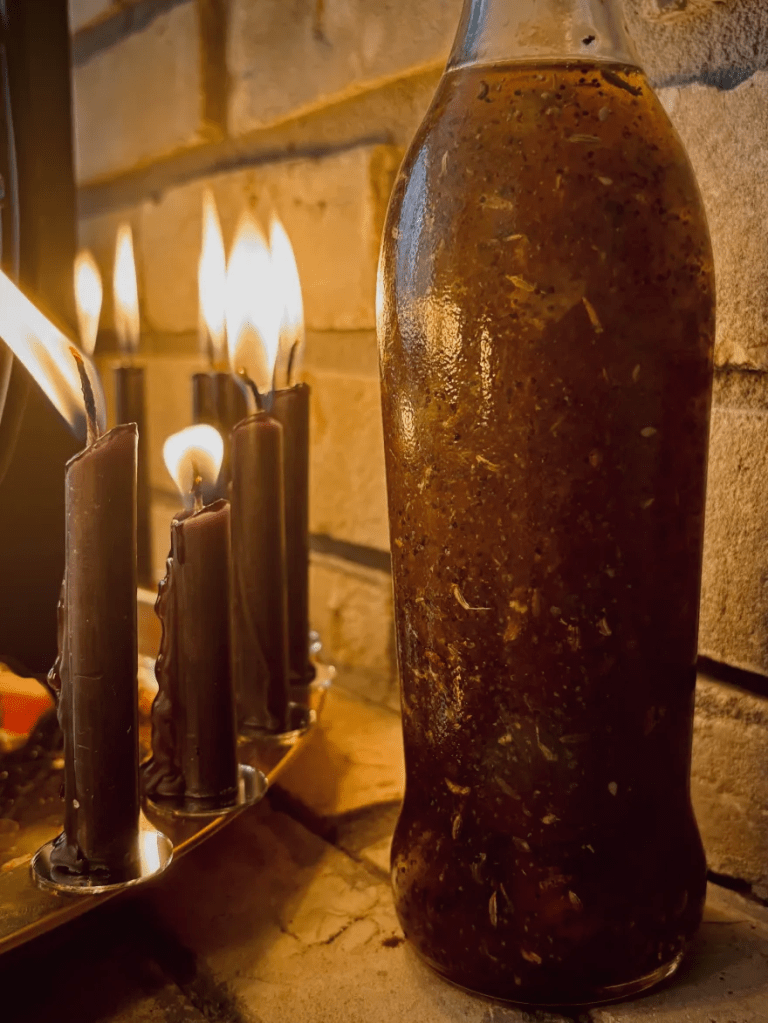
Give them according to their deeds…: In the wake of Episode 74 of the Frightful Howls, I composed this formula to meet the needs of this month’s first community ritual for invisibility from adversaries. Following the ritual, in dialogue with the spirits involved and with the spirit of the oil itself, we came to the decision to release this to the public to better facilitate the goal of granting additional forms of protection through concealment to those in need.
…And according to the wickedness of their endeavours: The composition of the oil began with the sun and ended with the moon, each drawn down through sympathetic herbs and resins such that the eclipse of the solar powder with the lunar grants the same power of occlusion to those who wield the oil. I used fennel to “steal” any remaining fire from the solar materia, and conjured it to redirect the light and heat of attention, prying eyes, and inquisitive minds away from the bearer. A mixture of seeds was added in an uncountable sum to introduce confusion and redirection through delay, in addition to serpent sheds, that the bearer may shed away old guises and take up new ones at a moment’s notice. To further enliven and empower the quiet beast that is this oil, I constructed multiple distinct talismanic cores as “organs” to form the body of the spirit within: a written copy of Psalm 28:4 atop a petition and pact sealed with wax, specific shells and animal materia, resins collected from lucky and auspicious trees, and bundles composed of cloth and herb containing traditional formulas for law-keep-away work (including my personal law-keep-away powder) in the American folkloric context to grant distinct protective, evasive, and deceptive functions and frayed threads from old charm bags to unravel plots and magic against you like old cloth.
Give them after the work of their hands…: Additional consecrations were completed on the oil under the dual lights of the recent eclipsed blood moon and the concurrent selenelion, at which time the now-pronounced redness of the oil was captured and augmented. I then brought the primary bottle of the oil with me to a place of conflict, a place of unjust law enforcement activity, a visible place, and a cursed place, and again tested the spirit’s ability to protect, to obfuscate, to distract, to hide, and to enact revenge. Each of the tests was passed with flying colors.
…Render to them their desert: This oil’s functions are diverse, ranging from protection and invisibility to retributive and even vampiric functions, each use dependent on the creativity and interaction of the conjurer. As something slightly more enlivened than other oils I’ve produced, I suggest spending time contemplating the oil in various forms – on a candle, in a lamp, on petitions, on photos, on your hands, and in the environment to tease out mysteries and uses. The spirit of this oil is one responsive to need, and is hungry to right what it sees as wrongs. I suggest using the oil somewhat regularly, so that it does not get bored. It can be fed with a neutral carrier oil to extend its life, although I recommend not stretching it further if the scent of cinnamon is no longer detectable in your original bottle.
Each order includes 1 fluid ounce (30 mL) amber glass dropper bottle of the Oil According to Their Deeds. Shipping included. Please allow for up to a week from the time of your order for me to ship via the USPS.
What a privilege and a joy it is to work alongside my dear friend Vanessa of Sword + Scythe again, whose artistry, dedication to their craft, and genuine love of the spirit world permeates each of their incredible pieces. Vanessa has created a truly exceptional set of new silver charms, completed on the Polish feast of Gromnica, Our Lady of the Thunder Candles, and Catholic Candlemas. Also known as the Divine Mother with Wolves, this Marian form preserves key aspects of the goddess Dziewanna or Devana, whose manifestation in the Balkan context can be most acutely found in the veneration of the Great White Wolf Mother or White She-Wolf, Bela Vučica. You can read more about their offering on their website [here].
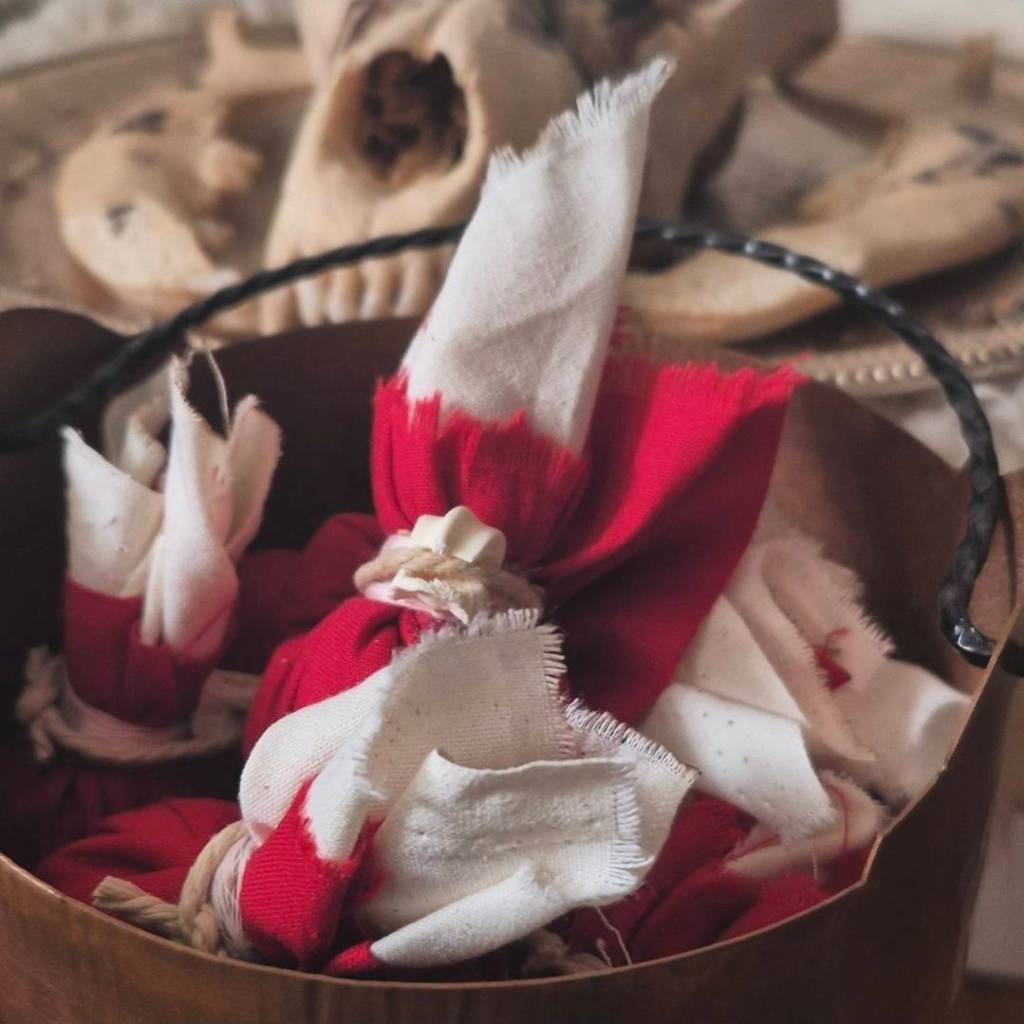
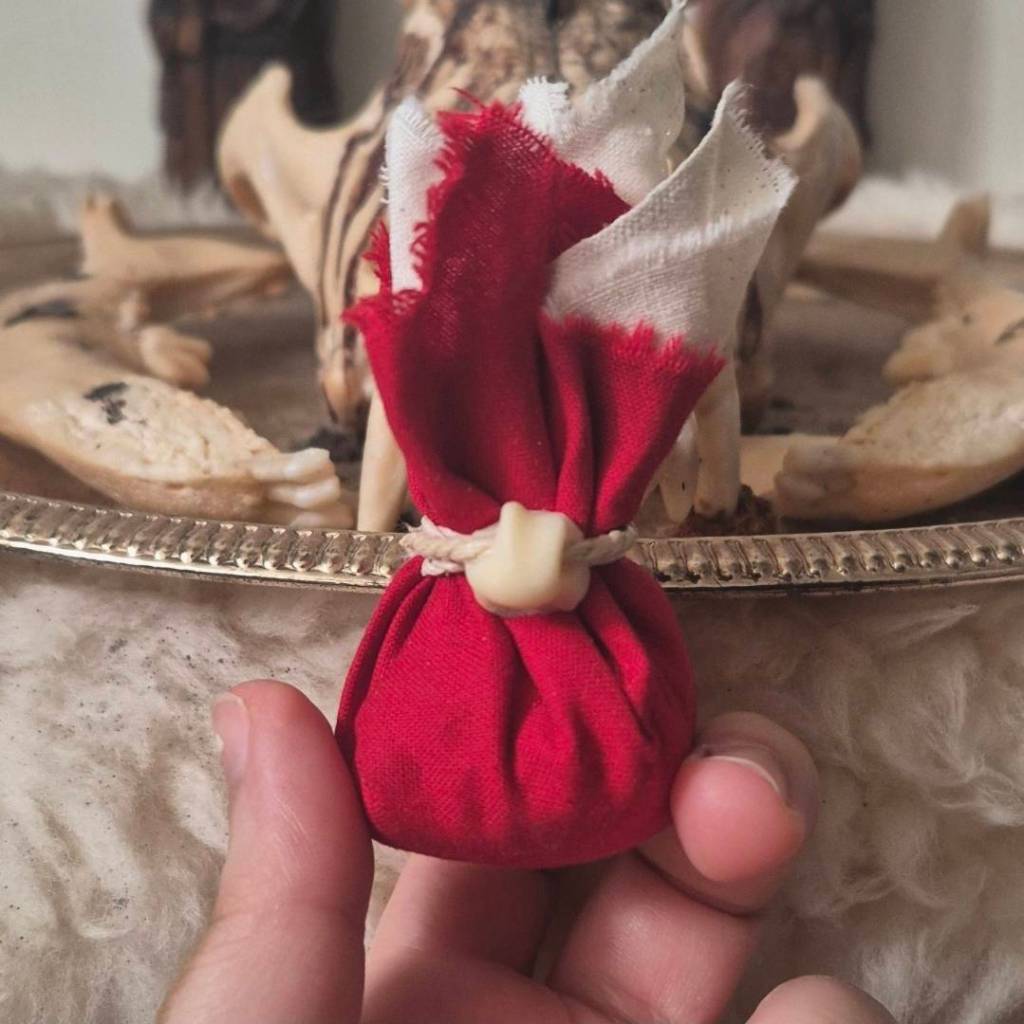
In addition to supplying the powder that is set behind each amber stone, I created my own clutch of charms over the course of the winter progression of dark to light. The core mixture that sits at the heart of each charm was first begun on Sveta Varvara, a key saint mask for the White She-Wolf. As her Christmas wheat grew, so too did the prayers, offerings of wax, blood, milk, resin, and prayer. The core bundle was born of three different stellar mixtures arising from my training in Serbian folk magic and witchcraft, white wolf fur, powdered white wolf bone, serpent vertebrae, linden, dittany of Crete, eyebright, mullein, Greek sage, the beans that approved the recipe in divination, and a mixture born of the Mother of the Moon, along with many other unnamed ingredients. Wrapped in white first, the primary colour of this powerful goddess, whose nature as divine ancestor and Thracian remembrance was petitioned through numerous offerings and libations at her sacred trees over the past two months, they are protected in the red of her blood and adorned with a wolf metatarsal bone each drilled to hang over the body of the charm.
The clutch before the Wolf.
In many ways, these are the female counterpart of our charms made several years ago with the Master of the Wolves. Where those housed fully bound spirit familiars each, these are a witch’s second skin, intended to be used by those who draw on witch-power to slip out of their bodies in the night and join the revelry and hunt directly. The primary benefit these confer is that of a fully adoptable fetch form, being that of a white wolf, to shapeshift into in works of trance, night flight, dreaming, and acts of attack and defence. Through the intercession of the White She-Wolf, each charm was imbued with the fleet-footed ability to grant their user the spirit form of a white wolf, a child of the Great Mother, and to be recognized as such in full disguise when being communed with. This fetch is bound to an internal charge within the charm, wrapped in white and red, linked to the external metatarsal bone as the feet of the charm. In several lineages of Balkan witchcraft, charms and fetishes which grant a second skin are categorized along the lines of which limb of the new form they preserve, and these charms are made in the tradition of the Feet; intended to be stepped into and worn, as opposed to autonomous spirit-forms that operate independently of their witch.
In addition to this, the charms provide protection from restless dead, curses, and hags, as well as blessings of controlled dreaming. To use, set up your usual protections and undergo whichever procedures assist you in entering trance. Then, feed the charm with your dreaming or skin-turning incense of choice (your favourite resin will do in a pinch, for the charm eats any smoke that soothes you and lulls you into trance), anoint the external bone with a small drop of spring water, and drag the wet bone down the crown of your head, forehead, lips and chin, and all the way down the body to the navel, as if tearing the body open to create a slit to birth the new form anew. Once at your navel, mark the sign of the cross over its opening, and place the charm over it as you relax into trance. The charm will then begin its work, pulling your consciousness out to assume the eyes of one of the White She-Wolf’s children, so that you may stalk the night. The skilled worker will be able to use theirs to fly, dream true, receive oracles, and solicit the help of her wolves in divination, sorcery, and healing.
One amidst the pack.
Today, on the feast of St. Charalambos, himself a negotiator and pacifier of wolves, Vanessa and I are proud to release this devotional collaboration. Only ten charms are available, intended for the intermediate to advanced practitioner and witch. Your creativity, cunning, and spirit alliances will only serve to enhance your experience with these second skins. May the Great White Wolf Mother protect and nourish you.
All charms are sold out as of March 6th, 2026! Thank you so much!
All charms will be shipped within one week of purchase! For Vanessa’s charms, please see their post [here].
I am delighted to present a set of empowered tools for ceromancy, or wax pouring divination, worked from the long stretch of Sveta Varvara (Saint Barbara’s day on the Julian calendar, being December 17th) to Bogojavljenje (Theophany/Epiphany, the 19th of January). One tradition still observed by several of my teachers in Serbian folk magic is the care and cultivation around divinatory omens during this time period. As the Christmas wheat sown on Barbara’s day grows, eventually overcoming the winter solstice and heralding the return of the light on Christmas itself (January 7), so too does it imbue its fecundity to our collective attempts to seek light in darkness, understanding in ignorance, and clarity in confusion. Generally, outside of passive observation and scrying of omens, I refrain from divination purely for my own sake during the days between Barbara and Christmas—though Christmas Eve on the Serbian folk calendar is of course a renowned day for the scrying of fortunes in candles, in blessed water, and even in gravy at the dinner table! Rather, it is once this holy light itself briefly returns on Christmas, and then emerges once more after the perilous Nekršteni Dani (“Unbaptized Days” between Christmas and Epiphany) that we celebrate the manifestation and revelation of the Theophany through performing this art ourselves. In my training, this is especially done with ceromancy, or wax pouring divination.
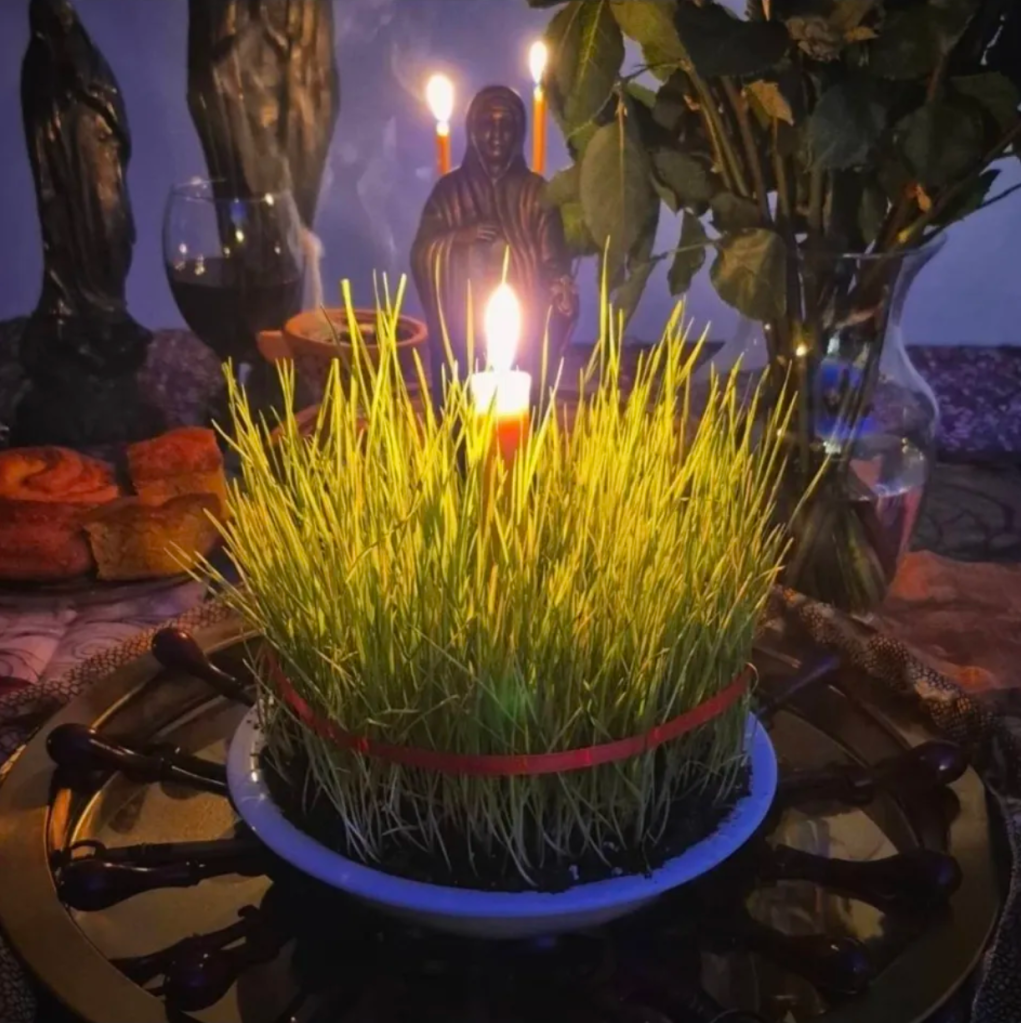
Each key and wax pouring spoon is oriented around the Christmas Wheat, under the watchful eyes of St. Petka.
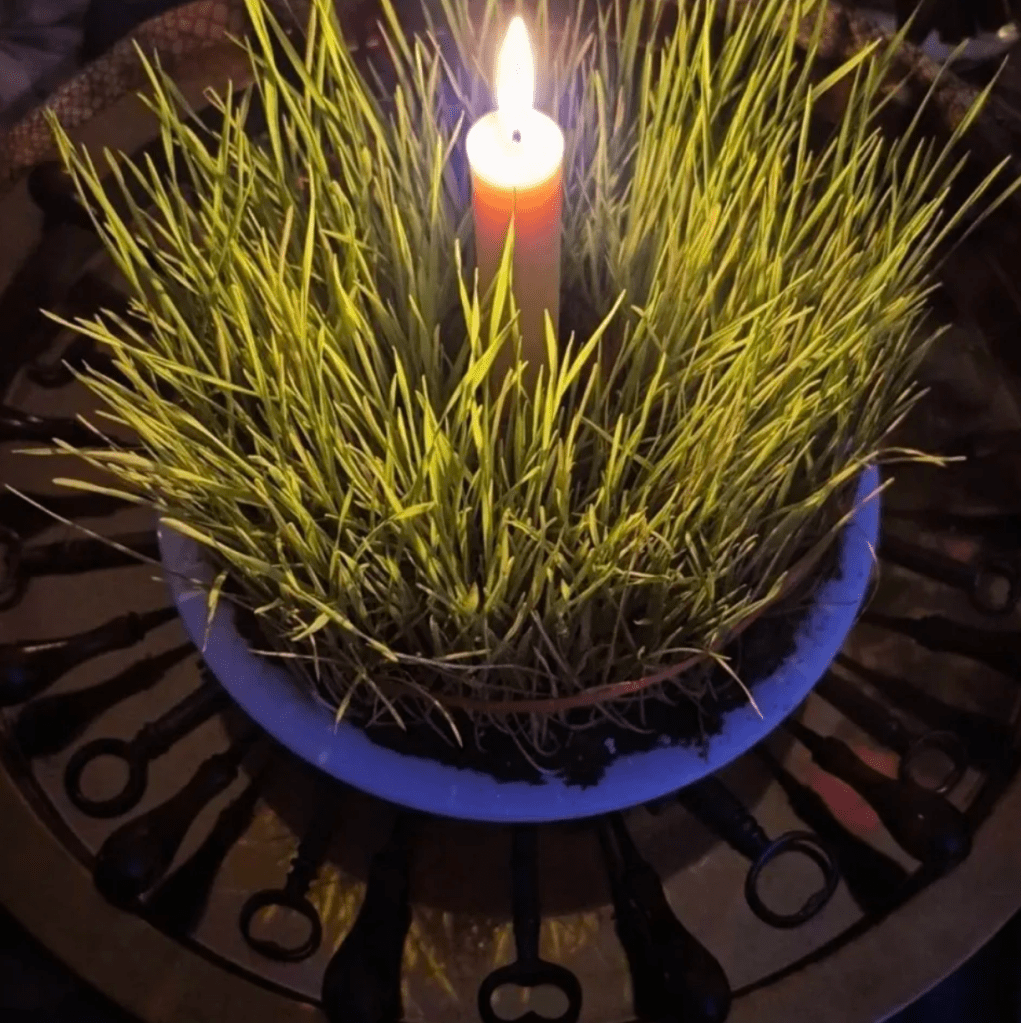
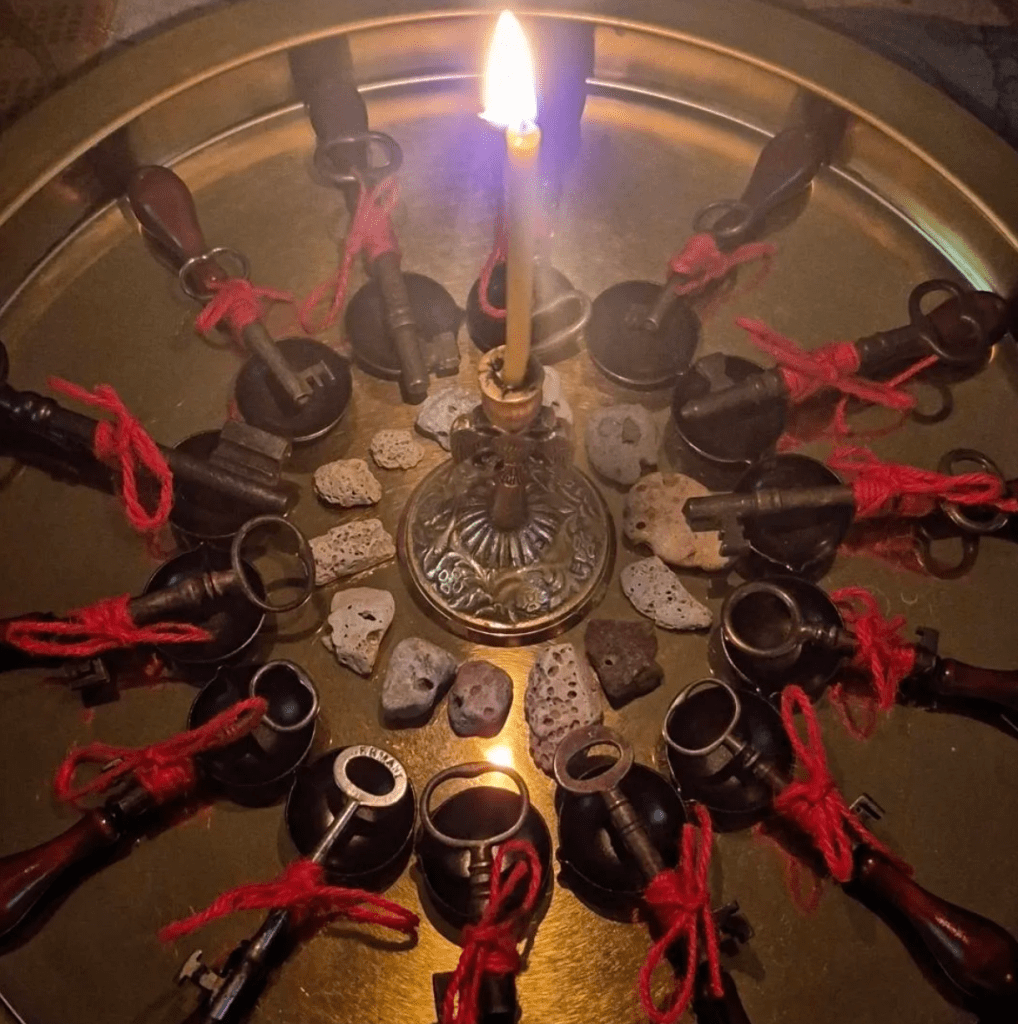
When I sowed my Christmas Wheat on Sveta Varvara, I set out the dishes before my spirits and asked them to lay their hands upon the germinating seeds, and bless them that as they grow and witness the return of the light, that so too may the instruments I had prepared similarly participate in this resurrection of insight, clarity, and oracular wisdom. The bundles themselves are composed of vintage skeleton keys bound to wax pouring spoons, such that beeswax candles can be melted directly into the spoons and then poured through the holes of the keys.
The light descends into the wheat.
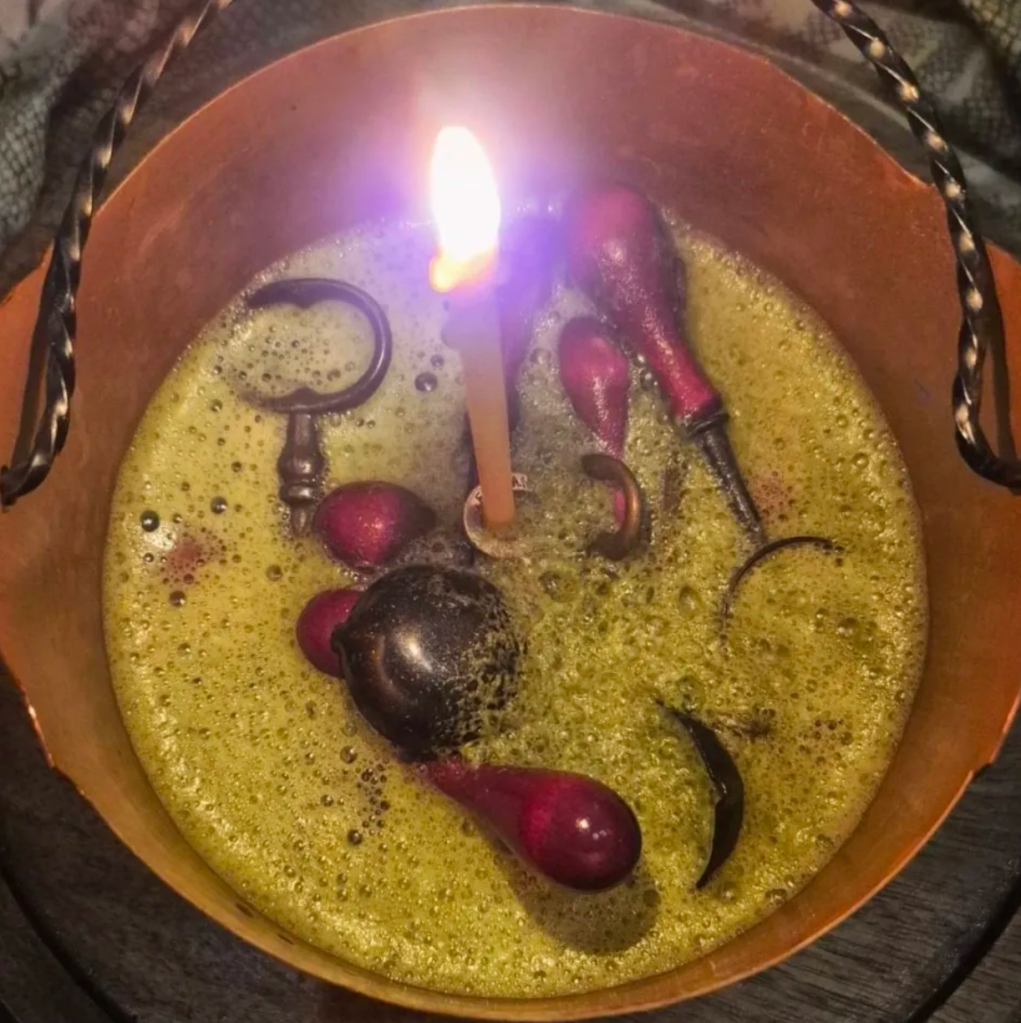
Each bundle was baptized in the four elements, being buried under the roots of an oracular tree, suffumigated in a personal divinatory incense blend, lit on fire using an alcoholic wash consecrated to Veles as god of divination, and then finally washed in a juice made of the very wheat grass they witnessed the growth of. The wheat was formally harvested on Christmas, after which they were each dried and tied with a red string as a new umbilical cord, binding each set and protecting them through the Unbaptized Days as a tether to the vibrancy and potency of life.
The keys and spoons bathing in freshly harvested wheat grass.
Once their consecrations were complete, the final step took place on Theophany (the Eastern church celebrates both the visitation of the three Magi and Jesus’ baptism at the hands of John the Baptist, so both of these events are celebrated on this day), at which point I performed the first ceromancy divination of the year using my own set. While ceromancy is usually performed with the wax dripping into water, on Theophany we use milk instead, so that the first “cast” is obscured to us visually fully behind the caul, needing to be retrieved in order to be fully witnessed. The shape that formed was that of a clothes iron, providing the final blessing needed for the other bundles and confirming their completion.
Each set bound and ready.
To perform ceromancy, prepare a vessel of water (ideally copper, though in truth any bowl will do) and light a beeswax candle. With the tools in hand, present them to your house spirit, or alternatively the primary spirit or force that protects your home, by witnessing the flame of the candle through each “hole” in the bows that form the knot tying the key and spoon together. Offer a prayer to your spirit that you bear witness to them through the red cord of life, and that as you untie the loose knot, you dedicate these implements to the betterment of your relationship with them and your ability to further communicate with their legions in better service to the cult of hearth and home. Anoint the red thread with some of your saliva, and then untie the thread, tying it instead around any item, idol, figurine, or object that you associate with the spirit of your home. If you do not have such an object, tying it around the base of the candle holder you have lit will do. Scry the flame once more through the keyhole and exhale through its opening, inhaling afterwards and drawing the flame’s essence into your heart. When you are ready, hold the spoon so that you may drip wax from the candle into it, keeping it steady over the vessel of water. Once the spoon is full, tip it gently through the keyhole so that the was passes through in order to enter the bowl, whispering: “Come, little master, drink and consume.” You may repeat this several times until the wax has fully emptied.
Allow the wax to fully cool before removing it from the water. Scry the shape by observing its form and casting it shadow against the wall. Different traditions assign meanings to the shapes according to their lore; my own teachers taught me their attributions in the context of lead pouring divination (molybdomancy), with the same applying to wax. There are many guides and books available out there, and I encourage folks to slowly journal down their own experiences and ciphers as they explore this art as well. Above all, experiment! Keep your wax shape and incorporate it into charms. Perform this rite with your house spirit at the equinoxes and solstices, or the important turnings of the year in your tradition such as key saint days and liturgical feasts. Make your set truly your own and use it for diagnostic purposes, to draw out illnesses and dispose of water and wax alike, or confer blessings through sipping the water and incorporating the wax into other workings as a charm or ingredient. When not in use, you may keep these by your house spirit or any other primary divining force in the cloth bag in which they come, or otherwise wrapped in fabric.
All bundles have been sold as of February 2, 2026. Thank you so much for your patronage!
All bundles will be shipped within a week of purchase. Thank you so much for your support! It is my dearest hope that these will assist you in your oracular and charming practices.
Once again, Key and I are so incredibly grateful for your generous support of our Nikoljdan community ritual. We were once again able to raise $2000 for our Cabula through the combined efforts of our Esteemed Initiate tier on Patreon and those who contributed directly through the blog. Thank you all so very much!
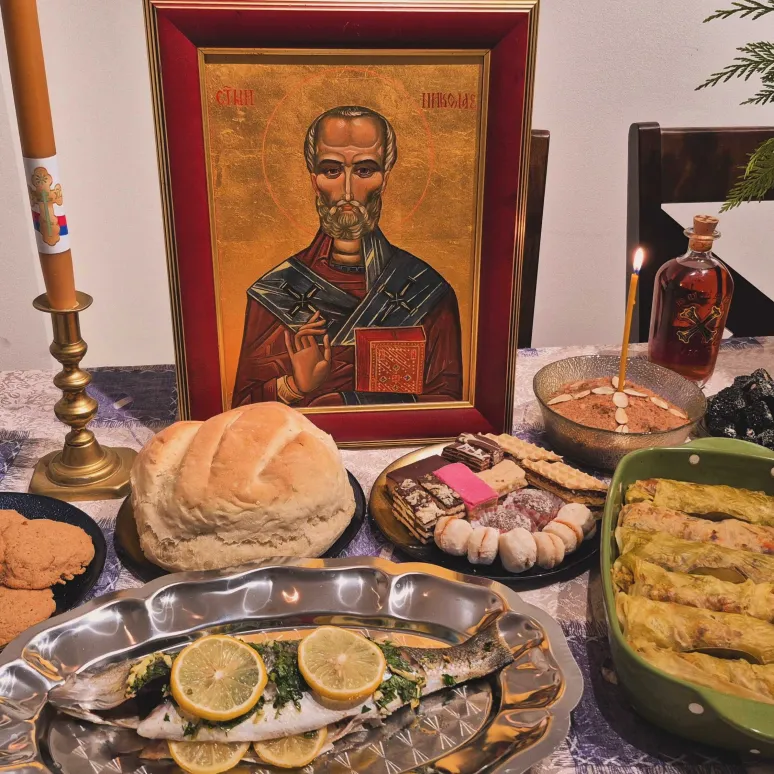
Here’s a brief recap of the workings as we completed them. Key and I began by throwing a small slava for Sveti Nikola in my home, inviting friends and family to visit and participate. From the early morning, we were up and baking bread, cooking sarma, preparing the fish, and baking Dutch pepernoten cookies. We prepared a small selection of traditional slava cakes and biscuits, as well as an apple strudel, and created small plates containing servings of each dish for the ancestors, protector spirits, land spirits, and spirits of the door and threshold. Having lit the slava candle, we offered prayers, veneration, and oral charms unto St. Nicholas as wayfarer of the paths to fortune, stability, and prosperity.
The table for the slava is set.
Just a couple days prior, on the 17th of December, I also celebrated Sveta Varvara (St. Barbara). As per tradition, I sowed wheat seeds to grow my Christmas wheat that I will trim on January 7th, and cooked a traditional meal of grains called a varica. This year, I opted for a sweeter version, consisting of wheat, corn, barley, honey, chopped walnuts, sliced walnuts, and raisins. “Varvarica vari a Savica ladi a Nikolica kusa” (Barbara cooks, Sava cools, Nikola tastes) is a saying encompassing the practices of this trinity of days, cooking the varica on Barbara, cooling it in the fridge for a full day during Sabbas the Sanctified, and finally consuming it with your family on Nicholas’ day. Several sorcerous projects were begun on her feast, and the varica, having been blessed for fertility and prosperity, was served on Nikoljdan and enjoyed by all present.
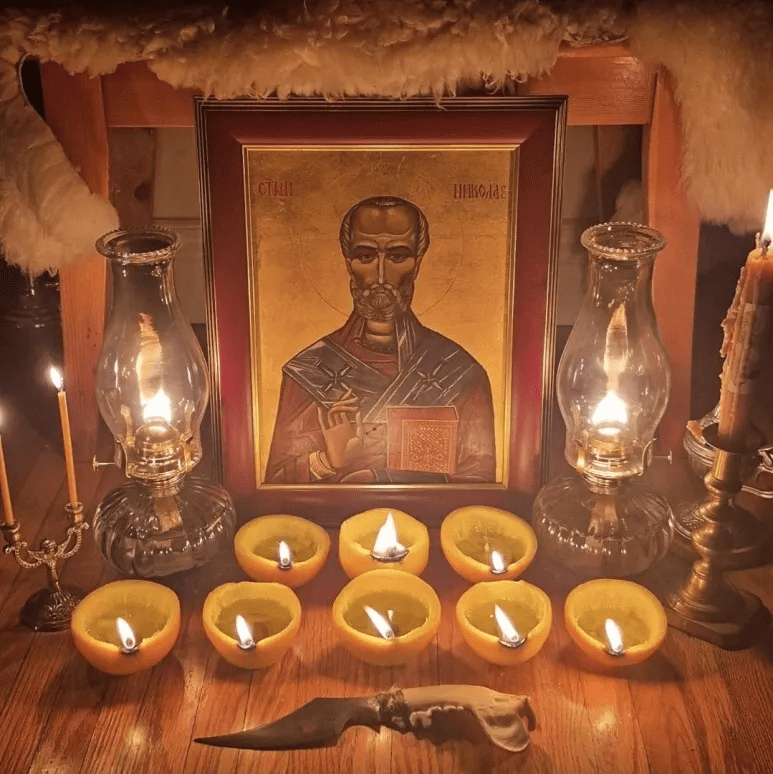
The lamps prepared and presented. The left-handed lamp manifested the omen we were looking for: the buildup of soot along its rim.
Once our guests had returned home, we set off to do our work on behalf of all patrons and named parties. Key and I prepared two oil lamps of St. Nicholas, one for the saint in his right-handed guise, and another for him as Devil, as Veles, as Master of the Wolves.
The right-handed lamp was built in several stages: for the first stage, the vessel of the lamp itself was prepared with an herbal wash, smoked out with incense, and lit on fire with some Florida water. Next, a little bit of the oil went in along with a wooden cross that was carved and blessed for the day, as well as crumbs from the slava bread baked that day and the full petition of names. Following this, we added our base of resins, including several kinds of Orthodox incense blends as well as frankincense, myrrh, Three Kings, and more. Key then took the grave dirt of nine different bishops to confer the blessings of those spirits unto the work. He also expressed some of the orange oil, harvested directly from the oranges we prepared as daughter-lamps, through a flame in order to consecrate it as the descent of the Holy Spirit into the lamp. Key then added a gold coin into the lamp as well as much more orange peel to code it for money, and then finished the lamp with a crown of rosemary.
For the left-handed lamp, every ingredient that went into the base was covered in charcoal and ash to “blacken” it with soot. The lamp itself was built over a black Joker card, specifically one chosen because it depicted the Joker riding a horse. This image coded the work both to the lore of the black Joker as a devil in a deck of playing cards, as well as calling upon his steed, which for our purposes also includes St. Nicholas’ boat. Additionally, in much of Dutch folklore surrounding St. Nicholas, the saint is depicted as riding a horse, or at least travelling alongside one. After each ingredient was added, pieces of coal were also put into the lamp, as well as pieces of tobacco from a cigar that fumigated the lamp, myrrh, and dirt gathered from the graves of 21 soldiers. Key then shotgunned a cigar into the lamp, shaking the vessel until the smoke infused into the oil, turning it grey. Sulphur, gunpowder, vetiver, and a final gold coin completed the work, built over the volatility and explosive nature of its ingredients, and handled carefully to bust open blocks, open roads, and ignite the raw power of luck in each named party’s life.
A pinch of the materia from both lamps, along with crumbs from the slava bread, then went into eight orange lamps which which were ritually born of their parents, and distributed to different crossroads to safely burn amidst the winter snow. A final pair of orange lamps, the youngest twins of the nest, were then taken to a nearby lake and left to float along the surface, carrying out the petitions crafted into the arms of the watery spirits that accompany St. Nicholas in both Balkan and Dutch lore. We completed the rite by offering one final battery of prayers to the saint, praising him for his potency and once more requesting that he open the roads to luck, fortune, prosperity, wealth, and new opportunities and horizons for everyone named. We are so grateful to each and every one of you who contributed! All proceeds from the rite are reserved for our Cabula as part of the charity of this working.
Dearest Karcists! It’s hard to believe that it’s already been a year since we last announced our St. Nicholas’ Day group working. We were incredibly touched by the success of last year’s St. Nicholas’ Day Candle Service, which allowed Key and I (Sfinga) to raise over $2000 USD for our Cabula as part of a winter fundraiser. This year, we’ve decided to continue in our newfound tradition of December Nikoljdan (the Serbian Orthodox feast of St. Nicholas on the 19th of December) workings and open up this opportunity again into an even more involved community rite. As the winter grows and the days approach the longest night, we intend to take up the banner of Sveti Nikola once more and build on this opportunity to instantiate a yearly tradition of workings by our hands for the community—both in magic and in proceeds.
By donating to this group rite, your name (or the name of a loved one—please contact us if you would like the name to be different from that which appears on the PayPal receipt) will be dressed in two different petitions: a ritual of fortune, levity, and joy from myself, Sfinga, and a ritual for road opening, insight, and wisdom from B. Key. The goals are closely aligned with the previous year’s rite, and they will likely keep these themes going forward throughout the years with some changes determined by divination, albeit the methodologies will vary in the spirit of St. Nicholas’ many traditions. This year, we will be working primarily with by the light of the sorcerous lamp, calling on the saint as both navigator amidst the stormy seas and devil perched on the perilous cliffs.
Key and I will once more draw on our familiarity of St. Nicholas veneration from the Serbian and Dutch folk traditions. Last year’s working was a candle service, and this year candles will only be one part of a greater whole, in which we will construct two complex oil lamps (one for the saint and one for the devil, as is tradition) with each name given directly to the herbal matter within. From these two mothers we will create many daughter-lamps which we will complete the feast with by floating them out into the lake to light the voyage for each named party’s prosperity, success, luck, and cunning insight into future possibilities in the new year. We will also prepare a feast for the saint and all the spirits that walk with him. In addition to a medley of Serbian and Dutch foods, a slava bread will also be prepared, whose crumbs, along with Thursday salt and a prosperity powder, will be added to the daughter-lamps we will float into the waters before midnight. We’re looking to double the offerings and double the effort for this year, and continue the momentum ever forward in love, honour, and gratitude to all the communities that have nourished us and whom we hope to continue nourishing in return!
This time will also mark the beginning of a series of workings on Sveta Varvara (the 17th of December on the Old Calendar for St. Barbara), linking the trinity of successive days of 17th (Varvara), 18th (Sava Osvećeni), and 19th (Nikola) for the growing of Christmas wheat and oracular power. Several charms will grow out of these workings which we will keep you updated on, including an exciting collaboration we’ll be able to speak more on in the new year.
A blog post containing pictures and our reflections on the ritual will go live in the days following the feast so that all who participated may have a record of its completion. The rite will be performed on the 19th of December.
If you would like to submit your name for this working, please use the link below. Subscribers to our Esteemed Initiate tier on Patreon are automatically entered into this rite at a discount as part of their monthly group ritual service.
All proceeds will go directly to our Cabula, as was the case last year, in the spirit of the Winter holidays. As always, we hope that this intersection of our traditions and communities serves you well in your New Year’s petitions and plans, and provides an ample boost to all you seek to grow and harvest in the coming months!
Thank you for participating in this year’s rite! A follow up post will be made available in the coming days.
After many months of prayer, supplication, and consecration, these charms, born of the fiery hands of Sts. George and Vitus, are at last available.
I’ve teased the mention of these for some time both on the podcast and on our official Discord server for our Patreon supporters, but the origin of these vigilant eyes began early in April of this year, when I first began to flesh out the shape of what my yearly offering to St. George would involve. While not always resulting in a public charm to share with the world, this practice has been one that has helped mark the triumph of the spring and summer seasons through the auspices of St. George, Jarilo, and all the spirits that follow under his red banner. This year, the thematic motif elected through divination was that of St. George’s lance, specifically in its capability to blot out that most difficult and tenacious foe: the consuming voyeurism of the evil eye. So when my great friend Vanessa of the illustrious Sword + Scythe informed me that she was working on a charm for St. George’s lance as well, I was absolutely over the moon.
We spent the “George season” of his Catholic to Orthodox feasts workshopping what a collaboration in honour of this mighty saint might look like. Divination revealed that my own charms would require a base of three different powders, each prepared at a different point of the season between Đurđevdan (St. George’s Day) on May 6th and Vidovdan (St. Vitus’ Day) on June 28th—a time period associated with the vanishing of the Pleiades from the night sky so that those seven sisters (or brothers) may consult with the Mothers of the Sun, Moon, and Winds respectively. The first would be a powder of St. George’s lance, born of herbs traditionally harvested on his day for vigour, stamina, potency, and protection, united under the image of his spear to seek out, identify, and neutralize the evil eye. Born, fed, and sealed on his day, this was the same powder I mailed Vanessa to include under each garnet faceted in their gorgeous sterling silver necklace charms.
Slava bread made on Vidovdan presented to my icon corner.
The second was a St. Vitus powder created and fed on Vidovdan from traditional herbs and materia under his watchful gaze, birthed to lend these charms the ability to detect, identify, and anticipate sources of malefica, Evil Eye, intrusive scrying, and magical attack. I offered and prepared a full meal to the saint including fish, projara, ajvar, olives, cheese, a slavski kolač, and many more offerings as part of this work. The kolač itself would become an integral part of the charms to come, as each charm bag includes three dried squares of this bread to represent the Father, Son, and Holy Spirit (as well as George, Vitus, and the Mother of the Moon as a folkloric figure invoked in this work).
The third is an anti-evil eye powder to anticipate, nullify, and deflect three traditional sources of the eye: jealousy, awe/admiration, and spite. This formula was born out of several recipes and herb lists I collected across Croatia and Serbia, which were then confirmed and added to through divination. A brief list of some of the most vocal allies that went into its creation include: blackthorn, hawthorn, garlic, red pepper, fulgurite, salt, hyssop, dogwood, wheat, mica from a prominent witch mountain, yew, rosemary, valerian, fur of a black wolf, ground pearl, and much more. Additionally, powders I created with the instructions of my mentors in Balkan witchcraft for the Pleiades, the Mother of the Moon, and the Forest Mother were also included in this dust to further augment its virtues to the task at hand.
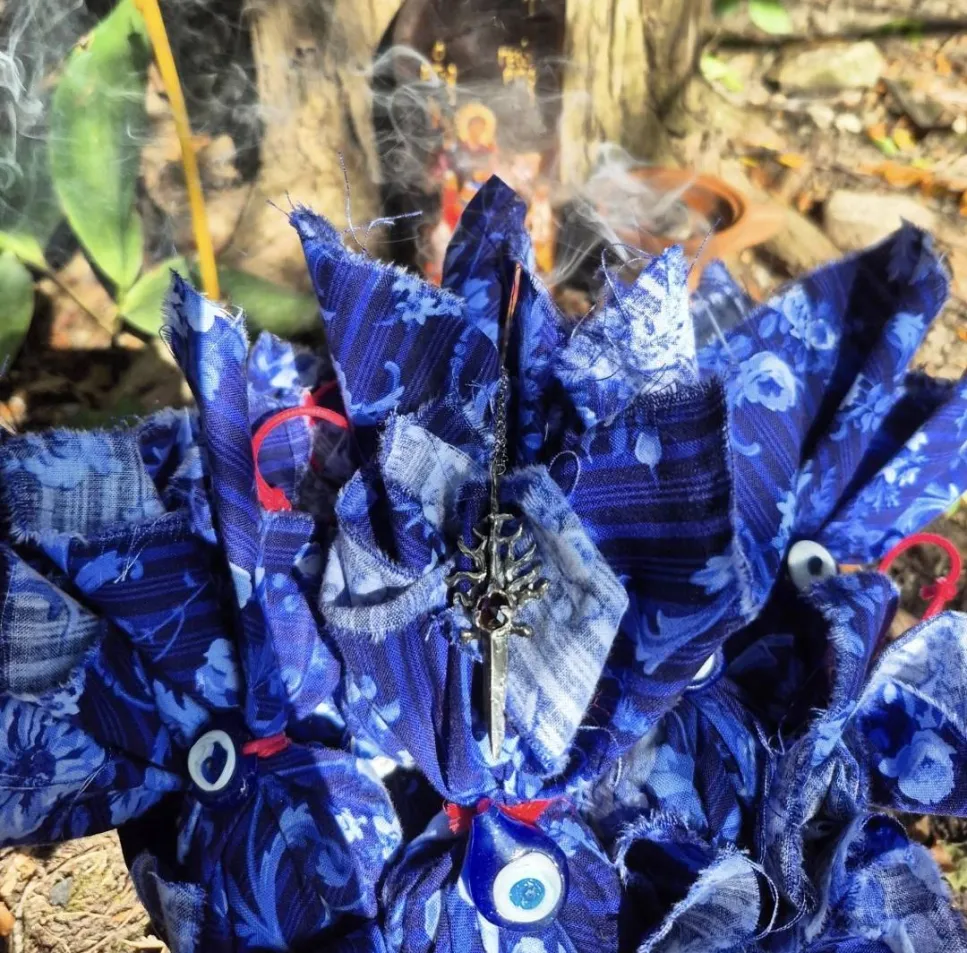
Each charm was tied up in cloth with red thread anointed in an anti-evil eye oil, and adorned with a glass nazar bead washed in seven holy waters sourced from sites of power in the Balkans, to watch for gossip, lies, threats, possessiveness (over one’s own work and spirits), and jealousy. I am immensely proud of these and have already given some out as gifts to close friends to test their abilities to great effect. The red threads are tied in a loop so that they may be hung in one’s home, facing the door or a prominent window of one’s choosing, so that their burning eye may blot out the venom of adversaries and intrusions with the might of St. George’s own spear.
The charms writhing beneath my tree of St. George.
Vanessa expertly made their own charms in the spirit of St. George’s immense ability to protect the weak and deliver decisive action in the face of danger. In addition to housing my powder, their charms include garnets that were prayed over on his Catholic feast day, washed with holy water, and placed with a St. George relic medal until they were set into the beautiful lances. I have been wearing mine faithfully in devotion to him and have already noticed its benefit as a protective amulet, especially in its precision and virility.
Vanessa’s photograph of our charms together.
I am immensely proud of our work together as the first of many other collaborations to come! Three dozen are available for sale below. Hang them above your doors and windows, or situate them to watch over where you sleep or work. These are slightly larger charm bags made to be hung in the home, in the car, or wherever the Eye’s consuming gaze watches you most. Vanessa has seven of their excellent charms available on their website available [here].
Sts. George and Vitus’ Charms Against the Evil Eye
One charm bag for voracious, proactive protection against all maladies the Evil Eye may bring. Shipping included.
After a full month of gathering, conjuration, and consecration, I am deeply pleased to unveil a new offering in the holy name of Sveti Haralampije, or St. Charalambos—the beloved saint known in the Serbian folk tradition as the Gospodar Svih Bolesti, or “Lord of All Diseases.” Here is a saint so beloved and revered for his capacity to heal any and all ailments that his very feast, celebrated February 10th or 23rd depending on the calendar, is understood to be a last chance to ward off the Čuma, a spirit of disease and illness sometimes said to be the wrathful form of the folk saint Bibi, who is her kinder, protective face when placated appropriately. The Balkan traditions vary on which saint’s day is the true feast upon which the Čuma is propitiated, with Čumindan being for the majority of Serbia Sveti Atanasije, whose feast at the end of January aligns with one of the most common dates that Bibi herself is honoured. It is during this period, right before Sretenje or Old Candlemas, that various rituals are performed to placate her wrath so that she does not become the “right hand of the Devil” and lay waste upon our settlements in her black-cloaked form as wandering witch.
It was on St. Athanasius’ day that this work began, then, with the preliminary offerings given unto Čuma and Bibi in both guises: shoes so that she may walk freely, a walnut comb so that she may brush her hair, a mirror so that she may see herself, and various sweets that she may refresh herself. According to folk tradition, by showing her this kindness and welcoming her as a house guest, as opposed to denying her entry and sustenance, her wrath is cooled, and she instead enters as an aunt and ally, softened by the hospitality. Much of Balkan folk magic, of course, involves the naming of familial pacts, such that even troublesome spirits are given their valued role within the clan structure. As Čuma is given her kindness, so too is she implored to pass over us and return that kindness by sparing us from her hordes of plague witches.
These blessings were built upon through the important holy day of Sretenje (Candlemas), finally leading into Charalambos’ day proper. The Lord of All Diseases is likewise given as one of the candidate dates of Čumindan in other parts of the Balkans—though more importantly this, for some villages, is the true end of the Wolf Days (the winter season beginning in early November), and the last opportunity to thank and herald the Master of the Wolves. It is on his day that the serpents below begin to burrow their way ever closer to the surface of the light, stirred by Old Candlemas and drawn towards the first Saturday of Great Lent, Todorova Subota or Hroma Subota (Theodore’s Saturday or Lame Saturday), in which Veliki Todor and his todorci riders embark on their nightly procession.
St. Charalambos is particularly notable for having lived to 113 years old. He was brutally martyred despite his age, lacerated with iron hooks and flayed alive, his only response to his torturers being: “Thank you, my brethren, for scraping off the old body and renewing my soul for new and eternal life.” It should come as no surprise, then, that St. Charalambos is deeply linked to serpent power within the folk tradition, as is any saint who was flayed; his ecstasies being inherently intertwined with the healing potency of shedding the skin.
In addition to being a powerful healer, he is also the patron saint of apiaries and beekeepers, precisely because he was able to heal others with honey. A jar of honey was sanctified in his name on his feast, during which he was also honoured with freshly baked bread, and the honey from within was used to mark my front door as well as each icon of him that I possess, in honour of his power and in memory of his pact with Čuma.
It was this bread and honey that laid the groundwork for the charms I created with him. From the period of his feast to Todorova Subota, I continuously prayed to the retinue of wolf and serpent spirits to which he belongs, gathering the necessary herbs and preparing the sorcerous powders that would go within these charms. In addition to propitiating Veliki Todor with sacrifice, I continually kept my shrine to the Master of the Wolves in illumination throughout, reminding him through prayer and offering of the ledger of deeds and boons made good on. Throughout this process, I continually prayed for the petition to be allowed to create a set of charms under his auspices for the healing of disease and the prevention of illness, by way of creating mobile, portable satellites of this pact between the martyr and Čuma for others to benefit from.
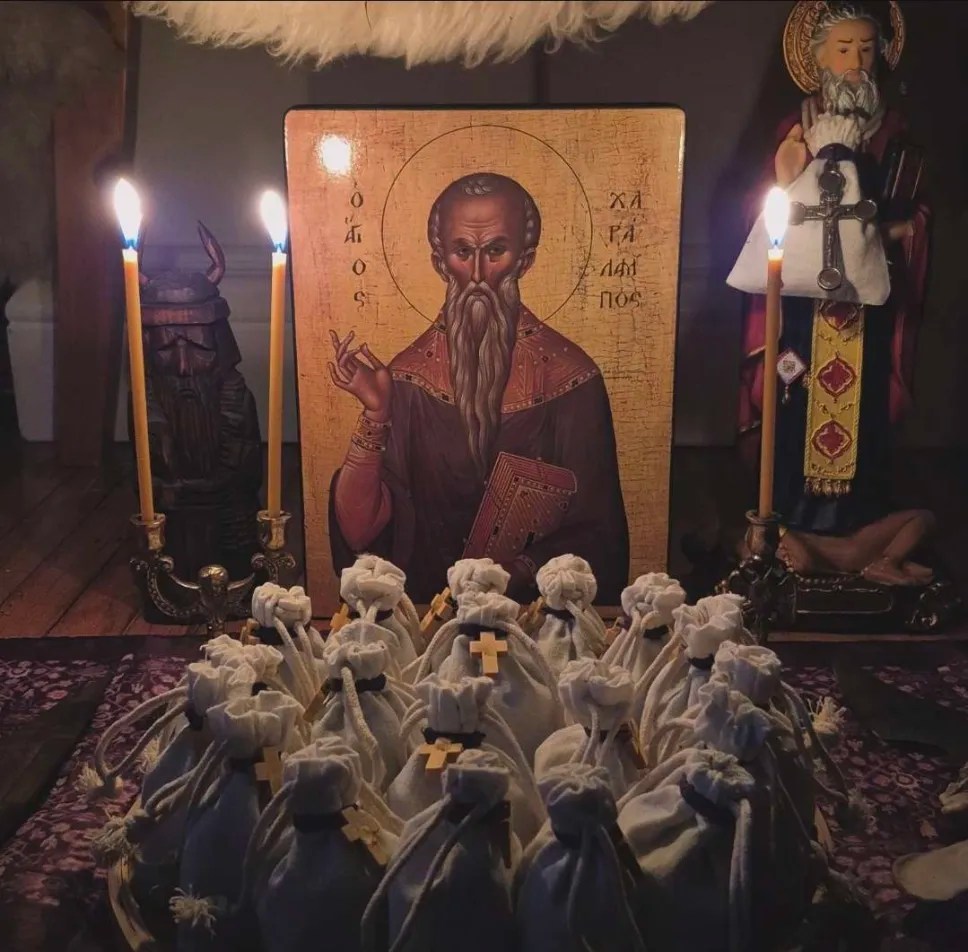
When the time finally came to create these, and the requisite omens were revealed, I prepared a set of cotton muslin drawstring bags, suffumigating them with myrrh and anointing them with holy water gathered from a well sacred to St. Charalambos. The bread specially baked for and offered on his feast was divided into equal parts and placed within each bag as a promise of the fulfillment of its magic. Rosemar, thyme, basil, lemon balm, wormwood, broadleaf plantain, eyebright, and many additional herbs picked for their virtues in healing different parts of the body were wrapped around this bread, to which were also divided the full 41 beans used in divination to approve of the recipe and enchantment and a generous helping of specially-made Thursday Salt. In addition to several powders sourced from my own recipes and study, attuned to different deities and fixed stars relevant for this working, I also prepared for each bag one small reflective mirror that was anointed with the honey consecrated on his feast. Each mirror was presented before Čuma, reminding her that whomever carries this bag upon their person has paid her their due and has called her “Aunt”—meaning that as they are family, so too must she treat them kindly and spare them.
To verify that these pacts were confirmed, a specific physical omen was demanded of every single mirror, with no charm being complete without its verified appearance. Key, who was present for the making of these charms, was my secondary witness—we both had to agree that we witnessed the physical manifestation before continuing. The design of these charm bags are intentionally plainer and more subtle than many of my other offerings, so that they may be carried easily on one’s person as an ordinary Christian amulet that one could easily suggest was purchased from a monastery gift shop. My wish is for these to be kept in one’s purse or shoulder bag without any anxiety as to what others would think or feel if they were discovered.
The completed charms before his icon.
Finally, a cumulative offering was given unto Čuma in her guise as Bibi, with candy, mirrors, money, bread, and honey placed before her alongside a walnut comb in memory of her pact. After reciting a lengthy prayer in her honour, she was reminded that each mirror within the charms was given the same honey sweetening her tongue now in St. Charalambos’ cooperation and care, and as such the charms carry, independently of me as their maker, the same blessing and safety my pact with her generates for me. Key and I tied little wooden crosses to each bag using purple thread and oral charms, completing the consecration by extinguishing one beeswax candle’s flame into each cross before relighting it again to instill the spirit fully within. In this way, each cross has already suffered once in the place of its owner—just as we say that lightning does not strike the nettles (“neće grom u koprive” in Serbian, “wo Brennnesseln stehen, schlug der Blitz nicht ein” in German), for nettle already stings as lightning does—so too do many of our rituals involve putting out controlled fire first on the tongue or into the wood of the home so that we are already “bitten” once, and therefore cannot be again by accidents and tempests. Through calling on Christ’s resurrection, each charm was fully imbued and reminded of their pact; that they have already paid their toll to the spirits of disease, and that they have already suffered a blight once. In this way, their conjuration is complete, through the settlement of their virtues and the honouring of their place as wards against all disease and illness, and the swift curing of any aches, pains, and viruses that may come with time.
Carry these on you for protection and to cure ailments. These charms are fully self sufficient and do not need any upkeep, but praying to them, holding them between the hands and above the afflicted area of the body, and anointing the cross with holy oil once a month is always welcome. Pray for continued safety and protection against all blights, in the name of St. Charalambos and Christ Eternal, and walk through the world with renewed confidence and peace.
Twenty of these charms were made under the auspices of St. Charalambos and his retinue, drawing on traditional Balkan folk magical techniques as well as personal innovations through spirit teachings. If you would like to purchase one or more for yourself or a loved one, the link is below and includes shipping. Please allow a week for orders to be fulfilled and shipped to the address provided via PayPal.
All charms have been sold as of March 27, 2025. Thank you so much for your patronage!
O, milosrdni mučeniče, moli se Gospodu za nas, da nas sačuva od gladi i svake bolesti, i da nam podari izobilje plodova zemaljskih, i umnoženje stoke potrebne ljudima i svega što nam je na korist a ponajviše da se udostojimo, molitvama tvojim, Carstva Nebeskog Hrista Boga našega, Kome priliči čast i poklonjenje, sa Bespočetnim Ocem Njegovim i Presvetim Duhom, sada i uvek i u vekove vekova.
As listeners of our podcast may have heard, I recently moved across the country, obtaining a brand new job and home at the beginning of the year. One of the joys of starting anew is the ability to witness first hand all your spirits settling in alongside you, scouting out the unfamiliar landscape, introducing themselves to its land spirits, and charting out the cartography of the many worlds which intersect across it. Since moving, my spirits have been constantly reporting to me their findings, leading me to walk and drive around exploring all manner of churches, crossroads, cemeteries, parks, forests, and trails off the beaten path to discover places of power, materia, and contact points for various beings. As much as I’m still very much putting my roots down, it goes without saying that my spirits have accomplished this far more quickly than I, taking to the new mountainous landscape with ease and excitement.
Yet as I’ve been getting set up, so too have all manner of other spirits been knocking at my newly-Christened door. Our latest episode, Cleansing the Home, was born out of this consideration: how to navigate routine spiritual hygiene for your dwelling space, as well as manage the ambient dead that will inevitably flow through it. With all the witchcraft that I get up to, many of my shrines behave as lighthouses for the dead, while others keep them far at bay, signaling danger and potential, devouring should any come close. As I’ve been constantly engaging with the dead of this new land in my waking and dreaming lives alike, I’ve found myself growing in my arsenal of techniques for how to care for them, nourish them, redirect them, and ultimately ward them away when it becomes necessary.
It is through these experiments that I’ve given birth to these charms. Constructed out of locally foraged grasses and brambles said to stave off the dead, dirts from cemetery gates, cemetery walls, church doors, and monuments dedicated to reclaiming space and territory previously lost, and numerous additional herbal and animal powders mixed into a matrix of black clay, these small, spherical talismans are meant to be carried on the person should one find themselves especially ghost-bothered, or alternatively hung up on a wall or placed on a shelf in the home where poltergeist activity is especially strong. These charms serve to turn away wayward, predatory, and fragmented dead, and to act as a sort of “vacuum”, neutralizing spiritual detritus and astral parasites. In addition to providing this protection, these charms also amplify the ability of your own spirits to manifest in the space left behind, ensuring that it is your allies going bump in the night, not strangers. In this way, these tools benefit your spirits by increasing their reach in your home, while keeping away unwanted visitors who may be lurking in hopes of catching a few crumbs off the plates of your familiars.
One of the charms, resting and receiving empowerment within a serpent-bone prayer rope and a rosary, each carrying prayers for and against the dead.
I’ve produced a larger batch of these and am making them available to sorcerers of every background to gift to their spirits, keep in their homes, or carry with them when out and about. These are especially useful for those prone to getting spirit sicknesses, who are sat upon heavily by the dead in general, or who work in places like hospitals, the funeral industry, or near and around cemeteries and places of frequent accidents. Take them with you to breathe easily in the chaos of it all, and hear your own spirits more clearly without the discordance.
It was a real joy to work on these and test them in real time until they passed every check and balance. I’m especially excited to share them with you all in anticipation of the Vernal Equinox!
All charms in the first batch have been sold out. Thank you!
All orders will ship via USPS with tracking within one week of being placed. Please note that due to the handmade nature of these charms and prevalence of natural materials within, there is some slight variation in size and shape. Thank you for your kind support!
At long last, here is an offering two and a half years in the making, born of discipline, love, veneration, and deep, sorcerous hunger. In the holy names of Saints Cyprian and Justina of Antioch, the magician and exorcist, warlock and virgin, theurge and mystic, the nail of command and the palm of cunning—here are a pair of tools for the discerning karcist following in the legacy of these mightiest of exemplars.
It is no secret that these blessed martyrs are some of my most intimate and long lasting patrons, with much of my personal and professional life being dedicated to the exploration and study of their mysteries. As I am presently wrapping up a crucial project I have undertaken in their honour, it felt right to finally put out into the world a pair of magical fetishes created in reflection and fulfillment of this very journey, from the very pilgrimage Key and I undertook which resulted in us being forever changed on Aphrodite’s shores, to the thousands upon thousands of prayers collected upon each gathering of knowledge and communion. Whether you’re a devoted follower of Sts. Cyprian and Justina looking to establish a deeper relationship with them, or a karcist looking to harness Cyprian’s authority over magic and Justina’s capacity to unmake its very fabric, this pairing is born of their mutual inseparability in power and wisdom. Drawing on my training and initiation into several forms of Balkan folk Orthodox cunning crafts and oral charming traditions, as well as personal study under Orthodox folk practitioners who venerate Sts. Cyprian and Justina, both the prayer rope and the horn charm were crafted with the aim of sharing some of the potent magics that went into all the adventure and training these saints have opened the roads to across my travels.
The Virgin’s Tears Prayer Rope
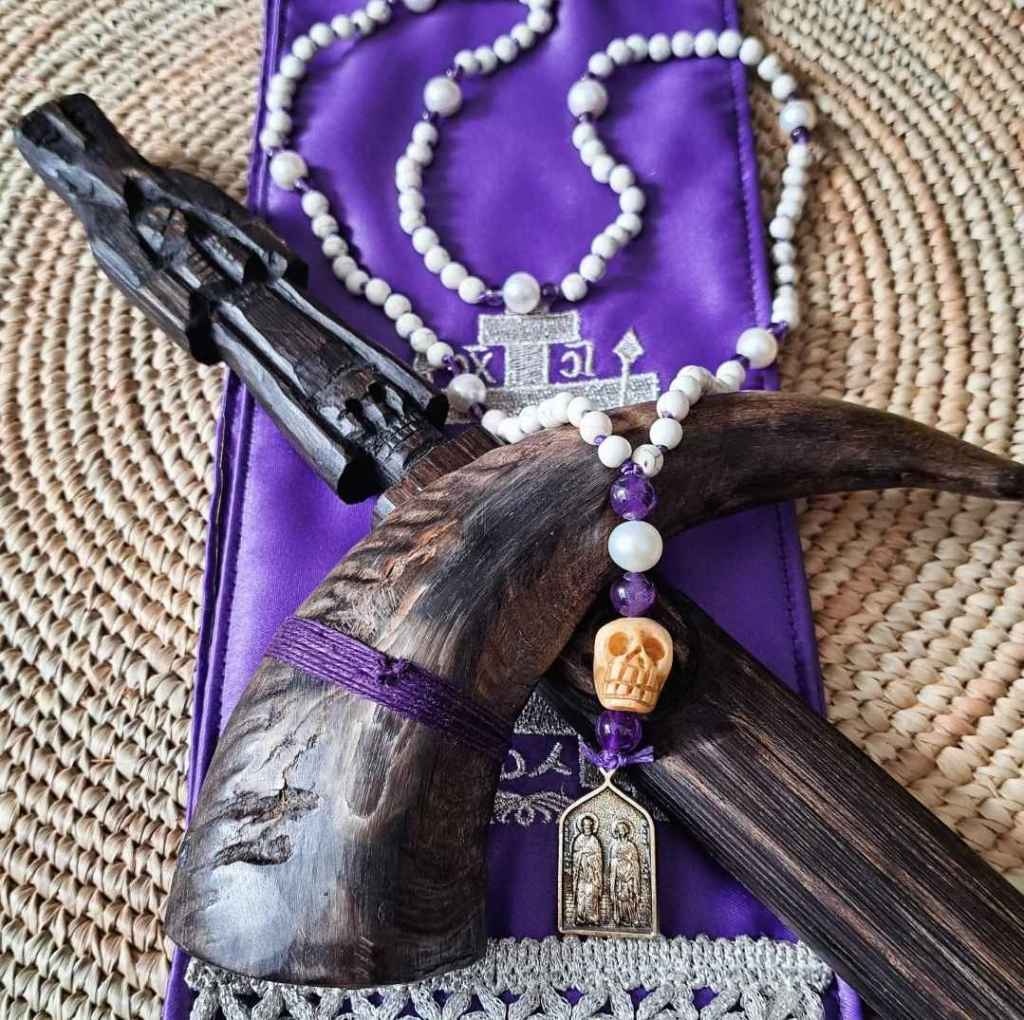
The prayer rope adorning a charm and consecrated chonta wood staff.
While Cyprian’s appeal among magicians may allow his fame to at times overshadow his counterpart, it is Justina’s power that ultimately vanquished him, her exorcisms that sent back his spirits in the Confessio Cypriani, and by her grace that he came to find his eventual sanctuary within the crimson gash of martyrdom and the gleaming crown of sainthood. The holy pair are ever inseparable within Orthodox iconography, always depicted together side by side in their proselytization; their charms, spells, oil recipes, and prayers tying their fates to each other, his salvation into her dexterous hands, and her mysteries within his sinistral embrace.
This Orthodox style prayer rope was crafted in the aim of venerating the pair through the access point of St. Justina’s all-conquering prayers. An overtly Christian tool, it is designed with the Orthodox prayer rope in mind, albeit with the spacers featuring in such a way that it could be easily adopted to the use of the Catholic rosary. The main beads are howlites, woven between knots of purple (the bishop’s colour), each anointed with holy oil gathered from The Holy Monastery of Saints Cyprian and Justina in Fili, Greece. Large, authentic freshwater pearls—memories of Justina’s purity, vanquishing tears, and a marker of certain Balkan folk Orthodox mysteries relating to her magic—form the spacers, washed in holy water gathered from the font in the Church of Saints Cyprian and Justina in Meniko, Cyprus. Both churches were visited during their Orthodox feast days (on the different old and revised Julian calendars, allowing for them to be attended in the same month), and as such the materia was gathered during their very masses. Each pearl is also nestled between amethysts fed a black rooster on the Catholic feast, empowering them with the sacrifice of martyrdom and a calling out to Cyprian’s famed sorcery. The rope connects through a bone skull, itself anointed in an oil of sorcerous insight, the recipe given to me by a Croatian folk practitioner who works primarily with the two saints, and terminates in a small icon also purchased in Greece.
Woven together under the auspices of the virgin, this prayer rope is consecrated for the binding and elevation of spirits. Consecrated primarily through St. Justina’s purity and power, with flashes of St. Cyprian’s cunning woven throughout in the reddened amethysts, this tool channels the saints in their ability to tame, command, and civilize spirits, as well as in Justina’s capacity to break all enchantments. It is suitable for any and all prayers, including liturgies to the holy pair (as well as any other intercessory spirit, Christian or otherwise), the counting of mantras, and the building of power. It may be draped over candles, activated spell remnants, and the vessels of spirits to impose your petitions, increase the potency of workings, or to break a particular curse, crossed condition, or evil eye over an object belonging to or picture of a victim.
These prayer ropes are especially adept at removing the magic other sorcerers have cast. Simply uttering the Jesus Prayer over each bead, placing it over a glass of water and a white candle anointed with holy oil, and then consuming the water once the candle is burnt is enough to cleanse off most enchantments. If you feel the persistent snag of an evil eye or jealous gaze, or would like additional protection when venturing into the public, you may wrap the prayer rope around your left hand (the traditional way of carrying them when not being used) or wear it over your head as a necklace. When dabbling with infernal spirits, the restless dead, and those beings for whom vampirism is a primary nature, call on St. Justina’s aid and place the rope over your head to bestow her pearlescent caul of protection over you. The clever karcist will find many ways to drape this tool over goetic vessels, the sigils of disagreeable spirits, and dirt and materia collected from places of great violence in order to make their spirits hospitable to their commands.
There are nine available for purchase, either individually or as part of the bundle below.
All prayer ropes have sold out!
The Sorcerer’s Goat Horn Fetish
Twelve horns for the twelve disciples of Christ and the twelve students of the Black School, the thirteenth laid before the feet of St. Cyprian.
Just as the ropes were consecrated primarily through St. Justina, with flashes and empowerments laid by her companion, here their roles exchange in the creation of twelve horn fetishes. Each goat horn is filled with a matrix that has been worked on for three consecutive years of veneration, with the middle year being when the masses were attended in their monasteries in the Mediterranean. While the full list cannot be revealed, a small sample of the materia included are: dirt from three churches dedicated to Cyprian and Justina from three different countries, dirt from nine churches visited over the nine days of the Cyprians (the novena between Cyprian of Carthage and Cyprian of Antioch’s Catholic feasts), dirt from nine cemetery gates, dirt from nine priests, dirt from nine nuns, dirt from nine bishops, dirt from the grave of a dead sorcerer who worked with St. Cyprian in life, black rooster, black cat, black toad, serpent and goat materia, tears collected from their enshrined icons within an Orthodox church dedicated to them, horseshoe nails dipped in oils dedicated to Cyprian’s sorcery, an entire burnt Livro de São Cipriano, the same amethysts and pearls featured on the prayer rope, and much more.
Each portion was prayed over, offered to, and judiciously enchanted over countless nights, receiving a final consecration on Orthodox Epiphany of this year. While the base prayers and manners of conjuration were carried out in a folk Orthodox manner, these horns draw on a wide breath of Cyprianic study across traditions, including the Spanish and Portuguese Ciprianillos, Norwegian prayers from the Svartkonstböcker, and the saint’s presence in my lineage of Quimbanda. With each step requiring multiple passes in divination to be approved, these charms are some of the more complex that I’ve worked on, and it is a true pride and joy to share them. The horn shape and casing of black beeswax, pearl, and nazar beads were taken in inspiration from patuá technology, and while these charms are not themselves patuá strictly, they invoke my training in their creation as a part of my dedication to expressing my care for these saints in all the traditions that I know them in. Just as the amethysts flag Cyprian in the prayer ropes, the Nazars and pearls flag Justina here, always calling one with the other in each incarnation.
These fetishes are exceptionally versatile. Ultimately, they are consecrated for the purpose of opening roads into spiritual and sorcerous initiation—to bring their owners closer to new opportunities of study, meeting with potential mentors across traditions, the opening of roads to hidden opportunities for magical training, and the ability to travel widely in pursuit of wisdom. Inside each horn is a physical testimony to the studies I was able to undertake through the blessing and permission of many mentors across countries and cultural settings. Drawing on the legend of St. Cyprian as the chief exemplar of a Mediterranean sorcerer, who had sampled the offerings of countless mystery schools and lineages, these horns are made in dedication to Cyprian the eternal student of theurgy and thaumaturgy. On their own, even without direct use, they work to expand your network of reliable and competent contacts for the gathering of knowledge, resources, rare materia, affordable travel, and channels of communication. Simply speak your intentions into the open face where the Nazar lies and place it down by a shot of liquor (whiskey, gin, and brandy preferred) and a candle (white, red, or purple preferred if not beeswax) once a month to nourish its passive road opening, or increase it manyfold by making this offering daily and praying.
Additionally, the charms may be placed by your shrine to the saints to empower their presence, held to your mouth like a speaker to command spirits—or relay messages to the minds and dreams of others while enchanting them in ceremony—used as a wand when held point forward, and placed over other workings to empower them ever further under the auspices of St. Cyprian. While their passive benefit already is one which pierces the threads of fate to continually gather initiatory experiences, knowledge, and opportunities to you, the manner in which they may be actively engaged with in sorcery are fairly limitless. The dirt of the sorcerer who once worked with St. Cyprian within the horn acts as the “master” of all the nuns, priests, and bishops within, creating a choir that prays with and for your magical success in all your tasks. Speak into its mouth freely and allow the tears of Cyprian and Justina to shield, bolster, and purify your commands, straightening your wording and hesitation and projecting forth the ultimate authority in your workings. Even if you may swallow your tongue or stutter an utterance, the holy and sorcerous dead within will join you in their ceaseless prayer, maximizing your efforts and bolstering each petition to further compound their manifestation into reality. You do not need to be a devotee of Sts. Cyprian and Justina to work with these horns; they will lend their power to any who possess them—as well as the boldness to carve out a more potent, adventurous, and magically vibrant life.
There are nine available for purchase, each individually or as a part of the bundle below.
The prayer rope and horn together before the saints.
All goat-horns are now sold. Thank you so much for your support!
In the name of the holy martyrs Cyprian and Justina of Antioch, swift helpers of all who approach them, guide us and protect us against all enemies visible and invisible, grant us the power to resist our temptations, and in the hour of our end be our aid and lead us to victory so that we may be honoured and celebrated amongst the saints, unto the ages of ages. Amen.
On behalf of Key and myself, we truly cannot thank you all enough for your overwhelming support of our first foray into providing a group ritual service. With your generous support, we were able to raise over $2000 USD for our Cabula‘s furnace, all while giving back to the wonderful people who listen along to our podcast and follow our various lectures and online offerings.
As promised, we wanted to share a brief recap of the workings as we completed them. On my end, I and a good friend and fellow practitioner of folk Orthodox magic, Maria (recently featured on The Frightful Howls!) put together slava bread, koljivo, red wine, and baklava for Sveti Nikola before one of the several icons I have for him as the patron saint of my patrilineal grandmother’s family. For the over a hundred people who participated in the rite, I prepared one pure beeswax candle for each name, which I wrote across a piece of paper and anointed with holy oil, prosperity oil, and a protection oil specifically made to avert the Evil Eye. Crossing the names with a longform prayer to St. Nicholas in Serbian, I placed it at the bottom of a large, terra-cotta dish and filled it with Thursday Salt, flour, sorcerous powders of prosperity, and multiple kinds of grains to nourish the saint and his horse on their journey to fulfill each spoken and unspoken desire.
Sfinga’s table laid for St. Nicholas.
Each candle was individually anointed with the same combination of oils and placed within the dish, with a separate name spoken over each as they were lit. Maria and I stood vigil over the flames until the last extinguished, scorching the flour mixture until it was the same texture and appearance as the Thursday Salt. We then emptied out the bowl into a cloth bundle, over which we laid the bread and petition, and tied it up to be taken to church. After the mixture heard the mass, a bean divination was performed to elect where it should be buried for the greatest efficiency in manifestation, with the answer generated being by a riverbed. The day after Nikoljdan proper, I carried the bundle to the very same river I had consecrated all my tools for the Tuba Veneris, and let it lie there with an additional helping of rakija, incense, and prayer.
Sfinga’s candles reducing into the powder.
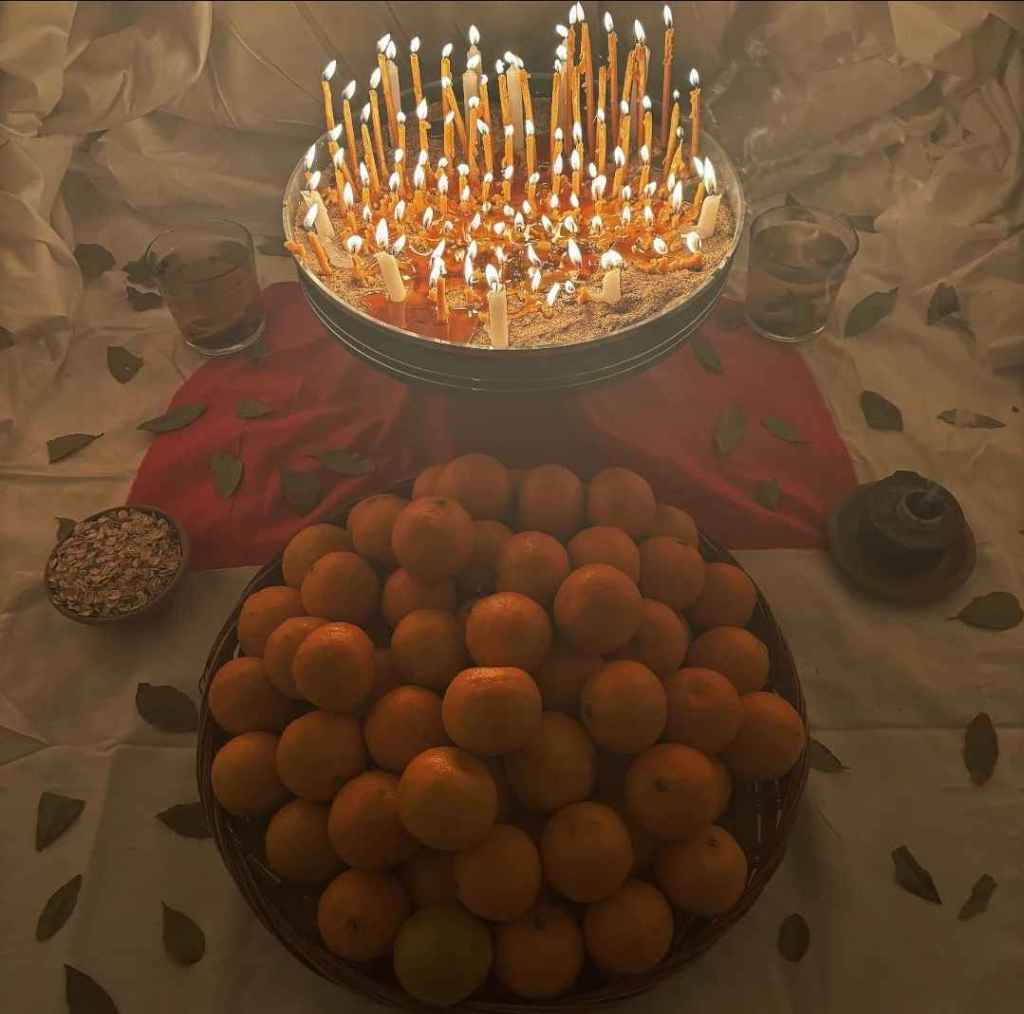
On Key’s end, he prepared a wash of fresh and dried citrus peels, cloves, star anise, cinnamon sticks, bay leaves inscribed with prayers, and allspice berries by boiling them all together, and allowed the aromatics to fumigate the candles used for the rite. This water was then allowed to cool, and mixed with holy water taken from three churches. A portion of this water was then used to wash the items on the shrine, the offerings of fruit, and the candles in the names of each respective donor, while the remaining two portions were divided into glasses and offered after receiving additional prayers and blessings to serve as vessels of refreshment and direction to the spirits inevitably called by the offering.
Key’s table set for St. Nicholas.
Key then hydrated a fireproof basin full of sand with another blend of holy waters from three churches, orange blossom water, and a splash of the herbal wash, then prayed over it a rosary dedicated to St. Nicholas, asking for his intercession. Each candle was then lit, naming each donor while doing so, then placed in the basin after pausing to interpret the omens that emerged from the candle as it pertained to each person’s condition. Appropriate oral formulas or prayers were offered to overcome corresponding blockages, uncross conditions, or wash away other forms of spiritual detritus.
Oats were then offered to provide sustenance to St. Nicholas’ horse, such that it may have the strength to bear each patron forward along their desired path, and the fruit offered before the saint with a prayer that he confer blessings of foresight, clarity, and prosperity on each patron. Incense was also offered to the Saint and the spirits present, and vigil was kept over the candles as further omens for the collective were observed and individual candles were maintained with additional remedies.
The candles burning down, each with their personal petition.
Each successive candle built off of the momentum of the last, eventually feeding into the sensation of the blustering squalls that drive the ships patroned by this saint forward, until the enchantment itself was caught by this wind and carried forth to each recipient.
Once our work was complete, we sent all the proceeds raised by the working to our Cabula, and gave the good Saint one final battery of prayers in thanks for his swift intercession, praising him for his good works and petitioning him once more over to elevate the wealth, prosperity, and luck of all those who submitted their names and the names of their loved ones to our group ritual. We are truly so grateful to each and every one of you who contributed to this first group offering, and look forward to offering more in the future for more good causes!







 With Cunning & Command