St. George’s Charms of the Victory-bearer

By the red cape of the soldier-martyr,
By the red wings of the adversary underfoot,
By the red-drenched spear piercing its maw,

The Charms of the Victory-bearer are born, baptized, and bled.
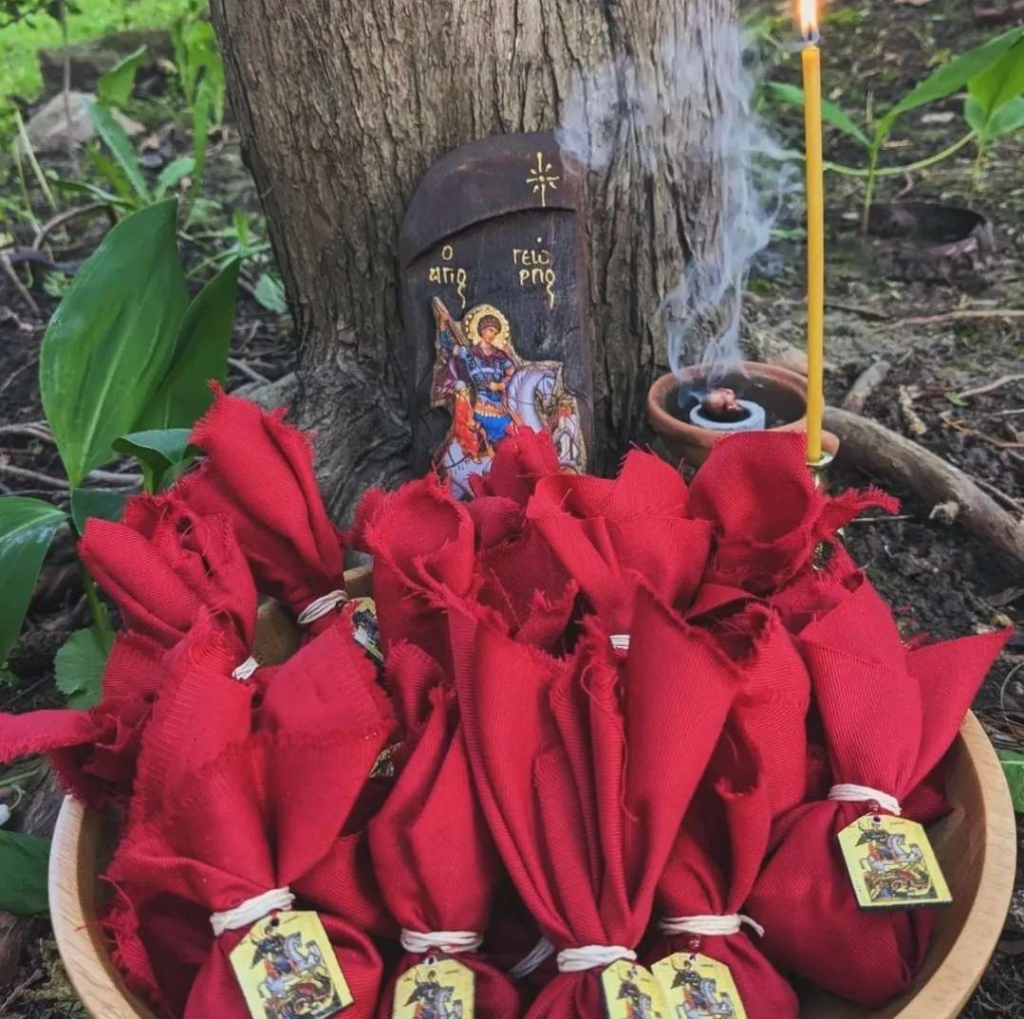
The charms at the foot of a pacted tree.

These potent bundles were first birthed on May 6th, the Orthodox feast of St. George, which this year happened to be the day immediately following Easter. I’ve much joked with friends about how much “longer” Lent felt this year in light of Easter being May 5th, but this too came with its own advantages. That the eve of Đurđevdan (St. George’s Day) was itself Easter provided the perfect folkloric confluence for a number of the key ingredients which went into crafting these sorcerous allies—fleetfooted, valiant, and unrelenting as the martyr himself.

Having collected the necessary herbs either on the eve or at dawn on the feast proper, retrieving each with the appropriate offering left in turn and through the auspices of a bajalica or basma (oral charm) specifically used on St. George’s Day for those very plants themselves, I began the core powder within the first hours of the feast. The shell of first red egg of Easter—a prized ingredient within the Balkan folk tradition—was crumbled and left to soak among the blood clots of an offered rooster, consecrated with the Jesus Prayer and given veneration through Good Friday, Holy Saturday, and Easter Sunday all. On the martyr’s day proper, I baked the kravaj or kravajče, a solar bread intended to mimic the wreaths which would crown cattle for protection, the first sacrificial lamb for protection, and the milk buckets that would receive the first milking of St. George’s Day for fertility. Across numerous villages, and most famously recorded in Vrtovac—a village in Serbia that has been much-studied for its detailed St. George’s Day customs of sacrifice and fertility magic—this bread would be wrapped in geranium, sprinkled with salt, and placed by the nearest river as an offering; or alternatively divided up amongst anthills so that the ants themselves may “lock up” the fertility gathered to protect it from negativity and the Evil Eye.

At the same time, bread baked specifically for a saint’s feast is itself a powerful fetish to be used in the creation of charms. I was trained to add a little piece to each charm I make (a ritual bread that was prayed over for many hours was a key component in the Master of the Wolves charms we released last year), and this case was no different. The rest of the kravaj was divided up between spirits, friends, anthills, tree hollows, the dead, and a river, each with a corresponding oral charm spoken over the piece as Thursday Salt was sprinkled over its resting place, tied to its post with white horse’s hair.

As an additional offering to the martyr and the spirits of his entourage, I cooked belmuž—a sheep’s cheese cornmeal porridge—and gave portions to each of my assisting familiars and to the holy saint himself. The banquet was laid over a red cloth that was consecrated as his cape, fumigated in red Orthodox St. George’s incense I brought back with me from my last trip to Greece, and sprinkled with wine, rooster blood, sheep’s milk, and holy water with sprigs of basil and plantain. When the time came to make the charms themselves, it was this cloth that was divided into the 21 squares that would host the cores birthed on his feast.
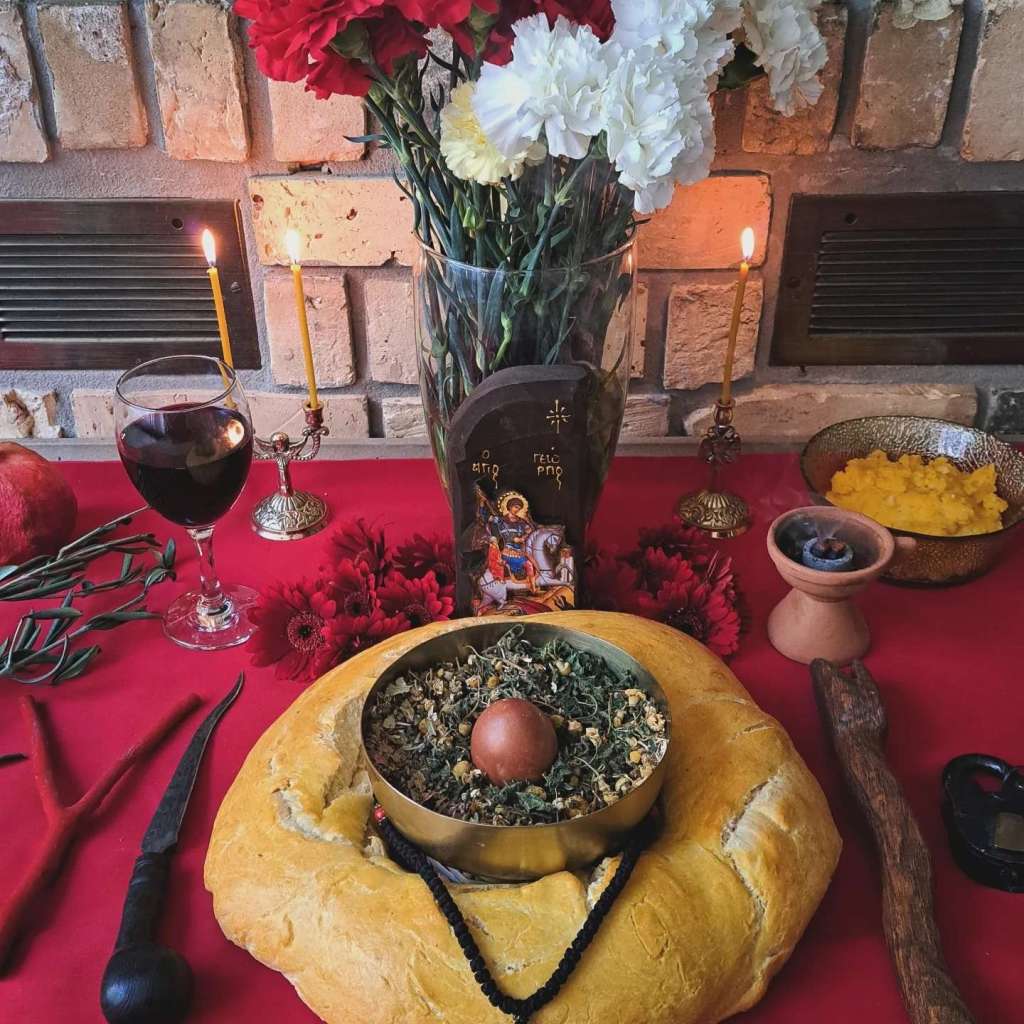
The feast given unto St. George.

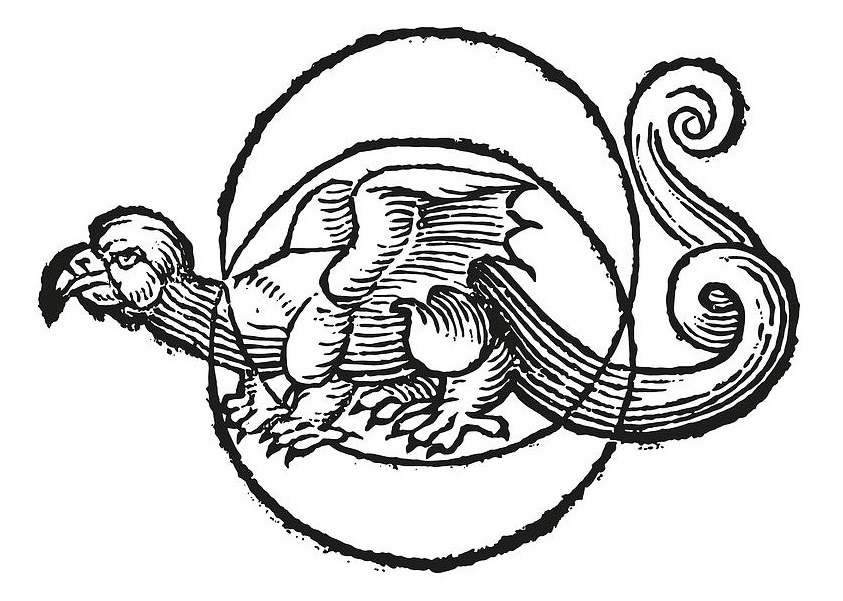
Herbal materia, both freshly gathered and dried from previous corresponding saint feasts, were combined within a vessel along with personal fixed star powders made in my tradition, specific dirts corresponding with the nature of these charms, and the first red egg of Easter, which had itself undergone numerous rituals upon Christ’s rebirth. As the serpents of Aldebaran and Regulus were massaged for their dew, so too were the armies of St. George supplicated, in memory of his eternal triumph over the aždaja and his folkloric allyship with the zmaj. Propitiating the saint and the gods he masks alike, the raw powder was left incubate within the kravaj, veiled by his bloodied cloak against the glare of any stars not pacted to this working.

Finally, once the raw bundles passed their requisite three omens of manifestation—that they were indeed alive and bringing victory unto their bearers—I was given license by my spirits to bind them still. All three of us at With Cunning & Command and The Frightful Howls You May Hear take efficacy and results extremely seriously; nothing we offer to the world can be sold before it has succeeded in its tests of fealty and power. The trials these cores underwent were in line with their intended use: the overcoming of obstacles, the germination of fertility, the destruction of nightmares, the evil eye, and any other such spiritual malady, and the ultimate triumph of their carrier in matters of competition. Be they deployed for the protection of fertility (in matters of one’s own, those of animals and plants, or even those of other magical workings so that they may bear fruit), the defeat of enemies in matters where only one may prevail, or the destruction of jealous gazes, lingering spirits with ill intentions, or stray miasma and malefica brought home underfoot, the Charms of the Victory-bearer are the white-hot flash of the spear, the crack of the celestial whip, the hooves of the thundering hero-steed crushing each viper before it ever slinks across the threshold.

The base mixture includes allies such as basil, linden, geranium, nettle, chamomile, plantain, dandelion, and many other potent herbs collected in the dark such that they cannot be named. Dirts from the graves of 23 soldiers, 23 anthills, and 23 crossroads, as well as dirt from the village Başköy/Potamia where St. George was said to have been born, are combined with powders of Aldebaran and Regulus created in a manner taught to me in my tradition, as well as a more conventional Sun in Aries powder elected by Salt. Serpent bone, St. George incense, white beans from a chart that approved these charms with the most blessed omen of the Three Stars, and many more implements made their way into the bundles, which were then tied with red thread, a piece of carnelian, and a small pocket icon of St. George, finally bound over with white waxed linen thread. Each knot had the appropriate oral charm breathed into it, an offering of air bestowed as the final gift before they were once again perfumed in incense and left to breathe the sunlight for the first time since the feast.

Having received countless prayers, rich offerings, and diligent attention to omens, auguries, and folkloric expressions of St. George’s might in nature, these charms are finally available for purchase. They may be kept in one’s backpack or purse, nestled in their place of work, placed by the hearth or on appropriate shrines, or hung by the main door to your home. Give them a candle (white, red, or beeswax) and a shot of vodka, brandy, or whiskey once a month, preferably on the full moon to keep them refreshed and spry. These are workhorses and soldiers, aggressively targeting areas of weakness and conquering obstacles in your path. If you have an enemy you need to triumph over, or are looking to be the victor selected from among a pool of candidates, place the charm with a lit candle over a copy of your application with your petition written over it in red. Tuck the charm by your pillow or hang it over your bed to protect against nightmares and vampiric spirits, or to assist in conception and sexual virility. Gift the bundle to your protective spirits to act as arms for them, becoming a battery of power for them to wield against disease, poverty, malefica, and loss in the pursuit of securing steadfast agency.

If you’d like to purchase one for yourself, please click the link below. Shipping is included within the price. They will be mailed out within a week of purchase and a tracking code will be e-mailed to the PayPal address used to buy them.

All St. George’s Charms of the Victory-bearer are sold out. Thank you for your patronage!

It is not my hand that cuts these cords, but the hand of St. George upon his holiest day. Amen, amen, amen.
Hagstones, Snake’s Eggs, Chicken Gods

Blessed Feast of the Assumption of the Blessed Virgin Mary to all on the Gregorian Calendar, and Happy Feast of St. Stephen the Protomartyr for those on the Julian! In my neck of the woods, today is Sveti Stefan Vetroviti, as our nickname for St. Stephen is “the Windy” or “the Windswept”, in thanks to his continued syncretism with the god of wind, Stribog. This is a powerful feast of the zduhać, vertovnjak, oblačar, gradobranitelj, and zmajevit čovek class of weather-manipulating healers and sorcerers, given Stribog’s enduring patronage of their arts, through his fatherhood of the Vjetreni Vojvoda spirits and his own fights against the ala, hala, german, and aždaja. Moreover, it is a day not only associated with the collection of hagstones, but their deployment in charms for knotting the wind, protecting livestock, and providing homes for spirits.

One of our recent episodes on our podcast, The Frightful Howls You May Hear, featured an overview of some of the basic lore around hagstones from the British, Germanic, and Slavic contexts. We’ve been so overwhelmed by the outpouring of support, love, and engagement on the podcast from so many of you; the warm reception and incredible feedback we’ve received has truly nourished us in our creativity and excitement to share more. We are so deeply grateful to everyone who has sent in comments, shared their thoughts on the episodes, and signed up to support our Patreon where we post bonus content such as our show notes, Salt’s incredible monthly astrological almanac, our Q&As, and far more! Over the next few weeks, we hope to share with our readers here on the blog not only a little of what we’ve been up to behind the scenes, but also new offerings to come in the form of courses, mentorships, readings, charms, and far more. It’s truly been a blast for the three of us to share more regularly, via our bi-weekly episodes, aspects of folkloric and magical research we’ve been up to, as well as tidbits of our personal adventures and sorcerous journeys.

The Hagstone episode (also adding the YouTube link since we only made the channel a few episodes after the launch, and most of our viewers are on Spotify and Apple Music—so for those of you who prefer YT, we’re finally live!) came about while the three of us were scattered over the past two months, travelling for work, spiritual training, conferences, and everything in between. Even on my travels, I had been collecting them where I could see (or, in the case of their hissing, hear) them, and asked Salt and Key if they’d be interested in contributing some German and English sources to an introductory episode on these most reliable of magical companions.

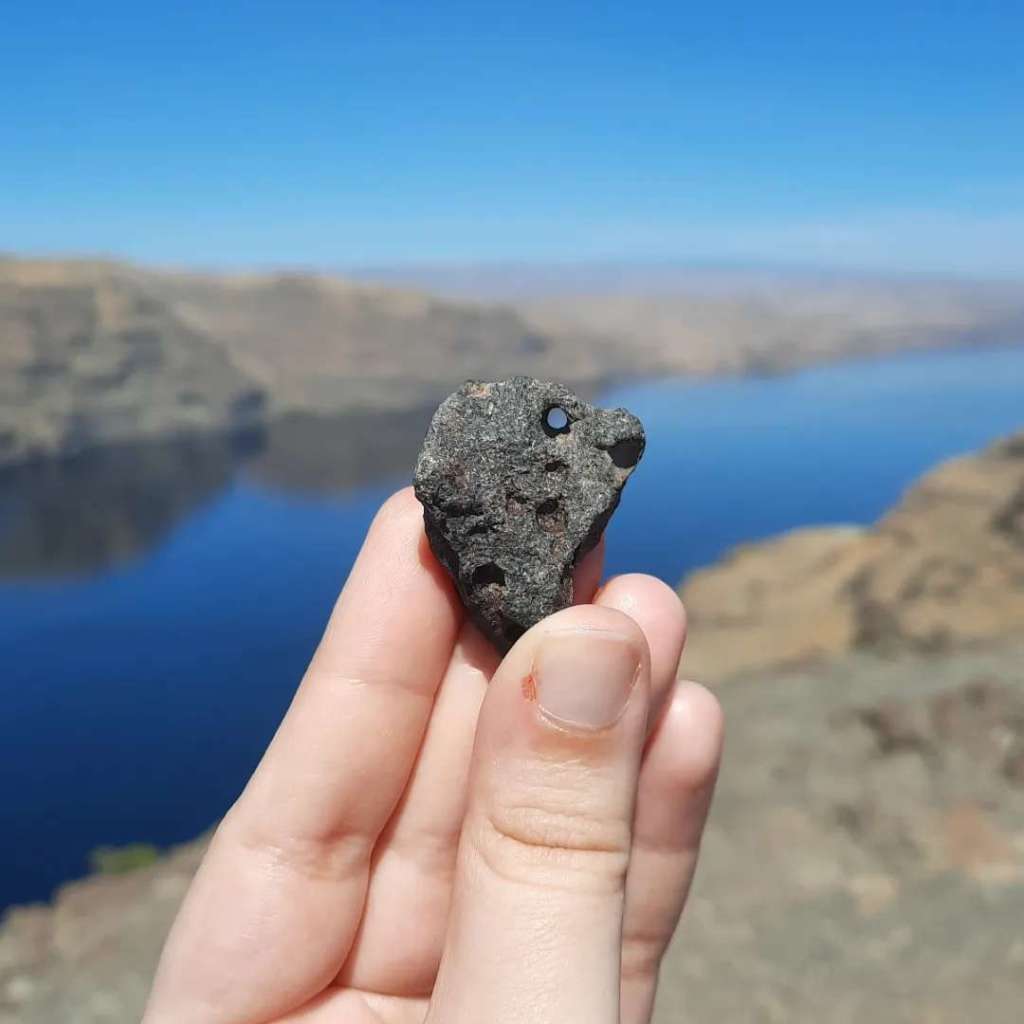
One of several hagstones I found at the Colombia River Gorge recently.

I thought it might be helpful to share some of what we went over in the episode here as well, in honour of Sveti Stefan Vetroviti. While we covered a great many names that holed stones have been referred to across Europe, “hagstone” is the name we’ve all used with each other in English from the beginning, and it’s certainly the one that’s stuck in our common parlance, as well as across occult spaces. That being said, while the list of names is especially long, a sample of our favourites from the episode include mare stones, bitch daughter stones, witch stones, and adder stones in English; Lochsteine, Trutensteine, Schratensteine (see our episode on the Schrat for more on this one!), and Hühnergott in German; and a great many coming from the South Slavic dialects, of which I’ll provide below with their translations from Serbian:

  • Chicken god (pileći bog)
    • Identical in meaning to Hühnergott, which itself is believed to be a German neologism form Slavic languages, referring to their use in the protection of livestock and especially chickens by being hung over their coops
  • Dog’s heart (psećim srcem)
  • Dog’s god (psećim bogom)
  • Dog’s luck (pasja sreća)
    • These dog-related motifs are a reference to Veles, lord of cattle, wolves, agriculture, the wilderness, magic, the chthonic world, and far more
  • Perun’s arrow (Perunovom strijelom
  • Thunderbolt (gromovnikom)
  • Thunderstone (gromovnički kamen or kamen groma)
    • These three come from the belief that these stones are formed when Perun, the god of thunder, order, and the heavenly realms, strikes the holes through with his furious lightning
  • Serpent stone (zmijski kamen)
    • from the belief that holed stones are black eggs from which basilisks are hatched
  • Snake’s poison (zmijski otrov)
  • Serpent’s egg (zmijsko jaje)
  • Witch’s stone (kamen veštica)
  • God’s eye (božje oko)
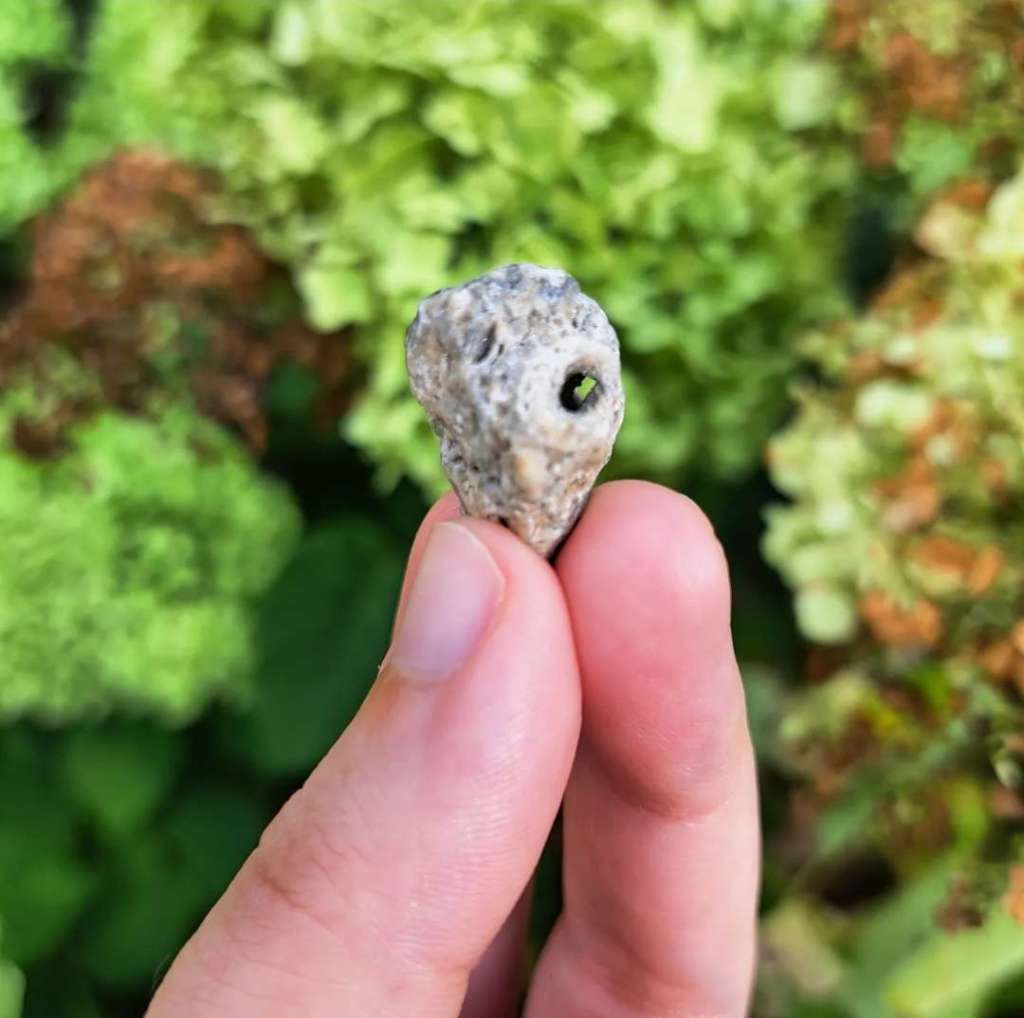
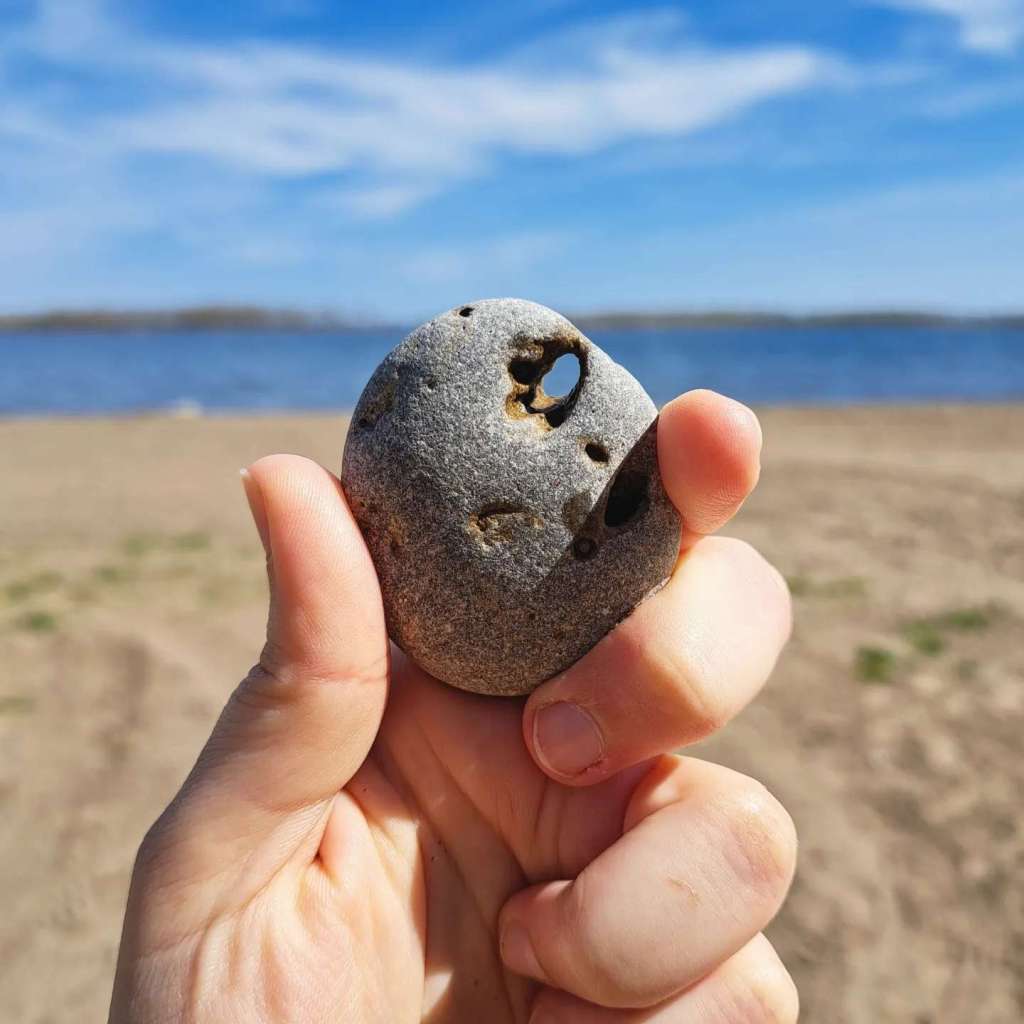
An example collected from a beach.

The uses for holey stones are all but endless. They protect livestock from curses, witches, and being ridden to the point of exhaustion by fairies, heal toothaches, headaches, and all manner of illnesses (in the Balkans, a common technique is to sandwich the afflicted area with a hagstone on either side, and conjure them to pass the pain through them and away, so that they may be disposed of later), ward against nightmares, and allow for the seating and ensoulment of spirits (in my tradition, this is typically done with seven-holed hagstones, which are especially prized). Some cultures recognize classifications of hagstones and their abilities and proclivities based on number of holes (with each having their own uses), whether they are seen as belonging to fire or water (based on their shape and hardness), whether they are male or female (less commonly used, but often having to do with roundness and pointedness), and in which location and weather conditions they were found. I went over a few variations from Slavic speaking countries with regards to these in the episode, though these classifications can become so detailed and so varied that they could take up their own chapbook!

One of our favourite charms that we shared, coming from Reginald Scot’s Discoverie of Witchcraft, is the famous “Man of Might” rhyme:

Tha mon o´ micht, he rade o´nicht
wi´ neither swerd ne ferd ne licht.
He socht tha mare, he fond tha mare,
he bond tha mare wi´ her ain hare.
Ond gared her swar by midder-micht
she wolde nae mair rid o´ nicht
whar ance he rade, thot mon o´ micht.

With the modern English being:

The man of might, he rode all night
with neither sword, nor army, nor light.
He sought the mare, he found the mare,
he bound the mare with her own hair.
He made her swear by mothers might
that no more would she ride at night
where once he, rode that man of might.

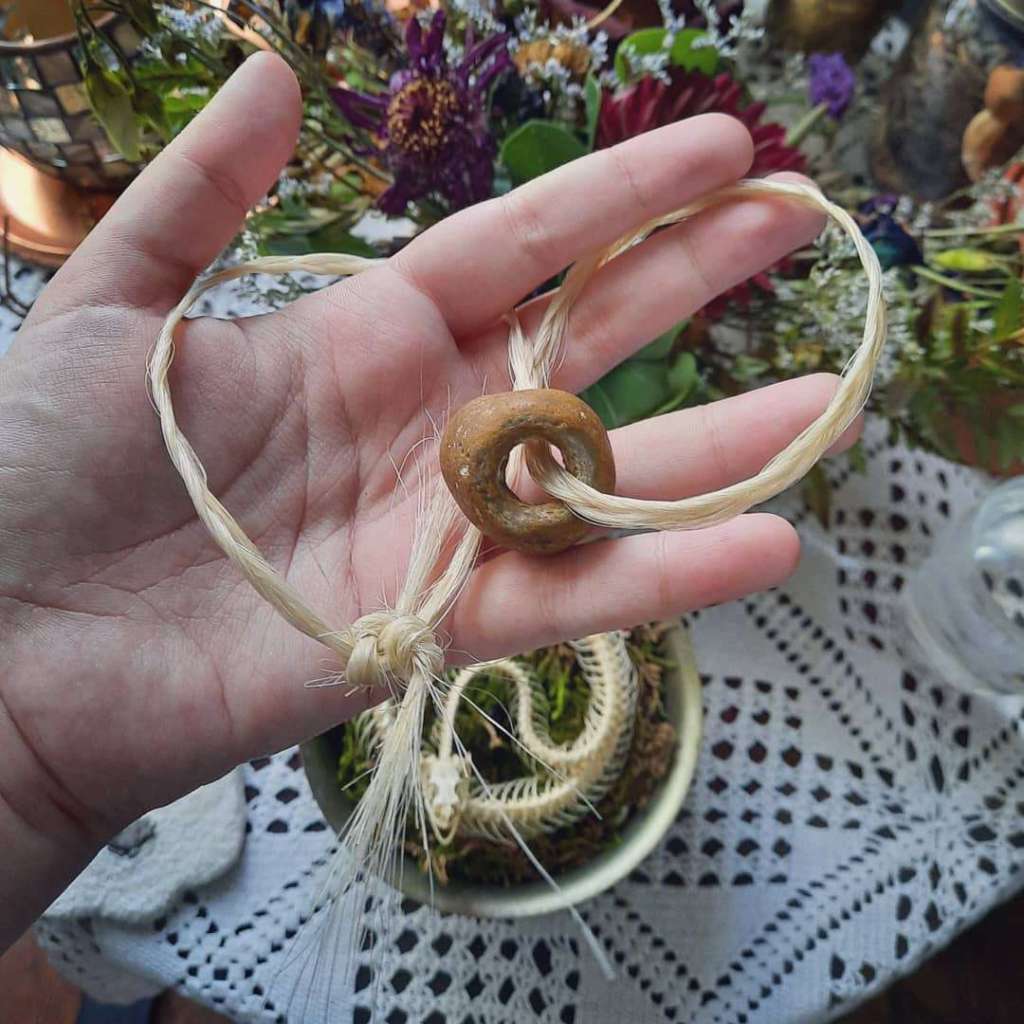
A common charm one can make from this cantrip is to braid horse hair (especially white horse hair, given that the “man of might” is none other than St. George in many understandings) through a hagstone while repeatedly uttering the verse, making an offering to your spirits and the good saint immediately after in thanks to empowering this anti-nightmare ward. I’ve made several of these for friends, family, and especially children’s cribs and found them to be exceptionally useful. The one which hangs over my and Salt’s bed is a two-holed hagstone, with the horsehair looping through the topmost hole, and the other being used to assist me to return to my body in dream and spirit flight.

A charm made in this manner using a hagstone I found while travelling.

Indeed, a very similar charm comes to us from the mid-16th century, as recorded by Thomas Blundeville of Norfolk in his The Order of Curing Horses Diseases (1566):

In nomine patris, &c. —-Patris et Filii et Spiritus Sancti
Saint George our Ladyes knight,
He walked day so did he night,
Until he her founde,
He her beate and he her bounde,
Till truly her trouth she hym plight,
That she would not come with the night,
There as Saynt George our Ladyes knight
Named was three tymes, Saint George.

Holed flint stones were typically hung, like iron, to ward people and horses alike from being ridden by night-mares—in the case of the latter, they could be placed around the manger or the neck of the animal. Blundeville considered this to be a “foolishe charme” that was to be written down while hanging a “flynte stone that hath a hole of his owne”, which was naught but a silly way to con money out of “playne folks purses”. Yet, much like Reginald Scot, in his very disdain he ultimately preserved for us this oral charm in writing, allowing us to make good use of it even now.

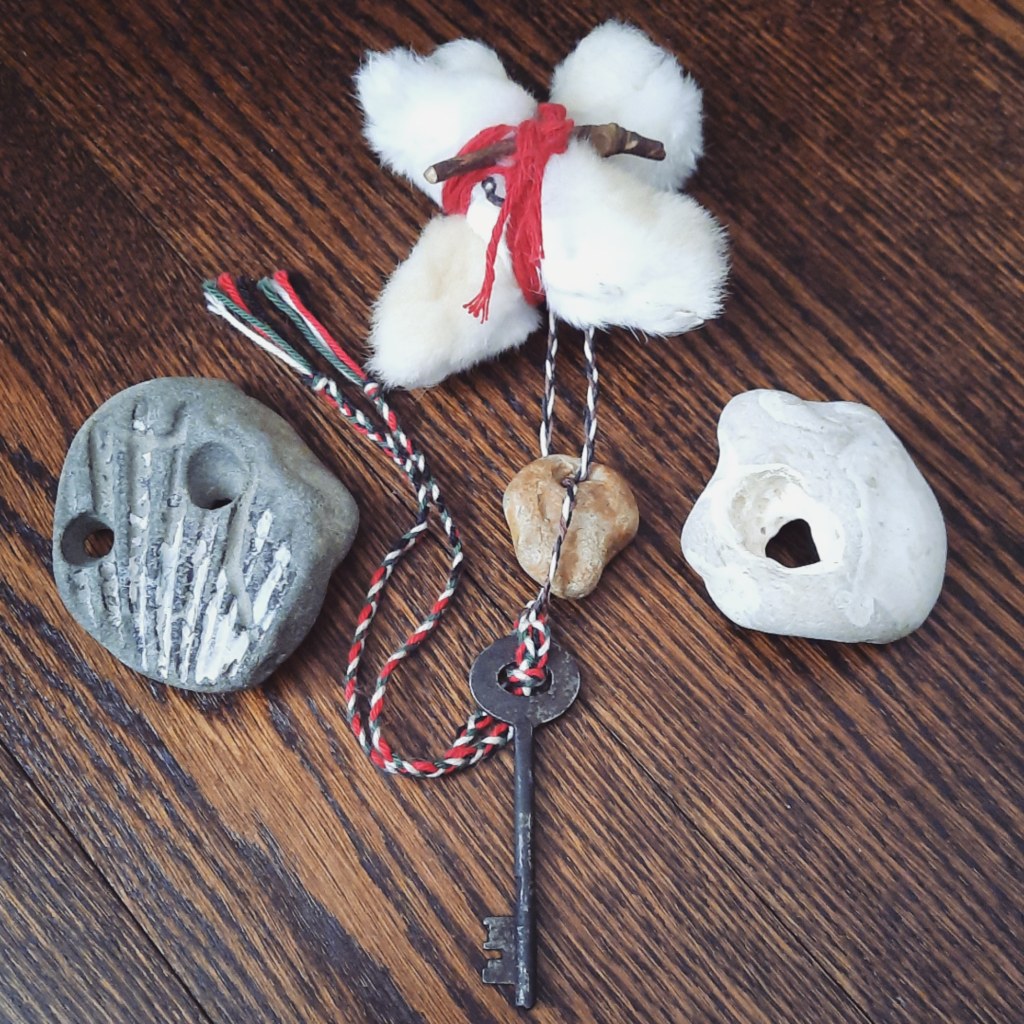
Another dreaming protection amulet, made from a hagstone, an iron key, crossed rabbit’s legs, and mandrake root.

While hagstones require no special ritual to make them “work” or to activate their virtues, there exists plenty of folklore with regards to how they should be acquired. J. Geoffrey Dent’s article “The Holed Stone Amulet and Its Uses” (1965) tells us that there is evidence from the South of England of beliefs that hagstones should be received as gifts, or, even better, stolen. Generational stones, that is, those which had been passed on throughout successive owners within a family, all used for the same purpose, are perhaps the most powerful through their repeated victorious efficacies, and presumably all the more potent if stolen. Yet in the Balkans, we repeatedly encounter the lore that hagstones indeed will only properly “activate” and bond with their owner if they are deliberately found within nature by them. I shared a few charms for how to actually go about and acquire them in this way, both with regards to luring them to you, such that spirits reveal their places and that you stumble upon them naturally, as well as how to seize their fortune once they are found in the episode.

Regardless of what you choose to say out loud (for ultimately many of these “charms” are oral prayers passed on that someone may have at some point invented, or, in the case of bajalice, received from a spirit), a good way to hunt them is to take off your left shoe, and walk barefoot along the shore or river while dropping one millet seed from your closed left fist into the ground at each step and repetition of your prayer. In this way, the spirits of the land are petitioned to receive your blessing of fertility, and accept your alm in exchange for revealing your prize.

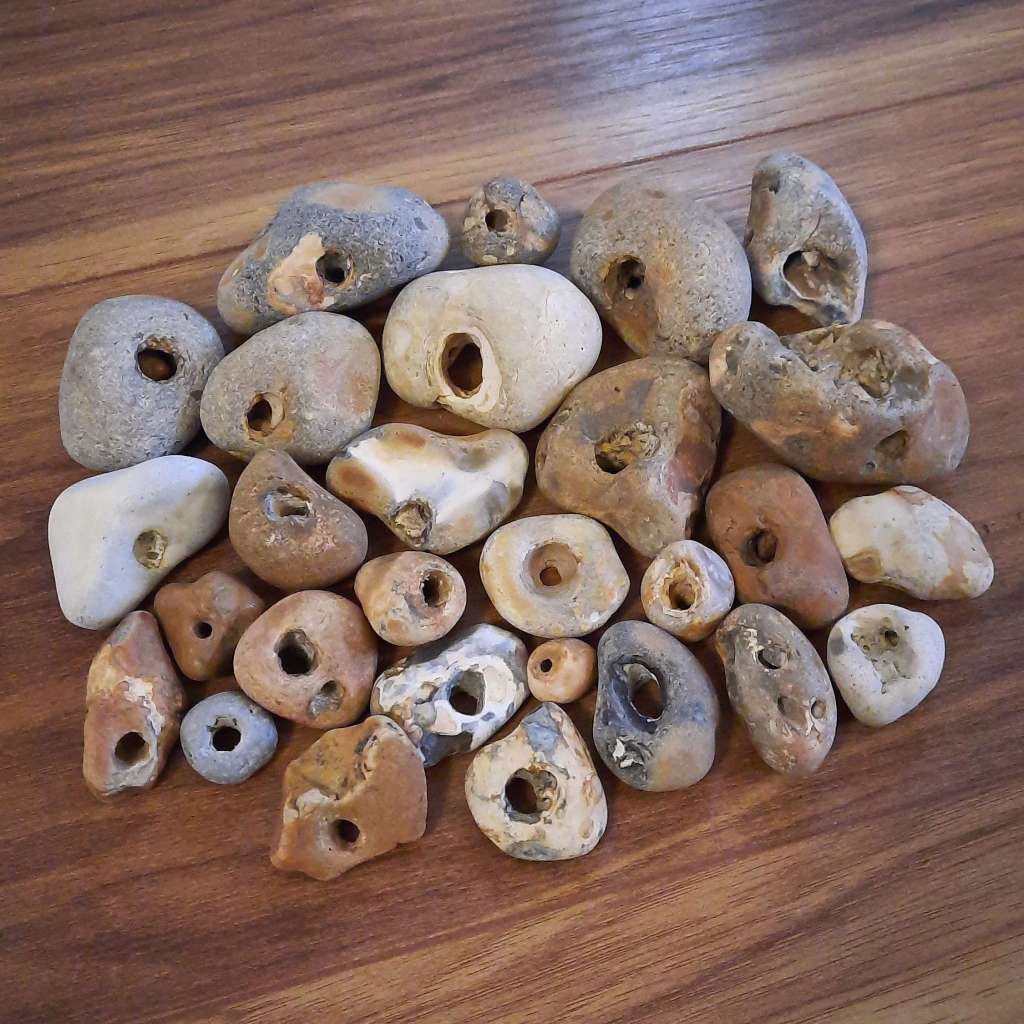
A collection Salt and I brought home from a trip to Brighton Beach together.

Many of the oral charms we shared ultimately serve the purpose of bonding a stone to you, especially if they are not already claimed by one of your spirits. The three of us have often had the shared experience of bringing home a great many hagstones from a hunt only to find that 2/3rds of them had been immediately spoken for by our spirits, who wanted them for their own ends, vessels, and amulets. I’ve often had to string them in groups of seven, nine, thirteen, or twenty-one as soon as I’ve brought them through my door as a saint or house spirit immediately wanted them placed over an important threshold. In cases in which I’ve bought hagstones over Etsy, specifically because I was searching for particular numbers of holes that a spirit requested, I’ve left them before my spirits in small bird’s nests that I’ve collected for them, such that they can incubate, receive the rays of the sun, and lubricate their hissing through the maws of their gates.

If you listen closely for their hissing, the serpents below may even lead you to them by sidewalks in the cities.

While different aspects of lore disagree on whether or not the thread which hagstones are hung on should be knotted or not, the notion that they should be strung up with natural material (such as wool, linen, or hemp) is fairly universal. If I’m about to use mine to scry, I will often make use of a fairly well-known technique across the Balkans to whisper through the whole what I wish to see while moving it around my left palm with my right index finger. Afterwards, I will breathe through the whole, and place it to my right eye while closing the left, and then scry for the augury—or directly at the sky in the morning to witness the rising star, that it may be captured later within that very stone.

There’s so much more that could be said on their collection, uses, and enchantments, such that we’re already planning the next edition of our hagstone episode series. If there’s anything in particular any of our readers are curious about or would like to be included, please feel free to write to us below, and we’ll do our best to include some tips and folklore on each matter in the next installment! For now, happy hunting, and thank you all so deeply for supporting our podcast!

To Conjure a “Horrible Great Dragon”: A Lunar Mansion Experiment from the Cunning Man’s Grimoire

Pre-Ritual Notes

One of the experiments I decided to perform from the Cunning Man’s Grimoire was the operation to conjure a “horrible great dragon to appeare in the ayre”. This ritual is to be performed when the Moon is in the 11th Mansion (though one of the authors of the text mentions it’s likely supposed to be the 12th due to the imagery of the that Mansion actually including a dragon) and is a fascinating example of a blending of ritual magic, folk magic and astrological image magic together into one single operation.

The ritual prescribes the creation of a small, red copper ring, with a hollow space inside that would allow one to place parchment with names of power written upon it. Unfortunately, the original text is unclear about the precise creation of the ring; if it needs to be made during an astrological election of its respective mansion, or if it is enough to simply perform the ritual during the appropriate time. One argument for the latter case is that the majority of the rings required in the Mansion rituals given in the text are hollow copper rings. This indicates perhaps that the original author of the text was only using one ring for multiple rituals, exchanging the parchments within. This is just a guess, of course, and as such one of the purposes of this experiment was also to see if the ritual works with a copper ring forged outside of the Lunar Mansion—as well as, of course, to see if it really would summon a dragon spirit in the air.

For the creation of the ring, I decided to go with a plain copper band with the names Qerminat, Baralama, Canempria, and Coriet engraved on it, instead of a hollow one with the same words on parchment inside. As for the ritual’s timing itself, I decided that to be less strict than I would require for a Talismanic one, and opted instead to have the Moon be on the Ascendant at the time of the 11th Mansion. The ceremony itself is relatively short; it simply involves a spoken prayer and a symbol to be etched on the ground using the ring.

Other additions to the experiment that were my own included bringing with me the Fifth Pentacle of Mars for protection, as well as the Scourging Rod from Magia Naturalis et Innaturalis with which I can quickly draw a circle about me in the dirt, should the spirit be malefic in nature. (This is, after all, a possibility, especially if it belongs to the 12th Mansion considering that the 12th shows a man and a dragon fighting).

I was quite excited to give this operation a try; past visions of dragons I’ve received through Sfinga in dreams have been utterly awe-inspiring, as has witnessing first-hand her Zmaj’s miraculous control over healing, destruction, and the weather. In light of the central role of Slavic zmaj lore and magic in her life, I was very eager to conjure this Lunar Mansion-derived dragon, especially as it might allow me to see a non-zmaj dragon by myself for the first time.

Post-Ritual Notes (First Attempt – 11th Mansion)

The first attempt at performing this ritual was done during the 11th Mansion. I prepared my tools and set out to a nearby dirt track along a large field. I drew the seal in the dirt and spoke the conjuration. Suddenly, I felt a surge of strength and vitality churn within me. With my spiritual sight, I saw a white serpent appear before me—on the ground, however, not in the air. Its spiritual form emerged physically in a translucent guise.

I greeted it, asking for its name, to which it first responded claimed to be Jazariel, the chief of the Tribal Spirits in the Faustian texts, and also the celestial ruler of the 13th Mansion (it is notable he also appears as a white serpent). However, after I pressed the spirit, it quickly confessed to another name instead to replace the first. I continued by inquiring as to the obtaining of wealth and also of the nature of local British dragon spirits. I did not receive satisfactory answers from him, with the conversation moving in circles for the most part. Eventually, I dismissed him, not sure what to make of the operation. That is, until I returned home and researched the second name he had given me. While I won’t mention what it was, it is safe to say that I had been had. This first spirit who appeared had likely been some sort of trickster. I found this more amusing than frustrating though, and looked forward to performing the operation again during the 12th Mansion the next day.

Post-Ritual Notes (Second attempt – 12th Mansion)

This second operation was performed while the moon was in the mid-heaven. The conjuration went well—the clouds immediately darkened from what had previously been a considerably bright and sunny day by English standards. Even the sky became dark, with the exception of the South Eastern corner along the horizon where the daytime moon sat overlooking the earth. Recognizing that, this being a Lunar Mansion experiment, the dragon would likely be related somehow to the moon, I decided to gaze at it for a little while. As I did so, clouds began to form where previously the sky had been entirely clear. They covered the moon in the shape of a claw, grabbing it as a pearl. When I took note of this, an all-white dove flew past me through the trees.

Suddenly, my spiritual sight perceived very clearly a large drake looming in the sky, its form two-headed and pure white. Like a wyvern, it had only feet and no arms. I greeted it, only to be ignored. I conjured it by the ring on my finger, by the names of my spirits, the Holy Trinity, and finally one of the names of Sfinga’s Zmaj guardian that I have been allowed to know, to which it finally paid me attention. Its demeanor, however, still seemed disinterested (after all, it is not like I had her Zmaj near me to bind it—she is back in Canada at this time!). I greeted him once more, asked for his name, and promptly received one. I inquired as to his nature, to which he replied:

“I move the wind, I shake the waves, I break ships with my tail and swallow them. I cause fleets to sink and storms to fall upon my enemies.”

It seemed that the way to get him to talk was to ask about himself! As I learned through our short conversation, he was a fairly boastful spirit—something Sfinga had told me to expect from certain kinds of dragons. Much to my delight, shortly after the ritual, I re-read the description of the 12th Lunar Mansion in various sources and saw that it has a malefic influence over ships and sea-men, confirming the spirit’s nature.

I received some advice from the spirit concerning how to further awaken the spiritual senses and utilize their discernment. Shortly afterwards, I thanked him and he departed. I was and remain greatly pleased that the experiment was not only successful, but that I was able to confirm for myself that the 12th Mansion is the most appropriate for the conjuration of its lunar dragon. Since I have his name, I definitely plan on calling this particular spirit in future 12th Mansions to ask further questions.

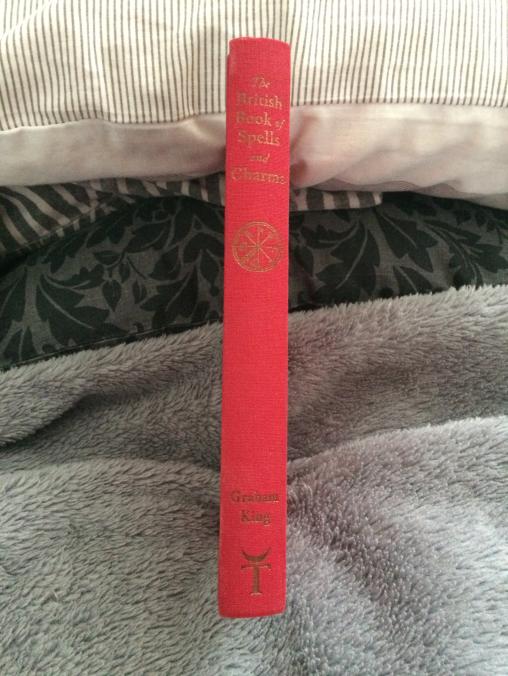
The British Book of Spells & Charms, by Graham King (Review)

Since we began seeing each other, Sfinga and I decided that one of our Valentine’s day traditions would be exchanging books. This last one, I got her a copy of Stephen Skinner and David Rankine’s A Cunning Man’s Grimoire, and she gifted me the special edition of Graham King’s The British Book of Spells and Charms. Today, I would like to briefly review this wonderful little book which, in addition to being a thoughtful gift I treasure, is genuinely an excellent addition to any folk magic library.

Sfinga’s picture of her paperback with True Black Magic.

Published by the always-impressive Troy Books, the special edition is really a feast for the eyes, bound in red cloth with bronze foil backing, the cover graced with a Mars talisman; my preferred planetary power of choice. The binding is tight and the paper quality superb. A quick flip-through reveals numerous illustrations and photographs from Cecil Williamson’s collection from the Museum of Witchcraft. Needless to say, I was in love with the little book as soon as I first laid eyes on it, and fortunately the material inside did not disappoint.

The text opens with the classic charm: “Rain rain, go away, come again another day”—which I can still to this day remember being taught in English Nursery school—flanking an upturned horseshoe. The introduction reflects on the fiercely syncretic and non-discriminatory nature of folk magic, which devours any source it finds and attunes them to the needs of the user. The analysis in this section was particularly thought provoking for me, especially when I began to mentally compare this fluidity within folk magic with the staunch conservatism of early modern ritual magic. As is the case for the entire book, the writing is littered with colourful illustrations and quality photographs from the Museum of Witchcraft in Cornwall.

The book moves on after the introduction to a collection of typical protection and good-luck charms. The one that struck me the most was the example of the more recent “Fums Up” charms, which you can see in the image above. These were apparently common during the First World War, carried by soldiers who were often gifted them by their lovers for luck. Sea urchin fossils/Faery Loaves, thunder-stones, hag stones, witch bottles, and all sorts of other artifacts are included in the chapter. I think it is perhaps this section of the book that most British people, including those who do not practice magic, would be familiar with, as we encounter the horseshoes and rowan crosses so closely tied to British folk-ways.

We also see a considerable number of verbal and written charms throughout the book, which are, alongside the illustrations, one of its biggest selling points as a reference text. Many of them were already fairly well-known to me, such as Isobel Gowdie’s “The Muckle maister Deil tak what’s atween dis twa hands!” and the numerous variations on the classic “three ladies” or “three angels” anti-burn charm, such as:

“There were three angels flying over the West
One cried Fire, the other cried Frost
The other was the Holy Ghost
Out fire, in Frost, in the name of the Father, Son and Holy Ghost.”

Other charms however were rarer, including some I have never seen before. In particular, the charms from Cecil Williamson’s personal collection include a number of very interesting exemplars; most notable perhaps being anti-Hitler sorceries from the 1940s. One fairly humerous example is that of a Hitler-themed pin cushion, used to afflict the dictator with all manner of ills. This fascinating example of effigy magic deployed for political purposes is quite evocative of the survival of the practical, folk magic mindset well into the Second World War, despite their otherwise widespread erosion.

The rest of the text is divided into a number of different sections, with examples of love divinations and spells, curses and healing techniques, and even magical folk-songs and dances. Each of these sections is filled with a considerable number of different charms, which are thankfully meticulously sourced in the footnotes. The sheer number of examples, in addition to their thorough cataloging, makes this work invaluable as a reference text for British folk magic, allowing us track down any that particularly catch our fancy. Another example that stuck out to me is that of a mole’s foot in a red bag, hung over the mantle. When a member of the household comes to suffer from a toothache, the bag is retrieved and worn around the neck until the pain is healed. In the final section, a “Magical Medley” of miscellaneous spells, there is even a short technique to ensure that your child will be a talented singer: all that is needed is to bury their first nail-parings under an ash tree and they will be granted the gift of song.

This little text is truly quite dear to me, both as a gift and as a reference work on one of my favourite topics of study. It is a fine collection of folk magic practices and techniques, full of historical curiosities and practical inspiration for my craft. I can’t pretend I’m not currently looking around for my own little “Fums Up!” figure as well! You can pick up your own copy in the numerous editions available on the Troy books website.

Hail and Welcome

Welcome to With Cunning & Command, a blog about magic, occultism, grimoires, spirit work, folk lore, and esoteric scholarship. We are magicians, karcists, necromancers, and diviners working with diverse Old and New World traditions, grimoires, and spirit courts joined by common goals, loves, and approaches to the hidden. Here, on our new website, we hope to host book reviews, snippets of ritual procedures, reflections on sorcerous practices, and a miscellany of other related writings. Our work is invested in ever furthering the transformation of the magician as a magical being herself, while concurrently deepening levels of spirit communion and mastery using the twin-forked prongs of knowledge and strength, insight and power—with sagacious cunning and authoritative command.

This blog is run by two authors, partners Sfinga and Salt:

Sfinga is a traditional witch, diviner, and spirit-worker from the Balkans. Born in Serbia, her magic is rooted in the oral traditions of zduhać and zmajevit lineages, especially surrounding ingress with dragon (zmaj) spirits. Fascinated with folk magic, Eastern Orthodox Christianity, Old Slavic folklore and mythology, and various ways of working both devils and saints, she strives towards ever refining new cunning with old wisdom. An alumna of many of Jason Miller’s courses, including Strategic Sorcery, Sorcery of Hekate, and Black School of St. Cyprian, she is also trained in rootwork and is an initiate of Quimbanda through Tata Apokan of the Cabula Mavile Kitulu kia Njila. St. Cyprian of Antioch is one of the most significant spiritual allies in her court both within Quimbanda and in her other practices. She can be most easily reached through this blog or her Instagram.

Salt (also known as Khamaiyinepu) is a magician in the vein of early modern English folk and ritual magic practices, ever cultivating relationships with local land wights while contacting angelic and demonic powers through various grimoires. He also practices Faustian magic following the German ritual praxis of the Magia Naturalis et Innaturalis. Passionate about Ancient Egyptian religion and sorcery, he is a fervent reader of all things pertaining to Kemetic ritual practices. A geomancer and student of Traditional Astrology and Scholastic Image Magic, he has recently begun to delve into the various techniques of the Picatrix. He is the author of the Hadean Press pamphlet, The Devil’s Bestiary: The Magpie.

We thank you for stopping by our new corner of the web! We’ll be updating this space with plenty of new posts in the near future, and we hope that you stay with us as we continue to write about our wanderings along the crooked roads.