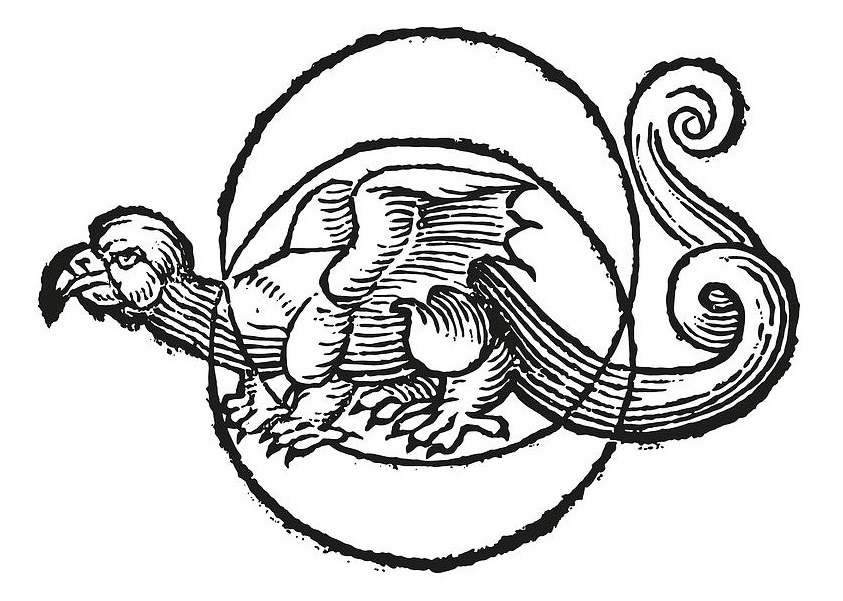
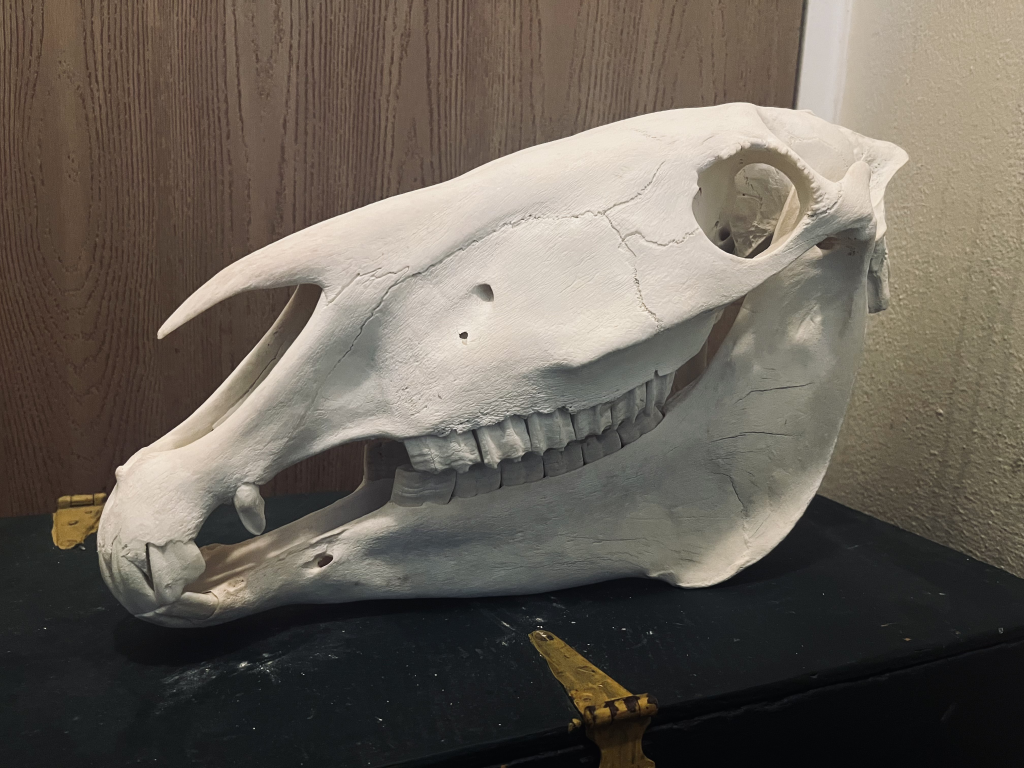
Over a year ago, Key wrote an excellent reflection on his experiences performing PGM XI.a 1–40: a conjuration of a familiar spirit that serves the household, captioned as “Apollonius of Tyana’s Old Serving Woman” in the Betz PGM collection. The three of us, along with and a few friends interested in the ritual, pitched in to procure a donkey’s skull and the blood of a black dog—the necessary materia for the consecration of the phylactery that serves to conjure the goddess Nephthys, so that she may grant the titular paredros spirit of the rite. Shortly after obtaining his own familiar, as well as additional ones for friends who happened to be visiting him at the time, Key shipped the skull along to Salt and I’s home, ready for the next installment for “The Sisterhood of the Travelling Donkey”. Our plan was to continue sending the skull around, each household obtaining their tooth (the vessel for the paredros), until it eventually made its way back to us to be permanently enshrined by the hearth at our combined home.
Since the skull’s arrival at our doorstep, Salt and I came to increasingly notice its surging awareness. While it is the teeth obtained from the old woman and the donkey that are truly the vessels and proofs of pact, the phylactery of the skull had clearly come to be endowed with its own numinous presence and alignment throughout its repeated use. Even without the conjuration being actively performed—and in the case of its use, even after the dismissal of the goddess—it was clear that some portion of Nephthys’ power remained within the skull, and that this was a holy object. When not in use, we kept it veiled in linen, treating it with the utmost respect as befitted an image of the mighty queen and her consort, the mighty lord Set. Salt and I specifically have, since before we even met and became a couple, long held fast a religious devotion to various Netjeru (Ancient Egyptian divinities), and so the phylactery had an additional layer of significance for us in our private observances.

Over the year, we’ve hosted many friends who have visited for various lengths of time to hang out, cook incredible meals, and get up to plenty of sorcerous adventures. In most cases, we actually got up to so many different projects that I had to draft an entire Google doc itinerary of planetary hours, elections, and roadmaps for where we’d go to gather what materia and what we had to enchant for at which time. In each moment, we intentionally tried to carve out a time to allow them to have their own midnight jaunt with the phylactery, especially as these were the very same folks who helped pitch in for its obtainment from the beginning. Yet an omen always arose for why it was not yet appropriate, even if temporally it would have been convenient for us all (shipping a donkey skull around is not fun!). In one case, we were about 20 minutes to the midnight hour, all dressed up with the wrapped skull in an IKEA tote, ritual printed off and candles for illumination at the ready, when I suddenly felt a distinct and knowing pang that led me to consult one of my closest spirits with their divinatory oracle about the matter, only to be told to call the rite off. The messages varied in each instance. Sometimes it was that our comportment was not sufficiently pure, in that even if we had all showered and donned clean clothes, something about our moods, excitement, earlier festivities of partying and revelry, or even the stench of the witchcraft we had been engaging in lingered still, rendering conjuring the goddess inappropriate. In other cases, the reasoning was even more nebulous, yet still felt by all. There was never any disappointment with regards to the timing—all present agreed something was “off” and that the skull phylactery would not consent to us proceeding with the ritual.
Naturally, I decided it would be better to ship it along immediately to keep the chain going, yet even this was interrupted. I could not shake that I should not yet part with the skull, and that there was still something left to do, or at the very least that it required some fulfillment still before being sent away on its long journey around and then back to us. Divination continued to advise for patience, as well as the completion of oaths already undertaken. I meditated for some time on what this may be, and continued to feel a nagging impulse that something about this entire scheme had to do with Salt in particular. Yet, the tooth we procured is to be shared between us, for our good lady paredros serves our combined household in which we live. We knew from the beginning that he would not be soliciting another, so what exactly was missing?
The answer came to us in vision in a truly illuminating and instructive fashion. Some time ago, Salt decided that he should procure a familiar from this ritual for his mother back in England and send her the tooth to assist her. By rank, she had to be next in line before any other. In other words, while sometimes the “vibe” was genuinely too off to proceed with the purity requirements of the ritual, the reason why we kept feeling as if we could not ship the skull yet to its next destination regardless was this essential matter in household authority. Before the goddess’ phylactery could impart its next boon, its blessing must first be addressed to the very person who kept Salt’s house throughout his childhood.
With this complete, the skull is now free to travel to its next keeper, passing all the necessary checks in omens and auguries. In addition to sharing our own experiences with the ritual (and again affirm its efficacy and usefulness to those discerning karcists interested in attempting it themselves), we wanted to give an example report of how the nature of the rite itself is imprinted in the very ethics of how it is conducted. If an agreement has been made to share a skull between sorcerers, and one of its intended beneficiaries is one of their mothers, then by rank she must inherently go immediately. Since the skull is ultimately going to remain with us once it has completed its circuit, Salt and I were planning on carrying out this additional rite then and giving it to her in person when we next visited, but the phylactery’s numinous awareness was adamant that the essential order of the proceedings must honour her first. As the paredros granted participates in the domestic mysteries, it is only right to address first whomever has played an essential role in one’s own life in such a manner, if they themselves are one of the intended recipients of the rite, regardless of the temporal proceedings of our visitations.
Without further ado, below you’ll find the accounts of what our individual experiences of performing the rite are—myself and Salt together for our own assistant spirit, and Salt’s when he conducted this another time.
When the night came for Salt and I to accomplish this undertaking, we first began by ensuring we were clean, freshly showered, and wearing new clothes. I printed off a copy of the ritual as it appears in Betz from the composite screenshot in Key’s post and prepared some candles and a candle holder so that we would have the light necessary to read it in the dark. With the skull wrapped tight in hand, we made our way to the middle of a three way crossroads, unveiled the donkey at the center of the fork, and lit the candle. I had my left foot over the skull as instructed, while Salt held onto me with the same glyphs beneath him.
Key’s experience with the ritual matched the level of intense manifestations and physical omens I witnessed in my own working of PGM IV. 3086–3124: The Oracle of Kronos. While none of us are strangers to those kinds of manifestations across our individual and shared traditions, they never cease to fill us with wonder and awe when they do occur. From the beginning of the first recitation of the formula, Salt and I immediately saw the otherwise still night air whip up into a frenzy of howling winds. The more we chanted, the more it screeched, shaking the trees and forcing us to continually shield the candle flame with our bodies so that we could read from the text. We saw the goddess appear top her donkey midway through the second repetition, swiftly appearing in all her brilliance, beauty, and divine splendor. Salt and I were stunned into silence by her theophany, bowing our heads swiftly at the sight of the beautiful young maiden sat atop her steed, her skin a vibrant gold and her hair extending into the night sky in streaks of lapis, jet, and labradorite.
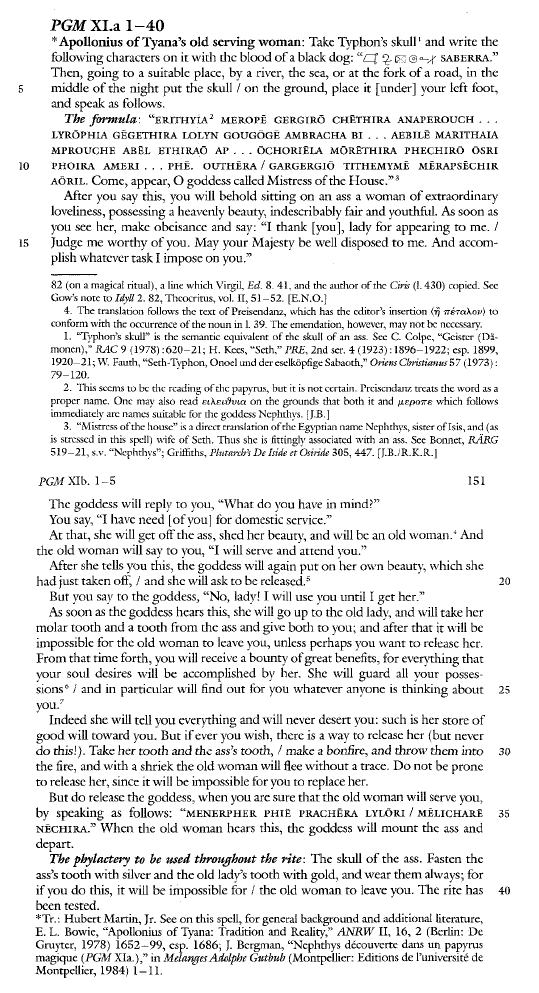
The dialogue proceeded roughly as the text describes. We stuck to the script, replying as the rite advises. When the goddess dismounted her steed (which appeared to us black with glowing red eyes, evocative of her husband Set), the light that illuminated her from within shifted, her skin sloughing to become that of an old woman, spots forming along her wrinkles, hair turning course and draining of colour. She only took this form momentarily before quickly receding into the shadows, within a blink taking on her earlier form. Scholar Eleni Pachoumi, in her article “Divine Epiphanies of Paredroi in the Greek Magical Papyri“, notes a similarity between the drama of this ritual and a scene from the Gnostic Apocryphon of John, from the Nag Hammadi library. John witnesses an epiphany in which Jesus first appears to him as a splendid youth, then as an old man, then as a servant. In this ritual, Nephthys first appears as a beautiful maiden, then takes the form of a crone herself, before eventually differentiating, emanating the old woman as a familiar spirit to be imparted upon the magician. We implored her to not leave, and that we would keep her until she grants us the old woman, at which point for the first time Salt and I saw the both of them, with the latter emerging from behind the steed of the former, pacing out from behind its tail.
At this point I felt a shift within the skull beneath my feet. While Key found a tooth already manifest outside the cloth as he was carrying the skull to the site of the ritual—somehow emerging from the tightly-bundled phylactery with a supernaturally loud clang on the pavement—we experienced a tooth visibly begin to wiggle and clatter about with the winds. As we gently moved to touch it, the howling air screeched even further, going from whipping from each direction to swirling around us, creating a visible circle of air that continued to lift higher, sending my hair up into the sky while the tunnel flexed towards the heavens. Throughout our dialogue, Salt and I continued to hear the physically audible barking of dogs and the braying of a donkey, as well as a persistent sound of bells ringing in perfect harmony. There was a moment when I thought there must have been several people with incredibly loud and animated dogs walking around at midnight in the middle of nowhere, but it was immediately obvious that there was no one around but us.
Salt knelt down to examine the skull under my foot, and carefully withdrew the wiggling tooth, which emerged easily into his hand. The rite says that the goddess will take from the old woman one of her molar teeth and a tooth from her steed and give both to you, after which it will become impossible for the spirit woman to ever leave you unless you burn the teeth. What we saw was the goddess retrieve these two teeth as described, present them towards towards us, and then merge them from physical apparitions into the body of the donkey’s tooth that had loosened and fell from the skull. Once we were absolutely certain that the pact had been signed, we scryed the tooth together, confirmed the presence of the old woman, and gave the dismissal. The goddess did not waste any time, mounting her donkey immediately and galloping off into the mists beyond the horizon. As soon as this was done, the cacophony of sounds—braying, barking, ringing, howling and all—ceased entirely, returning us to the silent and still expanse of the crossroad.
The next phase was carried out once we had determined the source of the delay. I was not present for this round, rather it was Salt alone who went to the crossroads. From conjuration to dismissal, he completed the ritual in record time, with all the same physical manifestations returning as if there had been no temporal distance at all. While in our first attempt, the tooth that wiggled forth was a molar, here Salt noted that all the teeth were completely fixed, rooted even deeper within the skull as if none of them had ever come loose, save for one incisor in the front that popped out immediately. The goddess made an additional instruction of him, as this was petitioned by him on behalf of a relative as opposed to purely for his own benefit—and especially as he had already solicited a familiar from her collectively as part of our collective domestic realm as a couple. With this agreed upon and sworn, Salt was able to complete the ritual swiftly and return to our home with his prize in hand, ready to be given over to his family.
Now with the skull freed up to go on its merry way to the next sorcerer, the three of us are even more excited to see what results will come of their own explorations. Our pool of experiences has widened to include several attempts now, each showing remarkable consistencies between manifestations, immediate proofs of power, the efficacy of the familiar spirits granted, and the entirely physical and immediately verifiable nature of the ritual’s conjuration. Not only can we vouch for the power of the ritual, we can confidently recommend its reliability through multiple tests.

 With Cunning & Command