Apollonius of Tyana’s Old Serving Woman: PGM XI.a 1–40 [A Second Experiment]

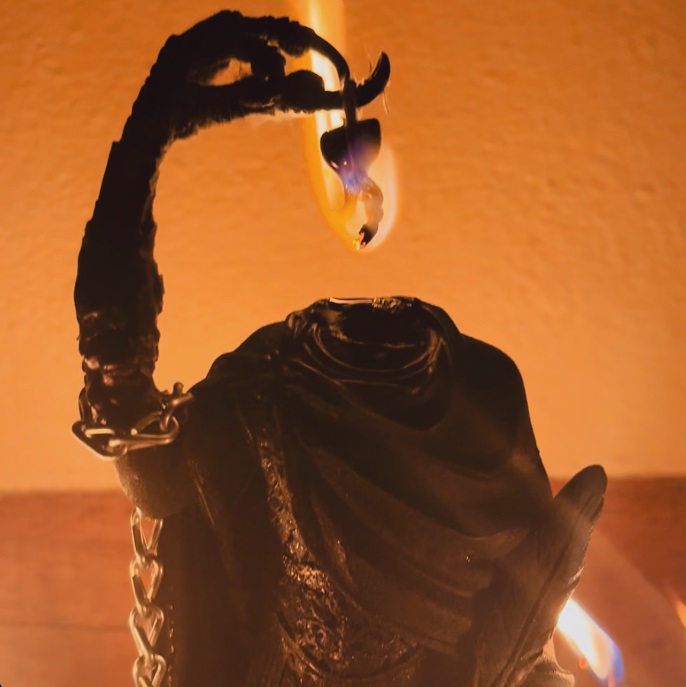
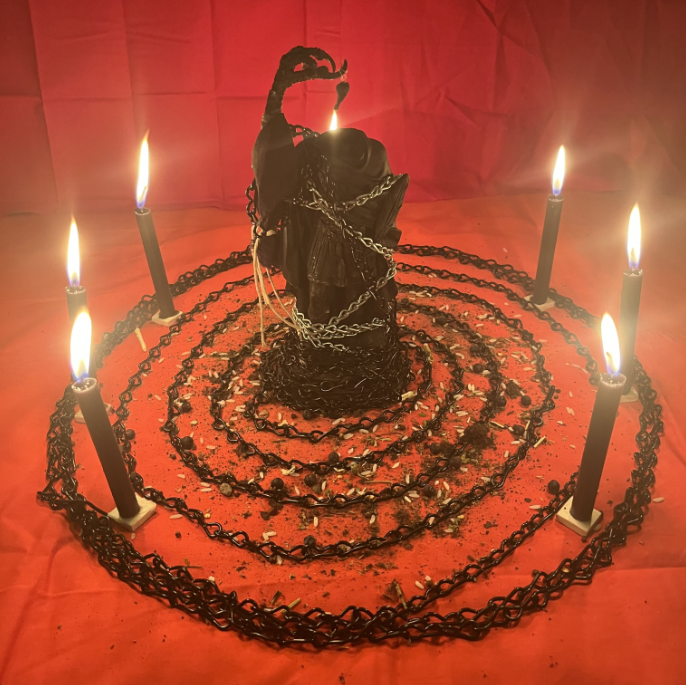
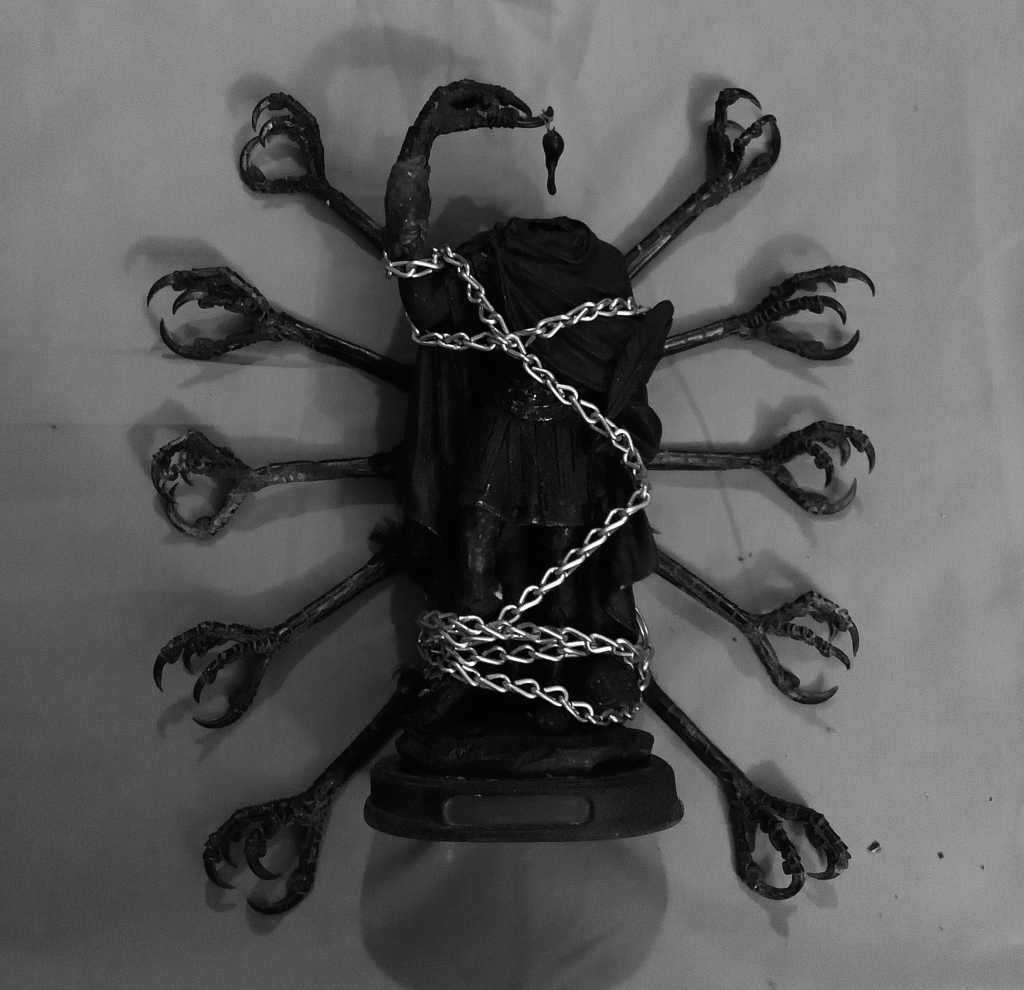
Over a year ago, Key wrote an excellent reflection on his experiences performing PGM XI.a 1–40: a conjuration of a familiar spirit that serves the household, captioned as “Apollonius of Tyana’s Old Serving Woman” in the Betz PGM collection. The three of us, along with and a few friends interested in the ritual, pitched in to procure a donkey’s skull and the blood of a black dog—the necessary materia for the consecration of the phylactery that serves to conjure the goddess Nephthys, so that she may grant the titular paredros spirit of the rite. Shortly after obtaining his own familiar, as well as additional ones for friends who happened to be visiting him at the time, Key shipped the skull along to Salt and I’s home, ready for the next installment for “The Sisterhood of the Travelling Donkey”. Our plan was to continue sending the skull around, each household obtaining their tooth (the vessel for the paredros), until it eventually made its way back to us to be permanently enshrined by the hearth at our combined home.

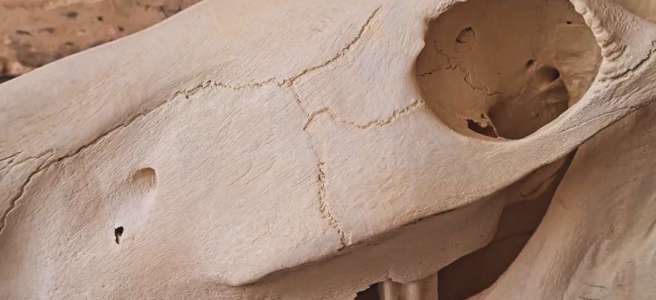
Since the skull’s arrival at our doorstep, Salt and I came to increasingly notice its surging awareness. While it is the teeth obtained from the old woman and the donkey that are truly the vessels and proofs of pact, the phylactery of the skull had clearly come to be endowed with its own numinous presence and alignment throughout its repeated use. Even without the conjuration being actively performed—and in the case of its use, even after the dismissal of the goddess—it was clear that some portion of Nephthys’ power remained within the skull, and that this was a holy object. When not in use, we kept it veiled in linen, treating it with the utmost respect as befitted an image of the mighty queen and her consort, the mighty lord Set. Salt and I specifically have, since before we even met and became a couple, long held fast a religious devotion to various Netjeru (Ancient Egyptian divinities), and so the phylactery had an additional layer of significance for us in our private observances.

The skull atop its linen veil by the hearth.

Over the year, we’ve hosted many friends who have visited for various lengths of time to hang out, cook incredible meals, and get up to plenty of sorcerous adventures. In most cases, we actually got up to so many different projects that I had to draft an entire Google doc itinerary of planetary hours, elections, and roadmaps for where we’d go to gather what materia and what we had to enchant for at which time. In each moment, we intentionally tried to carve out a time to allow them to have their own midnight jaunt with the phylactery, especially as these were the very same folks who helped pitch in for its obtainment from the beginning. Yet an omen always arose for why it was not yet appropriate, even if temporally it would have been convenient for us all (shipping a donkey skull around is not fun!). In one case, we were about 20 minutes to the midnight hour, all dressed up with the wrapped skull in an IKEA tote, ritual printed off and candles for illumination at the ready, when I suddenly felt a distinct and knowing pang that led me to consult one of my closest spirits with their divinatory oracle about the matter, only to be told to call the rite off. The messages varied in each instance. Sometimes it was that our comportment was not sufficiently pure, in that even if we had all showered and donned clean clothes, something about our moods, excitement, earlier festivities of partying and revelry, or even the stench of the witchcraft we had been engaging in lingered still, rendering conjuring the goddess inappropriate. In other cases, the reasoning was even more nebulous, yet still felt by all. There was never any disappointment with regards to the timing—all present agreed something was “off” and that the skull phylactery would not consent to us proceeding with the ritual.

Naturally, I decided it would be better to ship it along immediately to keep the chain going, yet even this was interrupted. I could not shake that I should not yet part with the skull, and that there was still something left to do, or at the very least that it required some fulfillment still before being sent away on its long journey around and then back to us. Divination continued to advise for patience, as well as the completion of oaths already undertaken. I meditated for some time on what this may be, and continued to feel a nagging impulse that something about this entire scheme had to do with Salt in particular. Yet, the tooth we procured is to be shared between us, for our good lady paredros serves our combined household in which we live. We knew from the beginning that he would not be soliciting another, so what exactly was missing?

The answer came to us in vision in a truly illuminating and instructive fashion. Some time ago, Salt decided that he should procure a familiar from this ritual for his mother back in England and send her the tooth to assist her. By rank, she had to be next in line before any other. In other words, while sometimes the “vibe” was genuinely too off to proceed with the purity requirements of the ritual, the reason why we kept feeling as if we could not ship the skull yet to its next destination regardless was this essential matter in household authority. Before the goddess’ phylactery could impart its next boon, its blessing must first be addressed to the very person who kept Salt’s house throughout his childhood.

With this complete, the skull is now free to travel to its next keeper, passing all the necessary checks in omens and auguries. In addition to sharing our own experiences with the ritual (and again affirm its efficacy and usefulness to those discerning karcists interested in attempting it themselves), we wanted to give an example report of how the nature of the rite itself is imprinted in the very ethics of how it is conducted. If an agreement has been made to share a skull between sorcerers, and one of its intended beneficiaries is one of their mothers, then by rank she must inherently go immediately. Since the skull is ultimately going to remain with us once it has completed its circuit, Salt and I were planning on carrying out this additional rite then and giving it to her in person when we next visited, but the phylactery’s numinous awareness was adamant that the essential order of the proceedings must honour her first. As the paredros granted participates in the domestic mysteries, it is only right to address first whomever has played an essential role in one’s own life in such a manner, if they themselves are one of the intended recipients of the rite, regardless of the temporal proceedings of our visitations.

Without further ado, below you’ll find the accounts of what our individual experiences of performing the rite are—myself and Salt together for our own assistant spirit, and Salt’s when he conducted this another time.

When the night came for Salt and I to accomplish this undertaking, we first began by ensuring we were clean, freshly showered, and wearing new clothes. I printed off a copy of the ritual as it appears in Betz from the composite screenshot in Key’s post and prepared some candles and a candle holder so that we would have the light necessary to read it in the dark. With the skull wrapped tight in hand, we made our way to the middle of a three way crossroads, unveiled the donkey at the center of the fork, and lit the candle. I had my left foot over the skull as instructed, while Salt held onto me with the same glyphs beneath him.

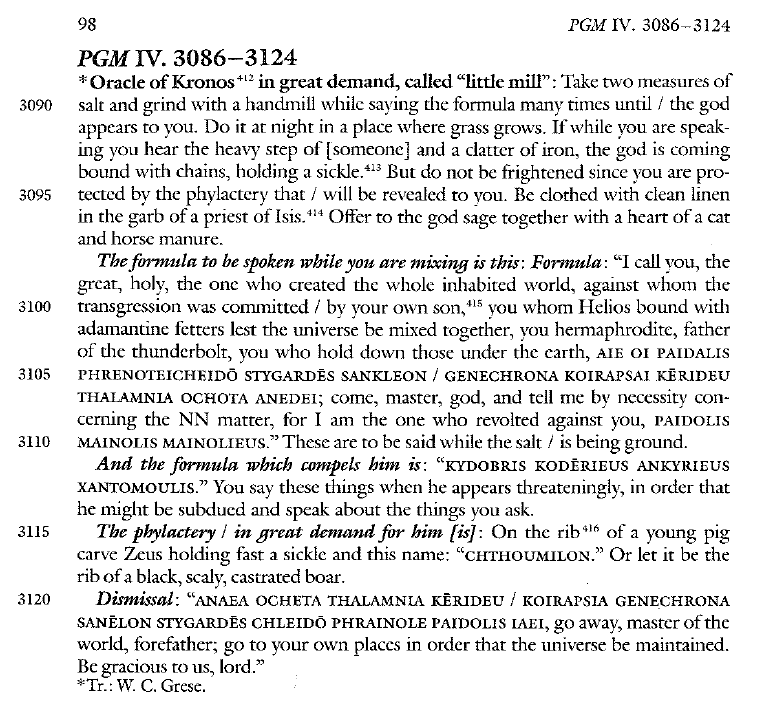
Key’s experience with the ritual matched the level of intense manifestations and physical omens I witnessed in my own working of PGM IV. 3086–3124: The Oracle of Kronos. While none of us are strangers to those kinds of manifestations across our individual and shared traditions, they never cease to fill us with wonder and awe when they do occur. From the beginning of the first recitation of the formula, Salt and I immediately saw the otherwise still night air whip up into a frenzy of howling winds. The more we chanted, the more it screeched, shaking the trees and forcing us to continually shield the candle flame with our bodies so that we could read from the text. We saw the goddess appear top her donkey midway through the second repetition, swiftly appearing in all her brilliance, beauty, and divine splendor. Salt and I were stunned into silence by her theophany, bowing our heads swiftly at the sight of the beautiful young maiden sat atop her steed, her skin a vibrant gold and her hair extending into the night sky in streaks of lapis, jet, and labradorite.

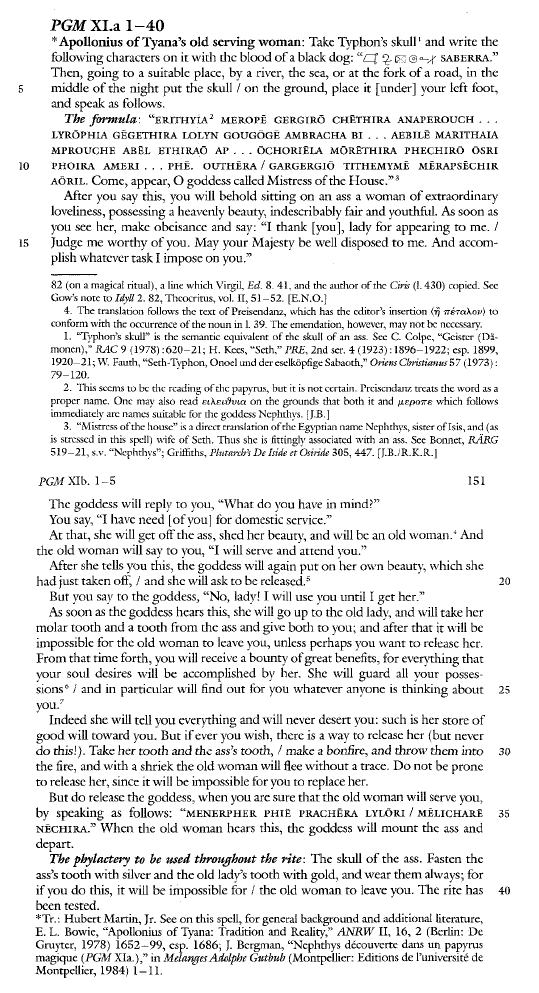
An image of the rite as it appears in the Betz translation, pages 150–1.

The dialogue proceeded roughly as the text describes. We stuck to the script, replying as the rite advises. When the goddess dismounted her steed (which appeared to us black with glowing red eyes, evocative of her husband Set), the light that illuminated her from within shifted, her skin sloughing to become that of an old woman, spots forming along her wrinkles, hair turning course and draining of colour. She only took this form momentarily before quickly receding into the shadows, within a blink taking on her earlier form. Scholar Eleni Pachoumi, in her article “Divine Epiphanies of Paredroi in the Greek Magical Papyri“, notes a similarity between the drama of this ritual and a scene from the Gnostic Apocryphon of John, from the Nag Hammadi library. John witnesses an epiphany in which Jesus first appears to him as a splendid youth, then as an old man, then as a servant. In this ritual, Nephthys first appears as a beautiful maiden, then takes the form of a crone herself, before eventually differentiating, emanating the old woman as a familiar spirit to be imparted upon the magician. We implored her to not leave, and that we would keep her until she grants us the old woman, at which point for the first time Salt and I saw the both of them, with the latter emerging from behind the steed of the former, pacing out from behind its tail.

At this point I felt a shift within the skull beneath my feet. While Key found a tooth already manifest outside the cloth as he was carrying the skull to the site of the ritual—somehow emerging from the tightly-bundled phylactery with a supernaturally loud clang on the pavement—we experienced a tooth visibly begin to wiggle and clatter about with the winds. As we gently moved to touch it, the howling air screeched even further, going from whipping from each direction to swirling around us, creating a visible circle of air that continued to lift higher, sending my hair up into the sky while the tunnel flexed towards the heavens. Throughout our dialogue, Salt and I continued to hear the physically audible barking of dogs and the braying of a donkey, as well as a persistent sound of bells ringing in perfect harmony. There was a moment when I thought there must have been several people with incredibly loud and animated dogs walking around at midnight in the middle of nowhere, but it was immediately obvious that there was no one around but us.

Salt knelt down to examine the skull under my foot, and carefully withdrew the wiggling tooth, which emerged easily into his hand. The rite says that the goddess will take from the old woman one of her molar teeth and a tooth from her steed and give both to you, after which it will become impossible for the spirit woman to ever leave you unless you burn the teeth. What we saw was the goddess retrieve these two teeth as described, present them towards towards us, and then merge them from physical apparitions into the body of the donkey’s tooth that had loosened and fell from the skull. Once we were absolutely certain that the pact had been signed, we scryed the tooth together, confirmed the presence of the old woman, and gave the dismissal. The goddess did not waste any time, mounting her donkey immediately and galloping off into the mists beyond the horizon. As soon as this was done, the cacophony of sounds—braying, barking, ringing, howling and all—ceased entirely, returning us to the silent and still expanse of the crossroad.

The next phase was carried out once we had determined the source of the delay. I was not present for this round, rather it was Salt alone who went to the crossroads. From conjuration to dismissal, he completed the ritual in record time, with all the same physical manifestations returning as if there had been no temporal distance at all. While in our first attempt, the tooth that wiggled forth was a molar, here Salt noted that all the teeth were completely fixed, rooted even deeper within the skull as if none of them had ever come loose, save for one incisor in the front that popped out immediately. The goddess made an additional instruction of him, as this was petitioned by him on behalf of a relative as opposed to purely for his own benefit—and especially as he had already solicited a familiar from her collectively as part of our collective domestic realm as a couple. With this agreed upon and sworn, Salt was able to complete the ritual swiftly and return to our home with his prize in hand, ready to be given over to his family.

Now with the skull freed up to go on its merry way to the next sorcerer, the three of us are even more excited to see what results will come of their own explorations. Our pool of experiences has widened to include several attempts now, each showing remarkable consistencies between manifestations, immediate proofs of power, the efficacy of the familiar spirits granted, and the entirely physical and immediately verifiable nature of the ritual’s conjuration. Not only can we vouch for the power of the ritual, we can confidently recommend its reliability through multiple tests.

Full Services by B. Key Now Available

After so much prodding and teasing from dear friends who have been (generously!) boosting my work despite my complete lack of social media, I’ve finally been conjured by the Tetra-instagram-maton to go more public, and also to offer a full spectrum of services.

I’ve been quietly coaching a cohort of mentees in scrying, mediumship, spirit work, and sorcery, stewarding the growth of their abilities to take charge of their own craft and identify and commune with their spirit courts ever more deeply. Now, thanks to the generous support and encouragement of our supporters and listeners, I’m ready to open my books to wider array of clients.

I’m happy to offer divination, spell work services, mentorship, and custom talismans, charms, oils, and wares to suit your needs, informed by spirit augury and confirmed with divination, to better assist the flourishing of your sorcerous agency on your terms. You can find a full list of all my services at our link [HERE]. I’ll be posting more on Instagram over the next little while of my previous work as well as current projects, and debuting some important new collections over the coming months. I’m greatly looking forward to taking in a wider array of clients full time, and building on the great work already accomplished with my current mentees in the cultivation of further freedom and agency through magic.

St. Christopher’s Protection Chaplets for Travelers

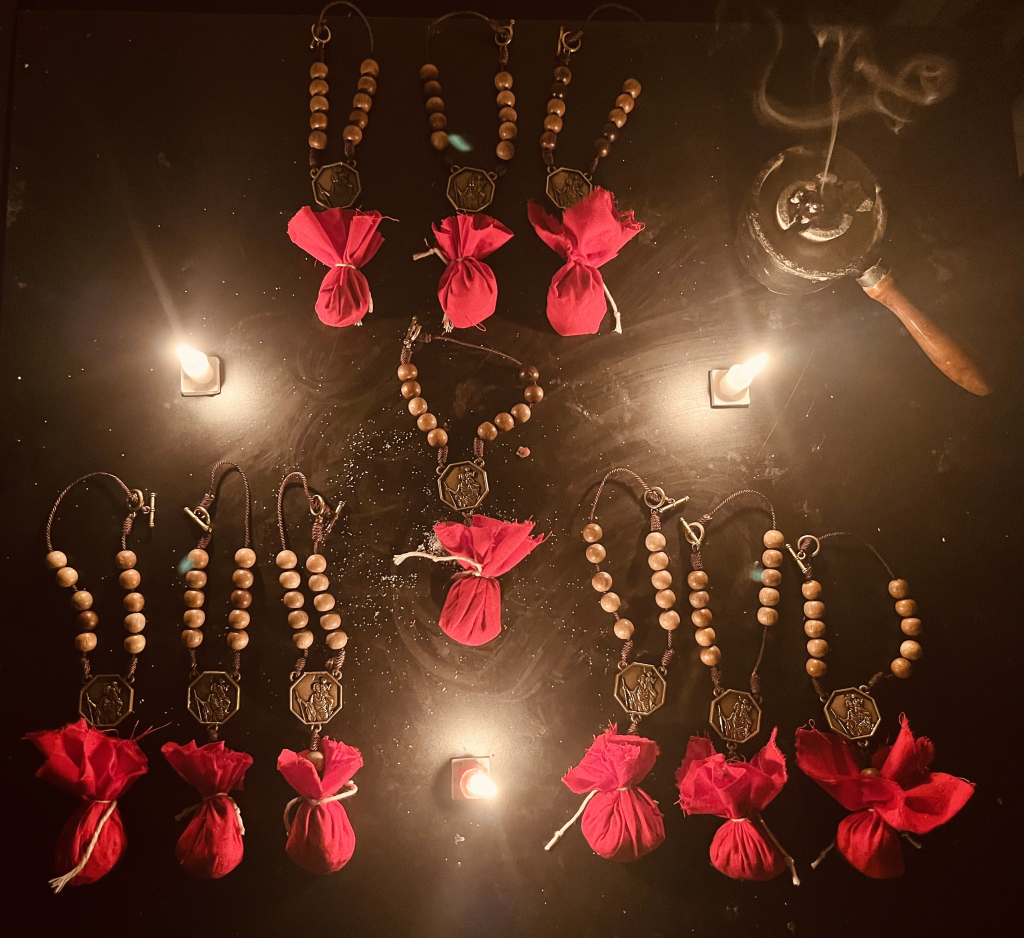
Inspired by our recent bespoke talismanic work, and much-teased on our podcast (that more such charms are indeed coming!) I’m proud to offer a new ally to our kind readers and listeners: protection chaplets diligently crafted under lamplight reflected by the watchful wolf-eyes of St. Christopher.

The talismans receiving blessings following their assembly.

As much-beloved protector and guide for all three of us at With Cunning & Command, St. Christopher is the immensely popular cynocephalic patron of travel by land and sea, athletics, bachelors, and surfing. A deeper analysis of the figure of the dog-headed warrior reveals a deeply-rooted identification with Hermanubis and resultant patronages of the dead, exorcism, treasure hunting, storms, gardening, conditions such as epilepsy and the plague, and of course the mysteries of wolves and dogs (all deserving of posts in their own right).

His most exoteric magical function is, however, situated in his protection of travelers, especially those on long journeys. Images of St. Christopher carrying the Christ-child are said to have excellent protective properties toward this purpose, so great in potency that simply viewing an image of the saint is said to be equivalent in spiritual benefits to receiving the Eucharist, prevent illness (especially plagues), and to avert any sort of sudden death. This lead to a massive proliferation of materials related to his cult, especially throughout Europe and the Americas—in a survey of images conducted for the British Archeological Association in 1904, a Mrs. Collier reports that his images were only outnumbered in English churches by those of the Virgin Mary. As a result, St. Christopher metals serve as the protection talismans par excellence in the popular imagination and find instantiations in folk magical traditions the world over. For these talismans, I decided to fuse the two most common protective modes for drivers and travelers that incorporate these properties: the charm bag and the rosary.

As recorded in Cat Yronwode’s book Hoodoo Herb and Root Magic, “A red flannel mojo containing Mugwort, Comfrey root, and a Saint Christopher medal is said to provide safety and protection to those who visit foreign places or venture away from home, and to make journeys more pleasant by eliminating interference in one’s travel plans.” The full composition of these charms will by necessity remain secret, but the core around which they are built is composed of the same mugwort and comfrey, each empowered and focused in their tasks by additional materia. Rosaries also serve as powerful and near-ubiquitous protective talismans throughout the Catholic world, especially seen hanging from the rearview mirrors of automobiles. This tradition has spawned various forms of rosaries and chaplets specifically made for this purpose, a set of which I repurposed for the construction of these talismans. The prayer that adorns the reverse of the image of St. Christopher reads: “São Cristóvão e São Miguel, protegei este motorista aqui na terra, para que ele não chegue adiantado no Céu!”, meaning: “Saint Christopher and Saint Michael, protect this motorist here on Earth, so that he doesn’t arrive early in Heaven!”

While a little more straightforward in its construction in comparison to other talismans I’ve created, these particular chaplets differentiate themselves through effort: they received extensive daily blessings and lavish offerings on my shrine to St. Christopher over a period of six weeks, culminating in various rosaries being said on each individual set of beads, and the charm bundles being fumigated through a sequence of astrologically elected incenses to further construct the enchantment. This particular diligence reflects the number and nature of the dangers inherent to the act of driving, each of which requires the utmost care in its aversion.

All St. Christopher’s Protection Chaplets are sold out. Thank you for your patronage!

Patreon Preview: Astrological Almanac

Greetings, all! Ever since we released our podcast and its Patreon, a staple offering I’ve been making available to our Patrons has been the monthly Astrological Almanac & Ephemeris. It’s been a true pleasure seeing everyone’s responses to it, and how creative many of our Patrons have been with their applications of the Almanac to their own practices.

Now that it’s September, I wanted to release last month’s issue to the blog, so that our beloved readers and listeners alike can get a feel for what this project actually is and entails. We’ve received many e-mails inquiring about this offering, so without further ado, here’s the August 2023 issue as it appeared on our Patreon:

This monthly e-zine is meant to accommodate those who have interest in astrology, as well as practitioners of folk magic, traditional Western and Galenic medicine, gardeners, farmers, and anyone else with a mind for the stars and the patterns of the sky on their craft. Each issue includes a number of different subjects, spanning electional astrology, articles on particular trees and herbs, monthly prognostications for particular horoscopic signs, astro-meteorology (or weather) prediction, as well as a calendar featuring daily Psalms and Saints for the particular days of the month to help you in consolidating your ritual calendars. In addition to all this, we also include an Ephemeris, giving the positions of the planets for each day of the month. Finally, we have the Voice of the Spirits, a monthly report presenting useful advice for those amongst our readers taken directly from a spirit-informed divinatory oracle on behalf of our Patrons.

Whether you want to look at the best day for a ritual purification, exorcism, what day would be best to use herbs belonging to Venus, or when the best time to administer a herbal treatment is, our monthly almanac aims to provide useful and condensed, immediately actionable advice on approaching all these topics and more. If you’d like to subscribe for access to the almanac as well as numerous other perks related to our podcast, myself and my co-authors and hosts would be honoured to have you at our Patreon. Our one (and only!) tier grants you access to our monthly magic Q&As, the ability to suggest episode topics, first dibs on new offerings at the website, and our show notes.

Thank you all so much for your continued support of our podcast, and stay tuned for new offerings and charms we’ve been hard at work on!

A PGM Miscellany of Charms to Restrain Anger

One of the genres of spells present in the PGM that B. Key and I have always found especially intriguing are those categorized as “charms to restrain anger”. There are a handful of these within the papyri, each containing a combination of one or both of the these components: an oral charm said in front of the person whose wrath you are restraining, and a lead lamella or papyrus stele that is either worn, thrown in a river, or deposited near the target. At this point, I’ve been keeping myself stocked on papyrus, clean linen, and sheets of lead to cut shapes out of for a while in my experiments; all I really needed to give these a test was the opportunity.

I have not had the need of using these charms for myself. Instead, my experiences testing them came from friends who approached me in moments of need, as well as from the handful of clients I regularly work with for matters of operative sorcery. (As an aside, while I am now only taking on new clients for divination, not sorcery, please consider contacting our very own incredibly talented B. Key if you are interested in custom talismans and materia to facilitate your own magical goals.) In order to respect their privacy, I will have to speak vaguely on these matters, omitting the majority of the identifying details. However, with the appropriate permissions given, I thought it might be prudent to write a little on my personal experiences with these charms, which were the most efficacious right off the bat, and which were combined with other workings in order to attain the desired results.

An image of the rite as it appears in the Betz translation, page 143.

In no particular order, let us begin with PGM VII. 940–68, being “A charm to restrain anger and a charm to subject”. Out of the entire miscellany, this is by far the one I have used the most frequently, largely owing to its balance of potency and ease of use.

All one needs is a new sheet of papyrus and some myrrh ink, making it especially easily accessible. I’ve found this charm to be highly reliable both on its own and as a compliment to other workings. With regards to the letters and names of power, I have had success with both the English transliterations and the Greek, and have found no changes in potency either way. The main way in which I have deployed this for others is to include the target’s name in the first space and the client’s in the second (“[…] silence, subordinate, enslave him, [target’s name], to him, [client’s name], and cause him to come under [his] feet”), swapping the pronouns as necessary, and then either further modifying the text to include more precise instructions as to how the target ought to be dominated, or including a full length petition with even more details, seals, sigils, and spiraling names of power on the back.

As the PGM does not state whether this charm is to be kept, disposed, or worn on one’s person, I’ve tried out a number of different ways to incorporate the papyrus once it is complete. In one case, I wrote out a spiraling command in a similar fashion to an incantation or demon-trapping bowl, and placed it within a jar I had filled with the target’s tag locks, along with numerous commanding, compelling, and controlling roots and herbs. I would continue to shake this regularly and burn candles anointed in domination oil over it, repeating both the petition on the back and the “come to me, you who are in the everlasting air […]” conjuration from the papyrus. In that circumstance, I incorporated the charm into this structure as this was for a longer-term working to dominate the client’s competitor. Once my client had won indeed won—and the competitor, a notoriously irritable and arrogant sore loser much prone to vengeful slander, did not make any fuss in their workplace—I buried the remains in an appropriate location chosen by my spirits.

Ultimately, what I’m most pleased about with this charm specifically is that, while these additional incorporations certainly boost its power, it still maintains a consistent efficacy when used alone. I have found that for long-term works of suppressing the pride and abuse of a perpetually-bitter and toxic person, it is best used as the driving component or petition of a greater whole that can be continually fed and prayed over. But for targeting temporary states, quelling heat, and ensuring, for example, that one’s boss overlooks and forgives a mistake, simply performing the charm as it is written in the PGM has proved consistently reliable.

Next up are a group of three charms which are entirely oral: PGM IV. 46–668, PGM LXXIX. 1–7, and PGM LXXX. 1–5.

From page 47.

This charm appears twice in the collection, once here and again at PGM IV. 831–32. The next two charms appear grouped together, and as their translator notes, are the same text written by different scribes. Given that they were both copied more than once, we might assume that they were actually found effective and thereby reproduced. After all, they are far from the only PGM spells numbering so few lines. Of course, there are many reasons as to why they might have been copied like this, but given their repetition, I felt more hopeful that they would work like an oral charm, whose power lies in the command of its utterance.

From page 299.

I have primarily tested PGM LXXIX. 1–7 by incorporating it into workings as a repeatable conjuration. In one instance, I stabbed a skull candle with pins anointed with our friend Mahigan’s Chains of the Siren’s Song Ritual Oil, an oil I’ve much tested under the employ of numerous familiars, while reciting this charm over each, seeing the pins as lances boring into the very parts of the target’s psyche most resistant to the sorcery. The bottom of the candle itself was loaded with a matrix of herbs and capped off with a Fourth Pentacle of Mercury, which grants the ability to “to acquire the understanding and knowledge of all things created, and to seek out and penetrate into hidden things”—and what might be so hidden as another’s mind and innermost thoughts? While this setup has proven to be powerful on its own, I did find that the inclusion of the charm provided a particular kick, gathering and commanding additional ambient spirits. I have also made use of this charm with a simpler skull candle working, in which the oil was slowly and hypnotically massaged into the wax (having already been baptized and crossed as the target, with a piece of their spirit conjured into it) while the charm to restrain the anger was repeated 365 times.

I mentioned earlier that I did not really have any need of these charms for myself. Perhaps the closest I have ever come to truly using one in immediate proximity was actually these very oral charms. During an instance of road rage, in which a belligerent driver in the adjacent lane began to blare his horn and drive recklessly, I locked my gaze onto as much of him as I could see and repeated PGM IV. 46–668 (“Will you dare to raise your mighty spear against Zeus?”) three times. When nothing changed, I switched to PGM LXXIX. 1–7 (which at this point I had memorized thanks to the earlier ritual) and was glad to see the driver indeed calm down—or at the very least, stop his fuming. While I do count this as a success of the latter charm working on its own, I reckon that perhaps an even better way to test it would be to mutter it three times in the spur of the moment when it is most crucial, to nullify swelling anger in its heat. Suffice to say, it is indeed a good thing that this opportunity has not yet presented itself to me.

In the highway example, PGM LXXIX. 1–7 had an effect while PGM IV. 46–668 did not. The latter is not only much shorter, but draws on only one name of power, being Zeus. I imagine that it would make for quite a mighty boast in the heat of battle—not just of weapons, but wits. Imagine being in the middle of a debate and whipping out such a flex under your breath! Some nearby spirit may well be spurred to action, or perhaps the charm could weaponize one’s Eye to affix itself upon their target. I have not used it as thoroughly as the other, though I have found it helpful as a mantra in one Jovian work of protecting a client not be fired by their boss. As additional materia and seals of Jupiter were being employed, this charm found itself all the more useful by its invocation of the mighty Zeus.

From pages 148–149.

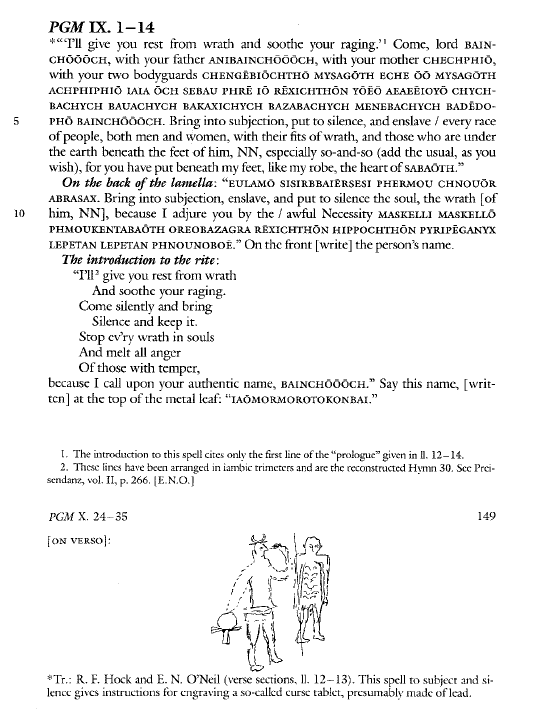
The first of our lamellas is PGM IX. 1–14. While the spell itself only mentions engraving the words, target’s name, and image upon a “metal leaf”, the metal in question is not specified. Much as the translators themselves note, I presumed this would be lead, and my daimons and familiars concurred.

I performed this spell precisely as outlined without including it into other workings. While the PGM doesn’t specify what should be done with the lamella afterwards, I decided to bury it at the workplace of the target. Within a week, my client alerted me that not only was the individual in question far more demure, but that they were no longer making snide comments, sabotaging her efforts, or behaving jealously and with constant venom towards her. This was the only time that I made use of this lamella specifically, though I have plenty of ideas for how it could be used in conjunction with further ritual. Much as in the earlier case, I imagine it could be incorporated into further materia, rolled up like a tube and inserted into wax or clay poppets, sewn into cloth talismans, or wrapped in snakeskin and placed in the claw of an owl to be hung and fumigated—both animals being associated with Ananke, a goddess called upon in the conjuration (“[…] I adjure you by the awful Necessity […]”).

Needless to say, I certainly plan on incorporating it into other methodologies in the future with my spirits and see how it lends its power to additional structures of sorcery. What is essential is that the charm itself worked when I needed it to and is perfectly sufficient for the job on its own. Next time the opportunity for using this arises, I will ask my spirits during our initial divination about the matter if they foresee this charm as being sufficient, or if I should further bolster it. This is really how I proceed with any of these—I first consult with my court about whether it would be appropriate to test out the charm in the situation (as opposed to rely on a more tried and true method between us), and then check if they advise any modifications or to proceed as given.

From page 149.

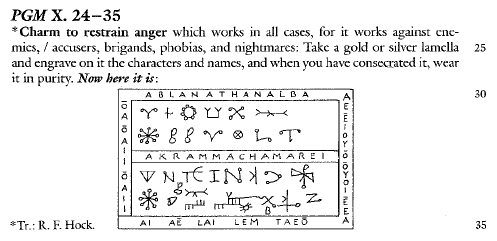
Speaking of charms which I didn’t change in any way, immediately following our previous example is PGM X. 24–35, a spell which allegedly “works all cases”, and not just against enemies, but phobias and nightmares. I am particularly fond of this one as it has such varied applications, being able to restrain not only the anger of others, but one’s fears and anxieties. While the spell specifies the use of gold or silver, I ended up using a sheet of tin to make four copies. All had varying degrees of success, so I can definitely vouch for the efficacy of tin specifically as a substitute. In fact, a friend even drew this out with a bronze stylus on aluminum foil and had it work, so it’s good to know that there are cheaper alternatives available. I plan on eventually making one out of silver just to have as a personal talisman, but for now tin definitely suffices.

I gave my set out to four friends and asked them to carry it on their persons while “pure” (not bleeding, not having recently had sex, etc.). One used hers to prevent nightmares, placing it under her pillow when not menstruating or having recently had sex, and otherwise by the bedside table. She reported to me that she noticed a marked decrease in regular nightmares, with the only ones that she did have appearing to be relevant as omens or indications of something being spiritually amiss. Another friend used hers to literally restrain her own anxiety and tendencies towards self-sabotage. While this of course did not fully resolve the anxiety in a long-term sense, being no substitute for therapy, it did help to contain it in moments of need, such as an important interview. The other two both used theirs for the primary purpose of restraining anger, albeit in both cases preemptively. They carried it to work around problematic colleagues and bosses and noticed a marked difference in their attitudes towards them specifically, but not towards others. It seems that even though one doesn’t engrave their own name upon the lamella, it is linked by the sympathy of being carried or worn to affect most powerfully its bearer. Wrathful coworkers and superiors still exhibited their usual behaviour to others, but ignored and passed over my friends entirely.

From page 269.

The next two charms are written one after the other in their papyrus. The first is PGM XXXVI. 1–34, which is a personal favourite as it calls upon Set-Typhon. The Kemetic Set is a deeply beloved deity for me, being formative in many of my personal experiences and bearing a place of great prominence in my home alongside the Lord of Wisdom, Djehuty. This spell calls on Set to restrain any subject—it is not specifically for anger, but rather works on “everything”. Inscribed by bronze stylus onto a lead sheet, the magician creates an image of Set (I confess mine was much nicer than the one preserved in the book, as I sketched the God more true to his Egyptian iconography) and inscribes the names of power within and around his body.

While I have only made use of this charm twice, it bore the most powerful and immediate result for me out of all of them. I do not doubt that this is at the very least partially owing to my preexisting relationship with the God. While I’m sure the powers and names of the associations alone will conjure success in the right circumstances (presuming one’s target does not have sufficient protections, and that one does not sabotage or work against the sorcery themselves by provoking them), the sheer intensity of the results I experienced with this were certainly benefitted from the decade of regular offerings and prayers I have made in cultivating my relationship with Set as a patron and Father to my craft. In one of the two instances, I deployed this charm to restrain both overbearing relatives and ancestral spirits alike from interfering with my client’s drastic change in career and lifestyle, and both parties evidenced a drastic change in attitude practically overnight. Out of the entire miscellany, I would recommend this one the most for matters of exorcism and the suppression of the pride and authority of particular spirits, who could not otherwise be bribed or negotiated out of their interference.

From pages 269–270.

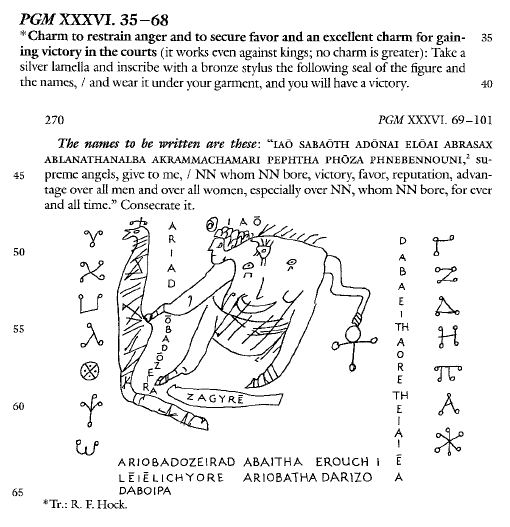
Immediately after we have PGM XXXVI. 35–68, which assures us that it works “even against kings” and that “no charm is greater”. This one is part of a group which aim to not only restrain anger but also to secure and promote success and victory over others. The figure (which looks to me like a deity doing a kick flip on a skateboard while holding a serpent) is drawn on a silver lamella with a bronze stylus. Again, I ended up using tin, and found it to still work in the time that I deployed it. I gave it to a client to wear during an important competition and was much overjoyed to have heard that he had won. According to him, the opposing team was unusually sloppy and distracted, and his own demonstrated extreme confidence and prowess. Emboldened by this, I was going to make the same charm for another friend who was about to apply for a significant award, but was informed by divination that they would not win, even with the help of the lamella. My spirits informed me that this charm is better used in interviews and in direct competitions in which one is confronting their opponents, not in long-term applications with multiple, anonymously peer-reviewed rounds. While I considered the idea of making one anyway and using it as the centerpiece of a larger working, such as placing it under a plate upon which I would inscribe seals, conjure spirits, and burn candles (while having my client wear a matching one on their person), I ultimately was shown a more efficacious way to assist them by my court and proceeded with their guidance. That said, my spirits did agree that it would still work when used in conjunction with other such workings—they just happened to suggest an alternate method for that particular case.

From page 273.

Oh, how I love a charm that has you hold your thumbs. I’m always reminded of Balkan cantrips for invisibility and leaving one’s body as a spirit that have you repeat a phrase while holding the thumbs—which is also the equivalent for crossing one’s fingers for luck where I’m from! PGM XXXVI. 161–77 is a great one when it comes to affordability: it’s an oral charm that offers the potential to “augment the words” with a papyrus amulet. Instead of performing this one myself, I had my friend perform it on her own behalf to stop slander. I particularly like the phrasing of “[…] stop the mouths that speak against me, because I glorify your sacred and honoured names which are in heaven”. The elevation of one’s pure mouth, which speaks the holy names, over profane libel and other such drivel. My friend also wrote the full list of angel names on papyrus and kept it on their person, which assisted in stopping the gossip. This is another one I think can be really easily incorporated into plenty of other workings of folk magic. It provides a buffer of protection and an exaltation of one’s own truth and piety over that of slander, so as such one should ensure that they do not engage in gossip or similar behaviour while seeking the charm’s solace.

From page 274.

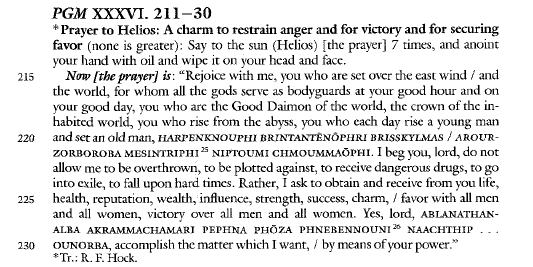
Shortly after we have our final charm which secures victory and favour in addition to restraining anger (by the way, in case you were wondering: none is greater). I just love that each of these makes mention that no charm is better while calling on entirely different gods and holy names; it feels a bit like watching an advertising competitions between cults. PGM XXXVI. 211–30 calls upon Helios, praying to him directly while facing the sun seven times and anointing your hand with oil, wiping it on your face. This one I performed myself to assist with winning a game of pure chance. As the spell does not specify which kind of oil is to be used, I opted for Holy anointing oil, though just frankincense would also do well in a pinch. I literally left my computer, stepped outside into my backyard to recite this, and then returned with the oil smeared on my forehead to resume the game, and promptly won six out of ten rounds of pure numerological chance—not a bad rate in the slightest! I definitely recommend playing around with this one. As it’s a prayer, it can be incorporated into many circumstances for obtaining victory, favour, honour, and fortune, and that’s with just using it on its own. Creativity is surely the limit with the ways this can be used. If you plan on using this for a major undertaking, I would always recommend divining first to see if it would work in your case, and if the answers are negative, using it more as a background boost for more elaborate sorcery.

From page 129.

Finally, there’s PGM VII. 417–22, which to my delight actually does call for tin! This one specifically should be thrown into a flowing body of water at sunrise, being engraved with the names of power and a customizable petition. I’ve done this one three times (making offerings at the riverbank to the local spirits in thanks each time) and it worked in two of the three instances, with the third one revealing under later divination that its magic was not able to sufficiently reach the intended target. In that instance, I went back to the drawing board, sent out a familiar adept at fetching etheric links from a long distance, and conjured more of the target’s presence into a spirit trap before subjugating their abusive behaviour towards my client further. The other two cases were far more local, which I imagine played an important role in how the spirits of the land and waters were able to deliver the potency of the lamella to them. The case in which this charm did not work ultimately involved an exceptionally prideful and stubborn target, so I was not surprised that it did not ultimately help much in the initial stages—though I found that making the charm anyway helped “soften” them up to make the later magic more effective, as it had stripped down some of the initial layers of resistance and protection.

In testing this genre of charm, I was able to verify that each is fully capable of producing its own result, while also easily being combined into other workings. In some cases, a lamella can simply be given over to a spirit on their shrine or laid atop their vessel, so that it becomes as a tool for them to use in your defence. In others, they were worn on the person, disposed of in places of power, or left to accumulate power inside containers and under candles. What strikes me the most about these charms against anger is how diverse they are. While they certainly are excellent to memorize in moments of passion when they would be necessary (especially in the case of the oral charms), they can be used to restrain far more. Pride, anxiety, nightmares, interfering spirits, gossip and slander, and even the very hidden plots and temptations within another to cause harm to oneself and one’s reputation—the diversity of use for these charms make them an excellent corpus to consider experimenting with, and I recommend those interested to not only play around with them with their own spirits, but to use them as a means to consider the applicability of other kinds of sorceries in matters concerning far more than what might initially meet the eye.

An Offering of Oil and Talismans in Celebration of the Feast of St. Expedite

Joyous feast of St. Expedite, holy martyr and swift intercessor of our souls! A saint deeply cherished by all three of us at With Cunning & Command, he’s been a continual guide, tutor, and ally in our workings. For his 2023 feast, I am proud to present a fresh take on an old offering, as well as three new rigorously-tested oils available for all who would like to further ingress into the pious soldier’s mysteries, accumulate great fortune and phenomenal luck, and solicit financial blessings, boons, and all manner of opportunities for the generation of wealth.

The intertwined consecration of the first batch of oils.

Oil of St. Expedite: Gold Edition

An oil built at the guiding hand of St. Expedite over many years and just as many iterations, bringing about countless successful workings, manifestations, and results for both myself and others along the way. This edition of the oil serves as a distilled offering to the Saint himself, primarily stirring him and his legions to action and guiding his virtues and sympathies into workings under his auspices. I recommend applying seven drops to the right foot of an image of St. Expedite upon the reception of this oil in order to complete a final personalized consecration. Cinnamon bark, cinquefoil, coconut flesh, coffee beans, dice, eucalyptus, lemongrass, blessed palm fronds from a Catholic church, crumbs from multiple pound cakes offered to St. Expedite in exchange for successful workings in his name, roses fed holy water from three different Catholic churches and offered to St. Expedite on Easter, whole vanilla beans, wintergreen leaves, skeleton keys, scraps of cloth from a cape that adorned a statue of St. Expedite, dirt from various shrines to St. Expedite, gold, silver, a carrier oil kept and fed on St. Expedite’s shrine for one year from feast to feast, and additional vegetable, animal, and mineral components. 1 fluid ounce / 30 milliliter amber glass dropper bottle.

$60.00

The Red Oil in its first stage.

Oil of St. Expedite: Red Edition

An oil that expands on a traditional Hoodoo formula to bring luck in all forms, especially in financial and amatory workings. This edition of the oil was tested through cash bingo games at a local bar, thoroughly satisfying my expectations after winning 4 of the 7 games played, much to the delight, or chagrin, of the bar’s patrons. Alkanet roots, multiple varieties of cinnamon bark, coconut flesh, blessed palm fronds from a Catholic church, roses fed holy water from three different Catholic churches and offered to St. Expedite on Easter Sunday, whole vanilla beans, scraps of cloth from a cape that adorned a statue of St. Expedite, a carrier oil kept and fed on St. Expedite’s shrine for one year from feast to feast, and additional vegetable, animal, and mineral components. 1 fluid ounce / 30 milliliter amber glass dropper bottle.

$60.00
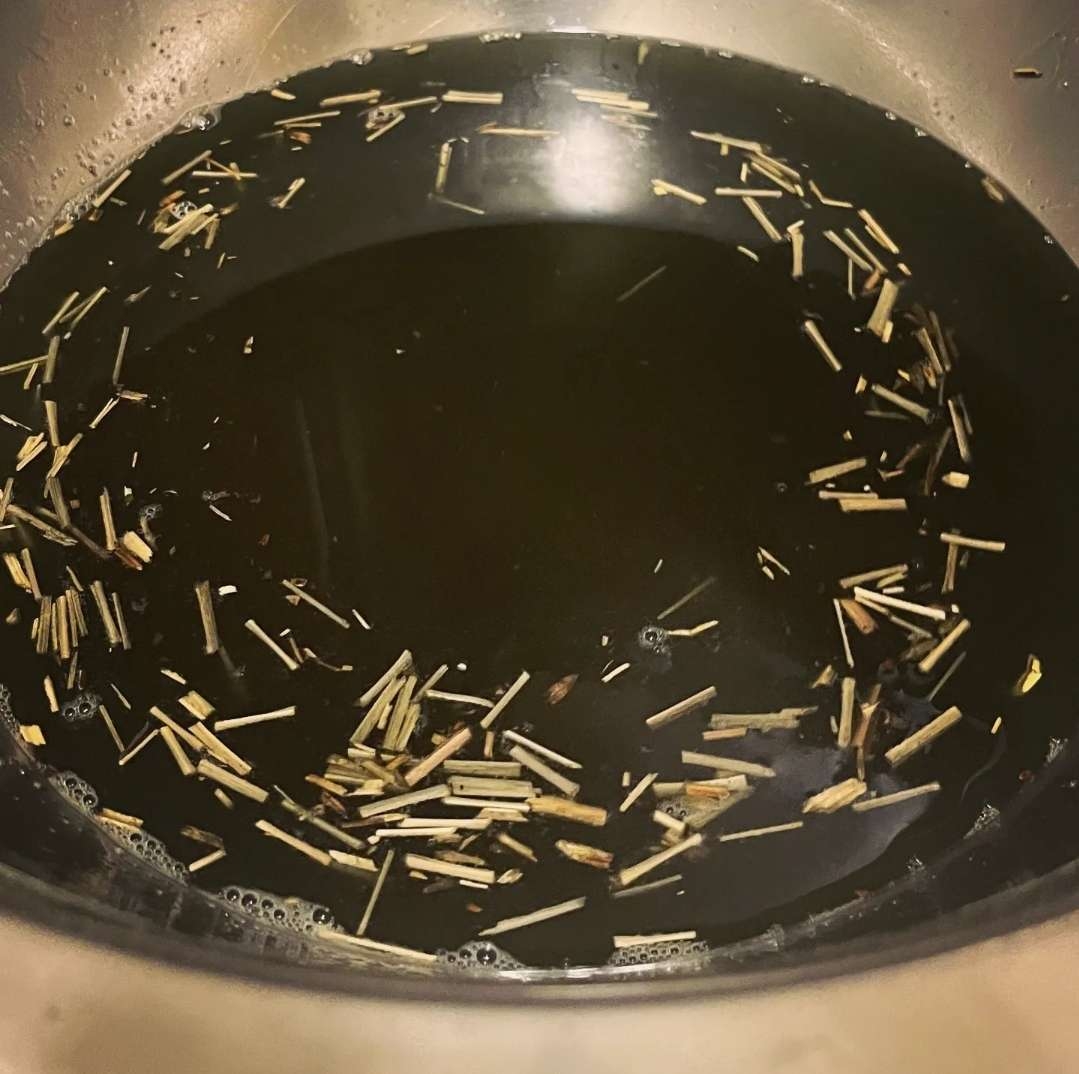
The Green Oil, having been produced from the bodies of Gold and Red.

Oil of St. Expedite: Green Edition

An oil that expands on a traditional Hoodoo formula to bring monetary, financial, and business success, along with myriad other forms of wealth. This oil’s construction was made possible only after the Gold and Red editions brought the material and financial components included within. Shredded currency won through gambling using the Red Oil, multiple varieties of cinnamon bark, cinquefoil, hyssop, indigo powder, lemongrass, multiple varieties of mint, coconut oil, sunflower oil, sweet almond oil, wormwood, gold, a carrier oil kept and fed on St. Expedite’s shrine for one year from feast to feast, and additional vegetable, animal, and mineral components. 1 fluid ounce / 30 milliliter amber glass dropper bottle.

$60.00
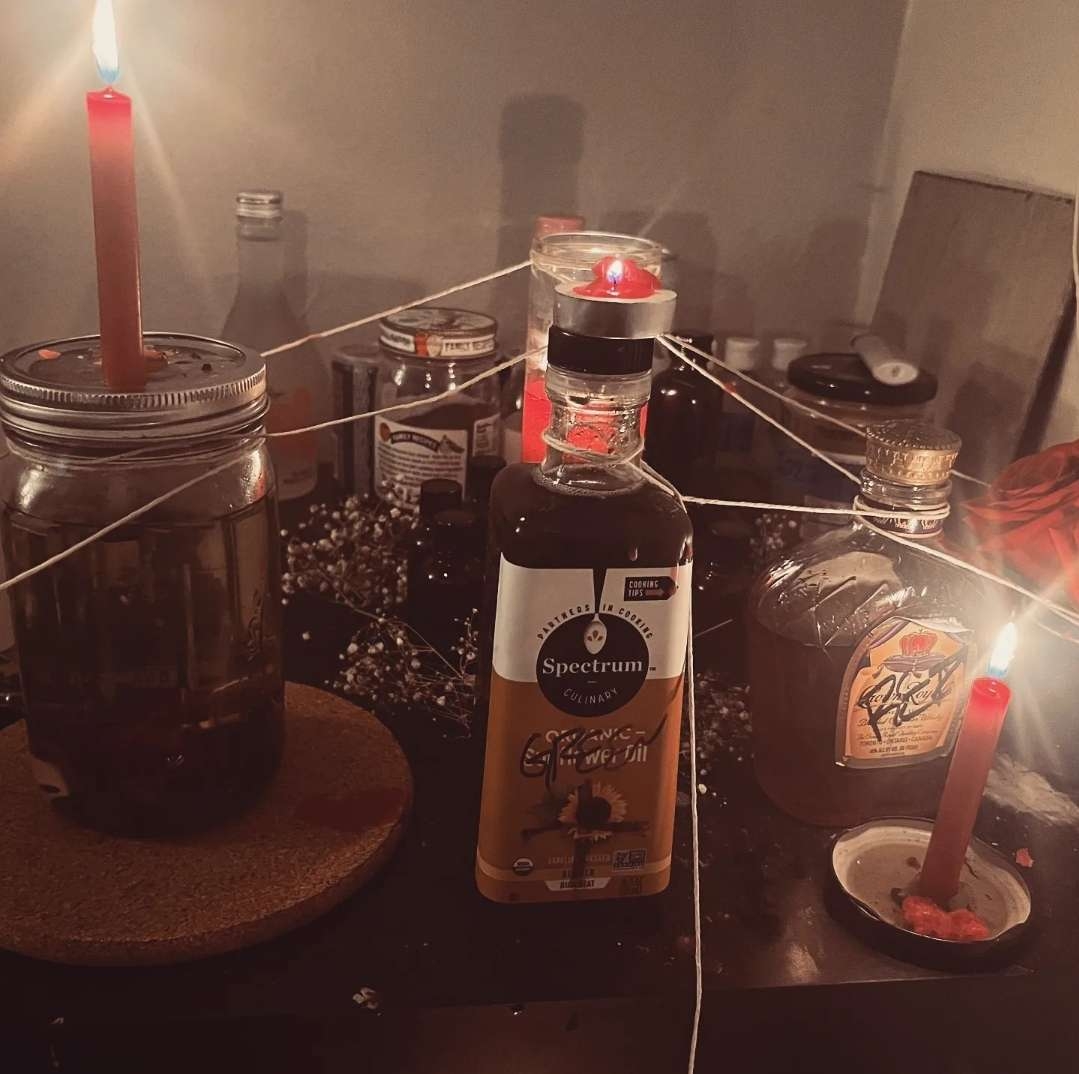
The three mother bottles receiving their final consecrations.

A Trinity of Oils

For those who wish to purchase a set of of each Gold, Red, and Green editions of Expedite Oil, a discounted rate is available. Three 1 fluid ounce / 30 milliliter amber glass dropper bottles.

$160.00

A batch of last year’s charms charging.

Mercury in Nutmeg, Third Edition

Back by popular demand, a batch of Mercury in Nutmeg charms are available for the Feast of St. Expedite. As described in a post all their own, these talismans for all manner of luck-enhancement can be petitioned with your desires in mind in order to bring about expedient and radical changes in fortune. Born from a year of continuous experimentation with the aim of refining the ensorcelled components therein, the third edition of the Mercury in Nutmeg charms contain an improved variation of the powdery matrix that fuels the talisman and an improved internal load born of metallurgical and alchemical processes hard won from the various patrons of these arts. As with previous editions of this talisman, a cantrip similar to a “knotting the wind” charm has been included to unleash a brief yet intense boost in luck in a critical moment. In order to use this extra boost in power, untie the red cord affixed to the talisman and burn it, scattering the ashes to the wind.

Those who have purchased previous editions report best results when carrying the talisman with them, or keeping the talisman situated in work spaces, on computer desks, or inside the cash registers of their businesses. As these talismans are very much alive, the spirit should be nourished with offerings of strong, dark liquors such as whiskey, brandy or dark rum, tobacco smoke, red, green, or yellow candles, and praise upon successful completion of tasks.

All Third Edition Mercury in Nutmeg talismans have been sold as of April 19, 2023! Thank you all so much for your support!

The first batch of individual bottles for sale being set over the Kamea of Mercury.

The products herein are made in limited quantity and offered on a first-come, first-serve basis as curios only. Please allow up to one week from the time of purchase to package and ship each order. An email with tracking information, when available, will be sent to the address associated with the PayPal used at purchase.

For those interested in bespoke work or wholesale opportunities, contact us [here]. Stay tuned for more offerings shortly, as well as an exciting new project for the entire blog!

Thank you, St. Expedite, for guiding my hands.
Co-Arising Stars: Formula for the Paranatellonta

Paranatellonta and the formula for calculating rising and setting stars

The paranatellonta are another major feature of astrology that is occasionally utilized by classical authors, such as Firmicus Maternus, Manilus, and so on. We also find examples of these rising stars in later authors, influencing works such as the Astromagia of Alfonso and the Astrolabium Planum (or Astrological Optics as the English edition is known) of Johannus Angelus. They even find themselves appearing in the works of William Lilly and later renaissance authors, by their tables of “bright, dark and empty” degrees.

Now, the word paranatellonta (παρανατέλλοντα), literally “parallel rising” (or alternatively, συνανατέλλοντα, “synanatellonta” – rising simultaneously according to the Brill’s New Pauly) describes the rising of the fixed stars that occurs over the horizon. This is contrasted with the method of Ecliptic Projection given by Ptolemy, which sees use in various works including Anonymous 379 – in which, though he might imply use of the paranatellonta by his language, is in practice giving the ecliptic projections of the fixed stars in his work. This ecliptic projection method is also used by many astrologers today and in the classical period. It’s the most common and popular method of using the fixed stars, and itself one of much use and virtue.

Yet it is not the sole method of observing them, and, alongside the heliacal phases of the stars, the paranatellonta make up one of the three approaches to using the fixed stars in classical astrology.

Now, in ecliptic projections for the fixed stars, even if 8° Leo is rising in the Ascendant, it doesn’t mean that a fixed star whose ecliptic projection is at 8° Leo will also have its physical body also rising, because it is not directly on the Ecliptic (though some are and thus will). In other words, its body might be elsewhere, under or above the horizon. The paranatellonta however, refers to the more precise astronomical observation that we can use to determine the ascendant degree at the time a particular star’s physical body appears over the horizon. The name itself – co-arising, parallel rising, or rising alongside, however you spin it – is chosen because they rise at the same time as a particular degree of the zodiac, over the circle of the horizon. Thus they share a sympathetic relationship to the same said degree and exert their influence over it. The precise astronomical relationship here is going to be a subject in my upcoming Astrological Course, and we’ll leave those finer details for another time, though those familiar with the basics of astronomical coordinate systems will be able to understand these things just by what has already been written.

The concept of paranatellonta does indeed have a relationship to the “parans” of modern astrology, though there are also some distinctions and differences as well. Namely, as far as similarities go, the emphasis is upon the star’s physical body rising over the horizon (though we arguably also include culminating and setting stars as well) at the time of the Native’s birth.

As far as the differences, the first is that the paranatellonta emphasise the horizon. In other words, a star must be in the Ascendant or (arguably) culminating, setting and so on, to be considered relevant. It does not need to be regarding a planet to be effective or to have influence over the figure.

The second is that the paranatellonta are only effective at the time of birth itself – the exact measure of this seems to be based on the exact degree that the star co-rises with, if we consider the ‘images of the degrees’ given in Johannes Angelus & the Astromagia to give us an indication of this, although its worth thinking that Firmicus is clearly ascribing Sirius multiple degrees of influence as well. On the other hand, contemporary use of the parans considers them in relationship to the planets and horizon, and through a 24 hour period, whilst the paranatellonta emphasise the moment and degree of birth itself.

So we can see that the fundamental concept is very similar, and holds a similar basis; but there are distinctions as well.

Now, these paranatellonta also have a relationship with the decans, which makes sense considering that the decans were observed in relation to the horizon as well as their heliacal phases by the Egyptians, creating a nocturnal stellar clock – though we should distinguish the earlier Egyptian decans and the later use of decans in horoscopy.

We see them as especially important in judgements of physiognomy and the body in Astrology – which, is a far more important topic than is given credit at times. The body itself is a Nativity – a natal chart in and of itself – and the divinatory art of physiognomy as expressed in premodern Europe, much as chiromancy (or palmistry), was essentially looking at the celestial influences upon a person using the body as the medium and making divinatory statements based on their appearance. Likewise the paranatellonta are given a clear relationship to the body by Firmicus Maternus in his Mathesis – who, drawing on (I believe, as I am quoting from memory here) a lost work by Nechepso and Petosiris, gives the degrees that he calls full, and the degrees that he calls empty. These are related to the “bright, empty, dark, smoky” degrees found in later Astrological literature.

The list given by Firmicus Maternus includes Sirius as the most reliably identifiable star, and gives it to the 7th to 11th degrees of Cancer. However, the ecliptic projection of Sirius was in Gemini during the period Firmicus was writing, and the same for any sources he would have been using. On the other hand, if we look at the rising of Sirius over the horizon, during 100 BC the value we have is roughly 12 degrees of Cancer using the modern zodiac. Of course, there would naturally be offset from the zodiac used by our classical authors by some measure, but, it is still approximately close enough.

Correcting these tables (assuming they need it – as I think they do) is a difficult task; the paranatellonta vary as to which star rises, and which stars set over the horizon at any given time based on latitude. Thus any such efforts to do so would need to be able to calculate them for the given latitude as well as precession. Probably an impossible task, all in all.

But we can see here the relationship the fixed stars and paranatellonta have with the appearance. This is resembling to the decans who themselves, in astrological literature, tend to represent the corporeal form or body of a thing that they signify, as well injury to the same by disease or accidents. We find examples of this relationship in the works of Sahl Bin Bishr (again quoting from memory, please comment if a correction is needed!) who cites Al Andrazaghar on the use of the Face-Lord in judging appearance and also Julian of Laodicea, recently translated by the Horoi project. Thus we see that the co-arising stars have a strong share and influence over the body of the Native, as well as their activity and behaviour.

This brief cursory look is just a beginning, but I leave you with the formula below – so that you can calculate the time that a particular fixed star might rise or set over the horizon, as well as the formula to determine which stars will rise or set.

Notes to the Formulary

A quick note: I do not have a background in mathematics, save for entry level programming in Javascript, BASH & a small amount of C#. As such please forgive my crude formatting and the fact that I am probably breaking several mathematical conventions. Furthermore, I wish to note my sources used here. Firstly, I have drawn upon the formula given by Robson in her work on the Fixed Stars, and the formula for the Ascendant and Midheaven given by Radixpro. I have removed the conversion of LST to RAMC (or vice versa) in both cases as a result, and redacted Robson’s use of the Logarithmic Trigonometry since it is unnecessary – though those who wish to make use of them will find modernized formula for these logarithmic tables following the example as a helping hand to those who are interested in using parans and calculating them by hand.

The Formula

Sin-1 (Tan (δ) x (Tan (φ)) = AD

90N + AD = H

or

90S – AD = H

α – H = Rising RAMC

α + H = Setting RAMC

sin RAMC / cos RAMC x Cos ε = ƛMC

Tan–1 (cos RAMC / -(sin ε x tan φ + cos ε x sin RAMC)) = ƛAsc

1. Breakdown of the Formula

First we need to take the declination of the fixed star (δ), the right ascension of the fixed star (α), and the terrestrial latitude (φ).

2. Calculate the Ascensional Difference (AD) for the star, as follows:

Sin-1 (Tan (δ)) x (Tan (φ))

In the windows calculator for example, this is as follows:

Tan δ x Tan φ = Dif

Sin-1 (Dif) = AD

3. Use one of the following, depending on whether the star is southern or northern

90N + AD = H

or

90S – AD = H

4. Calculate the rising RAMC of the star as follows, using the Right Ascension (α)

α – H = Rising RAMC

5. Calculate the setting RAMC of the star as follows, using the Right Ascension (α)

α + H = Setting RAMC

6. Now we calculate the MC, before calculating the Ascendant; so that we can determine the rising time of the star. This is a simple formula, divided into a few steps, and should give you the chance to familiarize yourself with these calculations before the more complicated Ascendant. The formula is as follows: to calculate the zodiacal longitude (ƛ) of the MC, using the RAMC we calculated above, and the obliquity of the ecliptic, which we can approximate to 23.4371 for modern dates but ideally, we use a more precise amount, especially in dealing with trigonometry.

ƛMC = sin RAMC / cos RAMC x Cos ε

Simplified, it is as so:

Step 6.1:: sin RAMC = SinRam

Step 6.2: cos RAMC x Cos ε = CosRE

Step 6.3: SinRam / CosRE = Result

Step 6.4: tan-1 (Result) = ƛMC

Note that if the RAMC is under 180, it will fall between 0 Aries and 29°59’ of Virgo. If it is greater than 180, then it will be between 0° Libra and 29°59’ of Pisces. If it is not meeting these requirements, add or subtract 180 as necessary to produce the result sought.

7. Now we use the following formula to calculate the Ascendant from the RAMC. To do this we need our RAMC from earlier steps, and terrestrial latitude (φ) from step 1. Finally we need the obliquity of the ecliptic (ε). This can be found easily online or via its own relevant formula. Then we consider the following formula:

Tan–1 (cos (RAMC) / -(sin ε x tan φ + cos ε x sin RAMC)) = ƛAsc

However, we can simplify this as follows into six steps.

7.1: cos RAMC = CosRam

7.2: sin ε x tan φ = sintanEL

7.3: cos ε x sin RAMC = cossinERAM

7.4: sintanEL + cossinERAM = Negative Number1

7.5: – Negative Number1 = Negative Number2

7.6: CosRam / Negative Number2 = Result

7.7: Tan-1 Result = ƛAsc

From this we have our ascendant axial degree – and remember that 00.00 is 0 Aries; Whilst 359.99 is 29.59’ of Pisces. It must be in a sign following, or to the left; of the MC. So if the result is not appropriate, then you must apportion 180 to the ascendant longitude as necessary.

Examplum

Let us take the star of Regulus, on 7 Sep 2022; and as for our local horizon, let us say that the Native is from Winchester, Hampshire.

1. First we need to take the declination of the fixed star (δ), the right ascension of the fixed star (α), and the terrestrial latitude (φ). [I have also included the obliquity of the Ecliptic (ε) since we will need it later.]

φ: 51°05’ or 51.08 North

δ: 11°51’ or 11.85

α: 10h9m32s, or 152.25

ε: 23.4382260812

2. Calculate the Ascensional Difference (AD) for the star, as follows:

Sin-1 (Tan (δ)) x (Tan (φ))

In the windows calculator for example, this is as follows:

Tan δ x Tan φ = result

Sin-1 (result) = AD

Let us take the Ascensional difference, by observing the formula given, and it gives us:

tan(11.85) x tan(51.08) = result 0.2598493562969941021326313835425

We then use the arcsin on result to generate our AD:

sin-1 0.2598493562969941021326313835425 = AD 15.061123671264834812596990682949 (or 15°03’)

3. Use one of the following, depending on whether the star is southern or northern

90N + AD = H or 90S – AD = H

Now, since the star of Regulus is of northern declination; and we likewise are northern, we add his ascensional difference to 90, so we can make H.

90.00 + 15.061123671264834812596990682949 = 105.06112367126483481259699068295

4. Calculate the rising RAMC of the star as follows, using the Right Ascension (α)

α – H = Rising RAMC

Then following this, we calculate the RAMC of the star by subtracting the same from his RA, and it gives us a sum of 47.18887632873516518740300931705 in RAMC. Thus the midheaven shall have the Right-Ascension of 47 degrees and 11 minutes, when the star rises over the Ascendant. Note that we will dispense with looking for the setting time (step 5) here to keep the example simple.

6. Now we calculate the MC, before calculating the Ascendant; so that we can determine the rising time of the star. This is a simple formula, divided into a few steps, and should give you the chance to familiarize yourself with these calculations before the more complicated Ascendant. The formula is as follows, to calculate the zodiacal longitude (ƛ) of the MC, using the RAMC we calculated above, and the obliquity of the ecliptic, which we can approximate to 23.4371 for modern dates but ideally, we use a more precise amount, especially in dealing with trigonometry.

ƛMC = sin RAMC / cos RAMC x Cos ε

Simplified, it is as so.

Step 6.1:: sin RAMC = SinRam

Step 6.2: cos RAMC x Cos ε = CosRE

Step 6.3: SinRam / CosRE = Result

Step 6.4: tan-1 (Result) = ƛMC

So, using the RAMC to determine the longitude of the midheaven in the zodiac, we must proceed as follows:

The Sine of the RAMC is 0.73359794075541645499224468998881

The obliquity of the ecliptic is 23.4382260812 and when cosined and multiplied with the cosine of the RAMC, it gives us 0.62351091696510862919932339243141.

So, we divide this sum from the sine of the RAMC, giving us 1.1765598978220749303357600844386. Make an arc-tan with it and we are given 49.637609676335657842990870332858.

Converted to DMS (this means at the time of the stars rising) it will be at 49°38’ degrees of absolute longitude. IE: 19°38’ Taurus will be on the MC.

Note, that if we consider the Swiss ephemeris table of houses for the right ascension of the Midheaven, the answer is approximately the same. (Possibly give or take an insignificant deviation of a few minutes – I haven’t interpolated the table of houses).

Intermission

Now, before we move onto calculating the Ascendant (which is more useful if we would construct a table, for example) we ought to examine the figure, and determine the evidence to show that this works.

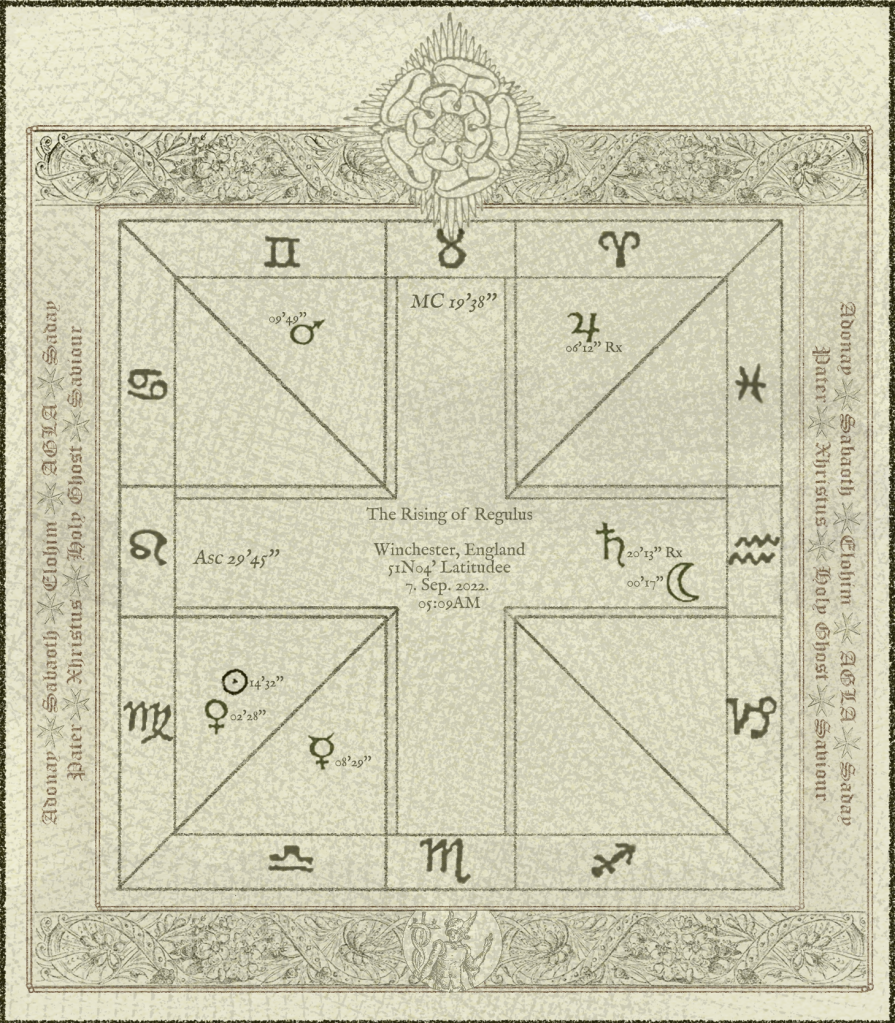
Here we have the Chart as I have designed it. We can see the Ascendant is 29’45’’ Leo. The Midheaven is at 19’38’’ of Taurus, as we observed earlier.

Now, if we look at the ‘parans’ in the Solarfire program reports, we can see that connecting to and rising over the Ascendant is Regulus, with only about a minute’s difference to our manual calculation.

In this respect then, we can see that it works effectively for the calculations. But still, if we had the wish to construct a table, for example, then it is good that we know the rising degree as well.

Back to our example!

7. Now we use the following formula to calculate the Ascendant from the RAMC. To do this we need our RAMC from prior steps, and terrestrial latitude (φ) from step 1. Finally we need the obliquity of the ecliptic (ε). This can be found easily online or via its own relevant formula. Then we consider the following formula

Tan–1 (cos (RAMC) / -(sin ε x tan φ + cos ε x sin RAMC)) = ƛAsc

However, we can simplify this as follows, into six steps.

7.1: cos RAMC = CosRam

7.2: sin ε x tan φ = sintanEL

7.3: cos ε x sin RAMC = cossinERAM

7.4: sintanEL + cossinERAM = Negative Number1

7.5: – Negative Number1 = Negative Number2

7.6: CosRam / Negative Number2 = Result

7.7: Tan-1 Result = ƛAsc

So in this example, we have our RAMC, and we make the cosine of it to be as follows which we will save for later. (Cosine of the RAMC: 0.67958374121178950478721381305492)

Now we take the sine of the Obliquity of the Ecliptic and multiply it via the tangent of the Terrestrial Longitude, and it gives us this result. 0.49259755429671712792119030118711

We then take cosine of the obliquity of the ecliptic, and multiply this via the sine of the RAMC. This gives us the following. 0.67306837551544119543796432811591

We add these two values together to produce the following:

1.165665929812158323359154629303

But we then negate it, so that it is written as such instead:

-1.165665929812158323359154629303

Now we take that Cosine of the RAMC, and divide it by the negative number:

0.67958374121178950478721381305492 / -1.165665929812158323359154629303

This shall give us the following result:

-0.58300043248351719733908295153597

And this we make the arctan, or tan-1 and the value that is returned will be our absolute longitude. However, in this example we must also add 180 Degrees, since the result is -30 and would place us elsewhere.

tan₀⁻¹ ( -0.58300043248351719733908295153597 ) = -30.242203862335842420585487984185

-30.242203862335842420585487984185 + 180 = 149.75779613766415757941451201582

Converted to degrees this is 149 degrees and 45 minutes, 28 seconds of absolute longitude. So we thus know the Ascendant will have the 29th Degree of Leo, 45 minutes and 28 seconds, just as it is also affirmed in the figure above. And if we wished to include it in a table for the same star, we could do so.

Co-Latitude and which stars can rise or set

Note that not every star will rise and set however, depending on the latitude we look. Therefore we must look to its colatitude:

1. Determine the Co-Latitude. This is found by subtracting the latitude of a place from 90. Thus, Alexandria has the latitude of 32°10’ (or 32.17 decimal).

90° – 32°10’ = 57°50’N

2. Any star with a greater declination than the co-latitude in the same hemisphere cannot set. Any star with a greater declination than the co-latitude in the other hemisphere cannot rise. As an example, if our co-latitude for Alexandria is 57°50N, then a fixed star at 58°N cannot set; and a fixed star at 58°S cannot rise over the horizon.

A final note on Robson’s formularies

Though I don’t consider the aspects with the paranatellonta, I wanted to make a note for those who are interested in using the above formula for their own use of parans. The formula given by Robson was making use of logarithmic tables, and converting these to a calculator can be troublesome. Whilst I won’t give the full formula here, as a helping hand for the interested parties who might want to use the same, the method of deriving the logarithms is as follows. For example, if we wanted to observe the logarithmic tangent of a particular stars declination:

log(tan(δ)) + 10 = LTδ

In the Windows calculator this would be as follows (make sure you are using scientific mode):

Tan δ = δt

log δt = δtl

δtl + 10 = LTδ (logarithmic tangent of the declination)

For example:

log(tan(11.85)) + 10 = 9.3218506117750843878824221985422

And finally, a note on usage of these formulas

If any readers, students, and fellow astrologers are interested in using these formulas in their publications and programs, you have my permission and encouragement to do so! All I’d ask you to give me a shout out as well, and ideally a link to either this article/our blog, or the website of our upcoming platform for hosting classes, soon to be featuring work from myself, Sfinga, and Key: mercurii-school.com. The website isn’t live yet, but expect updates very shortly on the first course: a 106 lesson tour of traditional astrology and magic by yours truly. I named my sources, and would appreciate being named in turn!

Many thanks for your time, and I hope you find this useful!

Oracle of Kronos: PGM IV. 3086–3124

Ever since I had forged my daimon pact through PGM VII. 505–28, I found my existing love and appreciation for the papyri become even more enflamed. My list of rituals to accomplish had more than doubled, coming to encompass a number of more complicated rites, my mind being at ease with my daimon’s assurances that he could arrange for all the necessary materia requirements without resulting in me breaking any budgets. While I am in no way averse to substitution, especially when the workarounds are orchestrated by the spirits themselves (and naturally, confirmed with cunning and insightful divinatory inquiries), I have often found a special thrill and excitement in carrying out older spells as they were written. My spirits have often noted that there are pacts forged at every step of a working’s channeling, with the powers that are drawn upon, anchored, and payed homage to through each ingredient often being far more complicated and nuanced than one would first assume, largely being the dominion of the privacy and secrecy of the ruling spirits of the working themselves. It is ultimately a sorcerer’s wit that will guide them in reading between the lines of received grimoires and rites, consulting with their spirits on matters such as what is superfluous or merely an artefact of the time, what marks a power’s presence and must be included, what can be summoned spiritually through existing alliances within one’s own court to stand in the place of the material, and which elements provide an initiation unto themselves simply by being gathered, alerting the watchers of the rite to the sincerity of the seeker of mysteries.

One of the most crucial lessons my patrons have ever taught me when it comes to magic is to always remain level-headed, curious, flexible, and diligent. To live tradition is to carry it forward into the incarnated times in which one lives; not to be a servant of its artefacts. At the same time, to disregard the pacts our ancestors had already made on our behalf, including the ancestors of sorcery itself—those who penned down the rituals we consult and seek to reenact, or who forged the first agreements with certain spirits and how they would consent to manifesting and arriving when called in the future—is to extinguish personal ambition with bitterness and arrogance. While I have always pursued magic’s manifestations and miracles for the consistent delights they have conferred upon my life, I find that in my heart I love the art for its own sake. That so much is possible, that so much folklore is true, and that so many spirits exist to consult with, learn under, and stretch the limits of our perception and cognition with will never fail to fill me with absolute glee.

In some cases, procuring certain items is in and of itself a significant part of the journey, in others, they flag important powers that must be noted and given their due in order for the requested spirits to manifest in the way the ritual assures they will. To love Mystery, what is hidden, occulted, and what in some cases may never be known to the magician, being the knowledge only certain spirits have the license to witness and bear, is also to allow for adventure in every step of the sorcerous process. A long-standing agreement I have with a few specialized familiars, combined with the work of the 2nd Pentacle of Mercury (which brings things “contrary unto the order of Nature”, that is to say, including that which is improbable or rare, or to make what is expensive cheap, etc.), is to open the roads to procuring rare materia for future experiments. In some cases, this manifests as unexpected windfalls of money to purchase what I need, in others, in the form of sudden connections with those who either themselves are able to obtain them for me, or know someone else who could. On this front, my new daimon was eager to join in, encouraging me to pursue other workings from the late antique Mediterranean period, both from within the PGM collection and beyond, with the assurance that he would open the way forward so to carry them out precisely.

At the top of my list was PGM IV. 3086–3124, the title of which is given as the Oracle of Kronos. This ritual had captivated my fascination for almost a year now, ever since another spirit of mine pointed out its remarkable qualities to me. Its intended outcome is to call forth the god Kronos, who, once manifested, may reveal the answer to any question. While the Oracle may certainly then be consulted as a purely divinatory ritual, it was made clear to me by my spirit that there is nothing which suggests the “questions” posed must strictly concern themselves with such matters. Instead, one may presumably petition the god in the same fashion, requesting knowledge, rituals, secrets, mysteries, ways to access particular powers and familiar spirits, and so on, as is the case for most rituals in the PGM intended to compel or conjure a deity to appear. I sat in discussion with my spirits to determine the list of questions and petitions to put forward some time ago, and immediately set out to recreate its instructions.

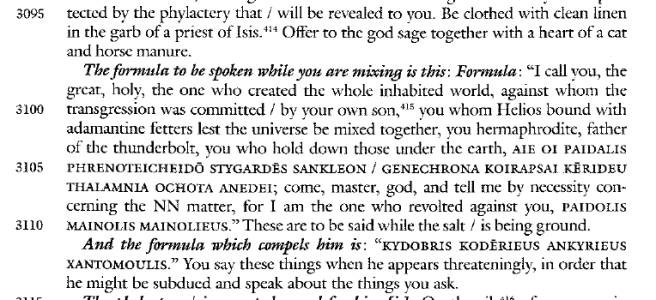
An image of the rite as it appears in Betz, p. 98.

The ritual involves going out to a place “where grass grows” at night and grinding salt in a handmill, speaking a formula until the god arrives. His manifestation is said to be heralded by the clattering of iron chains and the sound of heavy steps. The magician should be clothed with “clean linen in the garb of a priest of Isis”, and have prepared an offering of sage, the heart of a cat, and horse manure to burn. Additionally, a phylactery must be made and held on the person for the purpose of protecting oneself from the god, subduing him when he “appears threateningly”, and compelling him to provide the answers to the questions given, while similarly chanting another formula. The phylactery in question is to be made out of the rib of either a young pig (presumably one which has not reached sexual maturity) or a “black, scaly, castrated boar”. The rib is to be carved with the inscription “CHTHOUMILON” and the image of Zeus holding a sickle.

There are a few things to note from the outset. Firstly, it is clear that the conjuration conflates Kronos with his own father, Ouranos, given the reference to him as a “hermaphrodite” upon “whom the transgression was committed by [his] own son”—a reference to Kronos severing Ouranos’ genitals with a sickle (making him actually a eunuch, not a hermaphrodite), which resulted in the birth of Aphrodite as well as the Furies. The ritual itself is clearly coercive, with the incense offering being particularly foul-smelling (horse manure and a cat’s heart with sage), and the very act of grinding salt over grass which grows, rendering the land infertile, being a clear transgression against a patron of agriculture. There is a formula to further compel the god once he arrives, in order to subdue him in case he “appears threateningly”, as well as a phylactery of Zeus to protect the sorcerer, allowing them to take on the divine mask of Kronos’ son to threaten him with not only his banishment to Tartarus, but with the same fate he dealt his own father. That the phylactery is made of a piglet’s rib may be to evoke the imagery of a scythe (in the image, wielded by Zeus, but also of course being a typical symbol of Kronos as a castrator, with his depictions frequently wielding a curved harvesting blade), while also drawing on the common sacrifice of young pigs as offerings to chthonic deities in late antiquity. The presence of the cat’s heart is also evocative of the conflation and syncretism of Kronos and Chronos, saturnine associations of time and longevity, and the lion-headed Mithraic Aion.

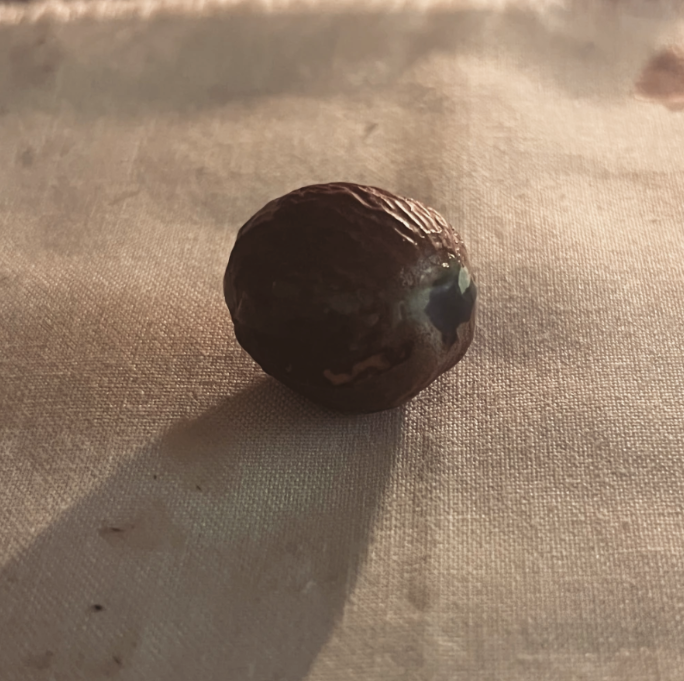
My spirits had given me much fruit for thought with their commentary as to what kind of theophany might appear from this conjuration. They recommended only changing the line “you hermaphrodite” to “you eunuch”, given the reference to Ouranos’ castration, but proceeding with the rest of the ritual as is. Naturally, my first order of business was to take inventory of what I already had in stock. Regarding the “garb of a priest of Isis”, I thankfully already had a white linen robe on hand for ritual use that I had fumigated with frankincense and myrrh. Similarly, I keep a stock of Dead Sea salt, as well as Greek sage, so I could write those two off the list. This left me with the cat’s heart, the horse manure, and the pig’s rib phylactery.

Key’s invaluable expertise with biochemistry came to my rescue with the matter of the heart. Initially, he kindly offered to place an order with his laboratory where he works for a cat to dissect, and to quite literally obtain the heart for me directly. I decided that this would be our last resort, assuming I could not find just a heart alone to buy elsewhere online. Thankfully, after consulting with one of my aforementioned treasure hunting spirits (whom I primarily at this point employ for assistance in obtaining materia and rare books), a taxidermy shop I frequent suddenly procured a cat’s heart preserved in formalin as a wet specimen, and I purchased it immediately. And yet, Key still managed to save the day regardless! I set the shipping address to his apartment, and once he received it, he treated the heart of the formalin in his lab, ensuring it would be safe to burn as incense when the time comes to give the offering. My biggest thanks as always to him for the crucial help!

I reckoned that the virtue of the horse manure in the offering lies in its foul smell, being coercive in nature. For this reason, I briefly entertained the idea of swapping this component for powdered sulfur, but ultimately decided to at the very least include it in some form while also offering one of my fouler-smelling Saturnine incenses, which contains sulfur in the recipe. I made my way to a small urban farm that is open to pedestrians, slipped away and collected a small amount of the manure, and returned promptly home. I always carry some extra plastic bags, a pair of gloves, and a Sharpie on me in my backpack full of talismans for materia collection, and I have to say that this smelly experience was not even within the top ten least pleasant things I’ve had to grab for magic. Witchcraft and Quimbanda alike have certainly provided the rest.

Finally, I was down to the matter of the pig’s rib. I decided that it would be far easier to obtain that of a young pig’s than a “black, scaly, castrated boar”, and placed an order for a rack of ribs from a suckling pig at a local butcher. I gave the meat itself as an offering to my spirits (as a vegetarian all meat I buy tends to go to spirits and friends) and treated the bones. Once I had an image of Zeus and the name of power to my liking, I lacquered it with clear nail polish to preserve the bone from cracking. In the meanwhile, my friend Alison of Practical Occult had also procured a similar set of piglet ribs, and graciously sent me one of the extras that she was distributing. This meant that, should everything work the way I’d hope, I would be able to mail out the additional leftover ribs to any friend who was hoping to carry out the ritual as well—assuming my other spirits didn’t claim them for their own devices and talismans first.

For the ritual itself, I decided to wait for the nighttime Saturn hour on a Saturday my spirits recommended. I scouted out the location “where the grass grows” ahead of time, placating the spirits of the land ahead of time, and letting them know that I would be grinding salt over the field until the deity manifests, making the appropriate offerings in advance. When the time came, I filled up my bag with the incense, phylactery, salt and mill (in my case, a mortar and pestle), charcoal and a brazier, a lighter, and one glass-encased candle so that I could see in the dark, and headed for the ravine.

By the time I arrived on location, it was a little past 10:30pm, right at the Saturn hour. I had already dressed in my ritual linen robe at home, wearing a plain white skirt and tank top underneath, and had marched over to the forest with no one seeing me on the way there. I set up the brazier and charcoal, lit the candle, and took out my ritual script (a printed scan of the rite as it appears in Betz), checked in with my spirits one more time, and proceeded with the call.

While I’ve never been scared of the dark, even as a child, I found myself feeling strangely anxious as I began the process. At first, I lit the charcoal and began to recite the prayer, entirely forgetting in my eagerness (and sudden onset of uncharacteristic nervousness!) to grind the salt itself—the key component of the ritual! I quickly came to my senses and managed to laugh at myself for a moment, filling my mortar with the salt, and started again, roughly pounding and grinding it with the pestle on its side to continue to spill the contents over the grass. I then continued repeating the prayer until, after the third time, the atmosphere in the darkness of the forest became completely eclipsed by a sudden, encroaching, swelling presence.

I have to emphasize again that I am not at all an easily-frightened person. Among my close friends my reputation for being incredibly difficult to startle is something of a meme, with many having attempted and failed to jump-scare me with various websites and videos. I’ve always enjoyed horror movies—the more unsettling, the better—and no amount of gore or tension has been able to truly unnerve me on an emotional level. If anything, being spooked by a physical manifestation or a spirit pulling a prank or trying to get my attention has only ever excited me. Yet, in that moment, it was as if my veins were filled with ice, my body entirely immobile, and my ears and eyes strained to their peak, staring blindly into the forest, mind absolutely awash with an overwhelming pressure and dread. I seized the phylactery in my lap and held it until my knuckles were white, willing my psychic perception to open further in order to catch even a potential glimpse of what it was that was approaching.

It was then that I heard it—not with my spiritual senses, but with my physical ears—the loud, slow, thumping of heavy footsteps, each movement followed by the piercing, clattering of chains. Words cannot express how genuinely shocked I was at the sheer noise and physicality of this manifestation! I instantly placed the cat heart over the charcoal and watched it quickly roast, adding then the horse manure (I nearly gagged from the smell at this point) and the merciful relief of the Greek sage which made the fumes at least tolerable. After a battery of steps and rattling, each louder than the last, I finally saw in my plain vision a massive, void-like stretch of black, blotting out even the regular darkness of the nighttime ravine, obscuring the outline of the trees I was able to make out by candlelight and my adjusted vision, extending to tower over me even unto the heavens. In my spirit sight, I was able to make out a titanic, hooded figure, features proud yet sunken, beard neat and elegant and yet frayed with time, joints bulbous and rough against stretched, thin skin which showed still the musculature and strength of an aging king. The passage of aeons had folded their paper-scarred weight into the wrinkles of his skin, yet the eyes which seared with flame and fervour—two lone stars in the sky his form had stripped of dimension—gazed down with cold eternity.

The proceedings of our interaction, and the petitions and inquiries I made, are not something I am able to retell publicly. Yet, suffice to say, the intense, passive aura of dread persisted throughout, and at one point the clattering of chains was so loud and the noise so disorienting that I wondered if I was happened upon by some poor nighttime hiker or a large animal—though there was no one there, not even a single forest spirit that I could detect, but me and the presence. I ended up using the compulsion formula when the sensation of fear was close to its peak, not only because I was sweating and gripping my phylactery so hard I worried any more and I might snap it, but because if there’s one thing I’ve learned across all the traditions I hold initiation in, it’s never to allow pride to supplant the practicality of protection formulas. It was not that I felt that I was going to be harmed, more that I decided I needed to do something about the way the feelings of dread were clouding my perception. I wanted to be as calm, articulate, and forward-thinking with the way I communicated my requests, and have the mental bandwidth to respond appropriately and with intelligently. Thankfully, the formula was truly effective, decreasing the aura that surrounded me significantly as it appeared to slink back like a shadow to where I felt the presence. While the tension was no less high, I was able to breathe and speak normally from then on, much to my satisfaction.

Once I had completed my work, and I received confirmation of my requests having been accepted, the answers I sought being given, and the familiar I asked for having been given unto me—with the name and abilities given and attested to, and the requisite oaths of loyalty sworn—I gave the license to depart and prayed for peace between us. Across various conjurations, especially grimoiric and necromantic ones, I have generally found that as soon as the license to depart is given, the spirit simply disperses or vanishes from my presence, leaving me back to my own devices within the ritual space. Yet here, I found myself mesmerized as the presence did not vanish at once, rather retreated the same way it came—with slow, heavy, receding footsteps slinking back into the woods, each step sinking lower and lower into the chthonic soil, accompanied by the clattering of the fetters and chains. I knelt, transfixed by the overpowering, physical sensation of the deific force quite literally walking away, until at last I could see the moon and stars, and feel the spirits of the forest and earth crawl back into their homes.

Suddenly, the time dawned on me, and I quickly gathered my things back into my bag, left the offering and brazier where it was, and scampered back home. I must have been quite the sight, should anyone have noticed me, running with an oversized book bag in a large white robe down the street and back to my neighbourhood! Once I was home, I enshrined the phylactery, which was now the physical token of the pact with the Saturnine daimon, made offerings to my spirits for their protection and guidance, and finally was able to rest.

I am truly beyond thrilled with how the entire rite proceeded. Acquiring all the materia for it was well worth the effort, and the divinatory answers I received have been nothing short of cosmically illuminating. One of the petitions I requested manifested instantly (in the very same Saturn hour!) in the first stage of its plan, being perhaps one of the fastest turnarounds I have ever seen. As for the new pact, forged so I could seek similar counsel when needed in a more personal capacity and flavour, among other reasons, all the powers involved have been integrating exceptionally smoothly and well. I had Key quickly scry the phylactery without telling him any details, as his psychic perception and spirit faculties have been trained diligently over the last year to become some of the most keen I have seen, and he was able to nail precisely the nature of the pact, its presence, and an array of subtler information I had been interested to test for. Ever since his most recent initiatory experience when I had last visited him in the States, his abilities have been so laser-precise and wide in scope, without faltering through any emotional or mental struggles, I have been all the more excited to resume our weekly training and practice on scrying, and checking each other’s materia and tools has been one such excellent way to do so. Suffice to say, this operation was far more successful than I had even hoped for, and I am so pleased to report that its manifestations are exactly as physical as the ritual instructions imply.

Gird ye on Every Man His Sword: To Arm a Statue of St. Expedite

Since visiting Sfinga earlier this year (some highlights of which can be seen here and here), a great deal of my time and energy have gone towards better ensouling and anchoring spirits into particular loci of devotion; in this world as well as the next. These developments primarily stem from numerous midnight talks between Sfinga and I, in which we mused about and theorized practical strategies towards the “arming” of our spirits. After years of covering ourselves in talismans, phylacteries, amulets, powders, condition oils, and the like, it seemed the natural next step would be to give similar to our spirit allies, such that they may independently reap the boons from the vary materia that they helped craft. This is not only a core principle to much cross-cultural technology with respect to seating spirits and birthing their vessels, but also a rather intuitive concept: if you’ve hired a skilled mercenary to protect you, would you rather he defend you in the hostile wilderness with no supplies and rusty ammunitions, or amidst a heavily-stocked fortress complete with neighboring alliances whose spies would inform of you of danger well ahead of time?

I began by consulting with my court to me to see what could potentially be desired, and one of the most prominent figures that immediately stepped forward to request such a working was St. Expedite (conveniently adding to our rapidly growing series of Expedite-related posts). Himself a centurion in life and just a capable warrior in holy death, it was not the good saint’s appearance that surprised me, rather the specifics of his request, which to this day still do. As I sat in contemplation, he delineated the recipe for what remains one of the most involved, intricate, and complex magical workings that I have had the privilege to see to completion.

The good saint revealed a recipe to me for what would serve as a load to the statue that has been the centerpiece of my altar since my devotional practice with him began. On a basic level, to load a statue is to fill it with the materials that carry the virtues sympathetic to the spirit, arming the spirit with tools to use once it is more strongly linked to the image. Naturally, this involves properly baptizing the statue as the spirit’s own, and preventing other spirits from inhabiting the figure in order to steal any offerings made. In the majority of the traditions in which I am involved, there is always a warning about buying statues and figures for spirits without baptizing and dedicating them properly—at minimum, they should be washed, fumigated, and prayed over to ensure that only the spirit being called into it will take up residence within its shape (or rather use it as their glove if it is not itself a house for them), lest ambient spirits become attracted to the spiritual attention it receives and come to shapeshift into its form. Different techniques exist across the globe, some very rightly claiming to place the spirit into the image—my personal favorite examples of this come from Thailand, in which amulets or bucha pieces can be fully ensouled and inhabited by the spirits residing within them—whereas others serve to increase the sympathy between and co-mingle the essences of the image and the spirit without actually calling the spirit to fully live within. I want to emphasize that this particular recipe falls into the latter category—one could hardly hope to place an ever-wandering saint into such any such vessel!

The recipe itself begins with the time in which it was to be made—the ten day period from Palm Sunday to St. Expedite’s feast. For each day in the Holy Week, specific ingredients corresponding to the holidays were to be gathered, and then in turn blessed every day following their collection, such that each piece received a blessing “today”. As I began to compile the list, I was initially daunted by the sheer scale of what would be needed. However, fueled by the power and potency of the saint that has been such a trusted compatriot over the years, I became determined to see things through while the spirit of the work was upon me, my ambition fully stoked.

For the next week, it was if I was possessed by the spirit of the work itself, with every waking moment consumed either by the collection and processing of materia, or the inspired contemplation of the loads as they began to take shape. Each day consisted of a spirit-lead journey around the city, visiting dozens of locations and negotiating with the spirits of each for permission and blessing to do my work, making offerings at each place of power along the way. I began to notice early on in the process that each ritual step closely matched the Passion—Palm Sunday bringing with it workings at the gates of seven cemeteries to mirror the triumphal entry into Jerusalem, Maundy Thursday bringing with it devils that walk the earth on the eve of the crucifixion and their being crushed beneath the foot of St. Expedite, crossroads workings performed and dirts collected as Jesus walked through the streets toward Calvary, dives into the underworld during the Harrowing of Hell, the triumphant return therefrom on Easter, and the ultimate culmination of the work on St Expedite’s feast.

At every turn, the working moved to finish itself, with incredibly lucky opportunities enabling the acquisition of trickier-to-find materia that needed to be collected and blessed on the same ritually potent day. Finding floral and herbal materia drifting down the river or floating in sacred grottoes at the beck and call of my sea spirits, encountering doors and gates unlocked (or very literally opening before me at utterance of a charm and wave of a spirit’s hand!), chance encounters with people on the street handing me that which was needed in exchange for a cigarette—all these and more highlighted just how much the Good Saint and I shared in the desire to see the creation finished.

As the adage goes, a magician must never reveal his secrets, but what follows is a fraction of the saint’s armament, for those with the cunning to replace the gears and wind the springs missing from a watch that ticks ever onward to the beat of “to-day-to-day to-day…”

  • Blend of soils from 7 crossroads collected on Good Friday
  • Blend of soils from the gates of 7 different cemeteries collected on Palm Sunday
  • Blend of soils from 7 Catholic churches collected on St. Expedite’s Feast
  • St. Expedite’s Hodie Powder (as discussed in a post from Sfinga, here)
  • A few drops of my personal St. Expedite Oil
  • A vehicle for the spirit of the Crow-Devil crushed beneath the foot of St. Expedite crafted on Maundy Thursday
  • A wishing bean, baptized in a river on the Harrowing of Hell
  • A piece of a palm frond from Palm Sunday Mass
  • A piece of the pound cake offered to the saint at the start of the work
  • A piece of the pound cake offered to the saint on His feast
  • Wax from dressed candles burnt as offerings on His Feast
  • A small square of fabric torn from the cape that adorned my St. Expedite statue over the duration Holy Week
  • Herbs blessed on His shrine including Abre Camino, Basil, Myrrh, Palo Santo, Spearmint, Vervain, and Vanilla beans
  • A skeleton key blessed at a crossroads
  • A small ampoule of Mercury

At last count, each load totaled around 100 components, the most important of which were tokens of those intangible acts found in the unfailing collection and processing of the materia on each day of Holy Week. As the final assembly was performed, every component and individual blessing to this point snapped into place and began to hum with a potency far greater than the sum of the individual parts, almost rhythmically and mechanically whirring together into an elegant machine in my own sorcerous arsenal—and the arsenal of the saint alike. In taking stock of the work, I have a newfound appreciation for the tireless diligence that the saint brings to his works, and an enflamed drive to go the extra miles for my spirits, without hesitation or fear of complexity or effort required for certain procedures or practices.

Two statue loads, one for myself and one for Sfinga, receiving their final blessings on St. Expedite’s feast day.

I cased the loads into blessed wax, allowing them to sit in the containers of used tealights in order to retain their smaller shape. From here, they could be easily removed and fitted into the bottom of any such statue once it was sufficiently hollowed out with a drill. After the load’s incorporation with the statue, I’ve noticed any workings performed with the aide or through the intercession of St. Expedite have greatly increased in efficacy and potency, with the saint heavier upon me than ever before, more ready to step forth and provide his aide today, with his new armor in hand, and girt upon him, his sword.

Meeting With Your Own Daimon: PGM VII. 505–28

I have a great love of the Greek Magical Papyri and all their related historical material, having experimented heavily with various phylacteries, talismans, conjurations, and dream incubation rituals from its corpus, as well as various broader collections of Coptic, Aramaic, and Hebrew sorcerous texts. For a number of years, it has been a bit of an unofficial tradition among myself and a few local friends to flip through the English translation by Hans Dieter Betz, fall upon an entry at random, and test out the formulary to see what comes of the results. The sorcery you can get up to with just a sheet of tin or papyrus!

Recently, while Salt has been busy with a particularly intense training program, Key and I took it upon ourselves to resume this practice and select a working from the papyri to carry out. At the top of our freshly-generated list (the remainder of which we will also write a series on, both together and individually, depending on the undertaking) was PGM VII. 505–28, a short ritual falling under the paredros or supernatural assistant evocation category, aptly named “Meeting with your own daimon”.

A cropped image of the rite as it appears in the Betz translation, pages 131–2.

Suffice to say, Key and I shared a lot of laughter about this one. There’s just something about waking up at dawn, immediately reading a gnostic prayer, and then eating a raw egg that had us feeling like we were on some sigma male bodybuilder mindset cultivation plan. And yet, this deceptively simple ritual had completely captivated us. The prayer, outlining the order of spatial and temporal emanation, from heaven and firmament down through the planets, elements, and finally the abyss. The repetition at dawn and dusk, culminating in fourteen prayers to match the fourteen eggs. The “male eggs” themselves, one of which must be cleansed with and the myrrh holy name licked clean, the other to swallow after ensorcelling it with the incantation. The fragmented mention of “olive branches”, perhaps suggesting that the magician should stand underneath them while showing the egg to the sun, was also doable—though ultimately, as we would later find out, unnecessary. Everything about the ritual’s logic to its tantalizing promise was especially intriguing, and, after much deliberation (and many memes), Key and I decided to carry it out together. At worst, we would be down fourteen eggs and some sleep; at best, we would have gained an exceptional new spirit ally.

As Betz himself notes in his 1981 article, “The Delphic Maxim ‘Know Yourself’ in the Greek Magical Papyri,” title “Meeting with your own daimon” at first glance appears misplaced, as the matter of the actual introduction between the magician and the daimon is never raised again. The oration is short, beginning with praise to Tyche, other divine names, Helios-Aion, and then continuing with the planets, elements, and abyss, terminating with the holy Scarab, Khepri. While the ritual does appear to be quite short, differing from other more complicated evocations in the paredros genre, Betz explains that not only is the title appropriate, there is a rich internal logic to the conjuration. Drawing on Plato’s myth of Er, he elaborates how the “personal daimon” (again, in this context, it is clear that this is not an emissary or assistant of another deity, granted unto the magician as a familiar, but rather the intimate companion and fated, celestial guide of the individual magician themselves) has been greatly associated with Ananke, Tyche, and the three Moirai. To begin with Tyche is especially advantageous, Betz muses, as this draws on a long Platonic and Neoplatonic history through Plotinus, Porphyry, Iamblichus, and Proclus of associating one’s personal daimon with the fulfillment and resolution of one’s own personal destiny, incarnated purpose, and fortune.

It is not immediately clear when the spirit is supposed to appear, however. The magician is to lick the divine names off the first egg and discard it, after first using it to cleanse their body thoroughly. The second egg, which is consumed following the seven utterances of the prayer, perhaps provides protection. Yet, there is nothing more following this. Key and I spoke to our spirits separately, and returned with similar guidance; both in additional advice on how to further enhance and complete the ritual, and also in terms of how best to consider its own structure. Independently, we were told that the “daimon” that will be summoned is incarnated through the consumed eggs, having passed through the various layers of reality, being reborn from its original substance into the fullest sphere of the magician. While the spirits long predate the ritual, it struck us that the eggs served the additional purpose of further inoculating their essence with our own, calling forth an ideal supernatural assistant. Our spirits also agreed that, as Key and I are both in exceptionally intimate, soul-bound pacts with our primary guardians and mentors/initiators, whom would otherwise fulfill the role of “personal daimon” in the Socratic and Plotinian senses, that whichever spirits would manifest through this rite would naturally have to be of a complimentary nature as familiars and tutors. With the approval to proceed given, and the relevant additions made, we proceeded without haste onto our new regimen of early rising, prayer, and cleansing.

For the ensuing seven days, we would exchange daily groggy, near-incoherent egg-related texts shortly before the crack of dawn after being woken by our alarms. We had sorted through our egg cartons and separated the fourteen “male” eggs for the ritual beforehand, but we decided to inscribe in myrrh ink the holy names upon the shell each morning before use instead of all at once in the beginning. On the subject of male and female eggs, Betz makes a comment in the footnotes that the ancients were themselves in disagreement over which eggs would produce which sex of bird, as well as how to distinguish them, and that there was no consensus. Following some practical folklore from my own culture, we ended up going with Pliny the Elder’s judgement in his Natural History, Volume 10, Chapter 74: that the male eggs are those with pointed ends, and the female eggs those which are rounder. This is, of course, merely a folklorically useful judgement and not a truly scientific one, but nevertheless it proved helpful in the carrying out of the rite. Once they were marked with the myrrh ink, we performed the cleansing with the first, the prayer with the second, and swallowed the contents. During the evenings, right as the sun was setting, we would give the oration another seven times, as per directed.

Over the week, we continued to catch glimpses of visions relating to the project. I would frequently see the egg in my hand coil with serpents, like in the famous Orphic Egg images, and at times I would catch flashes of a holy, golden scarab rolling it gently across the horizon. Whenever I would give the evening prayer, I would feel the taste of the yolk, and be reminded of the noble birth of this spirit presided over by Khepri, emerging out of the primordial sea, shaking the pillars upholding the earth. Throughout the conjurations, I was often reminded of Jan Bergman’s analysis of the prayer in his article, “Ancient Egyptian Theogony in A Greek Magical Papyrus (PGM VII, II. 516-521),” in which he noted the presence of the first-ever Greek transcription of the Egyptian names of the two solar barks, (Me)Sektet and Manedjet—the night and day barks respectively—proving an authentic Egyptian lineage. His own translation notes the noble birth (or the “primoridal apparition”) of a god: Ra as Khepri, coming into being to regulate the cosmos and create the daimon. Bergman’s entire article is excellent, and I highly recommend it as further reading; he goes into a great deal of depth into the Egyptian cultic origins of much of the prayer, and additionally touches on the possibility that the two male eggs—the primary materials for the magical work—are themselves representations of Khepri and Atum, the latter of which might even be syncretized with IAŌ.

On the final morning, Key and I both noted the visions becoming far more personal, though no spirit came. We had been told earlier by our spirits that the daimon would appear upon the final recitation of the prayer at sundown, and, when the time finally came, we were both overjoyed to report to the other that the operation was a success. On my end, the daimon manifested in a flash of light, gathering its form out from the corners of perception, bringing together heaven and earth at the horizon, and then springing forward towards me, emerging from what looked to be layers of reality riding a solar disk. An umbilical cord formed between us, humming with etheric, stellar light, filling my body with an intense warmth that flooded down to my shadow, to which I quickly became aware my new ally would anchor himself to, and rest within. The spirit indeed presented himself to me in a masculine form, the details of which I will not share, but suffice to say it was immediately clear that he had taken on not only the characteristics of the various divine names invoked within the conjuration, but also elements of my own witchcraft and deepest, sorcerous mysteries.

In Key’s case, primordial dusts and clay aggregated into a body that knelt before him, which was subsequently flooded with the remaining classical elements in sequence. Waters filled his veins, Air filled his lungs, and Fire ignited within him, all commingling and undergoing various transmutations to further enliven the body, ceasing only as the newly incarnate “soul” of the spirit stepped forth from the setting sun into the effigy that had assembled before him. The daimon then stood, immediately revealing the signs, omens, and forms similarly intimately linked to Key’s own witchcraft mysteries.

The characteristics of being able to reside in our shadows (not only that which is cast upon the ground, but every stretch of darkness that brings dimension to our skin), the presence of an umbilical-like tether, the forms mirroring both the cosmic mysteries of Ra and Khepri as well as our own innermost mysteries, and various obvious, immediately-tangible, and powerful abilities that they immediately were able to manifest clearly and plainly before us were shared between our spirits equally. They presented us with individual, private names, as well as nicknames to call them by when discussing them amongst each other, and were able to immediately cohere to our courts’ idiosyncrasies, facilitating manifestations, further organizing spirits, and gathering divinatory intelligence. One aspect we both remarked on was how easy it was to see through the eyes of the daimons, to trade visions, and fly out through their perception as with other more closely-bonded, pacted familiars. When we arranged for them to observe each other, we experienced the exciting vertigo of regarding each other’s magic and spirits through multiple sets of sensory perspectives, aligned in holy focus.

What started out as something of a joking dare flourished into a memorable experience, yielding precious companionship. We were not certain if the ritual would work at all when we began the process, but we are thrilled to be able to report that it was not only successful, but alarmingly so. Among the various paredros and supernatural assistant rituals in the papyri, PGM VII. 505–28 is not only an excellent one, but fairly simple to perform, requiring only dedication, consistent prayer, and some tenacity. If you are considering performing it yourself to encounter your assigned daimon, do field it by your court first with divination, and check in case there are any additional protocols unique to you that your spirits may suggest. Until then, happy conjuring.