Foam-born Aphrodite

To say that this has been a long time in the making would be a perilous understatement. Key and I have teased and hinted at this undertaking for over half a year, at various points ruminating on if it was the right time or not to release our offerings into the world, and at each turn being rejected swiftly in divination. The spirits that have guided our hands and hearts have continually asked for more—the Venusian increase, the love-struck outpouring, the tremendous and awe-inspiring chorus of muses lilting in heart-song—reminding us to never shy or shrink away from the importance of our toiling. What began as a decision born of serendipitous chance had, after all, become a sacred pilgrimage; and what we brought back from those shores was an experience that fundamentally reconstituted us at our cores.

For our thirtieth episode of The Frightful Howls You May Hear, Salt interviews Key and I about what it was like travel to the Sanctuary of Aphrodite Paphia—the single most holy site of Aphrodite in the world, being a place of pilgrimage for countless cultures across centuries—as well as the Petra tou Romiou or “Aphrodite’s Rock,” being the place of her legendary birth within the foam. Even as we could only share but a fraction of the full experience—the rest being subject to the taboos of secrecy placed upon us by the spirits we encountered—we were utterly delighted to at last unveil a portion of what made this pilgrimage so special. Far from a simple touristic joust, our experience of the Heavenly Queen transformed us beyond every measure, elated us to tears, humbled us to our knees, and pacted us to a worship that will endure for the rest of our days. While Key and I are no strangers to visiting sacred sites and places of power—having spent the last several years being ready travel companions as best friends across countries—we have never hesitated once over the past six months to declare to ourselves and others that this was the single most illuminating and transformative experience across all our adventures.
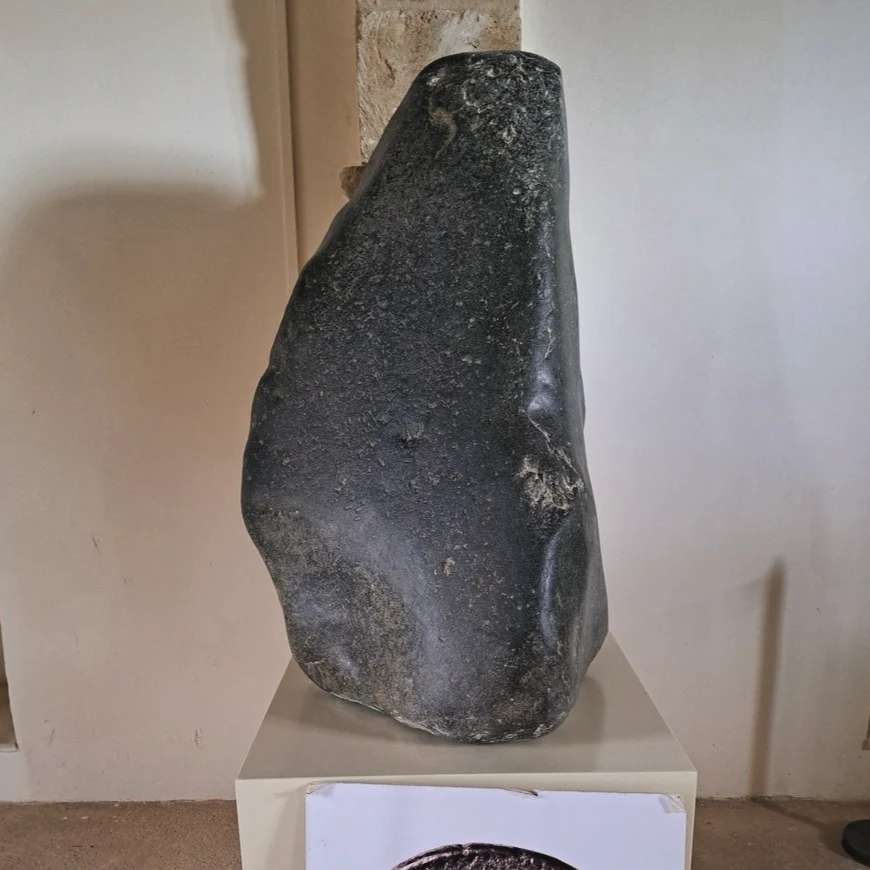
The Baetyl of Aphrodite: the aniconic site of her cultic worship in Paphos.

The blessed rain that purified us, the hymns we sang at her Sanctuary, the museum guard witnessing the manifestation of the Goddess through the light of the clouds parting and celebrating with us that “She had come,” the voices we heard within the airs swirling her Baetyl, the second physical manifestation at the beach, and everything that occurred in between—all this, to our capability under the necessity of secrecy and privacy as directed by spirits, we go into at various points throughout the episode. If you’re interested in hearing us attempt to even begin to grasp at the significance of what this was for us, we kindly invite you to give the episode a listen. It contains our usual mischief and humour as we process a story we’ve told many friends and ritual elders over the past half year, but also a lot of vulnerability at the humbling manifestations that we bore witness to, and the deep sense of honour and privilege we feel in being able to share a portion of this experience with our kind listeners and supporters.

Aphrodite’s Rock, illuminated by the sun. We took this photograph after having collected our seventh hagstone.

Those on our Patreon (and especially our Patreon’s new Discord server) have seen plenty of hints and previews over the past little while of the collection Key and I have been toiling over ceaselessly since we returned to our homes last year. Every Friday of every month since the mid-fall, he and I have given of ourselves our fullest effort to a series of offerings to share with the world a distillation of that experience. One of our many agreements we forged with the spirit intercessors and intermediaries we encountered was to share the love of our friendship, love of this experience, love for this Goddess, and Love as the force which binds all together as the rapturous intrusion and fermentation of reality; that while some aspects must be kept sub rosa by necessity and by design, the nature of beauty and love is to unfold as the rose does. These violent blossoms must yet germinate their delights within the maws of desire, enfleshed in promise and fulfilled in need.

While the frenzied touch of the Goddess of Love and Beauty kept us restless, pushing us onward to continue perfecting formulas and negotiating pacts, the spirits that guided us throughout this journey (including those who returned home with us from those shores) kept a steady beat to our toiling. The three of us—Salt, Key, and I all—have intimately shared with each other the aspects of the most transformative and incredible spirit-experiences we’ve encountered across our traditions and the stories of our lives, especially as we’ve deepened the immense friendship between us. Yet so rarely are even a portion of these stories allowed to be public in any capacity. At the same time, it also struck us as only appropriate that, in cultivating this burgeoning veneration of Aphrodite in light of all that She had wrought for us on this journey—so suddenly and remarkably cleaving into our lives and reaching into the pits of our natures to wrestle forth our deepest desires to the forefront—it was only appropriate that we allow for some of that vulnerability to be shared beyond words, even beyond writing: but in offerings of the spiritual essence itself.

This was always our heartfelt desire with this Foam-born Aphrodite collection, named in tribute to She who made it possible. While we will certainly create many more offerings in the future with respect to Aphrodite, the spirits of the Tuba Veneris, the angel Anael, and all the powers under the All and Many that is Venus Herself, this gathering here is made both limited and special in the truest senses of the words through the pilgrimage and its theophanies. Key was in charge of the majority of the creations and carried out his work with the diligence and attention to detail of a master artisan. My chief role was to bring about the circumstances that would allow a troupe of Venusian daimones to become bonded to a series of hagstones as their desired vessels, such that some of the very nymphs in service to the Goddess may become familiars to those most in need of their service and companionship.

The view of the beach and Aphrodite’s Rock from atop the slope.

Locals we spoke to in Paphos continually emphasized that when Aphrodite arose, fully-formed, from the foam of the sea, she was carried to the coast by myriad nymph beings that guided her from her rock to the beach. We continued to find stones in the shape of slippers amidst the waters as we swam, which a number of locals told us were the “shoes” of these spirits. After making our offerings, singing to the Goddess, saluting the many spirits of shorelines and beaches we already hold pacts with, and completing the end of our pilgrimage by swimming three times around the Rock itself (said to grant blessings of long-life, beauty, and love upon all who embark on this venture), we fell into deep trance, encountering some of these spirits that guided us back towards the beach as we swam.

What awaited us at the coast was, without exaggeration, as startling as the sight of the clouds parting to the light of a woman’s form before us and the guard in the Sanctuary. Once we returned to where we had left our offerings under the large boulder on the edge, we were approached by an otherworldly beautiful woman with dark, curly hair and a splendorous garnet-red dress. This was one of those encounters which no description could do justice. Everything about her appearance, gait, composure, and ominous gaze—penetrating yet distant, awe-inspiring yet familiar, ferocious yet docile—left the both of us so speechless we were unable to even muster a polite greeting. Her bare feet appeared to effortlessly glide across the pebbles, undisturbed by their rough edges, until she was just a step away from embracing me. My voice was so caught in my throat that I could not even manage the simplest utterance. Instead, she suddenly grasped my hand and impressed in it a stone—the same deep garnet-red as her dress. She did not respond to my breathless attempts to thank her in Greek and in English, physically vanishing around the bend of the stones as Key and I attempted to follow her. Only upon closer inspection later did I realize that its shape physically resembles the coastline from the Sanctuary to the beach itself.

It was after this encounter that Key and I collected the seven smooth, flat hagstones that would become our own “Baetyl”. While there are no shortage of excellent statues of Aphrodite across Cyprus’ many beautiful shops, we were so moved by the aniconic representation of the Goddess at her Sanctuary that as soon as we found seven (and no more, at that, than her sacred number) hagstones, we knew that this would be our shared representation of Her for the rest of our days. Even their holes perfectly overlap each other, allowing water to flow freely through the cairn. Throughout our pacing along the beach, the nymphs that guided us continually inoculated us with their designs; that some wished to accompany us as daimones and intercessory oracles for the Goddess and her pact, while others sought to pass through our hands and into the company of others still.
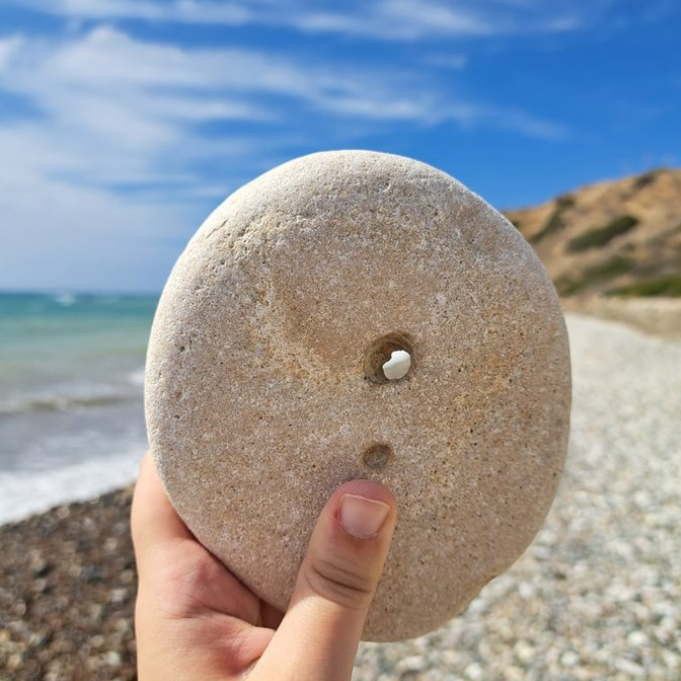
The first and largest of the stones.

We took this charge sincerely and with extreme conviction. Even on our breathless ride back to the capital where we were staying, Key and I could not help ourselves but begin to urgently brainstorm how to begin to share some of this bounty with other devotees and sorcerers as we had been directed to.

In our bags I had carried with us a number of hagstones we had collected from our journey. Cyprus was not our first destination, nor would it be our last during this month of travel, and while our reasons for going together were more for work than for pleasure, after this crucial point we began to finally grasp back towards the hands of the spirits that had guided us along the way, with the serpents’ eggs of these holed stones being vital points of germination on the path. The spirits tasked us with bathing the set they had selected from amongst the whole within the very waters between the boulder and the Rock as the first of many steps which would come to dominate my own life over the next half year; a love letter written in wooing desire to bring those same delicate feet over countless many shores home.

The Eyes of Nepherieri

It is no exaggeration for me to say that I spent every Friday toiling over these since I returned home. I had such designs in my own mind for how the shape they could take. The spirits insisted that the hagstones had to be their true seats, outlining for me an entire regimen of how to enliven them as their hearts. In my eagerness, I imagined charm bags wrapped in animal skins and adorned with feathers and beads, only to be swiftly redirected in divination and in dream alike to what they unveiled and insisted upon: prayer ropes. The more I attempted to negotiate the aesthetics I had in mind, the more they insisted upon simple luxury: garnets the colour of the stone the woman gave me (and the colour the hagstones themselves would turn after consecration), mother of pearl in honour of the shell protecting Aphrodite’s feet, and carnelian for her fire, her light, her sighs, her kisses. Seven by seven, her number, and the number which continually revealed itself to us along each stretch of our pilgrimage. Firm in the weight of the beads yet light in their manipulation—these spirits wish to be prayed with to the Goddess, to send each intonation of vowels, each gasp of joy, each tear of grief and longing, each prayer for liberation and recognition in the arms and gaze of Another through their circuit and back through the hole that is the womb of possibility. To be wrapped around the wrist and pressed into the palm, to have yearnings hissed through the gaps and folded directly over spells, to be draped over statues, candles, and workings to empower them with not only the bonds they will forge with their eventual keepers, but everything we were able to pour of ourselves from our experience into their grasps.
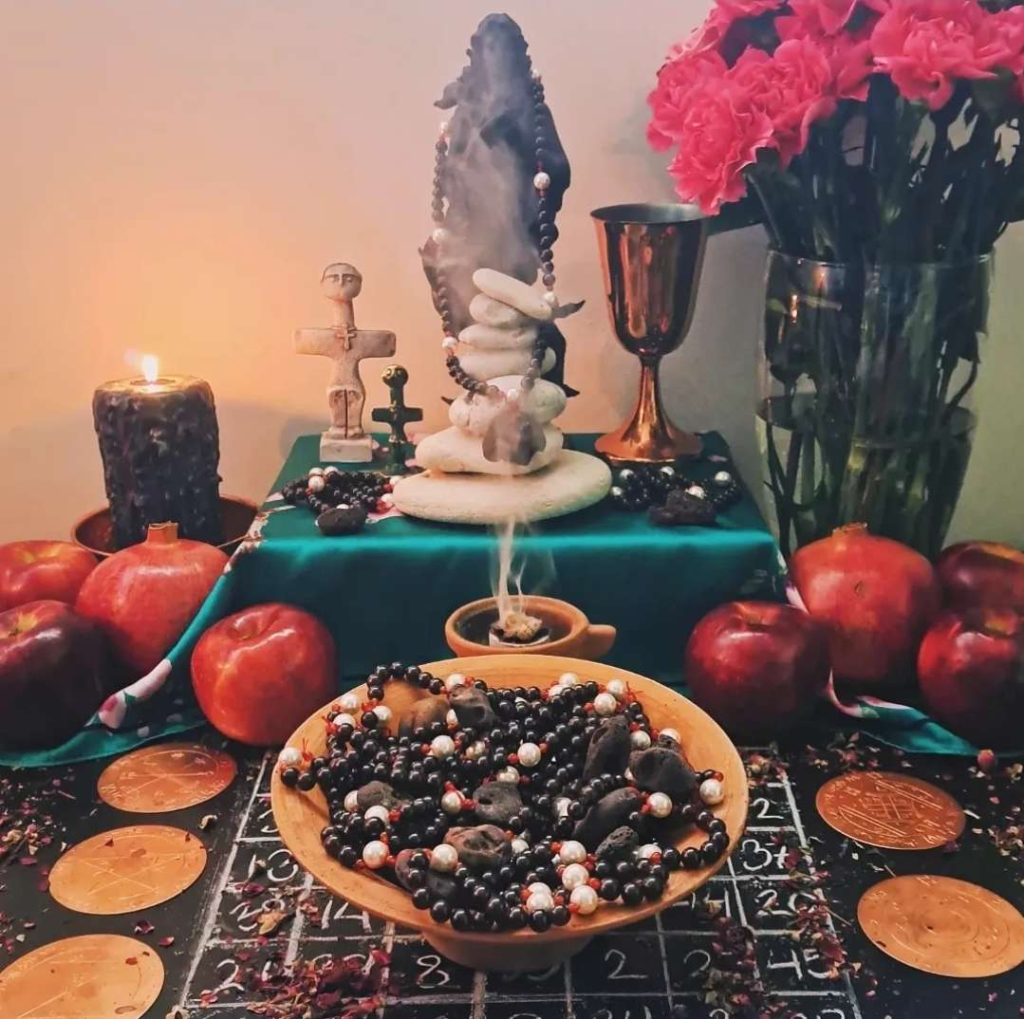
The hagstone cairn that is our private Baetyl of the Goddess, looking over the Eyes of Nepherieri.

Deceptively simple as their designs ended up being, the process of ensouling these fetish-vessels was anything but. Named the Eyes of Nepherieri in tribute to the secret name given in PGM IV. 1265–74, to be intoned internally seven times in order to instill love in another, they were the sole focus of my spiritual labours every Friday for the last two seasons.

It is difficult for me to even begin to illustrate how much effort went into their consecration. With many details having to be kept private for the sake of the spirits involved, what I can reveal is that they received such attention and reverence that they consumed a full calendar month’s worth of continuous effort. They were fed white doves, sat within the blood within a copper vessel until they were dyed red, then macerated in additional red wine, sorcerous oils capturing a Venus Rising in Pisces election that Salt had procured for us, tears shed during declarations of love, dirts collected from famous lovers who were buried together as well as serpent holes within the Sanctuary, and pomegranate seeds collected from the pilgrimage. Each had to be hung upon the branches of seven different trees, all divined upon and associated with the worlds of nymphs, faery beings, and otherworldly passage, and buried under seven different holy mounds and mountains chosen for their own historic importance to the same across the Balkans, Mediterranean, and North America. Each tree and place of power was placated with regular offerings, and, once the stones were retrieved, presented with a communal meal which was then also shared with those in need.

One Eye among the many.

Their final gasping breath of life was given to them through a commingling of sea water collected from Aphrodite’s beach and holy spring water from a mountain dedicated to St. Petka, each poured through the seven hagstones of the main cairn and into their individual mouths. As the water passed through the gates, it was impressed upon me a notion I was all too familiar with from my own work with the Libellus Veneri Nigro Sacer: that the Queen of All claims ultimate victory over every planet and every sphere. Just as light travels from Saturn to Luna to Terra, so Venus claims her rulership over all of germination, placing herself as regent of every sphere of the chain of being. I am genuinely proud of these and feel so humbled and moved that I am able to share them with those who would claim them. Their spirits have passed every “check” of manifestation, ability, and fealty I have asked of them with flying colours, giving unto me individual nicknames that I will provide with those who will take them in; their true names will be revealed only directly from spirit to sorcerer once they are in their destined hands. They will be sent nestled within red velvet pouches filled with rose petals and bits of the Venus Rising in Pisces powder I crafted with Salt’s erudite election, along with instructions sent electronically on how to care for them and work with these incredible allies.

Forty-nine garnets by forty-nine prayers, kissing the womb that unites them.

If you are interested in welcoming one of these unparalleled spirits into your court, I ask that you divine first with whatever method is most appropriate—even a simple nature augury—to see if this would be welcomed by your spirits. They are priced similarly to astrologically elected talismanic jewelry on the advice of many kind astrologer-magicians, not only a reflection of the work that went into ensouling them, but also because the experience they capture beyond the translation of a pact between daimon and sorcerer is not one that we can reproduce in any meaningful way again, even if we ever find the time and ability to embark on a similar pilgrimage in the future. Our dear friend Sasha Ravitch had this to say in our Patreon Discord recently, which touched Key and I profoundly to have our efforts be witnessed so nakedly by another seer and companion of the Others:

One of the things I am struck by is how nothing like this series, nor any item in this series, has ever existed before, nor will ever exist again. It cannot be replicated – not just the creation of the materia and the devotions, but also the literal pilgrimage, the literal appearance of the goddess, the availability at the site of the materia that was to be collected and utilized. This surpasses any astrological magical Venus election. It bypasses all need for those boundaries or rules because the Goddess herself gave her flesh to the work.

Sasha Ravitch

If one of these nymphs calls to you, it would be my sincerest honour to assist you in facilitating this pact. May their gentle hands and fleet-footed gait empower you to the fullest experiences of a relationship with the Goddess Herself, and enchant every relationship and expression of love henceforth.

All Eyes of Nepherieri are sold out! Thank you for your patronage!

The Oil of Nepherieri
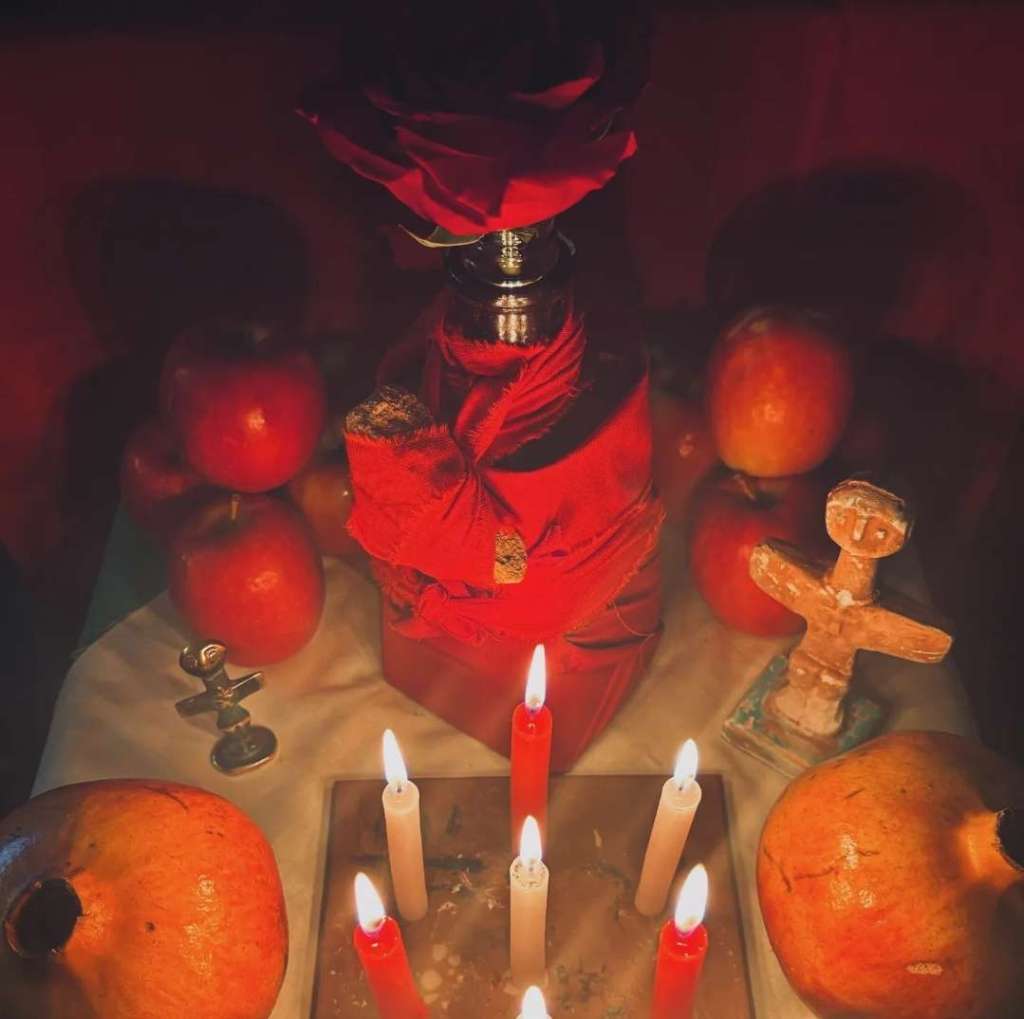
The Oil receiving its final consecration.

This is Key’s flagship offering for our bounty, an oil he has described on numerous occasions as an attempt to create a liquid personification of the blessings he bore witness to at Her holy site. Structured around historically attested offerings to Aphrodite, this oil also draws additional inspiration from Agrippa’s Three Books of Occult Philosophy, especially Book One, Chapter 28: What things are under the power of Venus, and are called Venereal.

Built off a foundation of apples and pomegranates gathered from her Sanctuary in Paphos, then dried, reduced to powder, and infused (some hot and some cold depending on the need of the spirits), this oil is itself a living spirit. It may be spoken to, prayed with, and used in any manner as befits the Queen on High. Its birth required immense attention and care, from the ways in which each herbal ally was freshly harvested by hand and by copper, to how each rose and myrtle bush was offered to and sung with. A powder made of the white doves given to the Goddess was added alongside countless other ingredients which must remain unnamed. The vessel of this oil was treated with just as much care as the contents, joining body and spirit in the sighs of incarnation and the joy of life. It was clothed with red and affixed with stones gathered from the temple as a calling to Aphrodite as Kythere (“the red one”), as attested in PGM IV. 2891–2942, and as Kythira; a purported birthplace of the goddess or alternative destination the nymphs carried her to in her most heavenly form. The red cloth itself was extensively consecrated, having seven feasts laid upon it and seven forms of love graced into its folds before it was ready to wrap the mother bottle in its embrace. Countless votive acts were performed to the bottle to ensure it was prepared to contain the essence of Key’s reflection upon his own devotion and experience at the temple.

The bottle you receive should be enshrined and treated as a cultic object of its own. It will be wrapped in its own cloth and act as its own mother bottle, an offering of the liquid form of the Goddess’ blessing. Use it in any manner of working you can imagine, to cultivate Her presence, to anoint your body and the bodies of others, to give unto spirits and to forge their pacts under Her gaze. This is not an oil designed only for the usual reasons of love, sex, beauty, fertility, and so on—there are incredible astrological elections and traditional recipes and formulas across the traditions we are initiated and trained in that can produce oils that work brilliantly for these goals instead. Rather, it is an offering of the Goddess unto the Goddess, forging a relationship between user and spirit directly. Include it in your own fetish vessels and add it to ropes that will tie together the pacts you will forge with even the most capricious of spirits. If you would like to use it for the everyday needs of sorcery and conjure, we recommend that you add seven drops to olive oil you pray Her hymns over to create a new mother bottle specifically for more regular engagement with practical magic.

Oil of Nepherieri

1 fluid ounce / 30 milliliter amber glass dropper bottle, draped in red cloth and secured as a devotional object of ritual use. Created by B. Key.

$220.00

Balm of Eros

Tins poured in submission and in domination.

The first of a trinity of offerings Key created in honour of the three most famous forms of love: Eros, Agape, and Philia. The Balm of Eros uses the Oil of Nepherieri as its main oil base, to which were added rose petals and thorns alike, lavender, red clover, damiana, kava, ashwagandha, skullcap, vanilla, a small portion of the dove powder, and dyer’s alkanet to turn the beeswax pink. There is a dream-like, opium haze to its kiss, liberating inhibitions and indulging the smooth, passionate glide of stripping silk, unveiled prowess, coy submission, and lurid command.

Having received extensive consecration and laboratory testing, these balms may be used to strengthen sexual and romantic bonds through mutual anointing over the skin, enhance the sensitivity of skin to touch, allow for more pleasurable and physical experiences with spirit lovers, heal minor cuts and bruises incurred through rougher, passionate play, and much more. They are also especially designed to make the clients of sex workers more docile, pliable, obedient to directions, and swifter to part with money.

Balm of Eros is sold out! Thank you for your patronage!

Tincture of Agape

A small vial of the tincture, gold as honey.

A gift unto the gods, this tincture was crafted with a number of coalescing goals in mind: to instill a benevolent blessing of overwhelming purity and the sensation of divine presence, to improve the intellect, to heighten spirit communion, and to make oneself friendly to spirits (especially those that are the least friendly of all) chief among them. Many herbal pacts were forged on behalf of this tincture, including hand-foraged motherwort as the base, hyssop, lemon balm, lavender, and more. Each individual vial was blessed with a mouse’s paw—taken from one acquired by a spirit at a three-way crossroad—to be as the gentle hand which removes the needle from the lion’s paw, ensuring that one’s humanity has a less abrasive effect to those spirits to whom we smell foully towards, and securing immediate communion between what was once stranger to become now beloved friend. In this way, this is also an incredible ally in repairing broken pacts, frayed bonds, and in allowing forgiveness to give way to lasting harmony.

In creating this tincture, we were both reminded of how deeply it is that love and beauty and the delights of this Goddess—so profoundly worshipped and so deeply called out to even to this day in her many forms and faces—is quite literally the force which makes all the stars in the sky shine and the world itself rotate on its axis, yet it is tragically what we often feel most guilty about claiming for ourselves and owning our own desires for. Our spirits have reminded us that our relationship to being seen and held by love’s embrace—romantic, platonic, or otherwise—is as necessary as breathing, yet so often we are taught it is something to fight for to become worthy of. This tincture is also an offering unto the mysteries of healing, rectification, and right alignment with the reception of love into one’s life, and that perilous and frightening as that journey may be, we never truly walk it alone.

While Key is proud of all of his offerings, this one holds a special place in his retinue for how potent its effects were upon testing. Even the very motherwort that was freshly wild harvested for this tincture was found through the assistance of the Eye of Nepherieri’s nymphs, who led Key directly through a bath of newly-blooming blue flowers into a grove pregnant with the herb. Deploy to approach the distant, to bridge gaps of understanding, to forge new bonds in impossible circumstances, and to urge ephemeral and cautious spirits rush to be present in communion.

Tincture of Agape

1 fluid ounce / 30 millilitre amber glass dropper bottle, crafted with utmost devotion, created by B. Key.

$150.00

Oil of Philia

Where there is one, may there be many.

The Oil of Friendship was born of a desire to strengthen all forms of platonic love. This oil is especially adept at finding new friends and colleagues, repairing familial problems and rifts to create peaceful homes, bring like-minded people into your fold to become fast and immediate friends, and protect existing agreements between parties. The oil is heavily strained and kept as sterile as the olive oil in one’s kitchen, especially that a drop may be incorporated in cooking without anyone being the wiser. Rub on the body, add to food, anoint on mirrors, and use in any way directed by your spirits to find, keep, stoke, and promote lasting harmony and exhilarating, adventurous, flourishing love among found and originating family alike.

For the majority of this oil’s consecration, it was not a fluid that was being addressed, but an empty bottle; slowly filled with words, sighs, blessings, incense smoke, and washed with seven veils of enchanted waters. Expressions of gratitude and love to friends were whispered daily for half a year into its mouth, perfumed with incense and bathed in elected and captured stellar milk. Once the oil was added, the effect was immediate and undeniable, setting instantly into the cushion of affection laid within.

Oil of Philia is sold out! Thank you for your patronage!

Star of Aphrodite Incense

An offering among offerings, to Her on High.

This is an incense which Key laboured over for months until he managed to achieve a smell identical to the fragrance we caught at the Sanctuary. When the Goddess appeared before us, this was the scent which permeated the temple. The smell it releases is utterly remarkable; rich and lofty, sensuous and spellbinding, lurid and elevated. The recipe draws heavily on PGM IV. 2891–2942, the Love spell of attraction which includes an “offering to the star of Aphrodite” composed of white dove’s blood and fat, untreated myrrh, and parched wormwood. Many other floral and herbal notes were added to this base until the scent was exact.

Use to manifest spirits tangibly, to call down divinities, to ensure intercessory spirits transmit your prayers to the ears of the Gods, to procure folkloric love, and call to the Mysteries.

Star of Aphrodite Incense is sold out! Thank you for your patronage!

Pigment of Venus

The hue of her embrace.

A pigment born of the kiss of copper, in honour of the relationship between the Goddess and this most sacred metal which harvested all the herbs of the collection. Key’s love of alchemy and his own background as a chemist led him to create a pigment replicating the colour of the waters themselves. Combine with oil to create a paint for sigils, seals, decorating statues, inscribing walls and pieces of art, and folding into the cracks of broken items to restore them anew.

Pigment of Venus is sold out! Thank you for your patronage!

Stele of Aphrodite

The famous Stele from the PGM.

The Stele of Aphrodite from PGM VII. 215–18, for friendship, favour, and success. These were cut from tin-plated steel and engraved with a bronze stylus, then reinforced with an engraving tool. They are sturdier than regular tin and can be placed within a wallet for easy carrying. These are a more affordable choice of talisman for everyday wear and use. In addition to following the PGM faithfully, these have been consecrated using the Star of Aphrodite incense, Venus Rising in Pisces incense, and left under the care of the Eyes of Nepherieri for additional potency. They have been tested extensively and have generated luck, fortune, wealth, soothed anger, courted deeper friendship, and propelled forward a feeling of control and peace within the turbulence of changing fortunes, that luck ever be by one’s side.

Beyond carrying them in wallets or on one’s person, they can be put in the bottom of boxes and jars as the core to prosperity vessels, given to spirits that preside over your luck/fortune/money, placed over petitions or under them with a candle burning over the top to nurture the arrival of soul-mate like friends, tied up in string to business cards so that they can persuade a boss or hiring manager to adore you without becoming too obsessed or attached, and far more. We highly encourage experimentation with these as they are a truly “super-charged” version of this reliable charm!

All Steles of Aphrodite are sold out. Thank you for your patronage!

Shields of the Sanctuary

Sherds gathered from the pilgrimage.

This famous and much-loved charm from PGM XXXVI. 256–64 protects against nightmares, spiritual assailants, curses/malefica, and physical harm. It is recommended that you hide these within your home or bury them somewhere on your property. What makes these amulets special beyond its usual formulation is that they are born of three-sided pot sherds gathered from crossroads that we found along the pilgrimage route around the Sanctuary. There are an incredibly limited amount of only seven sherds, each of which will be inscribed with your name in myrrh ink, consecrated before our shrines, perfumed in the Star of Aphrodite incense, and anointed with the Oil of Nepherieri. As such, these are especially precious and will be custom made for each individual client. If you claim one of these, please include in your notes if you would like your name to be different from the one on your purchase receipt.

All Shields of the Sanctuary are sold out. Thank you for your patronage!


None of the recipes and items will ever be in stock again once they are out, as they required the unique combination of the pilgrimage and its blessings to craft. Key and I were privileged to see many ancient temples and cultic sites across Dalmatia and the Mediterranean, including in Greece itself along our dealings. It would be our privilege and hope to be able to embark on such a journey again one day, immeasurably so with Salt in our company as well when our busy schedules afford it. Yet it was specifically in Paphos that an experience of this magnitude bore itself to us. We would not dare suppose that anything similar might happen again if and when we next find ourselves on those incredible shores. It is the unique confluence of the witnessing of the Goddess, the blessings with unfolded, physical manifestations of the path, and omens which hounded us at every turn that led to this limited collection, born of our deepest devotions. It would be our utmost honour and privilege to share our love and the love of this work and its spirits with you.

All prices include shipping. If purchasing multiple items, please note that each will ship from the individual who had created them, so you will receive two packages if acquiring offerings from Sfinga and B. Key together. Please allow for seven business days to ship your orders, as each undergoes an additional blessing before being sent.

May the heavenly, illustrious, laughter-loving Queen illuminate futures of loves untold, of passion thought only to exist in stories, and of fulfilled desire for companionship to be born of true perception. As She crests over the horizon, may your fulfilment surge to meet Her.
New Course: Pure Sympathies and Natural Magic

On behalf of the With Cunning & Command and Frightful Howls team, we wish everyone a blessed Easter! Whether you’re celebrating the resurrection of the Lord or counting down the days until the same date on the Julian calendar, may all your magics come to fruition and your cantrips and spells rise into reality with the Son of Man.

We just released our 25th episode of the podcast: Spiritual Hygiene and Sympathetic Magic. To think that we’re almost at our anniversary is almost unbelievable, it feels like just yesterday that we launched the podcast with the episode on the Toad Bone Rite. We’re so deeply grateful to the incredible following and reception the show has received, whether you’re a Patreon supporter or a fan who regularly engages with us our accounts on Instagram, your feedback means the world. Every time one of you sends us a DM or an e-mail detailing how you’ve put into practice something we’ve shared, or how a story we told impacted your practice, the three of us get even more inspired to put out more content, be it our research episodes, practicums, or hosting a personal friend of the crew on to discuss all manner of folklore and magic.

To celebrate the first 25 episodes, Salt’s put together a real treat for us all. If you enjoy the episode on spiritual hygiene and are hungry for more, our very own Wolf has put together an entire course module on the practical side to purity, cleanliness, and natural magic! It’s a real pleasure to hear him speak directly to the heart of such a sensitive topic, especially one that is so often misconstrued with notions of morality, strict orthodoxy, and personal worth.

Every now and then, some episodes of The Frightful Howls You May Hear will have an accompanying mini-course available right here at With Cunning & Command, bridging the theoretical exposition of the show with actionable techniques in the module. Within 24 hours of purchasing, a download link will be sent to you where you can both view the extra practical material, including over 30 simple and immediately actionable techniques relying on the principles of natural magic, as well as a PDF of all the charms sourced directly from primary texts and personal experimentation. No matter where you are in your practice, Salt’s “Pure Sympathies and Natural Magic” module is sure to have something engineered to help you navigate our animist reality with an even firmer foundation. The link to purchase is available below as well as on our new Courses page. Keep your eyes peeled for more episodes in time that will have a bonus component like this!

Pure Sympathies and Natural Magic

“Pure Sympathies and Natural Magic” is an hour long exposition into the practical side of spiritual hygiene, cleanliness, and natural magic, including over 30 accessible, simple, and immediately actionable techniques relying on the principles of early modern natural magic. The class includes a PDF of all the charms sourced directly from primary texts as well as personal experimentation, made available for your immediate and easy reference. Additionally, the module presents an accessible introduction to this most foundational of skills, which influences every working and spirit encounter we undertake. Within 24 hours of purchasing, you will be sent a download link to the class and the PDF of charms via the same e-mail you paid with. Happy trafficking among the spirits!

$60.00

We wish you deep communion, swift manifestations, and ever more transformative spiritual ecstasies in your traditions and workings on this holiest of days. Happy conjuring!

Patreon Preview: Astrological Almanac

Greetings, all! Ever since we released our podcast and its Patreon, a staple offering I’ve been making available to our Patrons has been the monthly Astrological Almanac & Ephemeris. It’s been a true pleasure seeing everyone’s responses to it, and how creative many of our Patrons have been with their applications of the Almanac to their own practices.

Now that it’s September, I wanted to release last month’s issue to the blog, so that our beloved readers and listeners alike can get a feel for what this project actually is and entails. We’ve received many e-mails inquiring about this offering, so without further ado, here’s the August 2023 issue as it appeared on our Patreon:

This monthly e-zine is meant to accommodate those who have interest in astrology, as well as practitioners of folk magic, traditional Western and Galenic medicine, gardeners, farmers, and anyone else with a mind for the stars and the patterns of the sky on their craft. Each issue includes a number of different subjects, spanning electional astrology, articles on particular trees and herbs, monthly prognostications for particular horoscopic signs, astro-meteorology (or weather) prediction, as well as a calendar featuring daily Psalms and Saints for the particular days of the month to help you in consolidating your ritual calendars. In addition to all this, we also include an Ephemeris, giving the positions of the planets for each day of the month. Finally, we have the Voice of the Spirits, a monthly report presenting useful advice for those amongst our readers taken directly from a spirit-informed divinatory oracle on behalf of our Patrons.

Whether you want to look at the best day for a ritual purification, exorcism, what day would be best to use herbs belonging to Venus, or when the best time to administer a herbal treatment is, our monthly almanac aims to provide useful and condensed, immediately actionable advice on approaching all these topics and more. If you’d like to subscribe for access to the almanac as well as numerous other perks related to our podcast, myself and my co-authors and hosts would be honoured to have you at our Patreon. Our one (and only!) tier grants you access to our monthly magic Q&As, the ability to suggest episode topics, first dibs on new offerings at the website, and our show notes.

Thank you all so much for your continued support of our podcast, and stay tuned for new offerings and charms we’ve been hard at work on!

Co-Arising Stars: Formula for the Paranatellonta

Paranatellonta and the formula for calculating rising and setting stars

The paranatellonta are another major feature of astrology that is occasionally utilized by classical authors, such as Firmicus Maternus, Manilus, and so on. We also find examples of these rising stars in later authors, influencing works such as the Astromagia of Alfonso and the Astrolabium Planum (or Astrological Optics as the English edition is known) of Johannus Angelus. They even find themselves appearing in the works of William Lilly and later renaissance authors, by their tables of “bright, dark and empty” degrees.

Now, the word paranatellonta (παρανατέλλοντα), literally “parallel rising” (or alternatively, συνανατέλλοντα, “synanatellonta” – rising simultaneously according to the Brill’s New Pauly) describes the rising of the fixed stars that occurs over the horizon. This is contrasted with the method of Ecliptic Projection given by Ptolemy, which sees use in various works including Anonymous 379 – in which, though he might imply use of the paranatellonta by his language, is in practice giving the ecliptic projections of the fixed stars in his work. This ecliptic projection method is also used by many astrologers today and in the classical period. It’s the most common and popular method of using the fixed stars, and itself one of much use and virtue.

Yet it is not the sole method of observing them, and, alongside the heliacal phases of the stars, the paranatellonta make up one of the three approaches to using the fixed stars in classical astrology.

Now, in ecliptic projections for the fixed stars, even if 8° Leo is rising in the Ascendant, it doesn’t mean that a fixed star whose ecliptic projection is at 8° Leo will also have its physical body also rising, because it is not directly on the Ecliptic (though some are and thus will). In other words, its body might be elsewhere, under or above the horizon. The paranatellonta however, refers to the more precise astronomical observation that we can use to determine the ascendant degree at the time a particular star’s physical body appears over the horizon. The name itself – co-arising, parallel rising, or rising alongside, however you spin it – is chosen because they rise at the same time as a particular degree of the zodiac, over the circle of the horizon. Thus they share a sympathetic relationship to the same said degree and exert their influence over it. The precise astronomical relationship here is going to be a subject in my upcoming Astrological Course, and we’ll leave those finer details for another time, though those familiar with the basics of astronomical coordinate systems will be able to understand these things just by what has already been written.

The concept of paranatellonta does indeed have a relationship to the “parans” of modern astrology, though there are also some distinctions and differences as well. Namely, as far as similarities go, the emphasis is upon the star’s physical body rising over the horizon (though we arguably also include culminating and setting stars as well) at the time of the Native’s birth.

As far as the differences, the first is that the paranatellonta emphasise the horizon. In other words, a star must be in the Ascendant or (arguably) culminating, setting and so on, to be considered relevant. It does not need to be regarding a planet to be effective or to have influence over the figure.

The second is that the paranatellonta are only effective at the time of birth itself – the exact measure of this seems to be based on the exact degree that the star co-rises with, if we consider the ‘images of the degrees’ given in Johannes Angelus & the Astromagia to give us an indication of this, although its worth thinking that Firmicus is clearly ascribing Sirius multiple degrees of influence as well. On the other hand, contemporary use of the parans considers them in relationship to the planets and horizon, and through a 24 hour period, whilst the paranatellonta emphasise the moment and degree of birth itself.

So we can see that the fundamental concept is very similar, and holds a similar basis; but there are distinctions as well.

Now, these paranatellonta also have a relationship with the decans, which makes sense considering that the decans were observed in relation to the horizon as well as their heliacal phases by the Egyptians, creating a nocturnal stellar clock – though we should distinguish the earlier Egyptian decans and the later use of decans in horoscopy.

We see them as especially important in judgements of physiognomy and the body in Astrology – which, is a far more important topic than is given credit at times. The body itself is a Nativity – a natal chart in and of itself – and the divinatory art of physiognomy as expressed in premodern Europe, much as chiromancy (or palmistry), was essentially looking at the celestial influences upon a person using the body as the medium and making divinatory statements based on their appearance. Likewise the paranatellonta are given a clear relationship to the body by Firmicus Maternus in his Mathesis – who, drawing on (I believe, as I am quoting from memory here) a lost work by Nechepso and Petosiris, gives the degrees that he calls full, and the degrees that he calls empty. These are related to the “bright, empty, dark, smoky” degrees found in later Astrological literature.

The list given by Firmicus Maternus includes Sirius as the most reliably identifiable star, and gives it to the 7th to 11th degrees of Cancer. However, the ecliptic projection of Sirius was in Gemini during the period Firmicus was writing, and the same for any sources he would have been using. On the other hand, if we look at the rising of Sirius over the horizon, during 100 BC the value we have is roughly 12 degrees of Cancer using the modern zodiac. Of course, there would naturally be offset from the zodiac used by our classical authors by some measure, but, it is still approximately close enough.

Correcting these tables (assuming they need it – as I think they do) is a difficult task; the paranatellonta vary as to which star rises, and which stars set over the horizon at any given time based on latitude. Thus any such efforts to do so would need to be able to calculate them for the given latitude as well as precession. Probably an impossible task, all in all.

But we can see here the relationship the fixed stars and paranatellonta have with the appearance. This is resembling to the decans who themselves, in astrological literature, tend to represent the corporeal form or body of a thing that they signify, as well injury to the same by disease or accidents. We find examples of this relationship in the works of Sahl Bin Bishr (again quoting from memory, please comment if a correction is needed!) who cites Al Andrazaghar on the use of the Face-Lord in judging appearance and also Julian of Laodicea, recently translated by the Horoi project. Thus we see that the co-arising stars have a strong share and influence over the body of the Native, as well as their activity and behaviour.

This brief cursory look is just a beginning, but I leave you with the formula below – so that you can calculate the time that a particular fixed star might rise or set over the horizon, as well as the formula to determine which stars will rise or set.

Notes to the Formulary

A quick note: I do not have a background in mathematics, save for entry level programming in Javascript, BASH & a small amount of C#. As such please forgive my crude formatting and the fact that I am probably breaking several mathematical conventions. Furthermore, I wish to note my sources used here. Firstly, I have drawn upon the formula given by Robson in her work on the Fixed Stars, and the formula for the Ascendant and Midheaven given by Radixpro. I have removed the conversion of LST to RAMC (or vice versa) in both cases as a result, and redacted Robson’s use of the Logarithmic Trigonometry since it is unnecessary – though those who wish to make use of them will find modernized formula for these logarithmic tables following the example as a helping hand to those who are interested in using parans and calculating them by hand.

The Formula

Sin-1 (Tan (δ) x (Tan (φ)) = AD

90N + AD = H

or

90S – AD = H

α – H = Rising RAMC

α + H = Setting RAMC

sin RAMC / cos RAMC x Cos ε = ƛMC

Tan1 (cos RAMC / -(sin ε x tan φ + cos ε x sin RAMC)) = ƛAsc

1. Breakdown of the Formula

First we need to take the declination of the fixed star (δ), the right ascension of the fixed star (α), and the terrestrial latitude (φ).

2. Calculate the Ascensional Difference (AD) for the star, as follows:

Sin-1 (Tan (δ)) x (Tan (φ))

In the windows calculator for example, this is as follows:

Tan δ x Tan φ = Dif

Sin-1 (Dif) = AD

3. Use one of the following, depending on whether the star is southern or northern

90N + AD = H

or

90S – AD = H

4. Calculate the rising RAMC of the star as follows, using the Right Ascension (α)

α – H = Rising RAMC

5. Calculate the setting RAMC of the star as follows, using the Right Ascension (α)

α + H = Setting RAMC

6. Now we calculate the MC, before calculating the Ascendant; so that we can determine the rising time of the star. This is a simple formula, divided into a few steps, and should give you the chance to familiarize yourself with these calculations before the more complicated Ascendant. The formula is as follows: to calculate the zodiacal longitude (ƛ) of the MC, using the RAMC we calculated above, and the obliquity of the ecliptic, which we can approximate to 23.4371 for modern dates but ideally, we use a more precise amount, especially in dealing with trigonometry.

ƛMC = sin RAMC / cos RAMC x Cos ε

Simplified, it is as so:

Step 6.1:: sin RAMC = SinRam

Step 6.2: cos RAMC x Cos ε = CosRE

Step 6.3: SinRam / CosRE = Result

Step 6.4: tan-1 (Result) = ƛMC

Note that if the RAMC is under 180, it will fall between 0 Aries and 29°59’ of Virgo. If it is greater than 180, then it will be between 0° Libra and 29°59’ of Pisces. If it is not meeting these requirements, add or subtract 180 as necessary to produce the result sought.

7. Now we use the following formula to calculate the Ascendant from the RAMC. To do this we need our RAMC from earlier steps, and terrestrial latitude (φ) from step 1. Finally we need the obliquity of the ecliptic (ε). This can be found easily online or via its own relevant formula. Then we consider the following formula:

Tan1 (cos (RAMC) / -(sin ε x tan φ + cos ε x sin RAMC)) = ƛAsc

However, we can simplify this as follows into six steps.

7.1: cos RAMC = CosRam

7.2: sin ε x tan φ = sintanEL

7.3: cos ε x sin RAMC = cossinERAM

7.4: sintanEL + cossinERAM = Negative Number1

7.5: – Negative Number1 = Negative Number2

7.6: CosRam / Negative Number2 = Result

7.7: Tan-1 Result = ƛAsc

From this we have our ascendant axial degree – and remember that 00.00 is 0 Aries; Whilst 359.99 is 29.59’ of Pisces. It must be in a sign following, or to the left; of the MC. So if the result is not appropriate, then you must apportion 180 to the ascendant longitude as necessary.

Examplum

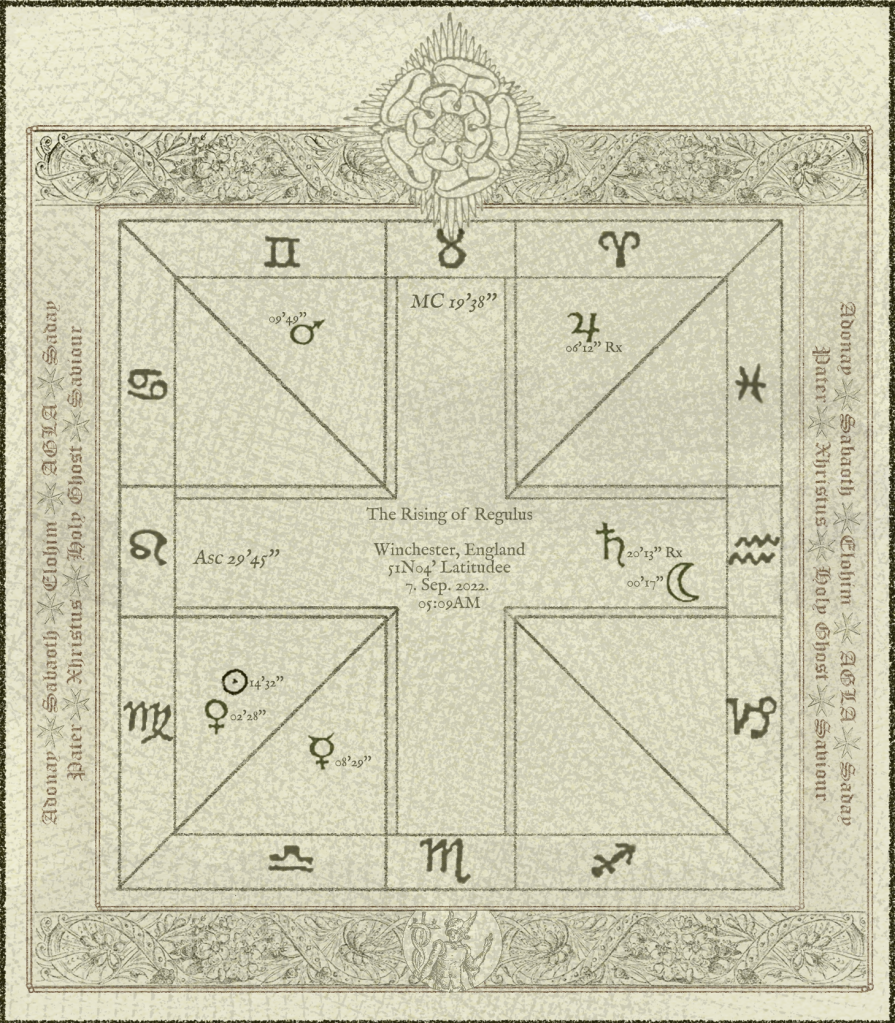
Let us take the star of Regulus, on 7 Sep 2022; and as for our local horizon, let us say that the Native is from Winchester, Hampshire.

1. First we need to take the declination of the fixed star (δ), the right ascension of the fixed star (α), and the terrestrial latitude (φ). [I have also included the obliquity of the Ecliptic (ε) since we will need it later.]

φ: 51°05’ or 51.08 North

δ: 11°51’ or 11.85

α: 10h9m32s, or 152.25

ε: 23.4382260812

2. Calculate the Ascensional Difference (AD) for the star, as follows:

Sin-1 (Tan (δ)) x (Tan (φ))

In the windows calculator for example, this is as follows:

Tan δ x Tan φ = result

Sin-1 (result) = AD

Let us take the Ascensional difference, by observing the formula given, and it gives us:

tan(11.85) x tan(51.08) = result 0.2598493562969941021326313835425

We then use the arcsin on result to generate our AD:

sin-1 0.2598493562969941021326313835425 = AD 15.061123671264834812596990682949 (or 15°03’)

3. Use one of the following, depending on whether the star is southern or northern

90N + AD = H or 90S – AD = H

Now, since the star of Regulus is of northern declination; and we likewise are northern, we add his ascensional difference to 90, so we can make H.

90.00 + 15.061123671264834812596990682949 = 105.06112367126483481259699068295

4. Calculate the rising RAMC of the star as follows, using the Right Ascension (α)

α – H = Rising RAMC

Then following this, we calculate the RAMC of the star by subtracting the same from his RA, and it gives us a sum of 47.18887632873516518740300931705 in RAMC. Thus the midheaven shall have the Right-Ascension of 47 degrees and 11 minutes, when the star rises over the Ascendant. Note that we will dispense with looking for the setting time (step 5) here to keep the example simple.

6. Now we calculate the MC, before calculating the Ascendant; so that we can determine the rising time of the star. This is a simple formula, divided into a few steps, and should give you the chance to familiarize yourself with these calculations before the more complicated Ascendant. The formula is as follows, to calculate the zodiacal longitude (ƛ) of the MC, using the RAMC we calculated above, and the obliquity of the ecliptic, which we can approximate to 23.4371 for modern dates but ideally, we use a more precise amount, especially in dealing with trigonometry.

ƛMC = sin RAMC / cos RAMC x Cos ε

Simplified, it is as so.

Step 6.1:: sin RAMC = SinRam

Step 6.2: cos RAMC x Cos ε = CosRE

Step 6.3: SinRam / CosRE = Result

Step 6.4: tan-1 (Result) = ƛMC

So, using the RAMC to determine the longitude of the midheaven in the zodiac, we must proceed as follows:

The Sine of the RAMC is 0.73359794075541645499224468998881

The obliquity of the ecliptic is 23.4382260812 and when cosined and multiplied with the cosine of the RAMC, it gives us 0.62351091696510862919932339243141.

So, we divide this sum from the sine of the RAMC, giving us 1.1765598978220749303357600844386. Make an arc-tan with it and we are given 49.637609676335657842990870332858.

Converted to DMS (this means at the time of the stars rising) it will be at 49°38’ degrees of absolute longitude. IE: 19°38’ Taurus will be on the MC.

Note, that if we consider the Swiss ephemeris table of houses for the right ascension of the Midheaven, the answer is approximately the same. (Possibly give or take an insignificant deviation of a few minutes – I haven’t interpolated the table of houses).

Intermission

Now, before we move onto calculating the Ascendant (which is more useful if we would construct a table, for example) we ought to examine the figure, and determine the evidence to show that this works.

Here we have the Chart as I have designed it. We can see the Ascendant is 29’45’’ Leo. The Midheaven is at 19’38’’ of Taurus, as we observed earlier.

Now, if we look at the ‘parans’ in the Solarfire program reports, we can see that connecting to and rising over the Ascendant is Regulus, with only about a minute’s difference to our manual calculation.

In this respect then, we can see that it works effectively for the calculations. But still, if we had the wish to construct a table, for example, then it is good that we know the rising degree as well.

Back to our example!

7. Now we use the following formula to calculate the Ascendant from the RAMC. To do this we need our RAMC from prior steps, and terrestrial latitude (φ) from step 1. Finally we need the obliquity of the ecliptic (ε). This can be found easily online or via its own relevant formula. Then we consider the following formula

Tan1 (cos (RAMC) / -(sin ε x tan φ + cos ε x sin RAMC)) = ƛAsc

However, we can simplify this as follows, into six steps.

7.1: cos RAMC = CosRam

7.2: sin ε x tan φ = sintanEL

7.3: cos ε x sin RAMC = cossinERAM

7.4: sintanEL + cossinERAM = Negative Number1

7.5: – Negative Number1 = Negative Number2

7.6: CosRam / Negative Number2 = Result

7.7: Tan-1 Result = ƛAsc

So in this example, we have our RAMC, and we make the cosine of it to be as follows which we will save for later. (Cosine of the RAMC: 0.67958374121178950478721381305492)

Now we take the sine of the Obliquity of the Ecliptic and multiply it via the tangent of the Terrestrial Longitude, and it gives us this result. 0.49259755429671712792119030118711

We then take cosine of the obliquity of the ecliptic, and multiply this via the sine of the RAMC. This gives us the following. 0.67306837551544119543796432811591

We add these two values together to produce the following:

1.165665929812158323359154629303

But we then negate it, so that it is written as such instead:

-1.165665929812158323359154629303

Now we take that Cosine of the RAMC, and divide it by the negative number:

0.67958374121178950478721381305492 / -1.165665929812158323359154629303

This shall give us the following result:

-0.58300043248351719733908295153597

And this we make the arctan, or tan-1 and the value that is returned will be our absolute longitude. However, in this example we must also add 180 Degrees, since the result is -30 and would place us elsewhere.

tan₀⁻¹ ( -0.58300043248351719733908295153597 ) = -30.242203862335842420585487984185

-30.242203862335842420585487984185 + 180 = 149.75779613766415757941451201582

Converted to degrees this is 149 degrees and 45 minutes, 28 seconds of absolute longitude. So we thus know the Ascendant will have the 29th Degree of Leo, 45 minutes and 28 seconds, just as it is also affirmed in the figure above. And if we wished to include it in a table for the same star, we could do so.

Co-Latitude and which stars can rise or set

Note that not every star will rise and set however, depending on the latitude we look. Therefore we must look to its colatitude:

1. Determine the Co-Latitude. This is found by subtracting the latitude of a place from 90. Thus, Alexandria has the latitude of 32°10’ (or 32.17 decimal).

90° – 32°10’ = 57°50’N

2. Any star with a greater declination than the co-latitude in the same hemisphere cannot set. Any star with a greater declination than the co-latitude in the other hemisphere cannot rise. As an example, if our co-latitude for Alexandria is 57°50N, then a fixed star at 58°N cannot set; and a fixed star at 58°S cannot rise over the horizon.

A final note on Robson’s formularies

Though I don’t consider the aspects with the paranatellonta, I wanted to make a note for those who are interested in using the above formula for their own use of parans. The formula given by Robson was making use of logarithmic tables, and converting these to a calculator can be troublesome. Whilst I won’t give the full formula here, as a helping hand for the interested parties who might want to use the same, the method of deriving the logarithms is as follows. For example, if we wanted to observe the logarithmic tangent of a particular stars declination:

log(tan(δ)) + 10 = LTδ

In the Windows calculator this would be as follows (make sure you are using scientific mode):

Tan δ = δt

log δt = δtl

δtl + 10 = LTδ (logarithmic tangent of the declination)

For example:

log(tan(11.85)) + 10 = 9.3218506117750843878824221985422

And finally, a note on usage of these formulas

If any readers, students, and fellow astrologers are interested in using these formulas in their publications and programs, you have my permission and encouragement to do so! All I’d ask you to give me a shout out as well, and ideally a link to either this article/our blog, or the website of our upcoming platform for hosting classes, soon to be featuring work from myself, Sfinga, and Key: mercurii-school.com. The website isn’t live yet, but expect updates very shortly on the first course: a 106 lesson tour of traditional astrology and magic by yours truly. I named my sources, and would appreciate being named in turn!

Many thanks for your time, and I hope you find this useful!

Oracle of Kronos: PGM IV. 3086–3124

Ever since I had forged my daimon pact through PGM VII. 505–28, I found my existing love and appreciation for the papyri become even more enflamed. My list of rituals to accomplish had more than doubled, coming to encompass a number of more complicated rites, my mind being at ease with my daimon’s assurances that he could arrange for all the necessary materia requirements without resulting in me breaking any budgets. While I am in no way averse to substitution, especially when the workarounds are orchestrated by the spirits themselves (and naturally, confirmed with cunning and insightful divinatory inquiries), I have often found a special thrill and excitement in carrying out older spells as they were written. My spirits have often noted that there are pacts forged at every step of a working’s channeling, with the powers that are drawn upon, anchored, and payed homage to through each ingredient often being far more complicated and nuanced than one would first assume, largely being the dominion of the privacy and secrecy of the ruling spirits of the working themselves. It is ultimately a sorcerer’s wit that will guide them in reading between the lines of received grimoires and rites, consulting with their spirits on matters such as what is superfluous or merely an artefact of the time, what marks a power’s presence and must be included, what can be summoned spiritually through existing alliances within one’s own court to stand in the place of the material, and which elements provide an initiation unto themselves simply by being gathered, alerting the watchers of the rite to the sincerity of the seeker of mysteries.

One of the most crucial lessons my patrons have ever taught me when it comes to magic is to always remain level-headed, curious, flexible, and diligent. To live tradition is to carry it forward into the incarnated times in which one lives; not to be a servant of its artefacts. At the same time, to disregard the pacts our ancestors had already made on our behalf, including the ancestors of sorcery itself—those who penned down the rituals we consult and seek to reenact, or who forged the first agreements with certain spirits and how they would consent to manifesting and arriving when called in the future—is to extinguish personal ambition with bitterness and arrogance. While I have always pursued magic’s manifestations and miracles for the consistent delights they have conferred upon my life, I find that in my heart I love the art for its own sake. That so much is possible, that so much folklore is true, and that so many spirits exist to consult with, learn under, and stretch the limits of our perception and cognition with will never fail to fill me with absolute glee.

In some cases, procuring certain items is in and of itself a significant part of the journey, in others, they flag important powers that must be noted and given their due in order for the requested spirits to manifest in the way the ritual assures they will. To love Mystery, what is hidden, occulted, and what in some cases may never be known to the magician, being the knowledge only certain spirits have the license to witness and bear, is also to allow for adventure in every step of the sorcerous process. A long-standing agreement I have with a few specialized familiars, combined with the work of the 2nd Pentacle of Mercury (which brings things “contrary unto the order of Nature”, that is to say, including that which is improbable or rare, or to make what is expensive cheap, etc.), is to open the roads to procuring rare materia for future experiments. In some cases, this manifests as unexpected windfalls of money to purchase what I need, in others, in the form of sudden connections with those who either themselves are able to obtain them for me, or know someone else who could. On this front, my new daimon was eager to join in, encouraging me to pursue other workings from the late antique Mediterranean period, both from within the PGM collection and beyond, with the assurance that he would open the way forward so to carry them out precisely.

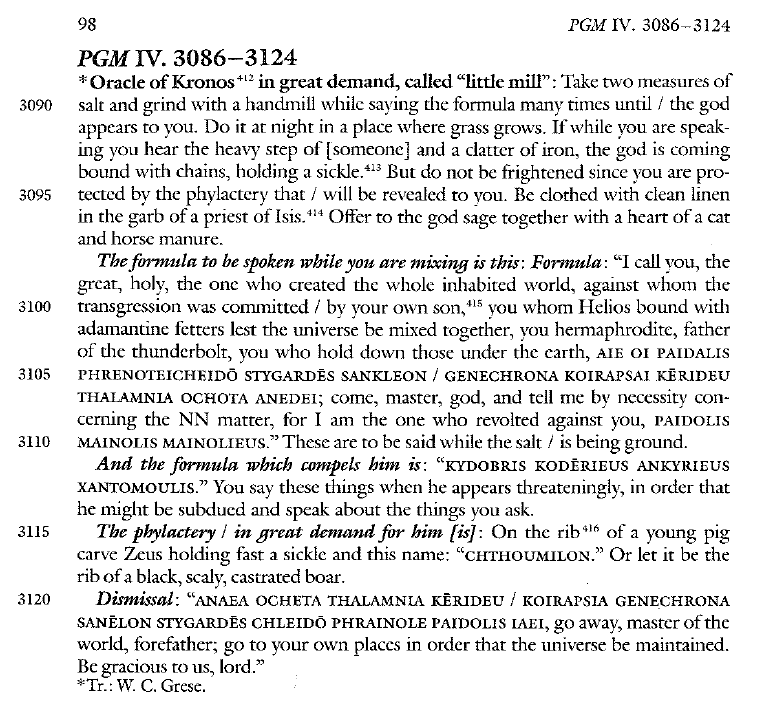
At the top of my list was PGM IV. 3086–3124, the title of which is given as the Oracle of Kronos. This ritual had captivated my fascination for almost a year now, ever since another spirit of mine pointed out its remarkable qualities to me. Its intended outcome is to call forth the god Kronos, who, once manifested, may reveal the answer to any question. While the Oracle may certainly then be consulted as a purely divinatory ritual, it was made clear to me by my spirit that there is nothing which suggests the “questions” posed must strictly concern themselves with such matters. Instead, one may presumably petition the god in the same fashion, requesting knowledge, rituals, secrets, mysteries, ways to access particular powers and familiar spirits, and so on, as is the case for most rituals in the PGM intended to compel or conjure a deity to appear. I sat in discussion with my spirits to determine the list of questions and petitions to put forward some time ago, and immediately set out to recreate its instructions.

An image of the rite as it appears in Betz, p. 98.

The ritual involves going out to a place “where grass grows” at night and grinding salt in a handmill, speaking a formula until the god arrives. His manifestation is said to be heralded by the clattering of iron chains and the sound of heavy steps. The magician should be clothed with “clean linen in the garb of a priest of Isis”, and have prepared an offering of sage, the heart of a cat, and horse manure to burn. Additionally, a phylactery must be made and held on the person for the purpose of protecting oneself from the god, subduing him when he “appears threateningly”, and compelling him to provide the answers to the questions given, while similarly chanting another formula. The phylactery in question is to be made out of the rib of either a young pig (presumably one which has not reached sexual maturity) or a “black, scaly, castrated boar”. The rib is to be carved with the inscription “CHTHOUMILON” and the image of Zeus holding a sickle.

There are a few things to note from the outset. Firstly, it is clear that the conjuration conflates Kronos with his own father, Ouranos, given the reference to him as a “hermaphrodite” upon “whom the transgression was committed by [his] own son”—a reference to Kronos severing Ouranos’ genitals with a sickle (making him actually a eunuch, not a hermaphrodite), which resulted in the birth of Aphrodite as well as the Furies. The ritual itself is clearly coercive, with the incense offering being particularly foul-smelling (horse manure and a cat’s heart with sage), and the very act of grinding salt over grass which grows, rendering the land infertile, being a clear transgression against a patron of agriculture. There is a formula to further compel the god once he arrives, in order to subdue him in case he “appears threateningly”, as well as a phylactery of Zeus to protect the sorcerer, allowing them to take on the divine mask of Kronos’ son to threaten him with not only his banishment to Tartarus, but with the same fate he dealt his own father. That the phylactery is made of a piglet’s rib may be to evoke the imagery of a scythe (in the image, wielded by Zeus, but also of course being a typical symbol of Kronos as a castrator, with his depictions frequently wielding a curved harvesting blade), while also drawing on the common sacrifice of young pigs as offerings to chthonic deities in late antiquity. The presence of the cat’s heart is also evocative of the conflation and syncretism of Kronos and Chronos, saturnine associations of time and longevity, and the lion-headed Mithraic Aion.

My spirits had given me much fruit for thought with their commentary as to what kind of theophany might appear from this conjuration. They recommended only changing the line “you hermaphrodite” to “you eunuch”, given the reference to Ouranos’ castration, but proceeding with the rest of the ritual as is. Naturally, my first order of business was to take inventory of what I already had in stock. Regarding the “garb of a priest of Isis”, I thankfully already had a white linen robe on hand for ritual use that I had fumigated with frankincense and myrrh. Similarly, I keep a stock of Dead Sea salt, as well as Greek sage, so I could write those two off the list. This left me with the cat’s heart, the horse manure, and the pig’s rib phylactery.

Key’s invaluable expertise with biochemistry came to my rescue with the matter of the heart. Initially, he kindly offered to place an order with his laboratory where he works for a cat to dissect, and to quite literally obtain the heart for me directly. I decided that this would be our last resort, assuming I could not find just a heart alone to buy elsewhere online. Thankfully, after consulting with one of my aforementioned treasure hunting spirits (whom I primarily at this point employ for assistance in obtaining materia and rare books), a taxidermy shop I frequent suddenly procured a cat’s heart preserved in formalin as a wet specimen, and I purchased it immediately. And yet, Key still managed to save the day regardless! I set the shipping address to his apartment, and once he received it, he treated the heart of the formalin in his lab, ensuring it would be safe to burn as incense when the time comes to give the offering. My biggest thanks as always to him for the crucial help!

I reckoned that the virtue of the horse manure in the offering lies in its foul smell, being coercive in nature. For this reason, I briefly entertained the idea of swapping this component for powdered sulfur, but ultimately decided to at the very least include it in some form while also offering one of my fouler-smelling Saturnine incenses, which contains sulfur in the recipe. I made my way to a small urban farm that is open to pedestrians, slipped away and collected a small amount of the manure, and returned promptly home. I always carry some extra plastic bags, a pair of gloves, and a Sharpie on me in my backpack full of talismans for materia collection, and I have to say that this smelly experience was not even within the top ten least pleasant things I’ve had to grab for magic. Witchcraft and Quimbanda alike have certainly provided the rest.

Finally, I was down to the matter of the pig’s rib. I decided that it would be far easier to obtain that of a young pig’s than a “black, scaly, castrated boar”, and placed an order for a rack of ribs from a suckling pig at a local butcher. I gave the meat itself as an offering to my spirits (as a vegetarian all meat I buy tends to go to spirits and friends) and treated the bones. Once I had an image of Zeus and the name of power to my liking, I lacquered it with clear nail polish to preserve the bone from cracking. In the meanwhile, my friend Alison of Practical Occult had also procured a similar set of piglet ribs, and graciously sent me one of the extras that she was distributing. This meant that, should everything work the way I’d hope, I would be able to mail out the additional leftover ribs to any friend who was hoping to carry out the ritual as well—assuming my other spirits didn’t claim them for their own devices and talismans first.

For the ritual itself, I decided to wait for the nighttime Saturn hour on a Saturday my spirits recommended. I scouted out the location “where the grass grows” ahead of time, placating the spirits of the land ahead of time, and letting them know that I would be grinding salt over the field until the deity manifests, making the appropriate offerings in advance. When the time came, I filled up my bag with the incense, phylactery, salt and mill (in my case, a mortar and pestle), charcoal and a brazier, a lighter, and one glass-encased candle so that I could see in the dark, and headed for the ravine.

By the time I arrived on location, it was a little past 10:30pm, right at the Saturn hour. I had already dressed in my ritual linen robe at home, wearing a plain white skirt and tank top underneath, and had marched over to the forest with no one seeing me on the way there. I set up the brazier and charcoal, lit the candle, and took out my ritual script (a printed scan of the rite as it appears in Betz), checked in with my spirits one more time, and proceeded with the call.

While I’ve never been scared of the dark, even as a child, I found myself feeling strangely anxious as I began the process. At first, I lit the charcoal and began to recite the prayer, entirely forgetting in my eagerness (and sudden onset of uncharacteristic nervousness!) to grind the salt itself—the key component of the ritual! I quickly came to my senses and managed to laugh at myself for a moment, filling my mortar with the salt, and started again, roughly pounding and grinding it with the pestle on its side to continue to spill the contents over the grass. I then continued repeating the prayer until, after the third time, the atmosphere in the darkness of the forest became completely eclipsed by a sudden, encroaching, swelling presence.

I have to emphasize again that I am not at all an easily-frightened person. Among my close friends my reputation for being incredibly difficult to startle is something of a meme, with many having attempted and failed to jump-scare me with various websites and videos. I’ve always enjoyed horror movies—the more unsettling, the better—and no amount of gore or tension has been able to truly unnerve me on an emotional level. If anything, being spooked by a physical manifestation or a spirit pulling a prank or trying to get my attention has only ever excited me. Yet, in that moment, it was as if my veins were filled with ice, my body entirely immobile, and my ears and eyes strained to their peak, staring blindly into the forest, mind absolutely awash with an overwhelming pressure and dread. I seized the phylactery in my lap and held it until my knuckles were white, willing my psychic perception to open further in order to catch even a potential glimpse of what it was that was approaching.

It was then that I heard it—not with my spiritual senses, but with my physical ears—the loud, slow, thumping of heavy footsteps, each movement followed by the piercing, clattering of chains. Words cannot express how genuinely shocked I was at the sheer noise and physicality of this manifestation! I instantly placed the cat heart over the charcoal and watched it quickly roast, adding then the horse manure (I nearly gagged from the smell at this point) and the merciful relief of the Greek sage which made the fumes at least tolerable. After a battery of steps and rattling, each louder than the last, I finally saw in my plain vision a massive, void-like stretch of black, blotting out even the regular darkness of the nighttime ravine, obscuring the outline of the trees I was able to make out by candlelight and my adjusted vision, extending to tower over me even unto the heavens. In my spirit sight, I was able to make out a titanic, hooded figure, features proud yet sunken, beard neat and elegant and yet frayed with time, joints bulbous and rough against stretched, thin skin which showed still the musculature and strength of an aging king. The passage of aeons had folded their paper-scarred weight into the wrinkles of his skin, yet the eyes which seared with flame and fervour—two lone stars in the sky his form had stripped of dimension—gazed down with cold eternity.

The proceedings of our interaction, and the petitions and inquiries I made, are not something I am able to retell publicly. Yet, suffice to say, the intense, passive aura of dread persisted throughout, and at one point the clattering of chains was so loud and the noise so disorienting that I wondered if I was happened upon by some poor nighttime hiker or a large animal—though there was no one there, not even a single forest spirit that I could detect, but me and the presence. I ended up using the compulsion formula when the sensation of fear was close to its peak, not only because I was sweating and gripping my phylactery so hard I worried any more and I might snap it, but because if there’s one thing I’ve learned across all the traditions I hold initiation in, it’s never to allow pride to supplant the practicality of protection formulas. It was not that I felt that I was going to be harmed, more that I decided I needed to do something about the way the feelings of dread were clouding my perception. I wanted to be as calm, articulate, and forward-thinking with the way I communicated my requests, and have the mental bandwidth to respond appropriately and with intelligently. Thankfully, the formula was truly effective, decreasing the aura that surrounded me significantly as it appeared to slink back like a shadow to where I felt the presence. While the tension was no less high, I was able to breathe and speak normally from then on, much to my satisfaction.

Once I had completed my work, and I received confirmation of my requests having been accepted, the answers I sought being given, and the familiar I asked for having been given unto me—with the name and abilities given and attested to, and the requisite oaths of loyalty sworn—I gave the license to depart and prayed for peace between us. Across various conjurations, especially grimoiric and necromantic ones, I have generally found that as soon as the license to depart is given, the spirit simply disperses or vanishes from my presence, leaving me back to my own devices within the ritual space. Yet here, I found myself mesmerized as the presence did not vanish at once, rather retreated the same way it came—with slow, heavy, receding footsteps slinking back into the woods, each step sinking lower and lower into the chthonic soil, accompanied by the clattering of the fetters and chains. I knelt, transfixed by the overpowering, physical sensation of the deific force quite literally walking away, until at last I could see the moon and stars, and feel the spirits of the forest and earth crawl back into their homes.

Suddenly, the time dawned on me, and I quickly gathered my things back into my bag, left the offering and brazier where it was, and scampered back home. I must have been quite the sight, should anyone have noticed me, running with an oversized book bag in a large white robe down the street and back to my neighbourhood! Once I was home, I enshrined the phylactery, which was now the physical token of the pact with the Saturnine daimon, made offerings to my spirits for their protection and guidance, and finally was able to rest.

I am truly beyond thrilled with how the entire rite proceeded. Acquiring all the materia for it was well worth the effort, and the divinatory answers I received have been nothing short of cosmically illuminating. One of the petitions I requested manifested instantly (in the very same Saturn hour!) in the first stage of its plan, being perhaps one of the fastest turnarounds I have ever seen. As for the new pact, forged so I could seek similar counsel when needed in a more personal capacity and flavour, among other reasons, all the powers involved have been integrating exceptionally smoothly and well. I had Key quickly scry the phylactery without telling him any details, as his psychic perception and spirit faculties have been trained diligently over the last year to become some of the most keen I have seen, and he was able to nail precisely the nature of the pact, its presence, and an array of subtler information I had been interested to test for. Ever since his most recent initiatory experience when I had last visited him in the States, his abilities have been so laser-precise and wide in scope, without faltering through any emotional or mental struggles, I have been all the more excited to resume our weekly training and practice on scrying, and checking each other’s materia and tools has been one such excellent way to do so. Suffice to say, this operation was far more successful than I had even hoped for, and I am so pleased to report that its manifestations are exactly as physical as the ritual instructions imply.

Libellus Veneri Nigro Sacer (Pt 5): The Practice

Since I initially wrote about my journey crafting the tools necessary to work the Tuba Veneris as my chosen ritual magic grimoire in 2019, I have regularly received e-mails, communication, and all manner of questions concerning what exactly happened since I completed my toolkit. Even in Discord servers and other chat groups that I’ve joined, as soon as I’ve noted my blog, the first question I receive privately tends to be about my experiences with this rarely-worked little grimoire, what my results so far have been, and what the nature of the spirits are, their offices, powers, manifestations, and deeds. It has been two years since that fateful Friday new moon when I consecrated all of my tools—including the second Horn I had mentioned procuring—and I have not publicly noted outside of my private circles of friends what exactly has transpired with the book since. An update is certainly well overdue.

Since the August of 2019, when I performed the consecration and burial of the tools by a riverbank once more, I have been working with the implements and conjuring the six spirits fairly regularly. I had mentioned in an earlier post that one of my goals was to test whether using either Horn made a difference. To reiterate: the first Horn was consecrated on a separate Friday new moon with my Seal and Book, and the second was carved, consecrated, and re-buried with all the original tools once more on the next Friday new moon the same year, in August. The only difference between them, besides the date of consecration, was that I knew that the first Horn had been severed during a Friday afternoon, but the person who had sold it to me could not recall precisely what time.

The second, however, was intentionally cut precisely during the necessary time according to the grimoire, and I wanted to check whether there was any difference between the two in terms of potency during the conjurations. It turns out that there was ultimately none, or at the very least none that I could detect. The spirits, when summoned, appeared readily regardless of which one I spoke the call through, and their manifestations were equally as potent. I concluded that the consecrations on both were sufficiently carried out, and have decided to save the first as a shrine piece on an area I have dedicated specifically to Venus and Anael as a result of all the work I have carried out with this text, and her continued patronage of the art. I use exclusively the second, not just because of its origin, but rather because its size is more pleasant to wield and the engravings I had made appear far more striking, bold, and pleasing to my eye. Below are the images of this Horn prior to consecration, shared with the permission of my spirits:

I’m really so thrilled with how it came out, and that I managed to fit all the seals of the six spirits on the one side without having to squish any of them, naturally growing in size as the horn itself expands in width. I tried to make haste with the engravings during that hour in order to have enough time to both consecrate the tools through the smoke, and run outside to the nearby forest by where I live to bury them at river that passes through it. I was working on a giant table where I had printed out Jeffrey S. Kupperman’s recreations of the seals (from Teresa Burns and Nancy Turner’s translation of the Tuba Veneris) in order to better copy them, already dressed in my outdoor clothes for the trek. I really did not want to have to wait for the Venus hour well past midnight for convenience’s sake (even witches and Quimbandeiras must sleep, allegedly), so I wanted to make sure I could do everything in the same planetary hour—a task thankfully made possible by my home’s convenient location by that forest and river.

There is actually an amusing story to go along with the second Horn’s consecration. That August afternoon, as I was sitting with my spirits in eager anticipation of the nighttime Venus hour, one of my familiars reminded me to once more read over the grimoire’s text. It suddenly dawned on me that the engraving tool one uses to for the Seal and Horn must be “a new and pure iron or steel instrument”, and my engraving pen was certainly not new or pure—I had used it for the first time on the prior round, and since then it has seen much use creating Salt’s astrologically elected talismans, Solomonic pentacles, and all manner of such instruments. As soon as I realized this, I sprinted out the door and grabbed the bus to the nearest hardware store to purchase a new one with only a few hours to go, and returned home victorious with a sufficiently virgin tool. This was certainly a humourous lesson for me in always double-checking my inventory before such important dates!

Needless to say, rolling out my beloved Circle, unwrapping my Book, Seal, and Horn from their linen coverings, lighting a healthy green taper and preparing a copper dish in which to scald the wax seal of the spirit (should it be disobedient) has become a fairly regular Friday evening activity over the past two years. I set out initially to work this text out of a curiosity, and later sincere magical intrigue, as I detailed in my first post [here]. It’s a fascinating text with many strange, almost pagan elements to its setup, with a ritual structure that is not only simple but uniquely short. The tools were attractive to me, and my spirits had given me the go-ahead to attempt it. Now, I can happily confirm that the entire process was deeply worth the effort. While an unpopular text in early modern magic and grimoire tradition circles, I hope that my reflection as someone who has worked the book to the letter, having crafted each tool precisely to its specifications, may encourage others to attempt the same work.

This text has become my primary grimoire of choice in its efficacy, power, and speed—when I have need of the assistance of its six spirits, or simply desire to work with them again instead of one of my allies in Balkan traditional witchcraft, Quimbanda, or any other system and initiation I keep more closely to my chest, I will await the Friday evening Venus hour of that week and call them forth with the Horn. In the past two years, I have never needed to recite the conjuration more than three times for the spirit to visibly appear—a record that has certainly shocked me, given that the calls are so short, consisting almost entirely of a few lines of barbarous words, bookended by the chosen spirit’s name. The manifestations of the six have varied with intensity, though their presence has always been entirely unmistakable. They have often paced the Circle’s edge, disturbing physically the objects in the room, causing apparitions and poltergeist phenomena in my ritual space, bringing with them changes of weather outside, shadows, streaks, haze, mist, pressures and alarming sensations in the body, deep trances and visions of their forms, and visible, physical manifestations of their beings in the air.

To this day, the six seals I made out of green wax and soot two years ago have remained undisturbed. Friends who have visited me and seen the space where I keep them have remarked that not a single one is blemished—this is because I have never had need to make use of the disciplinary procedure by which the spirits are reprimanded for being uncooperative, in which you heat the copper Seal around your neck in the candle flame and place it over the wax to melt and torment the being. Not a single conjuration have I experienced the spirits rebelling. I have consistently approached them politely, emphasizing amicable cooperation between the two of us in the name of Archangel Anael and the Holy Trinity, and have implored them to swear to speak the truth clearly and without any ambiguity by those same names, and have not been found wanting. Even the most sinister of the six, who speak in sly, envenomed tongues and slither about the perimeter of Circle, words dripping with lurid cunning, have kept to their oath, honoured my efforts as one who has carried out the work, and done good on their tasks I have set them out to accomplish. I suspect that one of the reasons I have never needed to take a more aggressive approach is because I speak every command, negotiation, and even mundane comment to them in our communications directly through the Horn. Another likely one is also that my guardian spirits and familiars are always ever-present with me, so even in the Circle itself I am never fully facing the daemons alone.

Ultimately, the results I have achieved with the grimoire have been superb. They have brought treasures, financial upheavals for family, assisted in business as well as domination, ruined enemies with curses, given accurate information as spies upon chosen targets and institutions, manipulated bureaucracies in the favour of friends, and assisted with all Venusian matters. They have revealed instructions for amulets, tools, and talismans (often favouring copper as the main medium—an old copper blade I’ve used for years as a witching knife has also come to serve a dual function now with the Tuba Veneris), assisted with other folk magic I have brought into the circle with them (including rootwork!) and further assisted with education, language acquisition, given details on the spirits of other grimoires and their uses, provided verified shortcuts to other such texts, and provided knowledge of “hidden” and “occult” virtues of various kinds.

While the grimoire itself does not differentiate between the offices and powers of the six spirits, only stating generally what the abilities of the work itself are for the magician, I have since filled my Book’s pages with notes in the same dove quill and ink on their individual characters, forms, special talents, preferred manifestations, and so on after much experimentation. I have also kept a log of their myriad successes within the pages as proof of their cooperation and further incentive to build on this working relationship between us. Many other familiars from across systems, as well as deceased magicians I have conjured for assistance and further education in better sorcery, have since lent their advice and nurtured my progress with the Tuba Veneris in how to better work with these six. It has certainly been nothing short of exhilarating, and I have been encouraging friends to give the grimoire a try when they are willing and able to dedicate the time to it, and naturally if their own spirits advise it. Perhaps by the following year, by the time the next Friday new moon rolls around, we will have some other testimonials and guest posts on here concerning the same!

Regarding the six spirits, I will be keeping the information I have learned about them to myself, sharing only with those who are also actively working the grimoire and can prove that they have made tools. They have on many occasions expressed to me that this entire work was one given to the text’s author by Anael, as a shortcut in and of itself into her arcana. Much as one might conjure one of the 72 demons of the Goetia, or from any other such spirit list, and once having successfully manifested them, implore the demon to reveal a secret name, seal, hand gesture, timing, or other such instruction to swiftly (and without all the lengthy conjurations and procedures!) manifest their powers again for the magician on account of their cemented pact, it appears that the procedure detailed in the Libellus Veneri Nigro Sacer is, at least according to the spirits as they’ve spoken to me, one such example of a “revealed” method of efficiently accessing the servants of Anael as the Black Venus. What exactly the “Black Venus” is apart from the planet at night is also a mystery I have explored, not only through this book but also in my own witchcraft. Needless to say, the six have often stressed that this very “little key” as they have called is not one that has been often worked, and that they have historically been rarely called by only a handful of sorcerers compared to other grimoiric spirits they are aware of, and whose hierarchies they have intimate knowledge of. As such, I think it is fitting to keep the book’s treasures among those who are actively engaged with it and can be counted as friends in magic.

As it is now among my main systems that I regularly go to, I am in the process of furnishing a shrine space dedicated to Anael and Venus, complete with the pentacles of Venus from the Key of Solomon, copper pots that house their seals among other materia and charms, various talismans and amulets I’ve made with the spirits’ instructions, my Book and tools, and other such items. I plan on painting a good kamea as well as a kind of “table of practice” for some of them to sit on as well, just because I think it would be fun, frankly. Much as with any grimoiric practice, once one makes the initial compacts with the spirits, the work will take on a new life of its own, merging with the organic elements of magic already present within the sorcerer’s life, receiving input and commentary from their spirits and allies, taking shape in their lives and in the heart of the needs to which they conjure the spirits forth to address.

What started out as a fun little side project has become a staple of my craft. It would be lovely to discuss the more intimate details of the work with those who come to attempt the grimoire in the future, and I sincerely hope that my testimony that this is indeed a worthwhile system to pursue may inspire others to do so as well, and to further shed light on this rarely-discussed text. The most difficult element is the Horn itself, given the manner in which it must be procured (severed from a live bull during the Friday Venus hour). My recommendation is to perform a road opening with one’s spirits to bring about the Horn more easily, whether by divining among a selection of horns for purchase which one was cut at the right time, or by meeting the right person who is preparing to dehorn a steer on their farm and paying them for the extra trouble of waiting for such an hour to do so.

All other elements are remarkably easy to procure and craft, and the conjuration itself is incredibly short and efficacious. Even the Seal is easy to make; one need only to buy a fresh pair of tin snips to cut the hexagonal shape from a copper stamping blank and affix a jump ring and chain for easier wearing during the appropriate times. I was especially careful to ensure that every step was carried out during the appropriate Venus hours, just to be absolutely certain, but I would encourage those interested in the text to always consult their own spirits for the process. After all, I went through an additional step with the Horn, washing it not only in the required “Vitriol dissolved in vinegar”, but also a bath made up of seven Venusian herbs, each prayed over in the Venus hour, in order to further empower the bull’s spirit and align it with the purpose of the work.

If anyone decides to embark on the journey and would like advice or feedback, I am an e-mail or DM away. Happy conjuring!

Libellus Veneri Nigro Sacer (Pt 4): The Circle

I spent the last week of May in New York City with my godfather, assisting with a new round of initiations and training in Quimbanda. After I had returned and sufficiently rested, I decided that the following Friday I would endeavor to complete my Circle for the Tuba Veneris.

The grimoire states that the Circle can be made from many different materials, from being drawn on the ground with chalk, charcoal, and paint, scratched into the dirt with a sword or staff, to painted on parchment or virgin paper. My main goal with mine was durability. I wanted to be able to roll and carry it to wherever I choose to perform the ritual, be it an abandoned building or the same forest I had buried my tools in previously. That way, I also wouldn’t have to redraw it every time I wanted to conjure the demons. On the day I poured the six wax seals, I took a large sheet of canvas and, with the help of a trusted friend, cut it to a six foot diameter circle as per the grimoire’s instructions.

The chapter also states that the inner circles can be drawn “two or three fingers in from the first”, but my hands are definitely on the smaller side so I decided to go with four inches each. With my friend’s help we painted the three rings in black. The divine Names, however, have to be written in colour (elsewhere in the grimoire the colours of Venus are given to be green and red) in the days and hours of Venus. I chose to paint them all in green, so as soon as it was the afternoon Venus hour last Friday, I sprung to work. In order to keep the spacing of the letters even so that they would actually wrap all the way around, I used the crosses that divide the names as goal posts.

I had only just finished going over each of the letters again when the Venus hour ended, so I waited for the evening one to consecrate the Circle with the incense. Finally, I folded it up and placed it with my Seal, Book, the six wax seals of the demons, and my first Horn. I’m really quite pleased with how it turned out.

With the Circle complete, I am technically finished with all the preparations for the Tuba Veneris. What remains is the second bull’s horn which I had just received in the mail shortly after I returned from my flight. A friend and witch who tends to a farm had procured for me a bull’s horn that had been severed during the day and hour of Venus and graciously sold it to me. My previous horn had been severed on a Friday, but the person who sold it to me could not say what the exact time was—only that it was shortly after noon. Given that I can be completely certain about the second Horn, I intend to wait until the next Friday new moon (which is in August) to engrave and consecrate it, just to cover all my bases. Either way, I may well eventually perform the operation with both Horns to test if the spirits manifest equally, but for now I intend to follow the advice of my spirits and be patient. There is much magical work to be done in the meanwhile.

Libellus Veneri Nigro Sacer (Pt 3): The Six Seals

My work with the Tuba Veneris continues to unravel in interesting ways. A few days ago, a friend who recently became aware that I was pursuing the operation messaged me, saying that he could procure for me a bull’s horn that fits the requirements of the grimoire exactly. Ecstatic, I agreed, and it should be in my hands within a few weeks. This will give me an opportunity to test how well the spirits manifest physically in different rituals. Before I engrave, consecrate, and bury it, I intend to once more bathe it in the seven Venusian herbs my Zmaj had recommended to stir the bull spirit, especially as it had such a potent effect with the last Horn. The next Friday new moon is in late August, so that is when I will be consecrating it. I will likely attempt the full operation before then once the Circle is complete, and then try again with the new Horn in September.

With that said, my next order of business was to create the six seals of the spirits. To borrow Teresa Burns and Nancy Turner’s translation, the grimoire states:


One takes green Wax, to which one mixes soot, makes from this round pieces and, with steel instruments, cuts into them the Seal of that Spirit one wishes to invoke. Let these Seals be consecrated with smoke in the same way as the others aforementioned in the time, by the day and in the hour of Venus, but do not bury them: rather, preserve them for the Work.

– “How to Make the Seals of the Spirits

As we can see, the consecration with smoke has to be carried out in the usual times of Venus, but there is no such recommendation for the actual construction of their physical forms. I decided I would make and carve them in the day and hour of Venus anyway, especially since I had the time. I filled a spare can with green candles and soot, placing it within a larger pot of water to double boil on the stove. As I waited for them to melt in the Venus hour, I set up my silicone molds in which I would pour the wax. Once the candles had turned into a dark green liquid, I fished out the wicks with a plastic fork and retrieved the can, carefully pouring the wax into the silicone. They fully dried and hardened in the Venus hour as well, and I gently carved them with a tiny steel pin.

I made sure that the seals would be on the thicker side, especially as the method by which the demons may be compelled if they are unruly involves stamping them with the heated copper Seal of Venus. They were consecrated at night in the Venus hour and are now waiting with the rest of my tools for their eventual use.

Since I will be consecrating the second horn on the next new moon, my next immediate goal with the Tuba Veneris is to construct the final piece of the ritual: the Circle. I have procured a large canvas cloth which I have already trimmed into a six foot diameter circle. On one of the following Fridays, I will paint the inner circles in black and write out the sacred names in green.

Libellus Veneri Nigro Sacer (Pt 2): The Primary Tools

In my first post, I gave a brief overview of the Libellus Veneri Nigro Sacer or Tuba Veneris, outlining my intentions to pursue the grimoire’s operation faithfully. This third of May was not only a Friday, but also fell within the range of the new moon; the combination specified for the consecration of the Seal of Venus, the Horn of Venus, and the Book of Venus. Needless to say, I was greatly looking forward to finally embarking on creating these three important instruments for the conjuration of the spirits.

I had previously acquired a brand new leather journal and two new inks (one black and one dove’s blood) to fashion my own “Consecrated Book of the Black Venus”. The Book must be written with the feather of a dove, which can be quite challenging as dove feathers tend to be so short. I made a very simple offering to the local land spirits the Friday before requesting to find a dove feather as I walked, and came across a longer one within half an hour. Satisfied, I took it home and cut it into a makeshift quill. Over the course of the Venus hours, I copied down the Tuba Veneris, including the additional titles in my red dove’s blood. For the first page, I reproduced a likeness of the female Venus standing with her own Horn and Seal, crowned with her symbol over her head. Despite the small feather, I did my best to keep my writing uniform and neat, and I am pleased to say that I’m quite happy with the end result now that it is complete. The rest of the pages will be used for writing down what the six spirits teach me, both about themselves and whatever I question them about in general, as well as the secret signs, hand gestures, and proof of our pacts they produce.

For the Seal of Venus, I cut a hexagram out of copper in the Venus hour using newly purchased tin snips. The grimoire instructs the magician to wear the seal around their neck during the evocation, so I drilled a very small hole into one of the vertices so that a copper jump ring may be affixed along with a chain. Engraving the characters came easily, especially as I’ve already had practice carving various gemstones and metals in the creation of astrological Picatrix talismans (whose elections Salt has been very adept at finding). I passed it through the smoke of verbena, myrtle, and musk and wrapped it in linen before heading to work on the Horn.

I went through great lengths to ensure that the Horn met the specifications laid out in the grimoire. Under the guidance of my primary guardian and tutelary spirit, I went through a few extra steps in preparing the bull’s horn for the consecration. One of these included another wash in a bath made up of seven Venusian herbs, each prayed over in the Venus hour, in order to further stir the spirit of the bull within it. When I retrieved it from the water, the energetic change noted was immediate. I rinsed it with water and scrubbed any last bits of dirt, blood, and grime out with a toothbrush, and then similarly engraved it in the nighttime Venus hour on the Friday new moon. The engravings appear a little faint when photographed due to the hardness and colouration of the horn, but they can be easily seen in person and I’m very happy with how evenly spaced they ended up being, especially for the seals of the six demons.

Finally, after having passed the Horn through the smoke, I wrapped it in linen and moved on to consecrate the Book. Once baptized and prayed over, I suffumigated it and covered it in green cloth as per the grimoire’s instructions. Since time was of the essence, I made sure that I was already dressed to go outside while preparing the instruments. I’m quite fortunate in that I live a ten minute walk away from a large forest, so it didn’t take long to carry the three instruments inside, locate the nearest stream, and bury them right underneath the bridge which crossed it.

While the process may seem straightforward when written out, the whole day ended up being fraught with omens. Though I didn’t set an alarm for it, I woke up exactly at sunrise when the first Venus hour of the day began. I took the opportunity to pray and then returned to sleep. I would then wake six more times, each after a short but intense, highly-charged dream full of chthonic journeying and magical conflict. I won’t speculate on the natures of these dreams too much, especially as I’ll hopefully be able to confront the six demons of the Tuba Veneris face-to-face in the coming months, but needless to say I was quite taken by the visions. I found that I was physically exhausted upon waking, far more so than I recall being in a long time. The dreams felt like a peculiar combination of test and augury.

Later, as soon as I ascended up the path which led into the forest and its creek, having just buried the instruments, I was suddenly overcome with the exact opposite sensation from how I felt in the morning. Instead of tired, I experienced a prolonged feeling of ecstasy, marked by a surge of power and authority that accompanied me all the way home. I didn’t know quite what to make of it at the time—it was certainly unexpected given that the consecration of the instruments wasn’t even technically complete—but it was definitely empowering. It’s difficult to put precisely into words, but I couldn’t shake the visceral feeling of something “clicking”; that the procedures had been carried out correctly, and that the authority of Anael was being installed into my sphere through the carrying out of these rites. I cross-checked my intuition with divination and then returned to bed, sleeping peacefully in anticipation of their retrieval.

The next day, in the nighttime Venus hour, I returned once more under the cover of darkness to collect my tools. They now sit in my temple space next to the incense blend, inks, and dove’s quill, awaiting future use as I move on to prepare the seals of the demons and the circle itself.

Libellus Veneri Nigro Sacer (Pt 1): First Thoughts

“She is VENUS on High, a name given to me by the Stars.
Soon to be a Stygian sojourner, she appears when the HORN sounds.
The subjugated Dæmon groans under the strength of the SIGN.
Well done! As the victor, infused with glory, you return from the enemy.”

I’ve been fascinated with the Consecrated Little Book of Black Venus ever since I first came across it, but my interest shifted from a merely scholarly appreciation to a sorcerous desire to work it only recently. A confluence of events over the past several months continued to surface it to my attention. The first instance was during a conjuration of the archangel Anael using Trithemius’ Drawing Spirits into Crystals, in which the text was directly cited during my questioning of the spirit. Though I had not mentioned this experience to Salt, I later found out that he had been transcribing me a copy of the Libellus, or Tuba Veneris during Venus hours as a gift for when I last visited him in England.

Upon my return Toronto, I immediately set myself to work planning how I would undertake the operation. As a part of this blog, I intend to chronicle my journey with the Tuba Veneris in its various stages, focusing primarily on the preparation of the tools necessary for the ritual and then, if the operation is successful, providing further insights where possible given the necessary secrecy involved with all spirit conjuration.

Let us begin with the book itself. A short text, written by its own account in 1580, its authorship is attributed to John Dee; though there are many reasons to doubt this. The writing itself does not resemble any of his works, it does not contain his enduring Christian and scholastic undertones, its methodology is unlike that of his other magic, and its dating and place of writing do not align with Dee’s own diaries of where he was. Similarly, he never references the text at any point in the future. At the same time, its dating does place it within his lifetime, and especially during the years in which he was not so famous or remarkable as to warrant pseudepigraphal attribution in the manner of Solomon, Cyprian, or Faust. While Dee’s authorship of the text is neither conclusively proven nor disproven, the ambiguities are significant enough that the Tuba Veneris‘ author is usually referred to as Pseudo-Dee.

The grimoire details how to summon six demons ruled by the planet Venus, also referred to as Anael. Unlike grimoires like the Goetia, these spirits are not distinguished by their particular talents, abilities, and offices, rather they are addressed as a single unit who can accomplish a wide variety of tasks. Examples given include finding hidden treasures, navigating, trade, war. The reader is reminded that “practice and experience will teach a lot”, encouraging one to test the demons. Its magic, unlike Dee’s angelic practices, is “nigromantic” in the sense that it deals with the forceful compelling and binding of the demons. The names of the spirits are: Mogarip, Amabosar, Alkyzub, Belzazel, Falkaroth, and Mephgazub—and their seals, as noted by Teresa Burns, to a certain degree share elements of the Olympic spirits from the Arbatel.

Before one may undertake the operation, five main tools must first be constructed. These are:

  1. The Seal of Venus
  2. The Horn of Venus
  3. The Magical Circle
  4. The Book of Venus
  5. The Seals of the Spirits

The Seal is inscribed with virgin steel instruments on a double-sided copper hexagram during the day and hour of Venus on the new moon, after sundown. It is consecrated with the smoke of verbena, myrtle, and musk, and is then wrapped in linen and buried in the same hours next to a flowing body of water, from which it is recovered on the following night in the Venus hour.

The famous “Tuba Veneris” or Horn of Venus is made from the horn of a living bull, removed during the day and hour of Venus, which is then purified in Vitriol dissolved in vinegar. Once it is washed, the characters given are inscribed using the same steel instruments during the same times, consecrated in the same smoke, and then buried together with the Seal and recovered in the same fashion. The conjuration itself during the evocation of the demons is spoken entirely through the Horn.

A circle which protects the magician is also created during the hours of Venus. The exact materials can vary, with the text suggesting drawing it with a sword or staff in dirt, with a chalk on the floor, or with ink on parchment. I would prefer mine to be fairly durable, so I am likely going to be using a thicker cloth or canvas that can be rolled and stored away when not in use. This is especially as the text instructs to conjure the spirits in a “Safe place free from all human disturbances, either in a building, or better in a Forest or at an isolated and deserted crossroads”. I plan on performing the operation at a dirt crossroads in a forest whose land spirits I have been offering to for some time. The circle is also smoked in the incense and then stored away. It, along with the seals, are the only tools not buried.

The seals of the six demons are made in green wax, similarly consecrated in the smoke though not buried. In the operation, if the demon refuses to cooperate, the magician is told to heat the Seal of Venus (which you are normally wearing over your breast) in the coals of the censer or a candle and then place it over the wax seal so that it melts; this pains the spirit who will beg mercy and relent. Again, these are not buried, rather preserved until the summonings.

Lastly, the Book itself is created. Made from parchment, the text is reproduced (with a few modifications given in the instructions), and is christened the proper “Little Consecrated Book of the Black Venus”. The book is written with a dove feather and virgin ink, again only in the hours of Venus, and then consecrated with smoke, baptized in Vitriol water, and prayed over through the authority of Anael. It is finally wrapped in a green or red cloth and buried with the Seal and Horn in the same way.

Currently, my Book is completed though not yet consecrated. I plan on engraving and fully consecrating the Seal of Venus this coming new moon at a minimum; if I manage to do the same for the Horn, then I will bury them together by a nearby stream as per the text’s instructions.

———

Teresa Burns and Nancy Turner’s translation of the Tuba Veneris can be found at the following Journal of the Western Mystery Tradition page: [link]. The images in this post were sourced from Jeffrey S. Kupperman’s recreations also published in the same translation.