Over the last few months I’ve received a number of emails relating to the famous anti-nightmare charm of horse’s hair braided through a natural hagstone. Even though the post I wrote in which I mention these was from two years ago, around the time our podcast episode on Hagstones came out, interest in these really picked up around Đurđevdan of this year, when quite a few of you reached out asking if I’d ever make some of these for purchase.
I try to do something special for St. George every year, whether it’s a charm I can make available to help others or a private devotion to mark the victory of the spring season. This year, from Đurđevdan to Vidovdan, I’ve been working on a set of charms against the evil eye through the auspices of Sts. George and Vitus, whose aims are to anticipate, apprehend, and destroy the eye before it even befalls their targets. These charms are a collaboration made with my friend Vanessa of Sword + Scythe, crafted in honour of the Lance of St. George, Ascalon, and born of our mutual love of folk Catholic and Orthodox technologies. Vanessa’s are a gorgeous set of lance pendants whose garnets are set into sterling silver with a powder I created ritually on Đurđevdan, and mine are charm bags that combine that powder, a St. Vitus powder, and an anti-evil eye powder to anticipate, nullify, and deflect three traditional sources of the eye: jealousy, awe/admiration, and spite. Both will be made available at the end of the month, on St. Martha’s day—a dragon saint dear to the both of our fiery hearts.
In the process of creating this series with Vanessa, I also birthed a clutch of these writhing serpent defenders, both in honour of the good saint’s lance and horse, as well as in response to the increased interest in anti-nightmare magic. While deceptively simple—born of threading braided horsehair through a holed stone while muttering the famous charm recorded in Scot’s Discoverie of Witchcraft—these have proven time and time again to be incredibly effective in warding away hag riding and “evil sleep” of all kinds, while still allowing for spiritually significant omens in dreams to manifest their harsh warnings when they must. With the “Man of Might” rhyme lovingly whispered into each braid and knot, each hagstone awakened and hissed to awareness through the techniques of my training, and dragged through offerings of red, black, and white to vivify their potency in averting the Mora, these guardians too kissed the same powders present in my forthcoming Sts. George and Vitus charms against the eye.
The clutch in the dusk sun.
I wanted to ensure these had an additional “boost” beyond the usual recipe, so I prepared them with some of the same methods and materia I had worked with continually throughout the Đurđevdan to Vidovdan period. Thirteen are available for purchase below to hang above your bed, guard you in sleep, and protect your spirit body while in flight with your familiars. If you’re interested in hearing more about nightmares and hag riding, check out the new Frightful Howls episode as well! Stay safe and bind the mare with her own hair.
All charms have sold. Thank you for your patronage!
Tha mon o´ micht, he rade o´nicht wi´ neither swerd ne ferd ne licht. He socht tha mare, he fond tha mare, he bond tha mare wi´ her ain hare. Ond gared her swar by midder-micht she wolde nae mair rid o´ nicht whar ance he rade, thot mon o´ micht.
We mentioned that in light of the incredible success of our St. Nicholas’ Day Candle Service, as part of a fundraiser for our Cabula, that we would continue to occasionally release sorcerous goods as a way to raise funds for the communities we cherish, and the time has once again come! This time, we’re far from alone—in addition to Key and my (Sfinga’s) efforts, we’re joined by our talented and wonderful friends, some of whom you might have heard on the podcast before, and others whom we hope to have on in the future! In collaboration with Gari Noriyuki of Manticore’s Den, Mahigan Saint-Pierre of Kitchen Toad, Sarah Jezebel of Lovi Artes, Austin Fuller of Bane X Bramble, and Jackson Walker of Haus of Ophidious, the two of us are contributing our own work in service of our Foam-born Lady and our beloved temple. Our fundraiser’s mission statement holds:
In honour of our Cabula Mavile Kitula kia Njila, the seven of us have come together to present a bounty of offerings born of devotion towards spirit and community alike. Crafted in cooperation with spirit and in service to our Cabula, we are excited to share a collection of charms, devotional items, candles, perfume, and oils made to better serve the bonds between you and your spirits, while contributing their proceeds to the temple that nourishes our own.
What follows are two offerings, one from Sfinga and one from Key, crafted through communion of our patroness Aphrodite in all that She has revealed and taught over the last year and a half since our experience with Her, with the focus of Her providence turned from love of friendship to love of community. In cherishing bonds with spiritual siblings, friends, spirits, and elders alike, we present two charms to facilitate the growth of intimate bonds and trust between you and your multivalent kin as well, with all proceeds going to our Cabula directly.
Aphrodite’s Charms of Reconciliation
These charms, nestled in leather drawstrings bags for convenient and inconspicuous use, are built over a tripartite powder recipe I had received in my work with Aphrodite. I’ve called these “Charms of Reconciliation” as their chief purpose is to smooth over misunderstandings, confusion, ill-formed and clumsy statements, and serious offences between their holders and spirits. The offerings Key and I put out for our initial Foam-born Aphrodite collection were grounded in Agape, Eros, and Philia, with a special focus on the latter in its exaltation of friendship and comradery. This charm too is an extension of this, focusing on the hard work of friendship in its repair, and in fostering the skills necessary to mend and soothe what was bruised, especially with offended and neglected spirit bonds, in a greater commitment to integrity and care.
We’ve discussed many times on the podcast how careful one must be with their wording around spirits, and how different spirits qualify what counts as a “promise” in highly divergent ways. The base of this charm is built for the purposes of not only protecting against the anger and ire of offended spirits, but on channelling the grace of Aphrodite to awaken sympathy, understanding, and a psychic vantage of a more prosperous future through the cultivation of grace, forgiveness, and greater growth and care. Each charm contains three powders placed under the guidance of three stellar patrons: one of reconciliation and friendship through Venus in Pisces, one of excellent communication and wit through Mercury in Gemini, as well as one of psychic perception and seership through the Pleiades. In this way, the groundwork and trust built through better communication and pact-making can be further enhanced through the growth of seership and scrying, which will enable their owners to continue to negotiate and work together with their spirits with increased accuracy.
Additionally, each charm contains a fully consecrated copy of PGM X. 24–35, one of the “charms to restrain anger” which also works against “enemies, accusers, brigands, phobias, and nightmares”. This charm was written with consecrated ink on genuine papyrus and rolled tightly over a cinnamon stick previously included in an offering to Aphrodite, then bound tight in consecrated cord that was anointed in Key’s Oil of Nepherieri. This papyrus was enchanted not only for the resolution of these conflicts, but to motivate spirits to your side in order to assist you in remediating others, and in protecting you from slander and misunderstandings that could harm your reputation.
Ultimately, these are discreet charms born of love and a desire for deeper communion with spirits and communities alike. Each one has a genuine hagstone tied to it, specifically chosen from a batch of ones I keep on reserve because they were gifts, to not only allow slander, misunderstandings, gossip, and ill intentions to slip through the hole and be directed away from you, but also to carry forth that torch of friendship and generosity into the charm. The hagstones were washed in waters I had brought back from Aphrodite’s temple in Cyprus, as well as wine that had rehydrated the powder of doves given unto the goddess.
Their design is intentionally discreet, so that you can carry them with you to new places to ensure smoother communion with local spirits, receive favours and boons from spirits wherever you go, have an easier time communicating with new friends and beings, foster better community between yourself and others, and cement better pacts in the making. Carry yours with you to confer their blessings or keep them in your home and working spaces to cultivate their benefit for all your shrines. Hold them on your person when conjuring new spirits, or suspend them from your belt when working magic outdoors. Keep them by your bed for protection from nightmares and an easier time communing with spirits in your dreams. All that is needed is to whisper into the hagstone to ask for increased psychic ability and ease of conversation with spirits before sleeping, though they can also be suspended over the bed or placed under the pillow for the same ends.
All charms have sold as of May 23, 2025. Thank you!
Aphrodite’s Charms of Communion
Key’s contribution is a similarly discreet charm, being easily carried as a keychain or affixed to a bag or backpack. Created out of seven copper lamellas each engraved with the seven Greek vowels arranged in an acrostic, this charm was blessed through multiple weeks of conjuration and enchantment with the nymphs and daimons of Aphrodite to bring their bearers closer to compatible communities, mentors, and friends in whichever spiritual and vocational pursuits they desire. Be they training in a particular tradition or gaining favour in an industry for work, these copper talismans, as they jingle and chime, will stir forth the Venusian spirits of the airs to you and facilitate a smoother flow of social opportunities for lasting friendships and connections. Enchanted as the chimes of the very same nymphs we worked with in our Foam-born collection, these are easy to carry tools that can be divined with through sortilege, bound to keyrings and everyday wear, and hung in the wind to bring forth powerful new spiritual allies. They attract good spirits and favourable connections simply by their presence, so daily use through handling them is recommended. The affixed beads were similarly anointed in Key’s Oil of Philia and Oil of Nepherieri, boosting their potency.
Burn incense over them and jingle them together like bells while praying to draw your desired communities to you. Carry them with you to increase the chances of overhearing the right reference, meeting the right person who can introduce you to the right friend, or coming across the right post on social media. Use them to call new, friendly spirits to your side, and combine with Sfinga’s charm for ease of creating and maintaining pacts.
All charms have sold as of May 23, 2025. Thank you!
All purchases will be shipped out within two weeks of purchase.
We thank you so much for your support and appreciation! It is our honour and pleasure to benefit the wonderful sorcerers who patron our wares and listen to our podcast in their own journeys in magic, while also nourishing the temple that trains us to better move through the world as warriors and healers. Laroyê!
Blessed Feast of the Assumption of the Blessed Virgin Mary to all on the Gregorian Calendar, and Happy Feast of St. Stephen the Protomartyr for those on the Julian! In my neck of the woods, today is Sveti Stefan Vetroviti, as our nickname for St. Stephen is “the Windy” or “the Windswept”, in thanks to his continued syncretism with the god of wind, Stribog. This is a powerful feast of the zduhać, vertovnjak, oblačar, gradobranitelj, and zmajevit čovek class of weather-manipulating healers and sorcerers, given Stribog’s enduring patronage of their arts, through his fatherhood of the Vjetreni Vojvoda spirits and his own fights against the ala, hala, german, and aždaja. Moreover, it is a day not only associated with the collection of hagstones, but their deployment in charms for knotting the wind, protecting livestock, and providing homes for spirits.
One of our recent episodes on our podcast, The Frightful Howls You May Hear, featured an overview of some of the basic lore around hagstones from the British, Germanic, and Slavic contexts. We’ve been so overwhelmed by the outpouring of support, love, and engagement on the podcast from so many of you; the warm reception and incredible feedback we’ve received has truly nourished us in our creativity and excitement to share more. We are so deeply grateful to everyone who has sent in comments, shared their thoughts on the episodes, and signed up to support our Patreon where we post bonus content such as our show notes, Salt’s incredible monthly astrological almanac, our Q&As, and far more! Over the next few weeks, we hope to share with our readers here on the blog not only a little of what we’ve been up to behind the scenes, but also new offerings to come in the form of courses, mentorships, readings, charms, and far more. It’s truly been a blast for the three of us to share more regularly, via our bi-weekly episodes, aspects of folkloric and magical research we’ve been up to, as well as tidbits of our personal adventures and sorcerous journeys.
The Hagstone episode (also adding the YouTube link since we only made the channel a few episodes after the launch, and most of our viewers are on Spotify and Apple Music—so for those of you who prefer YT, we’re finally live!) came about while the three of us were scattered over the past two months, travelling for work, spiritual training, conferences, and everything in between. Even on my travels, I had been collecting them where I could see (or, in the case of their hissing, hear) them, and asked Salt and Key if they’d be interested in contributing some German and English sources to an introductory episode on these most reliable of magical companions.
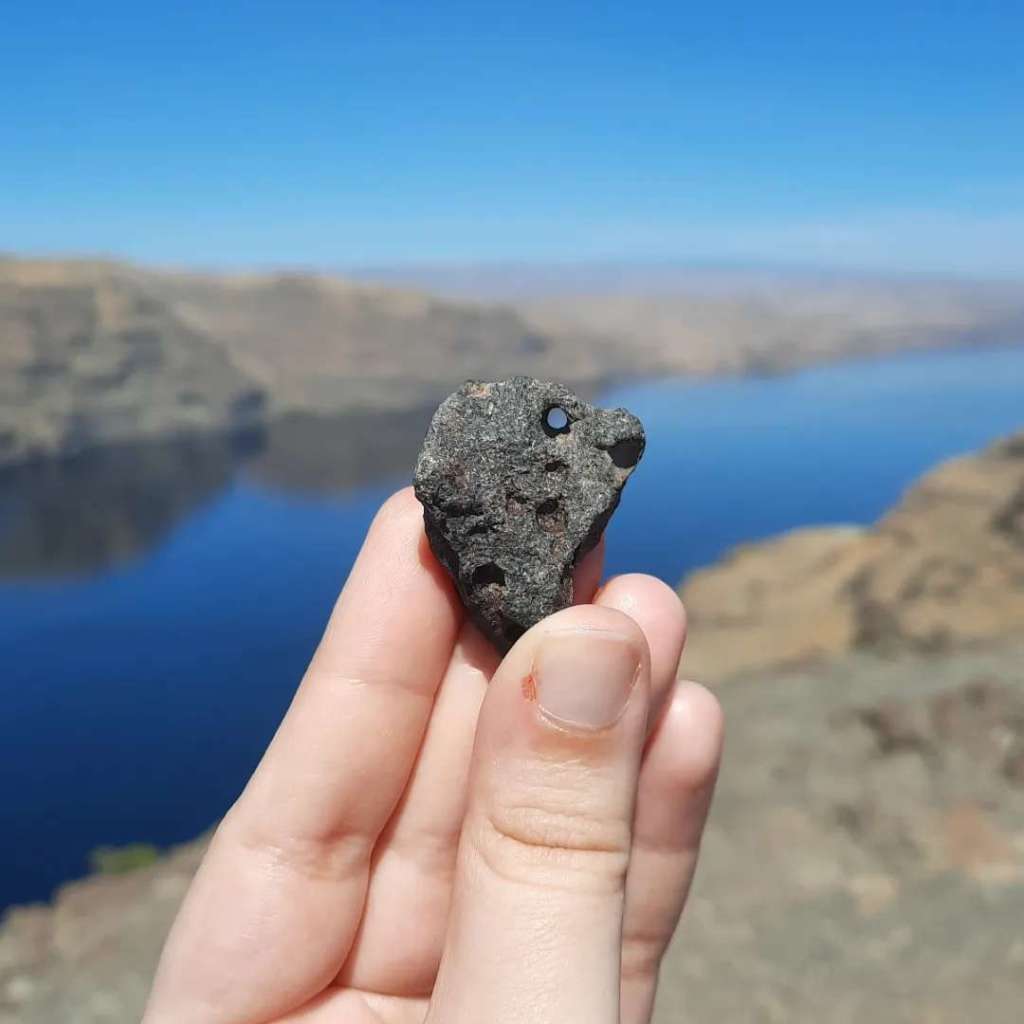
One of several hagstones I found at the Colombia River Gorge recently.
I thought it might be helpful to share some of what we went over in the episode here as well, in honour of Sveti Stefan Vetroviti. While we covered a great many names that holed stones have been referred to across Europe, “hagstone” is the name we’ve all used with each other in English from the beginning, and it’s certainly the one that’s stuck in our common parlance, as well as across occult spaces. That being said, while the list of names is especially long, a sample of our favourites from the episode include mare stones, bitch daughter stones, witch stones, and adder stones in English; Lochsteine, Trutensteine, Schratensteine (see our episode on the Schrat for more on this one!), and Hühnergott in German; and a great many coming from the South Slavic dialects, of which I’ll provide below with their translations from Serbian:
Chicken god (pileći bog)
Identical in meaning to Hühnergott, which itself is believed to be a German neologism form Slavic languages, referring to their use in the protection of livestock and especially chickens by being hung over their coops
Dog’s heart (psećim srcem)
Dog’s god (psećim bogom)
Dog’s luck (pasja sreća)
These dog-related motifs are a reference to Veles, lord of cattle, wolves, agriculture, the wilderness, magic, the chthonic world, and far more
Perun’s arrow (Perunovom strijelom)
Thunderbolt (gromovnikom)
Thunderstone (gromovnički kamen or kamen groma)
These three come from the belief that these stones are formed when Perun, the god of thunder, order, and the heavenly realms, strikes the holes through with his furious lightning
Serpent stone (zmijski kamen)
from the belief that holed stones are black eggs from which basilisks are hatched
Snake’s poison (zmijski otrov)
Serpent’s egg (zmijsko jaje)
Witch’s stone (kamen veštica)
God’s eye (božje oko)
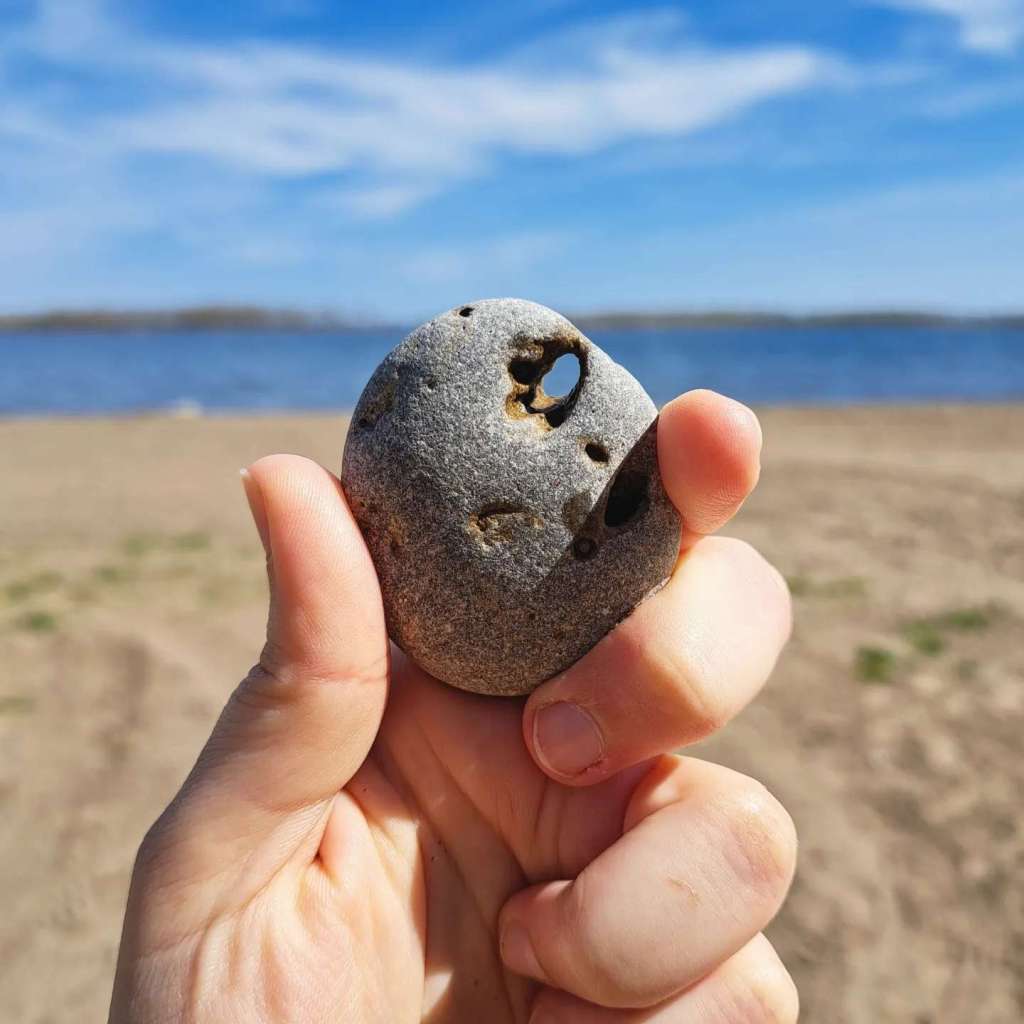
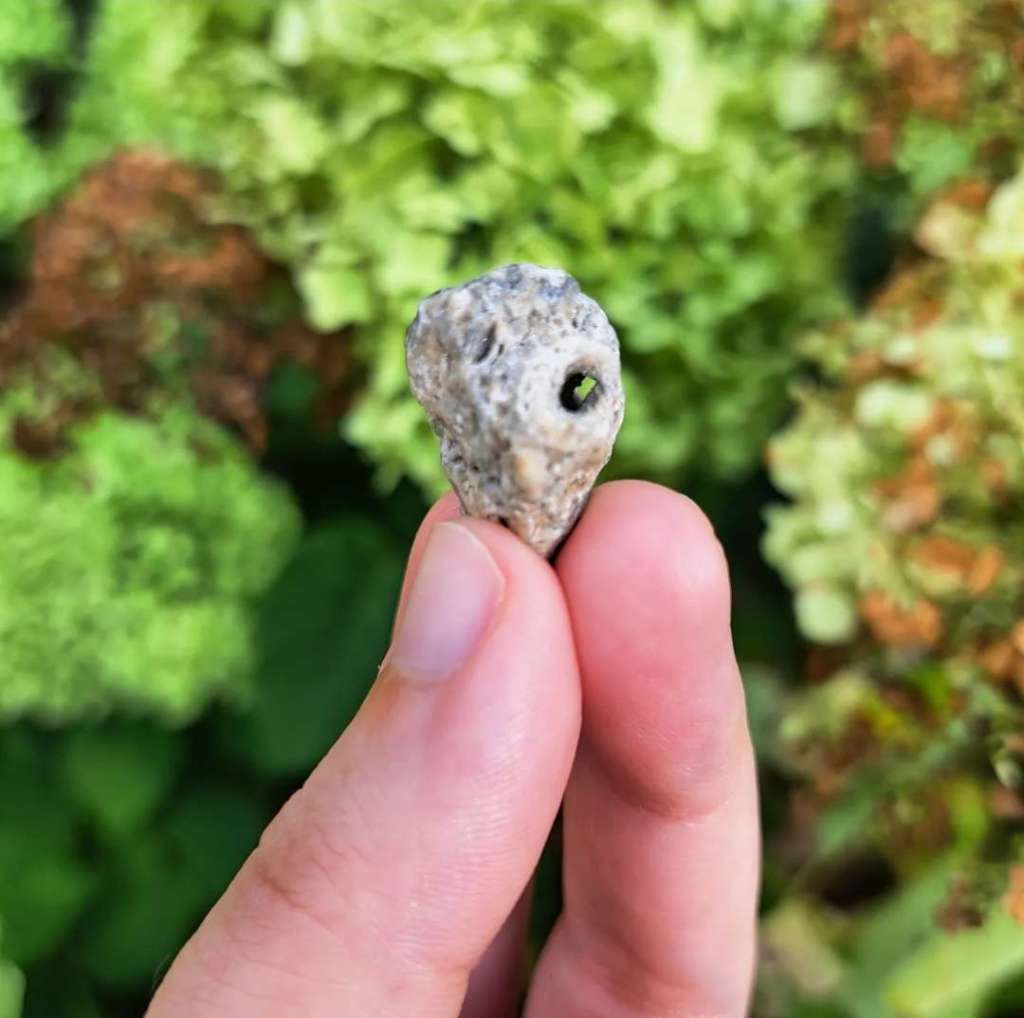
An example collected from a beach.
The uses for holey stones are all but endless. They protect livestock from curses, witches, and being ridden to the point of exhaustion by fairies, heal toothaches, headaches, and all manner of illnesses (in the Balkans, a common technique is to sandwich the afflicted area with a hagstone on either side, and conjure them to pass the pain through them and away, so that they may be disposed of later), ward against nightmares, and allow for the seating and ensoulment of spirits (in my tradition, this is typically done with seven-holed hagstones, which are especially prized). Some cultures recognize classifications of hagstones and their abilities and proclivities based on number of holes (with each having their own uses), whether they are seen as belonging to fire or water (based on their shape and hardness), whether they are male or female (less commonly used, but often having to do with roundness and pointedness), and in which location and weather conditions they were found. I went over a few variations from Slavic speaking countries with regards to these in the episode, though these classifications can become so detailed and so varied that they could take up their own chapbook!
One of our favourite charms that we shared, coming from Reginald Scot’s Discoverie of Witchcraft, is the famous “Man of Might” rhyme:
Tha mon o´ micht, he rade o´nicht wi´ neither swerd ne ferd ne licht. He socht tha mare, he fond tha mare, he bond tha mare wi´ her ain hare. Ond gared her swar by midder-micht she wolde nae mair rid o´ nicht whar ance he rade, thot mon o´ micht.
With the modern English being:
The man of might, he rode all night with neither sword, nor army, nor light. He sought the mare, he found the mare, he bound the mare with her own hair. He made her swear by mothers might that no more would she ride at night where once he, rode that man of might.
A common charm one can make from this cantrip is to braid horse hair (especially white horse hair, given that the “man of might” is none other than St. George in many understandings) through a hagstone while repeatedly uttering the verse, making an offering to your spirits and the good saint immediately after in thanks to empowering this anti-nightmare ward. I’ve made several of these for friends, family, and especially children’s cribs and found them to be exceptionally useful. The one which hangs over my and Salt’s bed is a two-holed hagstone, with the horsehair looping through the topmost hole, and the other being used to assist me to return to my body in dream and spirit flight.
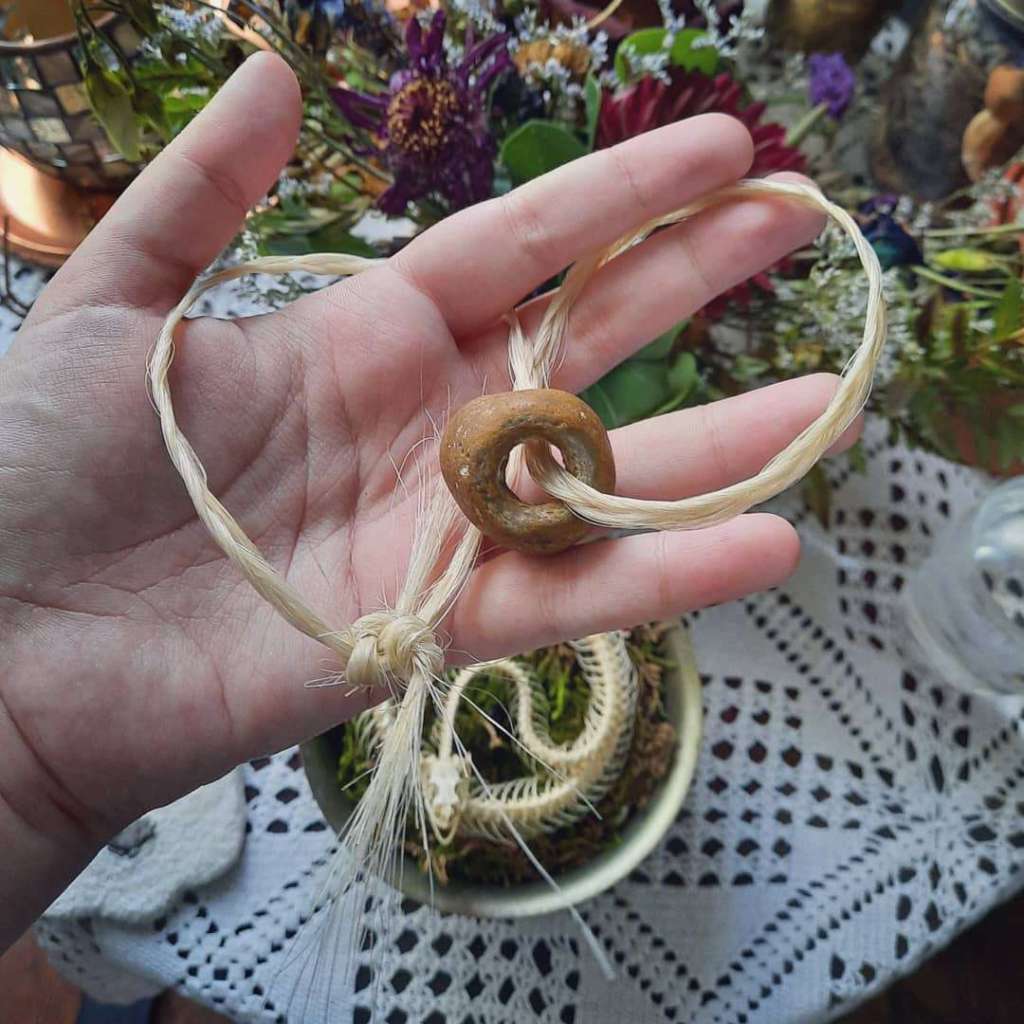
A charm made in this manner using a hagstone I found while travelling.
Indeed, a very similar charm comes to us from the mid-16th century, as recorded by Thomas Blundeville of Norfolk in his The Order of Curing Horses Diseases (1566):
In nomine patris, &c. —-Patris et Filii et Spiritus Sancti Saint George our Ladyes knight, He walked day so did he night, Until he her founde, He her beate and he her bounde, Till truly her trouth she hym plight, That she would not come with the night, There as Saynt George our Ladyes knight Named was three tymes, Saint George.
Holed flint stones were typically hung, like iron, to ward people and horses alike from being ridden by night-mares—in the case of the latter, they could be placed around the manger or the neck of the animal. Blundeville considered this to be a “foolishe charme” that was to be written down while hanging a “flynte stone that hath a hole of his owne”, which was naught but a silly way to con money out of “playne folks purses”. Yet, much like Reginald Scot, in his very disdain he ultimately preserved for us this oral charm in writing, allowing us to make good use of it even now.
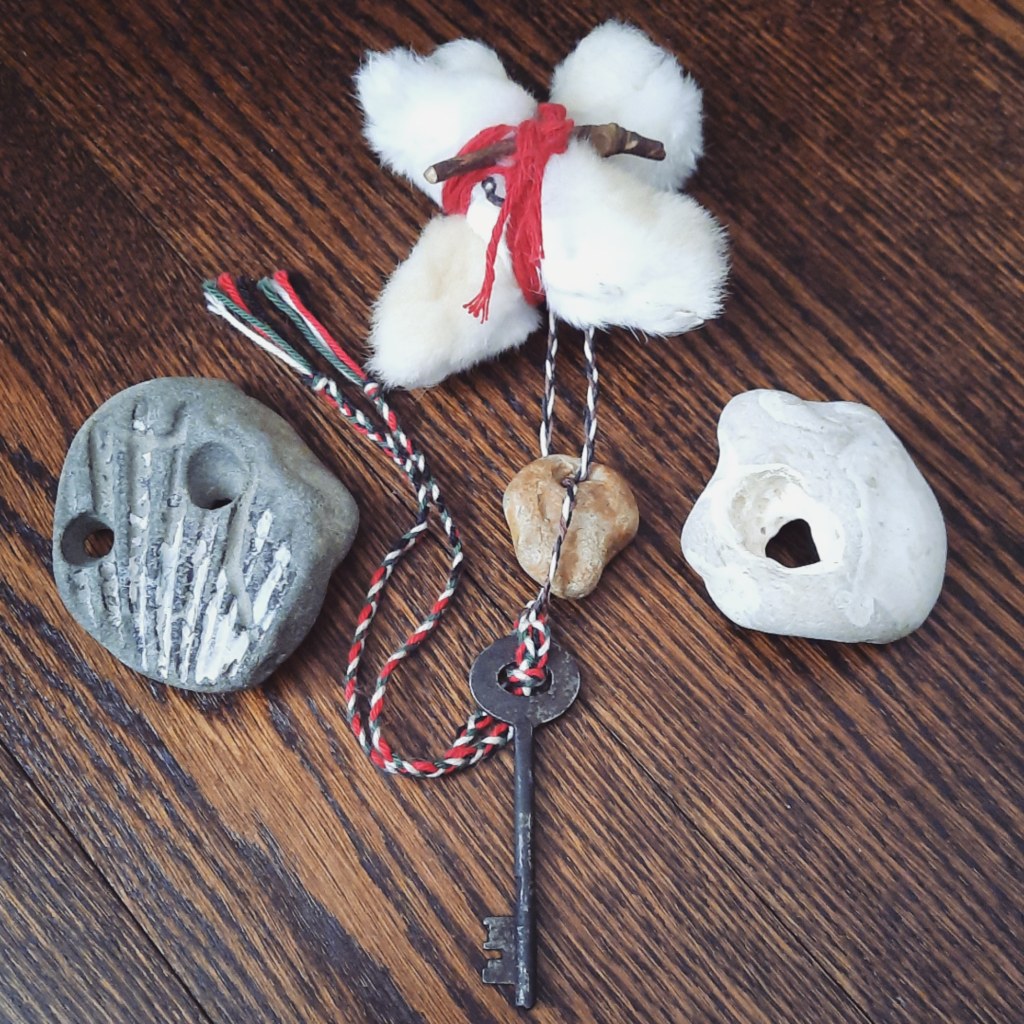
Another dreaming protection amulet, made from a hagstone, an iron key, crossed rabbit’s legs, and mandrake root.
While hagstones require no special ritual to make them “work” or to activate their virtues, there exists plenty of folklore with regards to how they should be acquired. J. Geoffrey Dent’s article “The Holed Stone Amulet and Its Uses” (1965) tells us that there is evidence from the South of England of beliefs that hagstones should be received as gifts, or, even better, stolen. Generational stones, that is, those which had been passed on throughout successive owners within a family, all used for the same purpose, are perhaps the most powerful through their repeated victorious efficacies, and presumably all the more potent if stolen. Yet in the Balkans, we repeatedly encounter the lore that hagstones indeed will only properly “activate” and bond with their owner if they are deliberately found within nature by them. I shared a few charms for how to actually go about and acquire them in this way, both with regards to luring them to you, such that spirits reveal their places and that you stumble upon them naturally, as well as how to seize their fortune once they are found in the episode.
Regardless of what you choose to say out loud (for ultimately many of these “charms” are oral prayers passed on that someone may have at some point invented, or, in the case of bajalice, received from a spirit), a good way to hunt them is to take off your left shoe, and walk barefoot along the shore or river while dropping one millet seed from your closed left fist into the ground at each step and repetition of your prayer. In this way, the spirits of the land are petitioned to receive your blessing of fertility, and accept your alm in exchange for revealing your prize.
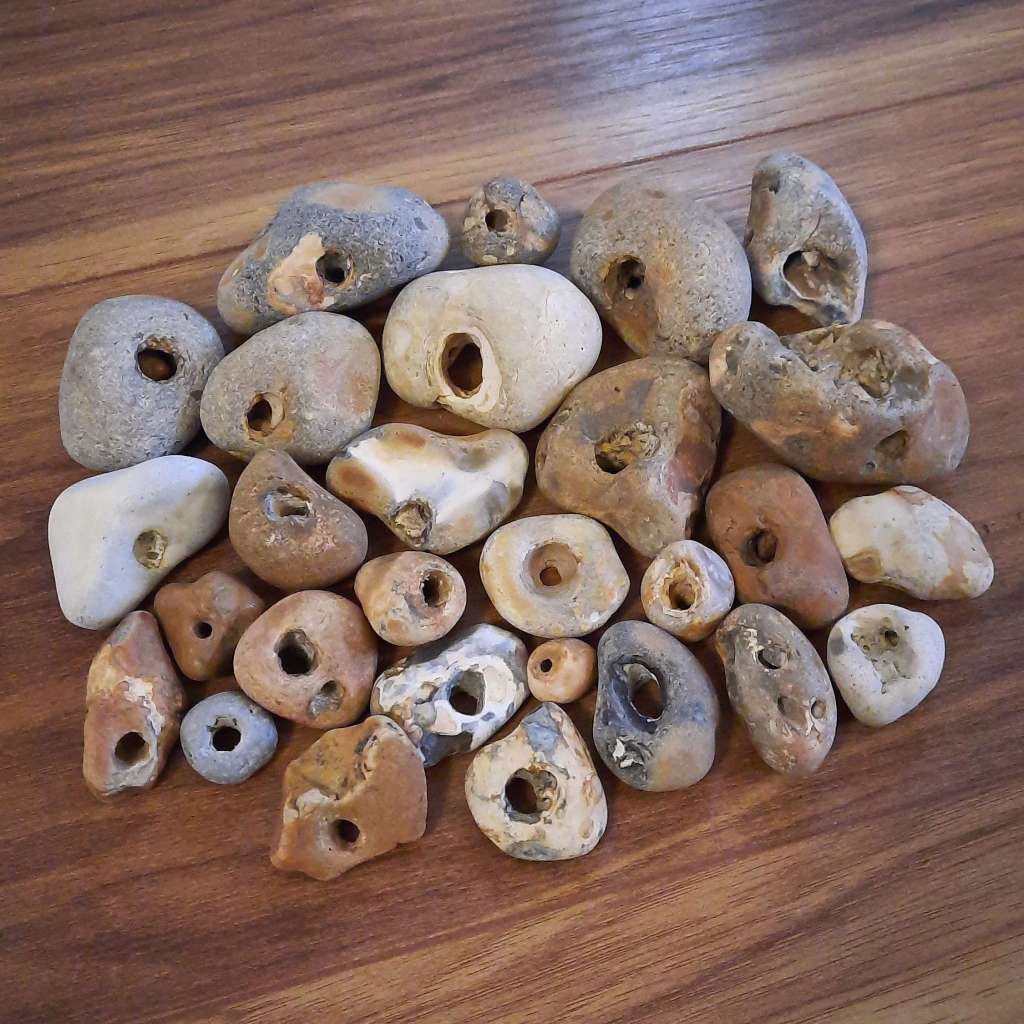
A collection Salt and I brought home from a trip to Brighton Beach together.
Many of the oral charms we shared ultimately serve the purpose of bonding a stone to you, especially if they are not already claimed by one of your spirits. The three of us have often had the shared experience of bringing home a great many hagstones from a hunt only to find that 2/3rds of them had been immediately spoken for by our spirits, who wanted them for their own ends, vessels, and amulets. I’ve often had to string them in groups of seven, nine, thirteen, or twenty-one as soon as I’ve brought them through my door as a saint or house spirit immediately wanted them placed over an important threshold. In cases in which I’ve bought hagstones over Etsy, specifically because I was searching for particular numbers of holes that a spirit requested, I’ve left them before my spirits in small bird’s nests that I’ve collected for them, such that they can incubate, receive the rays of the sun, and lubricate their hissing through the maws of their gates.
If you listen closely for their hissing, the serpents below may even lead you to them by sidewalks in the cities.
While different aspects of lore disagree on whether or not the thread which hagstones are hung on should be knotted or not, the notion that they should be strung up with natural material (such as wool, linen, or hemp) is fairly universal. If I’m about to use mine to scry, I will often make use of a fairly well-known technique across the Balkans to whisper through the whole what I wish to see while moving it around my left palm with my right index finger. Afterwards, I will breathe through the whole, and place it to my right eye while closing the left, and then scry for the augury—or directly at the sky in the morning to witness the rising star, that it may be captured later within that very stone.
There’s so much more that could be said on their collection, uses, and enchantments, such that we’re already planning the next edition of our hagstone episode series. If there’s anything in particular any of our readers are curious about or would like to be included, please feel free to write to us below, and we’ll do our best to include some tips and folklore on each matter in the next installment! For now, happy hunting, and thank you all so deeply for supporting our podcast!
Since visiting Sfinga earlier this year (some highlights of which can be seen here and here), a great deal of my time and energy have gone towards better ensouling and anchoring spirits into particular loci of devotion; in this world as well as the next. These developments primarily stem from numerous midnight talks between Sfinga and I, in which we mused about and theorized practical strategies towards the “arming” of our spirits. After years of covering ourselves in talismans, phylacteries, amulets, powders, condition oils, and the like, it seemed the natural next step would be to give similar to our spirit allies, such that they may independently reap the boons from the vary materia that they helped craft. This is not only a core principle to much cross-cultural technology with respect to seating spirits and birthing their vessels, but also a rather intuitive concept: if you’ve hired a skilled mercenary to protect you, would you rather he defend you in the hostile wilderness with no supplies and rusty ammunitions, or amidst a heavily-stocked fortress complete with neighboring alliances whose spies would inform of you of danger well ahead of time?
I began by consulting with my court to me to see what could potentially be desired, and one of the most prominent figures that immediately stepped forward to request such a working was St. Expedite (conveniently adding to our rapidlygrowing series of Expedite-related posts). Himself a centurion in life and just a capable warrior in holy death, it was not the good saint’s appearance that surprised me, rather the specifics of his request, which to this day still do. As I sat in contemplation, he delineated the recipe for what remains one of the most involved, intricate, and complex magical workings that I have had the privilege to see to completion.
The good saint revealed a recipe to me for what would serve as a load to the statue that has been the centerpiece of my altar since my devotional practice with him began. On a basic level, to load a statue is to fill it with the materials that carry the virtues sympathetic to the spirit, arming the spirit with tools to use once it is more strongly linked to the image. Naturally, this involves properly baptizing the statue as the spirit’s own, and preventing other spirits from inhabiting the figure in order to steal any offerings made. In the majority of the traditions in which I am involved, there is always a warning about buying statues and figures for spirits without baptizing and dedicating them properly—at minimum, they should be washed, fumigated, and prayed over to ensure that only the spirit being called into it will take up residence within its shape (or rather use it as their glove if it is not itself a house for them), lest ambient spirits become attracted to the spiritual attention it receives and come to shapeshift into its form. Different techniques exist across the globe, some very rightly claiming to place the spirit into the image—my personal favorite examples of this come from Thailand, in which amulets or bucha pieces can be fully ensouled and inhabited by the spirits residing within them—whereas others serve to increase the sympathy between and co-mingle the essences of the image and the spirit without actually calling the spirit to fully live within. I want to emphasize that this particular recipe falls into the latter category—one could hardly hope to place an ever-wandering saint into such any such vessel!
The recipe itself begins with the time in which it was to be made—the ten day period from Palm Sunday to St. Expedite’s feast. For each day in the Holy Week, specific ingredients corresponding to the holidays were to be gathered, and then in turn blessed every day following their collection, such that each piece received a blessing “today”. As I began to compile the list, I was initially daunted by the sheer scale of what would be needed. However, fueled by the power and potency of the saint that has been such a trusted compatriot over the years, I became determined to see things through while the spirit of the work was upon me, my ambition fully stoked.
For the next week, it was if I was possessed by the spirit of the work itself, with every waking moment consumed either by the collection and processing of materia, or the inspired contemplation of the loads as they began to take shape. Each day consisted of a spirit-lead journey around the city, visiting dozens of locations and negotiating with the spirits of each for permission and blessing to do my work, making offerings at each place of power along the way. I began to notice early on in the process that each ritual step closely matched the Passion—Palm Sunday bringing with it workings at the gates of seven cemeteries to mirror the triumphal entry into Jerusalem, Maundy Thursday bringing with it devils that walk the earth on the eve of the crucifixion and their being crushed beneath the foot of St. Expedite, crossroads workings performed and dirts collected as Jesus walked through the streets toward Calvary, dives into the underworld during the Harrowing of Hell, the triumphant return therefrom on Easter, and the ultimate culmination of the work on St Expedite’s feast.
At every turn, the working moved to finish itself, with incredibly lucky opportunities enabling the acquisition of trickier-to-find materia that needed to be collected and blessed on the same ritually potent day. Finding floral and herbal materia drifting down the river or floating in sacred grottoes at the beck and call of my sea spirits, encountering doors and gates unlocked (or very literally opening before me at utterance of a charm and wave of a spirit’s hand!), chance encounters with people on the street handing me that which was needed in exchange for a cigarette—all these and more highlighted just how much the Good Saint and I shared in the desire to see the creation finished.
As the adage goes, a magician must never reveal his secrets, but what follows is a fraction of the saint’s armament, for those with the cunning to replace the gears and wind the springs missing from a watch that ticks ever onward to the beat of “to-day-to-day to-day…”
Blend of soils from 7 crossroads collected on Good Friday
Blend of soils from the gates of 7 different cemeteries collected on Palm Sunday
Blend of soils from 7 Catholic churches collected on St. Expedite’s Feast
A vehicle for the spirit of the Crow-Devil crushed beneath the foot of St. Expedite crafted on Maundy Thursday
A wishing bean, baptized in a river on the Harrowing of Hell
A piece of a palm frond from Palm Sunday Mass
A piece of the pound cake offered to the saint at the start of the work
A piece of the pound cake offered to the saint on His feast
Wax from dressed candles burnt as offerings on His Feast
A small square of fabric torn from the cape that adorned my St. Expedite statue over the duration Holy Week
Herbs blessed on His shrine including Abre Camino, Basil, Myrrh, Palo Santo, Spearmint, Vervain, and Vanilla beans
A skeleton key blessed at a crossroads
A small ampoule of Mercury
At last count, each load totaled around 100 components, the most important of which were tokens of those intangible acts found in the unfailing collection and processing of the materia on each day of Holy Week. As the final assembly was performed, every component and individual blessing to this point snapped into place and began to hum with a potency far greater than the sum of the individual parts, almost rhythmically and mechanically whirring together into an elegant machine in my own sorcerous arsenal—and the arsenal of the saint alike. In taking stock of the work, I have a newfound appreciation for the tireless diligence that the saint brings to his works, and an enflamed drive to go the extra miles for my spirits, without hesitation or fear of complexity or effort required for certain procedures or practices.
Two statue loads, one for myself and one for Sfinga, receiving their final blessings on St. Expedite’s feast day.
I cased the loads into blessed wax, allowing them to sit in the containers of used tealights in order to retain their smaller shape. From here, they could be easily removed and fitted into the bottom of any such statue once it was sufficiently hollowed out with a drill. After the load’s incorporation with the statue, I’ve noticed any workings performed with the aide or through the intercession of St. Expedite have greatly increased in efficacy and potency, with the saint heavier upon me than ever before, more ready to step forth and provide his aide today, with his new armor in hand, and girt upon him, his sword.
I’m beyond thrilled that Key has joined us on this blog! After years of deep friendship between the three of us, plenty of sorcerous collaboration, and a great many late-night Discord calls discussing all manner of philosophy, magic, and jailbreaking our way through various texts, it’s a real joy to collaborate in blogging as well. Spending time together in person this month had been such a boon (the hope is to meet up again soon in the coming months!), and we’re already plotting a whole new host of experiments to try out and materia to make, including some Boxgrove Manual and Book of Oberon fun.
Within a few hours of picking him up at the airport, we had already begun to plan out our first working. We had both been itching to conjure, create, bewitch, and just collaborate together post Key’s licença, and had a great many ideas already in mind, but we both wanted to do something that very night—we were just not yet certain as to what. Our answer dawned on us when, on a trip to the local grocery to pick up extra offerings for each other’s spirits, our gaze landed on the pound cake aisle, and our minds wandered to one of our favourite mutual folk saints.
St. Expedite has been a phenomenal ally to us both. In my case specifically, his repeated swift intercession has earned him a place even in my Eastern Orthodox family’s homes, with various relatives submitting their own petitions to me to offer on their behalf. For Key, he’s formed a powerful component of his ever-increasing court of treasure hunting alchemists. We’ve both experimented with various charms, talismans, and workings received from the hands of the good Saint, and decided it was as good a time as any—that is, right now—to create a powder we had been independently receiving the pieces of the recipe for over some time. While we petition St. Expedite’s intercession in moments of dire need, the intention behind this powder is to have on hand a dust consecrated to his virtues to include in all manner of other workings, made under the auspices of this martyr’s fervent and miraculous hands.
I had been saving a jar of dirt collected on his feast from Our Lady of Guadeloupe Church in New Orleans (complete with some dust and pebbles from his famous statue housed within), that one of our godbrothers in Quimbanda had mailed to me. Initially, I kept thinking that I would use it on his next feast, being this year’s, to finally create this powder. The message both of us received simultaneously was loud and clear—the only “election” when it came to the timing of its creation was now, immediately. While we could certainly put the finishing touches on its consecration, and birth other sets of materia magica from it later on the feast, it was imperative that we work then and there in the spirit of “today”.
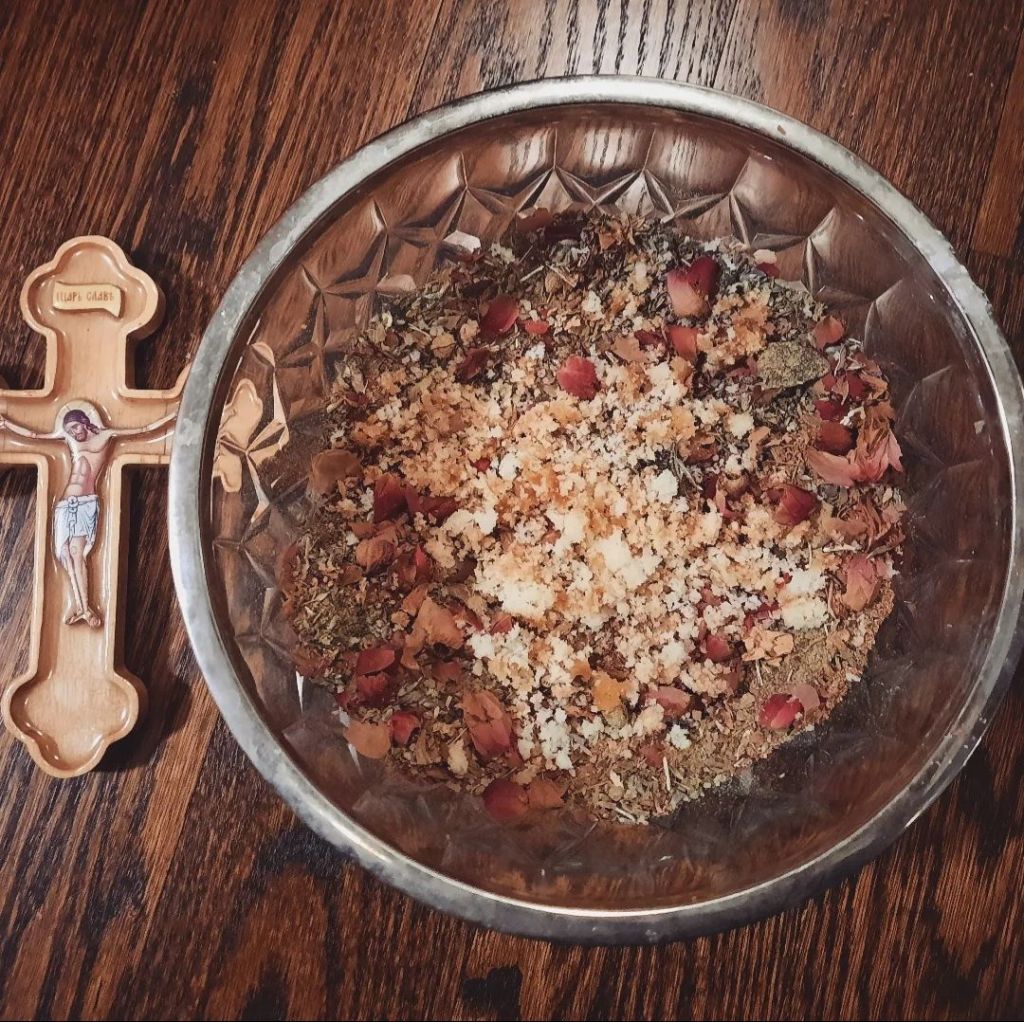
The recipe in progress.
The base is fairly simple: cinnamon, basil, rosemary, ginger, hyssop, chamomile, lemongrass, white sage, ground nutmeg, laurel, mint, lavender, honey, rum, red wine, and rose petals—all prayed to and enlivened—formed a potent beginning for a dust dedicated to quickening manifestations and bringing immediate success, especially in matters of wealth and road opening. To this was added a powdered slice of pound cake from an entire loaf offered to the Saint, the aforementioned dirt, a burnt and powdered copy of Psalm 23 from a Bible, the verses of Psalm 77: 14-15 written across five bay leaves that were subsequently enchanted and powdered, and pinches of Spica and Regulus powders (elected by Salt). At one point, one of my spirits manifested, commanding Key to taste the mixture, at which point he immediately divined the final series of elements that were needed (and will naturally remain secret). One decidedly Orthodox ingredient that we included is my very own Thursday Salt from 2021, the famous rye flour and coarse rock salt combination made in many Slavic households on Orthodox Maundy Thursday.
Key’s oil from his initial batch, which he also outfitted with an enchanted gambling die.
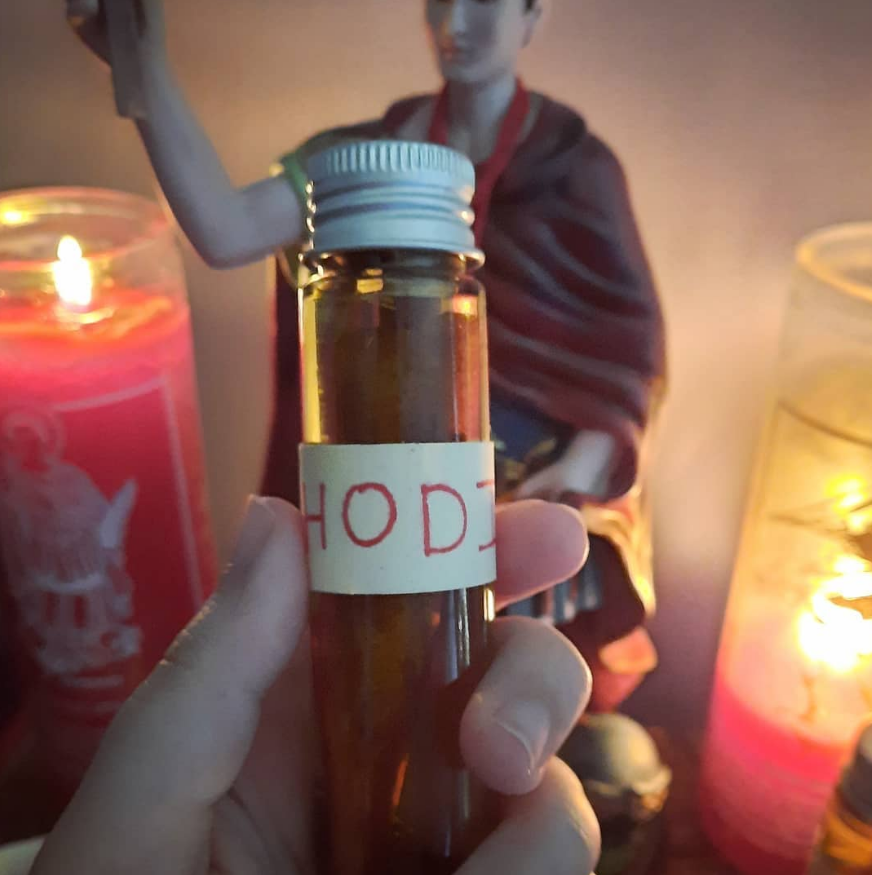
The mixture additionally received drops of Key’s personal St. Expedite oil as well as our good friend Mahigan’s Oil of St. Expedite. We can both highly recommend his work over at Kitchen Toad and were delighted to include his oil alongside Key’s own. I’ve tested both oils thoroughly, and both have ensured that events which were fixed to take place months in the future occurred within a few days or even the same day, cutting down deadlines and bringing shipments to the doors of the small businesses of my family and friends swiftly.
At the time that Key had made his recipe, which included separate consecrations and steps on Palm Sunday, Ash Wednesday, Good Friday, and finally Easter Sunday, he had also divined a mojo hand to compliment the oil with. The bag itself must be made from a red cloth that served as the cape of the Saint’s consecrated statue for a certain period of time, to which is added a series of ingredients including the charmed die, and secured on the outside with a cross formed by a cinnamon stick and a skeleton key. The final product of the powder was added to this hand as well, at which point it was given its name and fully ensouled.
The finished powder resting by his statue at my icon corner.
In the spirit of the powder itself, everything had to be consecrated and made immediately, today. Once it was sufficiently prayed over and activated, and its corresponding fixed candle consumed, we scooped it into its mother jar and tossed in a prayer card anointed with both oils. Since then, including this powder in workings, as part of candle-fixing blends, or as components in herbal talismans has ensured for consistently fast manifestation rates.
There are plenty of more St. Expedite-related workings to come, especially as Key and I prepare to create some new goodies for the saint leading up to his feast. In the meanwhile as we work on more materia, consider checking out the following article by our good friend and godbrother Matt Venus of Spiritus Arcanum to learn more about the good saint: [LINK]. If you’re in the mood to make a powder to the saint yourself, consider petitioning him for a similar recipe to be revealed and make it as soon as you’re able in preparation for his feast, or, you can buy a bottle from Mahigan [HERE] for the same purpose (and consider his excellent candles, oils, and rosaries too!).




 With Cunning & Command