St. Michael’s Charms of Spirit Valour

On the Eastern Orthodox feast of St. Michael the Archangel, Maria of Green Dragon Healer and I continued our work of producing charms adapted from the folk Orthodox tradition. We are deep in the Wolf Days now, and St. Michael the Archangel is one of the foremost wolf saints, known in Serbia as the Dušovadnik or Soul-Taker. It is to him that we light the final candle upon a dying person’s bed to guide their soul into the afterlife, and his sword that touches the water that bathes the corpse upon rest. Drawing on Serbian and Greek traditions, Maria and I celebrated his feast with koljivo, pear liquor, incense, and light. While koljivo is typically given only to those saints that have experienced an earthly death, typically excluding angels as well as the likes of St. Elijah, in this case we prepared the traditional dish in honour of the many ancestors and souls supplicated in this work.

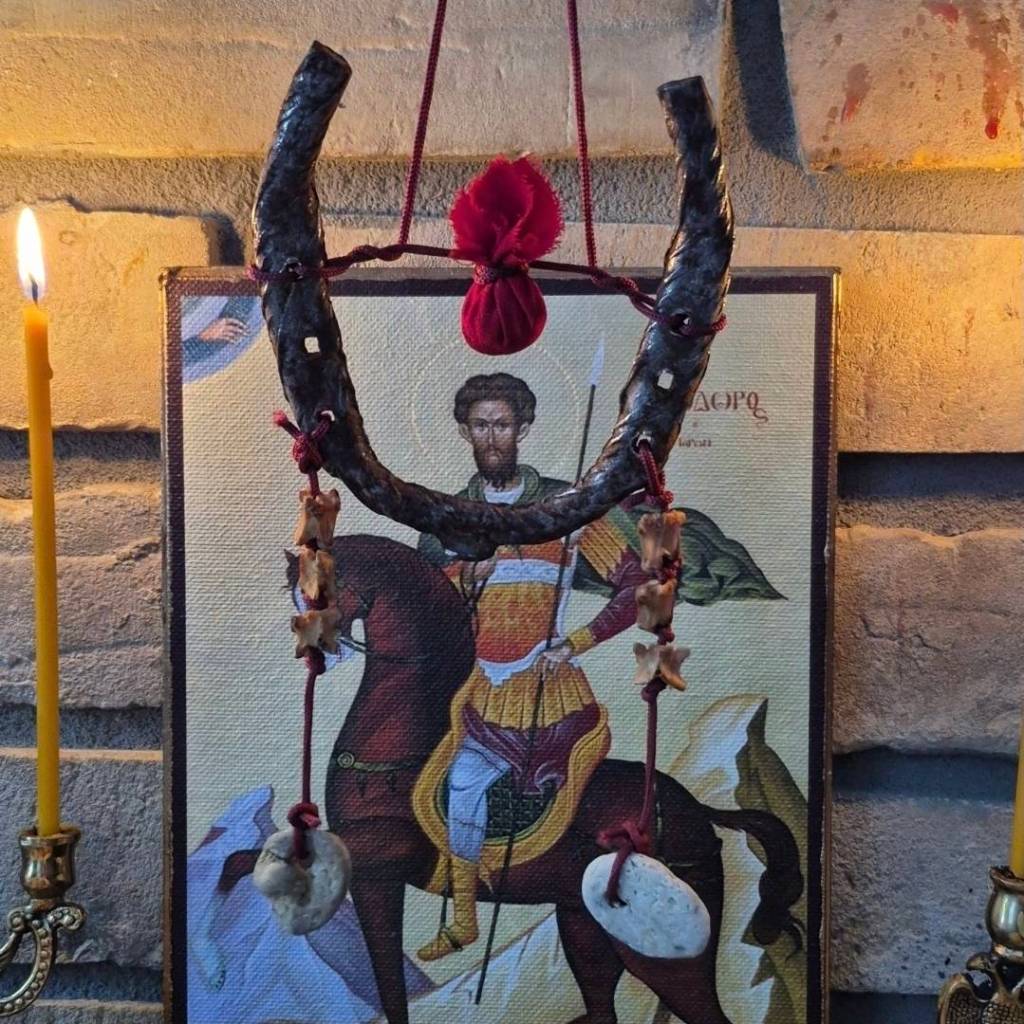
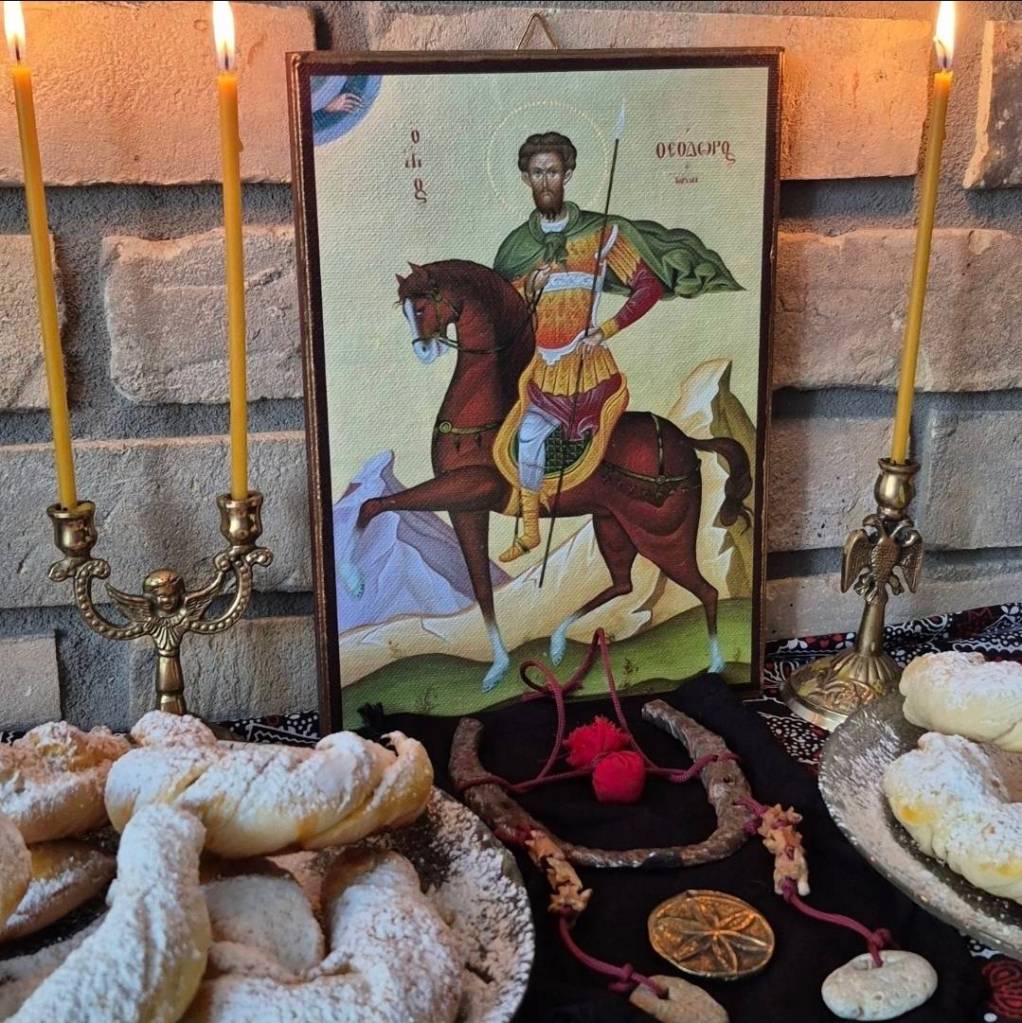
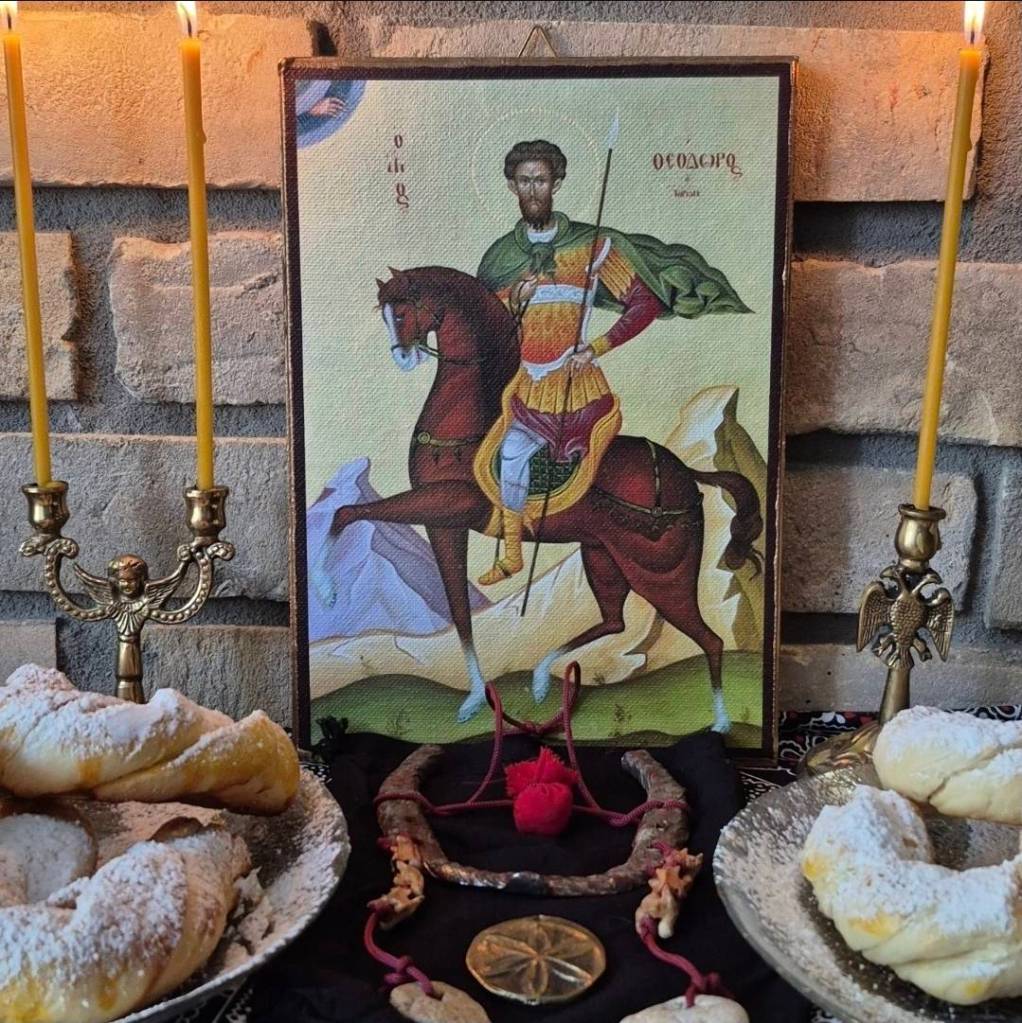
The charms presented before the icon.

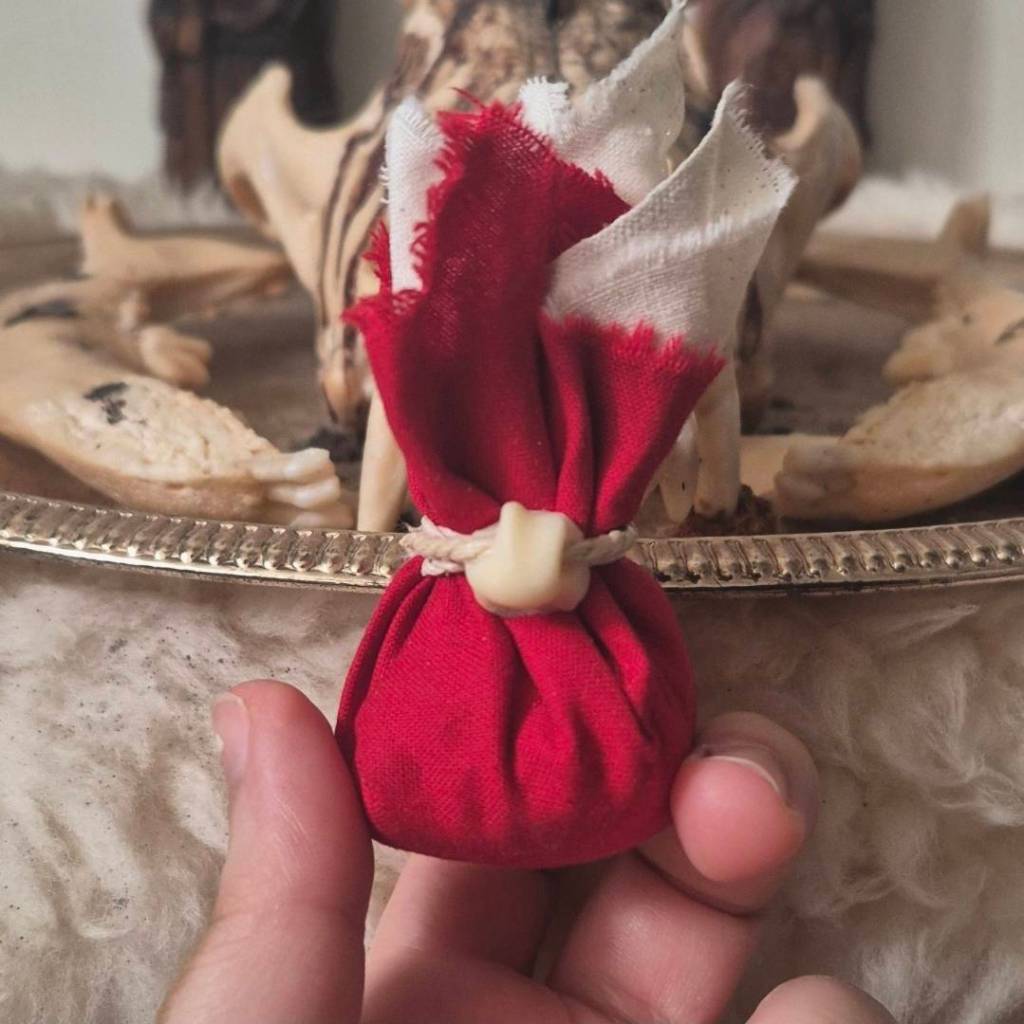
These charms are born of a recipe Maria and I divined on, drawing on our shared training and familiarity in Orthodox folk magic. Their purpose is primarily that of protection—against evil eye, curses, vengeful spirits, and outright spiritual assault—as well as the cultivation of spiritual valour, being the bravery, confidence, and raw might that helps one conjure and command, and make effective one’s petitions and prayers. Created under the aegis of St. Michael, who gave unto Solomon the very ring of fealty that allowed him to command the demons, we crafted our charms with the guidance of our spirits to empower those who hold them with increased authority, that their prayers are amplified by the celestial choirs and chthonic wolves alike; that each oral charm and prayer uttered have more vigour, tenacity, and power in manifestation, dragging others into being with every repetition.

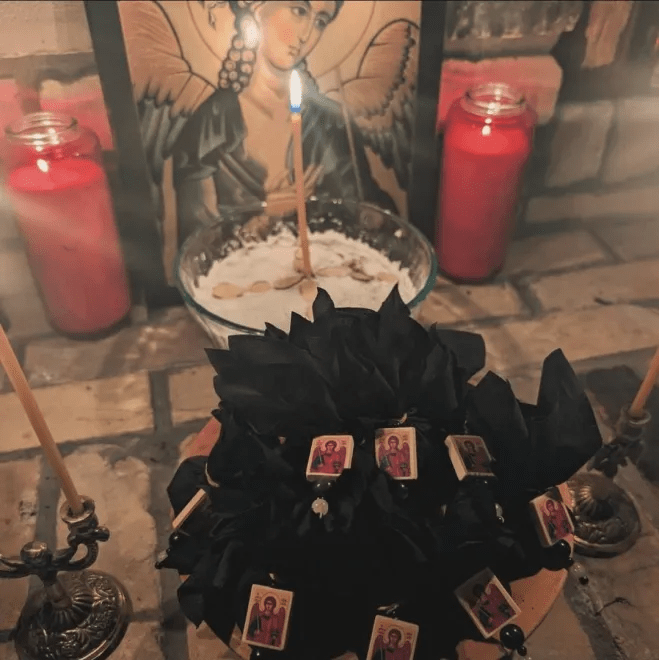
A close up of the miniature icons Maria created.

These charms are primarily born of earth and fire, each housing a complex matrix of dirts gathered from cemeteries, churches, and places of power across Serbia, Greece, Croatia, Cyprus, England, Canada, and the United States. In addition to dirts of nine nuns, nine priests, nine bishops, and nine cemetery gates, these charms also house dirt taken from the temple of Olympian Zeus, nine Orthodox churches dedicated to St. Michael, a Serbian ruin linked to the Master of the Wolves, and the banks of the river Acheron gathered by a dear friend who is also a traditional Balkan witch. Divination beans, rosemary, frankincense, Syrian rue, and a powder dedicated to St. Michael as Wolf Shepherd and Psychopomp are nestled within the heart of the charm along with many other unnamed ingredients, bound together by thread, gold sheen obsidian, yellow quartz, and custom miniature icons created by Maria. These icons were ritually prepared and anointed with a trinity of oils for protection, command, and necromantic power throughout the Wolf Days, while the core matrix was empowered from St. Demetrios’ Day to St. Michael’s, receiving an additional boost on Sts. Cosmos and Damian.

While the bulk of this work was carried out during this winter season, its inception was first born far back in the dregs of the old winter. Each charm contains a potent base of powders composed of burnt offerings, paper money, and talisman papers offered during the four most important days of the fifteen days of the Lunar New Year. While this custom is not Balkan in origin, Maria’s own fusion of practices from her training in Traditional Chinese Medicine and Taoist folk practices contributed to these charms heavily, as any practice that involves paying one’s debts to the ancestors, regardless of cultural and religious system, ultimately is one that will be recognized by the Master of the Wolves. During these days, Maria and I made offerings of fruit, cooked foods, rice, candies, alcohol, cakes, incense, and far more, with Maria reciting mantras she was given the transmission to use from her lineage in China to empower and uplift each prayer. It is the burnt offerings and talismans of these rites that were saved and incorporated into a powder for the charms you see here, ushering in additional protection, prosperity, and command by providing proof of previous pacts honoured, ancestors supplicated, and celestial guardians of the dead honoured in their own right during the turnings of the seasons.

These charms may be carried on one’s purpose for protection, authority, command, bravery, and an increased sensitivity to the celestial and chthonic guardians of the seasons. They may also be left on shrines, hung over doors, or placed with one’s ancestors for clearer messages, additional protection, passive increase to one’s authority in conjuration, and additional fortune in all ventures. One key boon these charms bestowed is an increased ease and levity when dealing with cemetery guardians, celestial judges, and any spirit of authority in charge of taking account of proper etiquette in liminal spaces. By relying on St. Michael’s command, the various priests, nuns, bishops, and mighty dead called on by dirt, spit, blood, and golden resin, and the additional lineage holders in both of our magical practices that attest to the efforts made to honour the seasons and their chthonic-solar emissaries, these charms assist their wielders in having increased luck, communication, and ease when entering cemeteries, churches, places of transition, and in the acquisition of raw authoritative power. While they pair well with our previous charms to Cyprian and Justina, they ultimately work on their own to increase authority, spiritual vigour, instil bravery before adversaries, soothe anxiety that can lead to spiritual offences, and instil command over the spirits of in-between spaces. Wield on your person when engaging in grimoiric work, hold when petitioning saints and angels, and deploy especially when you wish to move your ancestors to work for an intended goal in unison without fracture and disagreement. These charms are especially helpful to those who deal with ancestral resistance and blocks towards life decisions, as it soothes their worries through the authority of St. Michael and the memory of previous petitions, offerings, and supplications honoured and promises kept; encouraging them to keep their end of the same bargains.

Anoint with any holy oil heavy with frankincense weekly, especially on Sunday if possible, or burn the same incense below it.

All charms will be shipped out within a week of purchase. We thank you so much for your patronage and hope that they bring you luck, power, and vitality in the cold months ahead!

St. Michael’s Charms of Spirit Valour

Charms of might, vigour, bravery, protection, and valour through the aegis of St. Michael, as well as spiritual command over and in unifying the dead. Shipping included.

$150.00

St. Charalambos’ Charms Against All Disease

Uždi svecu jednu svijeću, a đavolu dvije.”

After a full month of gathering, conjuration, and consecration, I am deeply pleased to unveil a new offering in the holy name of Sveti Haralampije, or St. Charalambos—the beloved saint known in the Serbian folk tradition as the Gospodar Svih Bolesti, or “Lord of All Diseases.” Here is a saint so beloved and revered for his capacity to heal any and all ailments that his very feast, celebrated February 10th or 23rd depending on the calendar, is understood to be a last chance to ward off the Čuma, a spirit of disease and illness sometimes said to be the wrathful form of the folk saint Bibi, who is her kinder, protective face when placated appropriately. The Balkan traditions vary on which saint’s day is the true feast upon which the Čuma is propitiated, with Čumindan being for the majority of Serbia Sveti Atanasije, whose feast at the end of January aligns with one of the most common dates that Bibi herself is honoured. It is during this period, right before Sretenje or Old Candlemas, that various rituals are performed to placate her wrath so that she does not become the “right hand of the Devil” and lay waste upon our settlements in her black-cloaked form as wandering witch.

It was on St. Athanasius’ day that this work began, then, with the preliminary offerings given unto Čuma and Bibi in both guises: shoes so that she may walk freely, a walnut comb so that she may brush her hair, a mirror so that she may see herself, and various sweets that she may refresh herself. According to folk tradition, by showing her this kindness and welcoming her as a house guest, as opposed to denying her entry and sustenance, her wrath is cooled, and she instead enters as an aunt and ally, softened by the hospitality. Much of Balkan folk magic, of course, involves the naming of familial pacts, such that even troublesome spirits are given their valued role within the clan structure. As Čuma is given her kindness, so too is she implored to pass over us and return that kindness by sparing us from her hordes of plague witches.

These blessings were built upon through the important holy day of Sretenje (Candlemas), finally leading into Charalambos’ day proper. The Lord of All Diseases is likewise given as one of the candidate dates of Čumindan in other parts of the Balkans—though more importantly this, for some villages, is the true end of the Wolf Days (the winter season beginning in early November), and the last opportunity to thank and herald the Master of the Wolves. It is on his day that the serpents below begin to burrow their way ever closer to the surface of the light, stirred by Old Candlemas and drawn towards the first Saturday of Great Lent, Todorova Subota or Hroma Subota (Theodore’s Saturday or Lame Saturday), in which Veliki Todor and his todorci riders embark on their nightly procession.

St. Charalambos is particularly notable for having lived to 113 years old. He was brutally martyred despite his age, lacerated with iron hooks and flayed alive, his only response to his torturers being: “Thank you, my brethren, for scraping off the old body and renewing my soul for new and eternal life.” It should come as no surprise, then, that St. Charalambos is deeply linked to serpent power within the folk tradition, as is any saint who was flayed; his ecstasies being inherently intertwined with the healing potency of shedding the skin.

In addition to being a powerful healer, he is also the patron saint of apiaries and beekeepers, precisely because he was able to heal others with honey. A jar of honey was sanctified in his name on his feast, during which he was also honoured with freshly baked bread, and the honey from within was used to mark my front door as well as each icon of him that I possess, in honour of his power and in memory of his pact with Čuma.

It was this bread and honey that laid the groundwork for the charms I created with him. From the period of his feast to Todorova Subota, I continuously prayed to the retinue of wolf and serpent spirits to which he belongs, gathering the necessary herbs and preparing the sorcerous powders that would go within these charms. In addition to propitiating Veliki Todor with sacrifice, I continually kept my shrine to the Master of the Wolves in illumination throughout, reminding him through prayer and offering of the ledger of deeds and boons made good on. Throughout this process, I continually prayed for the petition to be allowed to create a set of charms under his auspices for the healing of disease and the prevention of illness, by way of creating mobile, portable satellites of this pact between the martyr and Čuma for others to benefit from.

When the time finally came to create these, and the requisite omens were revealed, I prepared a set of cotton muslin drawstring bags, suffumigating them with myrrh and anointing them with holy water gathered from a well sacred to St. Charalambos. The bread specially baked for and offered on his feast was divided into equal parts and placed within each bag as a promise of the fulfillment of its magic. Rosemar, thyme, basil, lemon balm, wormwood, broadleaf plantain, eyebright, and many additional herbs picked for their virtues in healing different parts of the body were wrapped around this bread, to which were also divided the full 41 beans used in divination to approve of the recipe and enchantment and a generous helping of specially-made Thursday Salt. In addition to several powders sourced from my own recipes and study, attuned to different deities and fixed stars relevant for this working, I also prepared for each bag one small reflective mirror that was anointed with the honey consecrated on his feast. Each mirror was presented before Čuma, reminding her that whomever carries this bag upon their person has paid her their due and has called her “Aunt”—meaning that as they are family, so too must she treat them kindly and spare them.

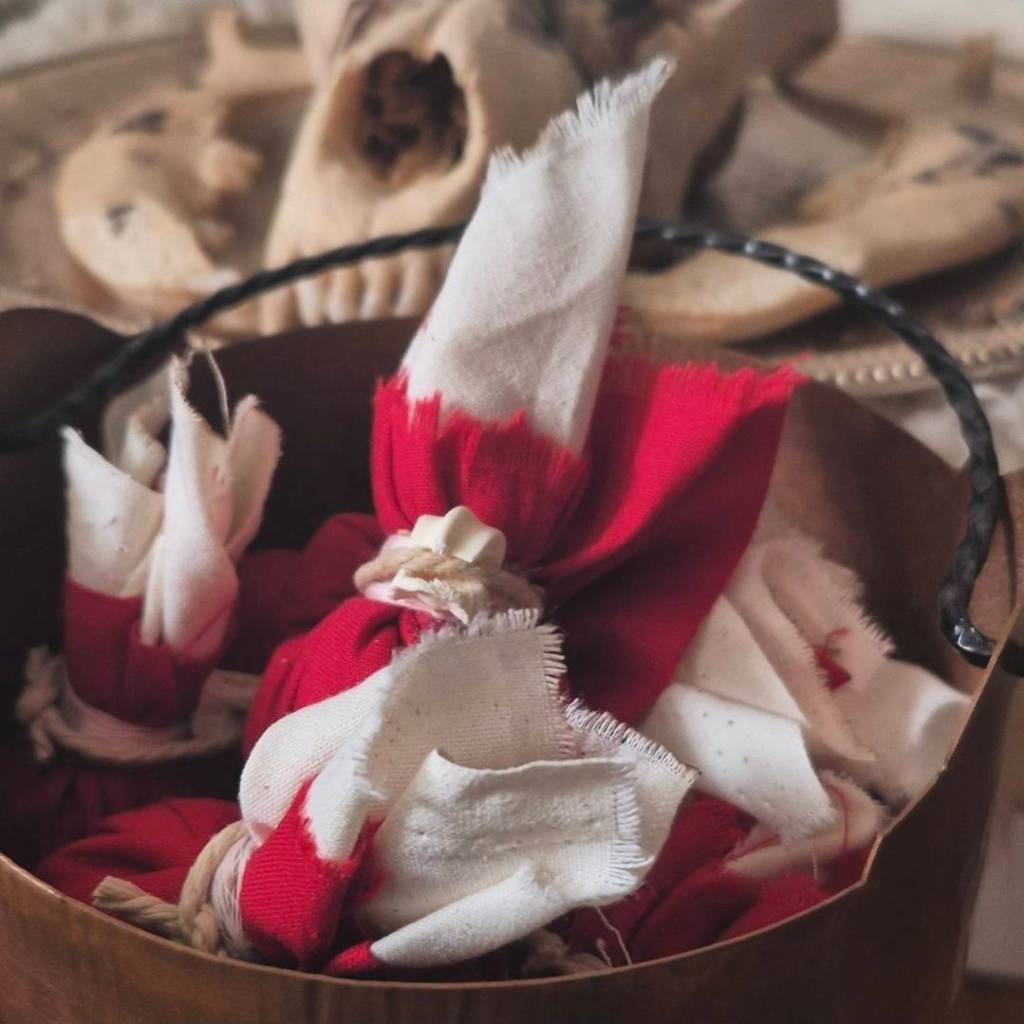
To verify that these pacts were confirmed, a specific physical omen was demanded of every single mirror, with no charm being complete without its verified appearance. Key, who was present for the making of these charms, was my secondary witness—we both had to agree that we witnessed the physical manifestation before continuing. The design of these charm bags are intentionally plainer and more subtle than many of my other offerings, so that they may be carried easily on one’s person as an ordinary Christian amulet that one could easily suggest was purchased from a monastery gift shop. My wish is for these to be kept in one’s purse or shoulder bag without any anxiety as to what others would think or feel if they were discovered.

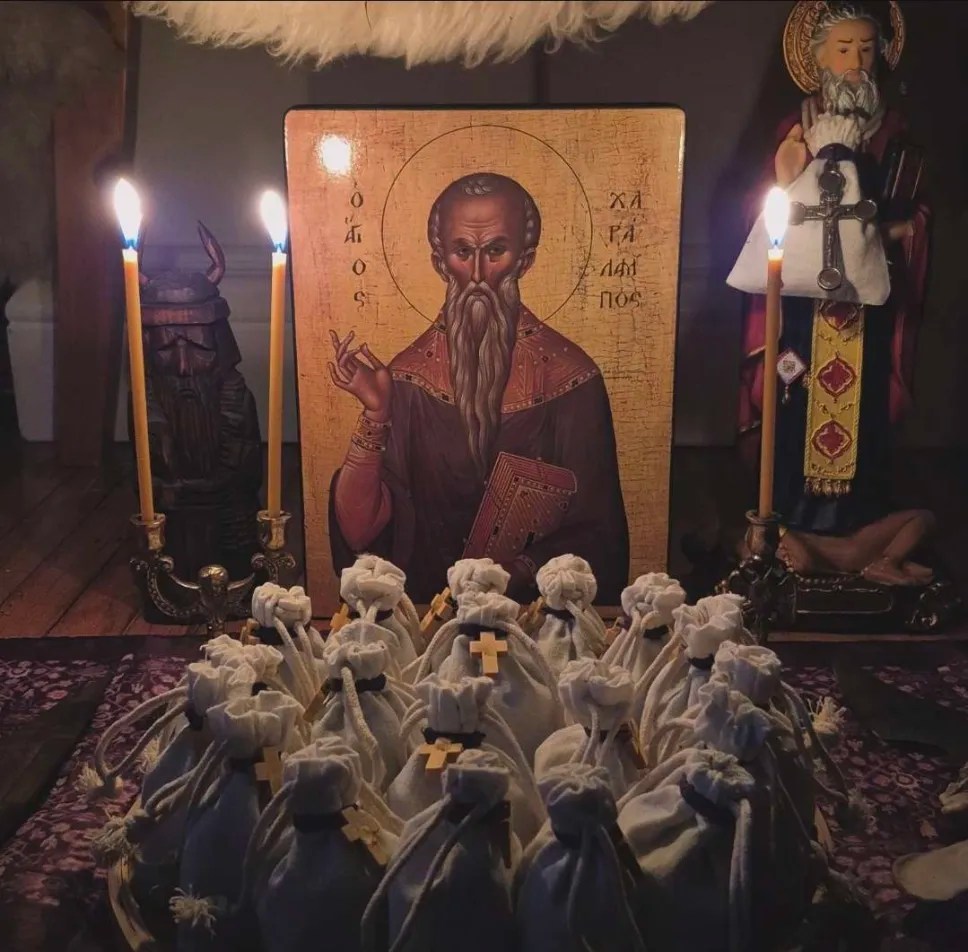
The completed charms before his icon.

Finally, a cumulative offering was given unto Čuma in her guise as Bibi, with candy, mirrors, money, bread, and honey placed before her alongside a walnut comb in memory of her pact. After reciting a lengthy prayer in her honour, she was reminded that each mirror within the charms was given the same honey sweetening her tongue now in St. Charalambos’ cooperation and care, and as such the charms carry, independently of me as their maker, the same blessing and safety my pact with her generates for me. Key and I tied little wooden crosses to each bag using purple thread and oral charms, completing the consecration by extinguishing one beeswax candle’s flame into each cross before relighting it again to instill the spirit fully within. In this way, each cross has already suffered once in the place of its owner—just as we say that lightning does not strike the nettles (“neće grom u koprive” in Serbian, “wo Brennnesseln stehen, schlug der Blitz nicht ein” in German), for nettle already stings as lightning does—so too do many of our rituals involve putting out controlled fire first on the tongue or into the wood of the home so that we are already “bitten” once, and therefore cannot be again by accidents and tempests. Through calling on Christ’s resurrection, each charm was fully imbued and reminded of their pact; that they have already paid their toll to the spirits of disease, and that they have already suffered a blight once. In this way, their conjuration is complete, through the settlement of their virtues and the honouring of their place as wards against all disease and illness, and the swift curing of any aches, pains, and viruses that may come with time.

Carry these on you for protection and to cure ailments. These charms are fully self sufficient and do not need any upkeep, but praying to them, holding them between the hands and above the afflicted area of the body, and anointing the cross with holy oil once a month is always welcome. Pray for continued safety and protection against all blights, in the name of St. Charalambos and Christ Eternal, and walk through the world with renewed confidence and peace.

Twenty of these charms were made under the auspices of St. Charalambos and his retinue, drawing on traditional Balkan folk magical techniques as well as personal innovations through spirit teachings. If you would like to purchase one or more for yourself or a loved one, the link is below and includes shipping. Please allow a week for orders to be fulfilled and shipped to the address provided via PayPal.

All charms have been sold as of March 27, 2025. Thank you so much for your patronage!

O, milosrdni mučeniče, moli se Gospodu za nas, da nas sačuva od gladi i svake bolesti, i da nam podari izobilje plodova zemaljskih, i umnoženje stoke potrebne ljudima i svega što nam je na korist a ponajviše da se udostojimo, molitvama tvojim, Carstva Nebeskog Hrista Boga našega, Kome priliči čast i poklonjenje, sa Bespočetnim Ocem Njegovim i Presvetim Duhom, sada i uvek i u vekove vekova.