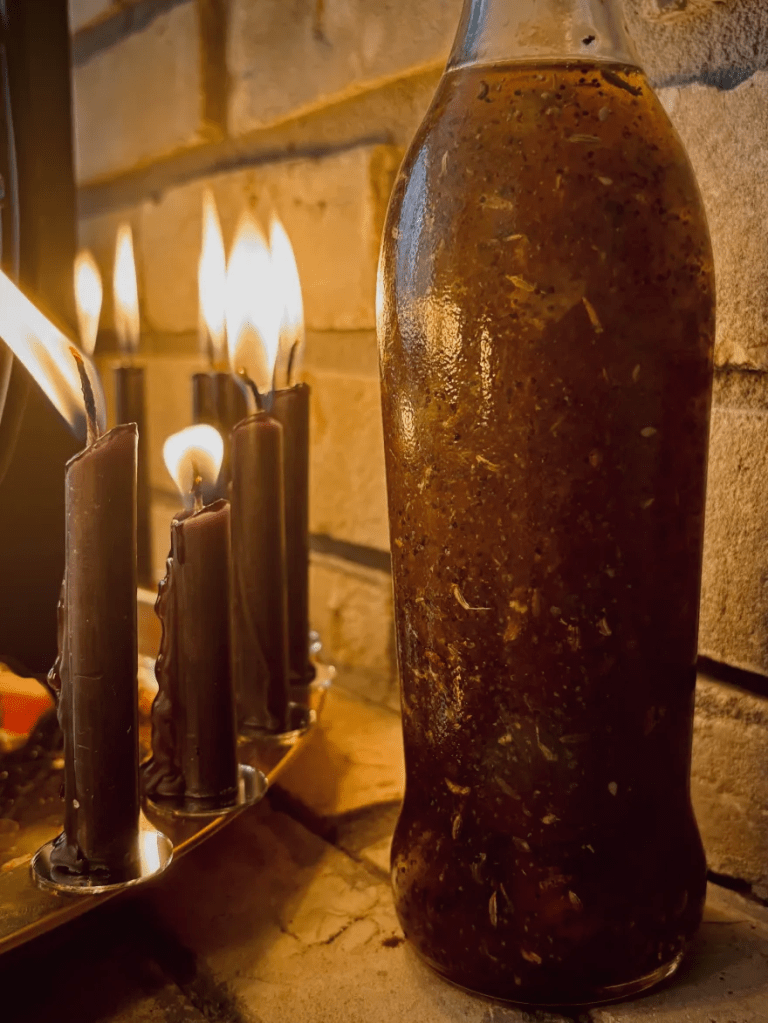
Give them according to their deeds…: In the wake of Episode 74 of the Frightful Howls, I composed this formula to meet the needs of this month’s first community ritual for invisibility from adversaries. Following the ritual, in dialogue with the spirits involved and with the spirit of the oil itself, we came to the decision to release this to the public to better facilitate the goal of granting additional forms of protection through concealment to those in need.
…And according to the wickedness of their endeavours: The composition of the oil began with the sun and ended with the moon, each drawn down through sympathetic herbs and resins such that the eclipse of the solar powder with the lunar grants the same power of occlusion to those who wield the oil. I used fennel to “steal” any remaining fire from the solar materia, and conjured it to redirect the light and heat of attention, prying eyes, and inquisitive minds away from the bearer. A mixture of seeds was added in an uncountable sum to introduce confusion and redirection through delay, in addition to serpent sheds, that the bearer may shed away old guises and take up new ones at a moment’s notice. To further enliven and empower the quiet beast that is this oil, I constructed multiple distinct talismanic cores as “organs” to form the body of the spirit within: a written copy of Psalm 28:4 atop a petition and pact sealed with wax, specific shells and animal materia, resins collected from lucky and auspicious trees, and bundles composed of cloth and herb containing traditional formulas for law-keep-away work (including my personal law-keep-away powder) in the American folkloric context to grant distinct protective, evasive, and deceptive functions and frayed threads from old charm bags to unravel plots and magic against you like old cloth.
Give them after the work of their hands…: Additional consecrations were completed on the oil under the dual lights of the recent eclipsed blood moon and the concurrent selenelion, at which time the now-pronounced redness of the oil was captured and augmented. I then brought the primary bottle of the oil with me to a place of conflict, a place of unjust law enforcement activity, a visible place, and a cursed place, and again tested the spirit’s ability to protect, to obfuscate, to distract, to hide, and to enact revenge. Each of the tests was passed with flying colors.
…Render to them their desert: This oil’s functions are diverse, ranging from protection and invisibility to retributive and even vampiric functions, each use dependent on the creativity and interaction of the conjurer. As something slightly more enlivened than other oils I’ve produced, I suggest spending time contemplating the oil in various forms – on a candle, in a lamp, on petitions, on photos, on your hands, and in the environment to tease out mysteries and uses. The spirit of this oil is one responsive to need, and is hungry to right what it sees as wrongs. I suggest using the oil somewhat regularly, so that it does not get bored. It can be fed with a neutral carrier oil to extend its life, although I recommend not stretching it further if the scent of cinnamon is no longer detectable in your original bottle.
Each order includes 1 fluid ounce (30 mL) amber glass dropper bottle of the Oil According to Their Deeds. Shipping included. Please allow for up to a week from the time of your order for me to ship via the USPS.
In continuing my experiments with Lion, I’ve been asked about one particular item more than any other – the belt. The lion skin belt itself is one of the most impressive, and thereby most elusive, instruments of art from the Lemegeton’s Goetia, which calls for the magus to prepare “The other materials [are] a scepter or sword; a miter or cap, a long white Robe of Linen, with shoes and other Clothes for the purpose also a girdle of Lyons skin 3 Inches broad, with all the names about it as is about the uttermost round Circle” (Peterson, 2025). Similar variations of the belt are found in other proto-Lemegetons such as Sloane 3824, and in Scot’s Experiment of Bealphares. Skinner, in his Techniques of Solomonic Magic, suggests that in each case, wearing lion is both to convey authority to the magician and to provoke fear and obedience in the spirits (for if the magician can have dominance and triumph over a lion, they can have the same dominance and triumph over a spirit). Due to the lack of abundant lion skin for what are hopefully obvious ethical and environmental reasons, many solomonic magicians substitute, or more commonly entirely omit, this garmet. This implement aims to bring the magician closer to the letter of the text, with an eye toward tested practical efficacy.
Enhancing the inherent virtues of the lion within the circle is the The 5th pentacle of Mars, which “…is terrible unto the demons, and at its sight and aspect they will obey thee, for they cannot resist its presence“, with its verse being Psalm 91, verse 13: Thou shalt tread upon the lion and adder: the young lion and the dragon shalt thou trample under feet. With lion, serpent, and spirit alike subjugated in the same manner as suggested by Skinner. In practice, both in my own experiments and in those of other Goetic magicians who I’ve compared notes with over the years, this pentacle serves as the ideal substitute for the belt in whole. Its hold on infernal spirits is jarring in its efficacy, as the grimoire describes, especially those lower in the infernal hierarchies. The use of lion is both prescribed, and for the aforementioned reasons, serves as an added layer of correspondence and sympathy in the performance of the art of Goetia.
I consecrated these pentacles in the usual manner described by the Greater Key, working only within the days and hours of Mars with blessed ink and consecrated tools. I performed additional consecrations and layered enchantments for personal power, subjugation of spirits, and subversion of entrenched powers in subsequent days and times, and finally sealing the enchantment before additional Angels and planetary spirits of Mars atop a tablet inscribed with the first pentacle of Mars.
The pentacles themselves are warm to the touch and have a tangible “buzzy” feeling, radiating their virtue if left exposed. Through this quality, I noticed a decrease in phenomena in spaces where this pentacle was left, in addition to prompting an exodus of astral larvae and other ambient parasitic spirits. In testing these pentacles, to say they were strongly repulsive to the infernal hordes conjured is an understatement – I have not encountered a tool so effective at demanding obedience and stripping infernal spirits of their ministers and attendants as when this was revealed within the circle.
5 pentacles are available as of 30 December 2025 in honor of Mars, and they will not be restocked once sold due to the rarity of the material. We wish you all a happy new year!
Once again, Key and I are so incredibly grateful for your generous support of our Nikoljdan community ritual. We were once again able to raise $2000 for our Cabula through the combined efforts of our Esteemed Initiate tier on Patreon and those who contributed directly through the blog. Thank you all so very much!
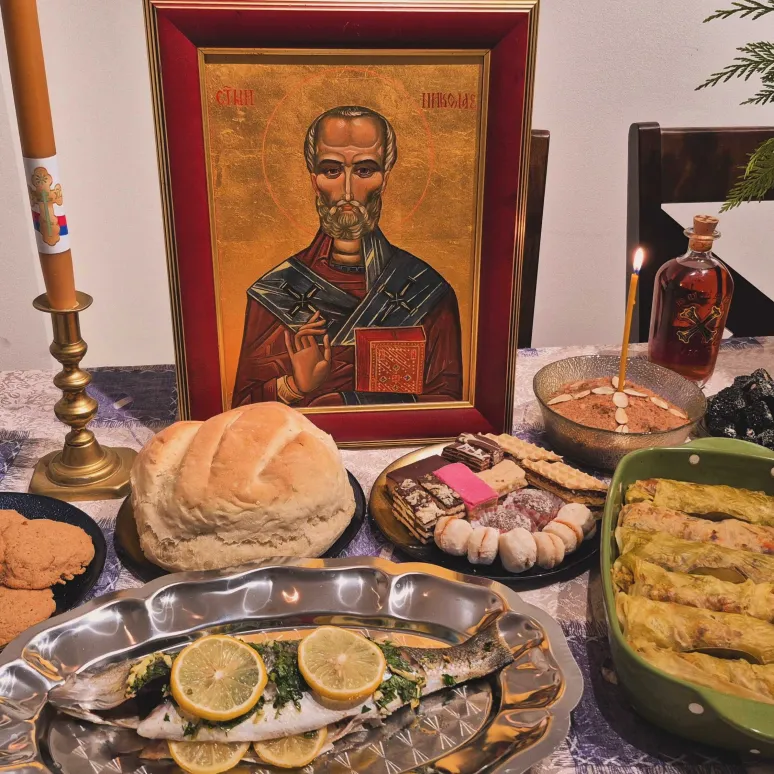
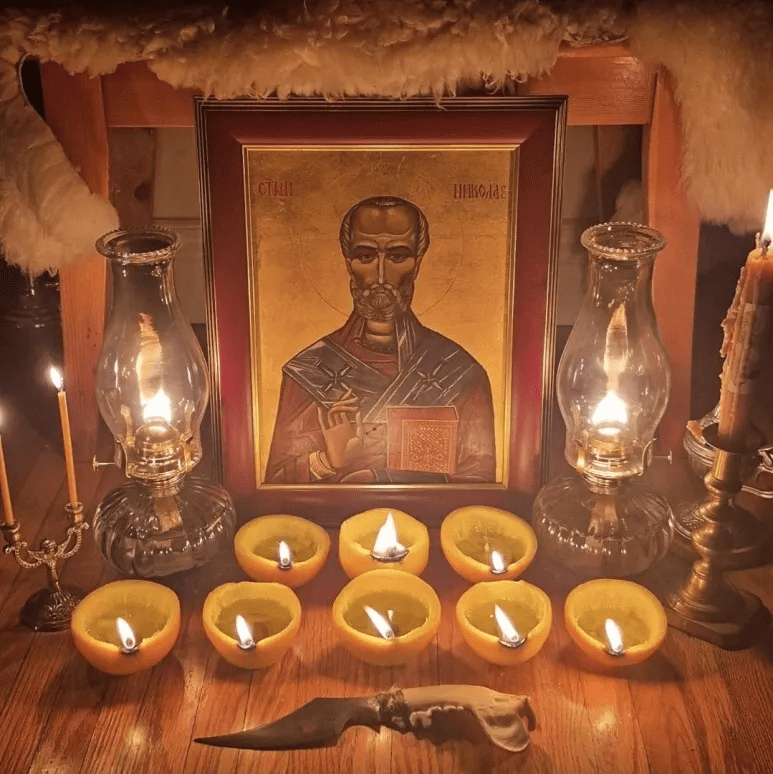
Here’s a brief recap of the workings as we completed them. Key and I began by throwing a small slava for Sveti Nikola in my home, inviting friends and family to visit and participate. From the early morning, we were up and baking bread, cooking sarma, preparing the fish, and baking Dutch pepernoten cookies. We prepared a small selection of traditional slava cakes and biscuits, as well as an apple strudel, and created small plates containing servings of each dish for the ancestors, protector spirits, land spirits, and spirits of the door and threshold. Having lit the slava candle, we offered prayers, veneration, and oral charms unto St. Nicholas as wayfarer of the paths to fortune, stability, and prosperity.
The table for the slava is set.
Just a couple days prior, on the 17th of December, I also celebrated Sveta Varvara (St. Barbara). As per tradition, I sowed wheat seeds to grow my Christmas wheat that I will trim on January 7th, and cooked a traditional meal of grains called a varica. This year, I opted for a sweeter version, consisting of wheat, corn, barley, honey, chopped walnuts, sliced walnuts, and raisins. “Varvarica vari a Savica ladi a Nikolica kusa” (Barbara cooks, Sava cools, Nikola tastes) is a saying encompassing the practices of this trinity of days, cooking the varica on Barbara, cooling it in the fridge for a full day during Sabbas the Sanctified, and finally consuming it with your family on Nicholas’ day. Several sorcerous projects were begun on her feast, and the varica, having been blessed for fertility and prosperity, was served on Nikoljdan and enjoyed by all present.
The lamps prepared and presented. The left-handed lamp manifested the omen we were looking for: the buildup of soot along its rim.
Once our guests had returned home, we set off to do our work on behalf of all patrons and named parties. Key and I prepared two oil lamps of St. Nicholas, one for the saint in his right-handed guise, and another for him as Devil, as Veles, as Master of the Wolves.
The right-handed lamp was built in several stages: for the first stage, the vessel of the lamp itself was prepared with an herbal wash, smoked out with incense, and lit on fire with some Florida water. Next, a little bit of the oil went in along with a wooden cross that was carved and blessed for the day, as well as crumbs from the slava bread baked that day and the full petition of names. Following this, we added our base of resins, including several kinds of Orthodox incense blends as well as frankincense, myrrh, Three Kings, and more. Key then took the grave dirt of nine different bishops to confer the blessings of those spirits unto the work. He also expressed some of the orange oil, harvested directly from the oranges we prepared as daughter-lamps, through a flame in order to consecrate it as the descent of the Holy Spirit into the lamp. Key then added a gold coin into the lamp as well as much more orange peel to code it for money, and then finished the lamp with a crown of rosemary.
For the left-handed lamp, every ingredient that went into the base was covered in charcoal and ash to “blacken” it with soot. The lamp itself was built over a black Joker card, specifically one chosen because it depicted the Joker riding a horse. This image coded the work both to the lore of the black Joker as a devil in a deck of playing cards, as well as calling upon his steed, which for our purposes also includes St. Nicholas’ boat. Additionally, in much of Dutch folklore surrounding St. Nicholas, the saint is depicted as riding a horse, or at least travelling alongside one. After each ingredient was added, pieces of coal were also put into the lamp, as well as pieces of tobacco from a cigar that fumigated the lamp, myrrh, and dirt gathered from the graves of 21 soldiers. Key then shotgunned a cigar into the lamp, shaking the vessel until the smoke infused into the oil, turning it grey. Sulphur, gunpowder, vetiver, and a final gold coin completed the work, built over the volatility and explosive nature of its ingredients, and handled carefully to bust open blocks, open roads, and ignite the raw power of luck in each named party’s life.
A pinch of the materia from both lamps, along with crumbs from the slava bread, then went into eight orange lamps which which were ritually born of their parents, and distributed to different crossroads to safely burn amidst the winter snow. A final pair of orange lamps, the youngest twins of the nest, were then taken to a nearby lake and left to float along the surface, carrying out the petitions crafted into the arms of the watery spirits that accompany St. Nicholas in both Balkan and Dutch lore. We completed the rite by offering one final battery of prayers to the saint, praising him for his potency and once more requesting that he open the roads to luck, fortune, prosperity, wealth, and new opportunities and horizons for everyone named. We are so grateful to each and every one of you who contributed! All proceeds from the rite are reserved for our Cabula as part of the charity of this working.
On the Eastern Orthodox feast of Saints Cyprian and Justina of Antioch, most holy and most powerful intercessors, a clutch of charms in honour of their exorcistic abilities and prowess were born.
I had been intending on making a set of these charms for the two saints inspired by Orthodox folk traditions, drawing from my training in different forms of saint veneration, folk magic, and oral charming in Western Serbia. After my last release for the holy pair, I wanted to make some amulets in their honour that would not only be more affordable, but whose proceeds would also be donated directly back to the teachers and sources of Cyprianic magic that have informed my practice across the traditions I have training in, named and unnamed, acknowledged and hidden. In divining on their ingredients, consecration, and nature, it became quickly apparent that I was to incorporate techniques and lore I learned across their Balkan traditions, most notably Serbian, Greek, and Cypriot. As such, I invited my good friend Maria of Green Dragon Healer to join me in their construction, and lend her Greek herbal training to the various recipes I had picked up on them in my travels.
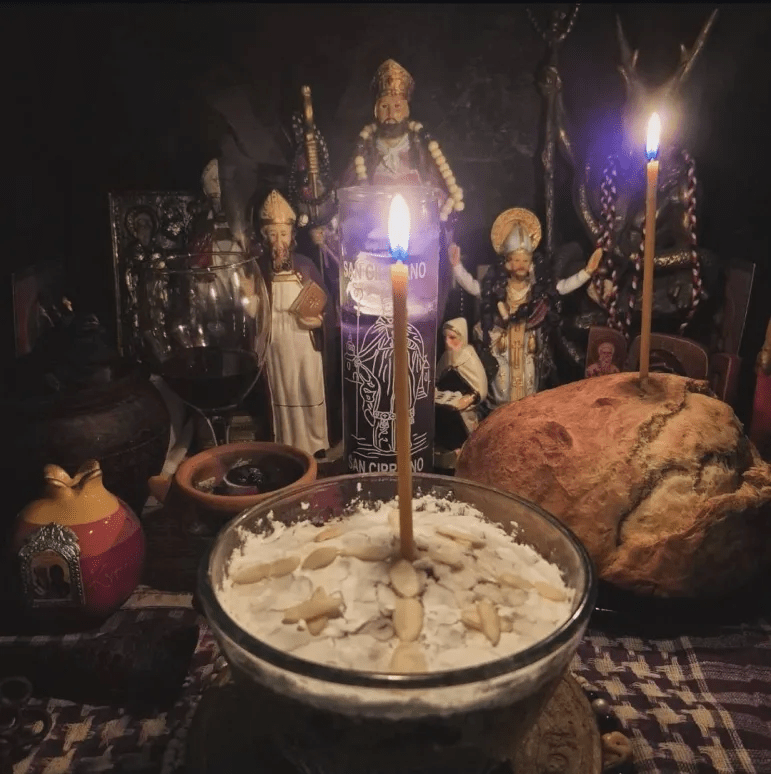
Koljivo, freshly-baked bread, incense, wine, and prayer offered before the saints.
On the 15th of October, I used holy water I collected from a font dedicated to Sts. Cyprian and Justina on their feast in Meniko, Cyprus to bake a bread that was prayed over, charmed, and ensorcelled to grow with particular virtues necessary for the work. Maria brought over a koljivo she made and ornamented with powdered sugar and almond slices to present in offering alongside red wine, spring water, and black Orthodox St. Cyprian incense used for exorcism. We joined in offering a litany of traditional prayers sourced from various Akathists to the holy pair, and fumigated both the forty-one beans that would be used in finalizing the recipe as well as the purple cloth that would serve as their skin and surface of divination. Once set, we laid out the cloth in a large square and cast the beans before the saint, receiving the omen necessary to proceed with the original divined materia list immediately without modification.
Cutting half the bread into twenty-one small squares, we anointed each piece with a trinity of oils—one of Cyprian, one of Justina, and one of a mitigating stellar force that became known to us in the divination to carry forth the energy of Cyprian’s magician disciples and Justina’s pious nuns. Enlivening them once more as the fulfillment of the pact of each individual amulet, we layered all other herbs and materia over these squares, including pieces of incense, herbs associated with Cyprian and Justina across the Balkans, and various mineral and animal ingredients, finally dividing the forty-one beans that approved of the formula between them all. Each amulet bag was then tied up with purple thread, over which was layered white hemp cord that holds together a real freshwater pearl and a small hagstone each.
The nest of charms within their crown.
Each hagstone was dragged through dirt, blood, milk, and holy water, the serpent which passed through the hole of its egg vivified from the vespers of his first Orthodox feast on the second of October to the day of the fifteenth, with both the revised and the old Julian calendars being honoured together. Through the amulets, dragon and pearl are married once more, each hagstone being bound to a freshwater pearl anointed with holy water, holy oil, and tears from the icons of Cyprian and Justina in their name. Pearls are especially sacred to St. Justina, and as the holy water and holy oil themselves were either gathered or purchased from monasteries and churches bearing their names on their feast days, so too were the pearls enlivened in honour of the temporal and spatial dimensions of their veneration and faith.
One exemplar from amongst the clutch.
These charms were then prayed over extensively across traditions. Over nine days, Maria recited daily exorcistic prayers intended for lay use from the Greek Orthodox tradition, empowering them to keep away evil spirits, restless dead, vampires, and all manner of malefica. During that same period, I offered a Serbian Orthodox prayer for protection against witchcraft and the familiars and servants of other sorcerers, including those sent to spy in spiritual voyeurism. Finally, they were programmed to benefit their owners in empowering the communicative abilities and oracular manifestations of friendly, allied spirits, thereby acting not only as wards against those unwanted but also granting Cyprian’s saintly cloak of authority and magical prowess to those spirits who follow their sorcerer as closely and dutifully as his own disciples.
The students of Cyprian and the nuns of Justina were supplicated throughout this process, lending their hands and vows to the trinity of bread, pearl, and hagstone to affirm that these charms will continue to empower the ability of their owners to receive recipes, workings, and instructions for the cultivation of different spiritual activities directly through them. Hold in your hands as you meditate with your spirits or place it on a shrine that you wish to communicate better with or boost the powers of. Cleanse your body with it by wiping it down each limb and under the toes to rid yourself of malefica. Carry on your person to neutralize prying eyes and ill intents. Place at the feet of Sts. Cyprian and Justina in prayer and then move by your bedside to incubate magical instructions in dreams. When divining on recipes with your spirits, hold this charm in your hand or have it by your divinatory tools in order to hear the spirits more clearly. Anoint on Saturdays with an oil of St. Cyprian, a holy oil, or an oil of rosemary to keep fresh and empowered.
Sts. Cyprian and Justina’s Charms of Exorcistic Power
One charm bag for keeping away the hungry dead, malefica, and witchcraft, and empowering the protective dead. Shipping included. All proceeds will be donated to different sources that have informed Sfinga’s Cyprianic practice, be they teachers, temples, or churches.
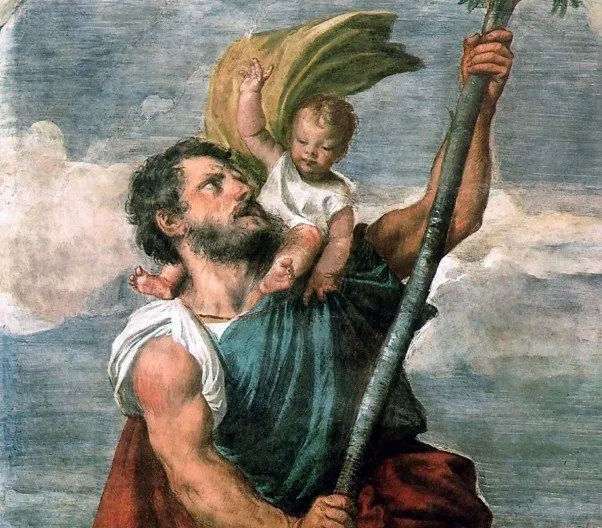
A few years back, I wrote a post about about a matrix of herbs and powders that came together to better presence St. Expedite and those spirits that dance in his blazing footfalls in a particular loci of devotion. The everlasting quest to help my spirits meet me somewhere in between this world and the next by finding ways to ensoul, manifest, and anchor them in this world that they may have more ingress and presence, and resulting experiments, lead me to making this new set of charms. In technique a spiritual companion piece to the charm bundles affixed to Christopher’s Protection Chaplets for Travelers, these bundles draw from the life of our beloved dog-saint, in which he bore the entire world upon his shoulder (in the form of the Christ-Child). It follows that if he can uplift, make safe, and most importantly make manifest the world, he can do so with anything therein. In lifting up spirits all the same, he provides both a gentle hand elevating and aiding the manifestation of our allied spirits, bringing closer those distant and forgotten, and, as needed, a mechanism of control against unruly, wild spirits.
Like most of my charms made at the foot of St. Christopher (and one might argue like the saint himself!), they are simple in construction, but blessed through labour and repetition. Each bag contains an herbal blend, with plants selected to share breath with spirits to rouse their presence and increase their strength, pacify disagreements among those they encounter, send roots and stems and seeds into other worlds to secure and germinate the means of ingress, and to mediate and nullify imbalances that need to be navigated in the environs of the spirit. Like following a long and desolate path, each component was selected to navigate obstacles and hindrances without being so heavy or distracting as to over-encumber the bearer. Tobacco, Sage, and Dittany of Crete feature heavily, with celandine, mullein, and many members of the mint family mediating.
Each plant was called forth to the table of his catholic feast, and united under the celebratory banner of the dog-saint, with an exhortation of his virtuous qualities delivered over corresponding herbs. Candles lit for the saint and each of these allies were used to apply a small drop of beeswax on the reverse of each metal, to deliver their fire and seal the initial enchantment. Following their initial consecration, they were continuously prayed over, offered to, and further empowered through charm and incantation, until they satisfactorily eased the production of spirit phenomena (being sustained and visual or auditory, beyond the usual capabilities of the distant and forgotten spirits contracted to test the charms).
I suggest affixing this charm to the leg of an altar table or shrine, or keeping it beneath a table of practice during use, that they may participate in, and themselves osmose the virtues to bear up spirits. The bundles can also be given to spirits to use as toolboxes, with each component potentially easing the burdens to travel between their world and ours. I encourage communion with your own spirits at the locus of the charm to determine further idiosyncratic uses, as the composition is meant to be a kaleidoscope through which these encounters are had.
10 charm bundles from this set are available for sale, with shipping included.
The long-awaited Mercury in Nutmeg charms are available once again! I have deeply enjoyed experimenting with this rich-in-folklore talisman over the last few years, itself embodying a synthesis of herb and metal that always fascinates and delivers secrets of each. As was discussed in [previous] [posts], the technique of drilling a hole in a whole nutmeg, adding mercury, and sealing it with wax was once a favourite of gamblers and those looking for a fast change in luck and circumstance. Having fallen out of fashion due to the dangers inherent to mercury as a material, I set about finding ways to make this magic safely available again, through the use of more intricate wax seals and better containment within the layers of flannel, with this edition developing on the lessons learned and techniques honed through five prior batches.
As such, these talismans for all manner of luck-enhancement can be petitioned with your desires in mind in order to bring about expedient and radical changes in fortune, luck, finances, and all manner of ever-winding fates. The buzz of the talisman helps the bearer remain awake and focused, with an inspired drive toward grabbing life by the reins. This year’s form of the talisman is much closer its folkloric counterparts in more ways than its past counterparts: a green flannel mojo hand containing the nutmeg itself alongside various luck and money drawing herbs and dressed in oils for the same, with the ever-flowing mercury contained such that its physical movement is much more tangible than previous versions.
This particular edition, through the gracious guidance and help of Sfinga, also contains a Balkan folk magical “boost” for psychic strength and discernment of the ever-shifting lines of fate and fortuna, following omens interpreted, offerings made, prayers given, charms uttered, and magic woven on Vidovdan this year. While specifics must remain veiled, St. Vitas, being the foremost patron saint of Sight, was called upon to bless the mercury as mirror, harkening to its use in telescopes in order to grant the bearer the ability and faculties to gaze into the most distant horizons and beyond.
This edition is limited to 21 charms (many already spoken for), so be sure to get one fast!
All charms are sold as of the 11th of July. Thank you so much for your patronage!
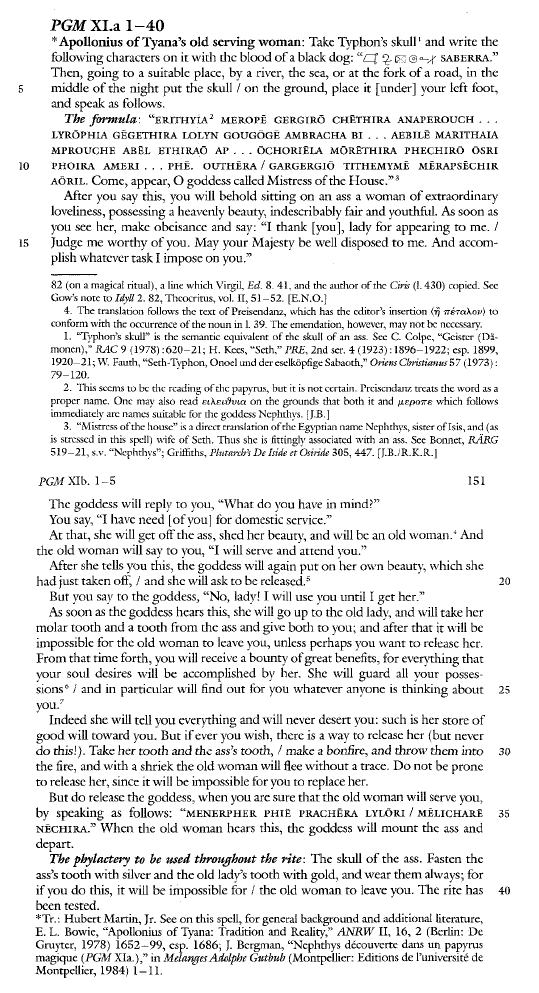
Over a year ago, Key wrote an excellent reflection on his experiences performing PGM XI.a 1–40: a conjuration of a familiar spirit that serves the household, captioned as “Apollonius of Tyana’s Old Serving Woman” in the Betz PGM collection. The three of us, along with and a few friends interested in the ritual, pitched in to procure a donkey’s skull and the blood of a black dog—the necessary materia for the consecration of the phylactery that serves to conjure the goddess Nephthys, so that she may grant the titular paredros spirit of the rite. Shortly after obtaining his own familiar, as well as additional ones for friends who happened to be visiting him at the time, Key shipped the skull along to Salt and I’s home, ready for the next installment for “The Sisterhood of the Travelling Donkey”. Our plan was to continue sending the skull around, each household obtaining their tooth (the vessel for the paredros), until it eventually made its way back to us to be permanently enshrined by the hearth at our combined home.
Since the skull’s arrival at our doorstep, Salt and I came to increasingly notice its surging awareness. While it is the teeth obtained from the old woman and the donkey that are truly the vessels and proofs of pact, the phylactery of the skull had clearly come to be endowed with its own numinous presence and alignment throughout its repeated use. Even without the conjuration being actively performed—and in the case of its use, even after the dismissal of the goddess—it was clear that some portion of Nephthys’ power remained within the skull, and that this was a holy object. When not in use, we kept it veiled in linen, treating it with the utmost respect as befitted an image of the mighty queen and her consort, the mighty lord Set. Salt and I specifically have, since before we even met and became a couple, long held fast a religious devotion to various Netjeru (Ancient Egyptian divinities), and so the phylactery had an additional layer of significance for us in our private observances.
The skull atop its linen veil by the hearth.
Over the year, we’ve hosted many friends who have visited for various lengths of time to hang out, cook incredible meals, and get up to plenty of sorcerous adventures. In most cases, we actually got up to so many different projects that I had to draft an entire Google doc itinerary of planetary hours, elections, and roadmaps for where we’d go to gather what materia and what we had to enchant for at which time. In each moment, we intentionally tried to carve out a time to allow them to have their own midnight jaunt with the phylactery, especially as these were the very same folks who helped pitch in for its obtainment from the beginning. Yet an omen always arose for why it was not yet appropriate, even if temporally it would have been convenient for us all (shipping a donkey skull around is not fun!). In one case, we were about 20 minutes to the midnight hour, all dressed up with the wrapped skull in an IKEA tote, ritual printed off and candles for illumination at the ready, when I suddenly felt a distinct and knowing pang that led me to consult one of my closest spirits with their divinatory oracle about the matter, only to be told to call the rite off. The messages varied in each instance. Sometimes it was that our comportment was not sufficiently pure, in that even if we had all showered and donned clean clothes, something about our moods, excitement, earlier festivities of partying and revelry, or even the stench of the witchcraft we had been engaging in lingered still, rendering conjuring the goddess inappropriate. In other cases, the reasoning was even more nebulous, yet still felt by all. There was never any disappointment with regards to the timing—all present agreed something was “off” and that the skull phylactery would not consent to us proceeding with the ritual.
Naturally, I decided it would be better to ship it along immediately to keep the chain going, yet even this was interrupted. I could not shake that I should not yet part with the skull, and that there was still something left to do, or at the very least that it required some fulfillment still before being sent away on its long journey around and then back to us. Divination continued to advise for patience, as well as the completion of oaths already undertaken. I meditated for some time on what this may be, and continued to feel a nagging impulse that something about this entire scheme had to do with Salt in particular. Yet, the tooth we procured is to be shared between us, for our good lady paredros serves our combined household in which we live. We knew from the beginning that he would not be soliciting another, so what exactly was missing?
The answer came to us in vision in a truly illuminating and instructive fashion. Some time ago, Salt decided that he should procure a familiar from this ritual for his mother back in England and send her the tooth to assist her. By rank, she had to be next in line before any other. In other words, while sometimes the “vibe” was genuinely too off to proceed with the purity requirements of the ritual, the reason why we kept feeling as if we could not ship the skull yet to its next destination regardless was this essential matter in household authority. Before the goddess’ phylactery could impart its next boon, its blessing must first be addressed to the very person who kept Salt’s house throughout his childhood.
With this complete, the skull is now free to travel to its next keeper, passing all the necessary checks in omens and auguries. In addition to sharing our own experiences with the ritual (and again affirm its efficacy and usefulness to those discerning karcists interested in attempting it themselves), we wanted to give an example report of how the nature of the rite itself is imprinted in the very ethics of how it is conducted. If an agreement has been made to share a skull between sorcerers, and one of its intended beneficiaries is one of their mothers, then by rank she must inherently go immediately. Since the skull is ultimately going to remain with us once it has completed its circuit, Salt and I were planning on carrying out this additional rite then and giving it to her in person when we next visited, but the phylactery’s numinous awareness was adamant that the essential order of the proceedings must honour her first. As the paredros granted participates in the domestic mysteries, it is only right to address first whomever has played an essential role in one’s own life in such a manner, if they themselves are one of the intended recipients of the rite, regardless of the temporal proceedings of our visitations.
Without further ado, below you’ll find the accounts of what our individual experiences of performing the rite are—myself and Salt together for our own assistant spirit, and Salt’s when he conducted this another time.
When the night came for Salt and I to accomplish this undertaking, we first began by ensuring we were clean, freshly showered, and wearing new clothes. I printed off a copy of the ritual as it appears in Betz from the composite screenshot in Key’s post and prepared some candles and a candle holder so that we would have the light necessary to read it in the dark. With the skull wrapped tight in hand, we made our way to the middle of a three way crossroads, unveiled the donkey at the center of the fork, and lit the candle. I had my left foot over the skull as instructed, while Salt held onto me with the same glyphs beneath him.
Key’s experience with the ritual matched the level of intense manifestations and physical omens I witnessed in my own working of PGM IV. 3086–3124: The Oracle of Kronos. While none of us are strangers to those kinds of manifestations across our individual and shared traditions, they never cease to fill us with wonder and awe when they do occur. From the beginning of the first recitation of the formula, Salt and I immediately saw the otherwise still night air whip up into a frenzy of howling winds. The more we chanted, the more it screeched, shaking the trees and forcing us to continually shield the candle flame with our bodies so that we could read from the text. We saw the goddess appear top her donkey midway through the second repetition, swiftly appearing in all her brilliance, beauty, and divine splendor. Salt and I were stunned into silence by her theophany, bowing our heads swiftly at the sight of the beautiful young maiden sat atop her steed, her skin a vibrant gold and her hair extending into the night sky in streaks of lapis, jet, and labradorite.
An image of the rite as it appears in the Betz translation, pages 150–1.
The dialogue proceeded roughly as the text describes. We stuck to the script, replying as the rite advises. When the goddess dismounted her steed (which appeared to us black with glowing red eyes, evocative of her husband Set), the light that illuminated her from within shifted, her skin sloughing to become that of an old woman, spots forming along her wrinkles, hair turning course and draining of colour. She only took this form momentarily before quickly receding into the shadows, within a blink taking on her earlier form. Scholar Eleni Pachoumi, in her article “Divine Epiphanies of Paredroi in the Greek Magical Papyri“, notes a similarity between the drama of this ritual and a scene from the Gnostic Apocryphon of John, from the Nag Hammadi library. John witnesses an epiphany in which Jesus first appears to him as a splendid youth, then as an old man, then as a servant. In this ritual, Nephthys first appears as a beautiful maiden, then takes the form of a crone herself, before eventually differentiating, emanating the old woman as a familiar spirit to be imparted upon the magician. We implored her to not leave, and that we would keep her until she grants us the old woman, at which point for the first time Salt and I saw the both of them, with the latter emerging from behind the steed of the former, pacing out from behind its tail.
At this point I felt a shift within the skull beneath my feet. While Key found a tooth already manifest outside the cloth as he was carrying the skull to the site of the ritual—somehow emerging from the tightly-bundled phylactery with a supernaturally loud clang on the pavement—we experienced a tooth visibly begin to wiggle and clatter about with the winds. As we gently moved to touch it, the howling air screeched even further, going from whipping from each direction to swirling around us, creating a visible circle of air that continued to lift higher, sending my hair up into the sky while the tunnel flexed towards the heavens. Throughout our dialogue, Salt and I continued to hear the physically audible barking of dogs and the braying of a donkey, as well as a persistent sound of bells ringing in perfect harmony. There was a moment when I thought there must have been several people with incredibly loud and animated dogs walking around at midnight in the middle of nowhere, but it was immediately obvious that there was no one around but us.
Salt knelt down to examine the skull under my foot, and carefully withdrew the wiggling tooth, which emerged easily into his hand. The rite says that the goddess will take from the old woman one of her molar teeth and a tooth from her steed and give both to you, after which it will become impossible for the spirit woman to ever leave you unless you burn the teeth. What we saw was the goddess retrieve these two teeth as described, present them towards towards us, and then merge them from physical apparitions into the body of the donkey’s tooth that had loosened and fell from the skull. Once we were absolutely certain that the pact had been signed, we scryed the tooth together, confirmed the presence of the old woman, and gave the dismissal. The goddess did not waste any time, mounting her donkey immediately and galloping off into the mists beyond the horizon. As soon as this was done, the cacophony of sounds—braying, barking, ringing, howling and all—ceased entirely, returning us to the silent and still expanse of the crossroad.
The next phase was carried out once we had determined the source of the delay. I was not present for this round, rather it was Salt alone who went to the crossroads. From conjuration to dismissal, he completed the ritual in record time, with all the same physical manifestations returning as if there had been no temporal distance at all. While in our first attempt, the tooth that wiggled forth was a molar, here Salt noted that all the teeth were completely fixed, rooted even deeper within the skull as if none of them had ever come loose, save for one incisor in the front that popped out immediately. The goddess made an additional instruction of him, as this was petitioned by him on behalf of a relative as opposed to purely for his own benefit—and especially as he had already solicited a familiar from her collectively as part of our collective domestic realm as a couple. With this agreed upon and sworn, Salt was able to complete the ritual swiftly and return to our home with his prize in hand, ready to be given over to his family.
Now with the skull freed up to go on its merry way to the next sorcerer, the three of us are even more excited to see what results will come of their own explorations. Our pool of experiences has widened to include several attempts now, each showing remarkable consistencies between manifestations, immediate proofs of power, the efficacy of the familiar spirits granted, and the entirely physical and immediately verifiable nature of the ritual’s conjuration. Not only can we vouch for the power of the ritual, we can confidently recommend its reliability through multiple tests.
Blessed Feast of the Assumption of the Blessed Virgin Mary to all on the Gregorian Calendar, and Happy Feast of St. Stephen the Protomartyr for those on the Julian! In my neck of the woods, today is Sveti Stefan Vetroviti, as our nickname for St. Stephen is “the Windy” or “the Windswept”, in thanks to his continued syncretism with the god of wind, Stribog. This is a powerful feast of the zduhać, vertovnjak, oblačar, gradobranitelj, and zmajevit čovek class of weather-manipulating healers and sorcerers, given Stribog’s enduring patronage of their arts, through his fatherhood of the Vjetreni Vojvoda spirits and his own fights against the ala, hala, german, and aždaja. Moreover, it is a day not only associated with the collection of hagstones, but their deployment in charms for knotting the wind, protecting livestock, and providing homes for spirits.
One of our recent episodes on our podcast, The Frightful Howls You May Hear, featured an overview of some of the basic lore around hagstones from the British, Germanic, and Slavic contexts. We’ve been so overwhelmed by the outpouring of support, love, and engagement on the podcast from so many of you; the warm reception and incredible feedback we’ve received has truly nourished us in our creativity and excitement to share more. We are so deeply grateful to everyone who has sent in comments, shared their thoughts on the episodes, and signed up to support our Patreon where we post bonus content such as our show notes, Salt’s incredible monthly astrological almanac, our Q&As, and far more! Over the next few weeks, we hope to share with our readers here on the blog not only a little of what we’ve been up to behind the scenes, but also new offerings to come in the form of courses, mentorships, readings, charms, and far more. It’s truly been a blast for the three of us to share more regularly, via our bi-weekly episodes, aspects of folkloric and magical research we’ve been up to, as well as tidbits of our personal adventures and sorcerous journeys.
The Hagstone episode (also adding the YouTube link since we only made the channel a few episodes after the launch, and most of our viewers are on Spotify and Apple Music—so for those of you who prefer YT, we’re finally live!) came about while the three of us were scattered over the past two months, travelling for work, spiritual training, conferences, and everything in between. Even on my travels, I had been collecting them where I could see (or, in the case of their hissing, hear) them, and asked Salt and Key if they’d be interested in contributing some German and English sources to an introductory episode on these most reliable of magical companions.
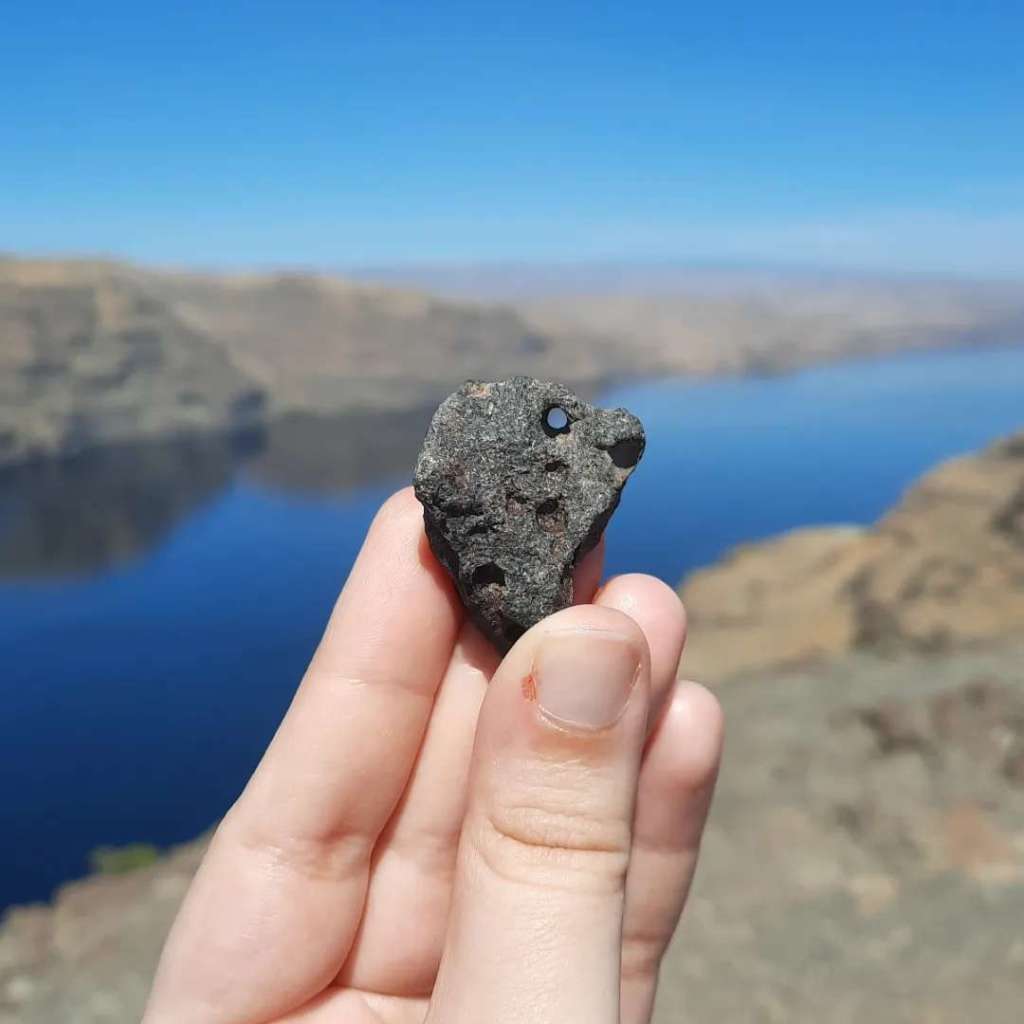
One of several hagstones I found at the Colombia River Gorge recently.
I thought it might be helpful to share some of what we went over in the episode here as well, in honour of Sveti Stefan Vetroviti. While we covered a great many names that holed stones have been referred to across Europe, “hagstone” is the name we’ve all used with each other in English from the beginning, and it’s certainly the one that’s stuck in our common parlance, as well as across occult spaces. That being said, while the list of names is especially long, a sample of our favourites from the episode include mare stones, bitch daughter stones, witch stones, and adder stones in English; Lochsteine, Trutensteine, Schratensteine (see our episode on the Schrat for more on this one!), and Hühnergott in German; and a great many coming from the South Slavic dialects, of which I’ll provide below with their translations from Serbian:
Chicken god (pileći bog)
Identical in meaning to Hühnergott, which itself is believed to be a German neologism form Slavic languages, referring to their use in the protection of livestock and especially chickens by being hung over their coops
Dog’s heart (psećim srcem)
Dog’s god (psećim bogom)
Dog’s luck (pasja sreća)
These dog-related motifs are a reference to Veles, lord of cattle, wolves, agriculture, the wilderness, magic, the chthonic world, and far more
Perun’s arrow (Perunovom strijelom)
Thunderbolt (gromovnikom)
Thunderstone (gromovnički kamen or kamen groma)
These three come from the belief that these stones are formed when Perun, the god of thunder, order, and the heavenly realms, strikes the holes through with his furious lightning
Serpent stone (zmijski kamen)
from the belief that holed stones are black eggs from which basilisks are hatched
Snake’s poison (zmijski otrov)
Serpent’s egg (zmijsko jaje)
Witch’s stone (kamen veštica)
God’s eye (božje oko)
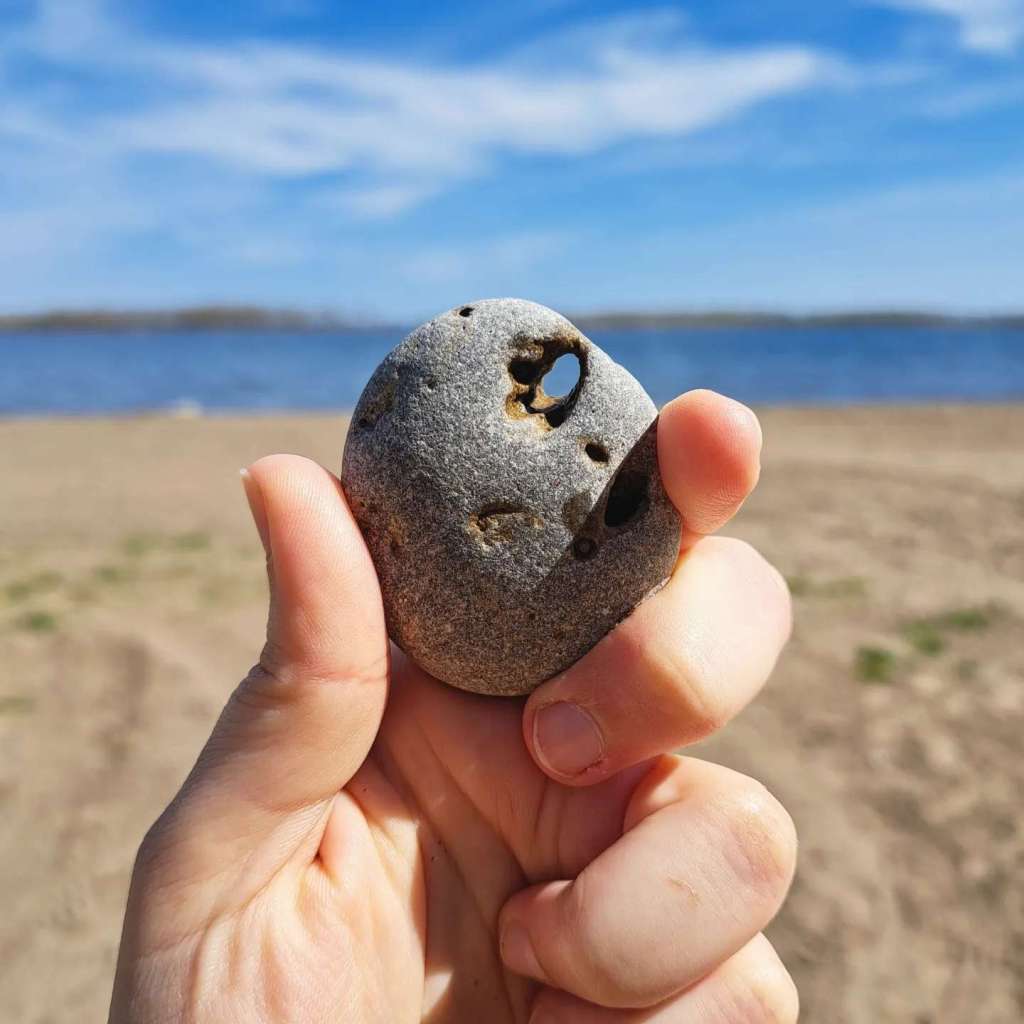
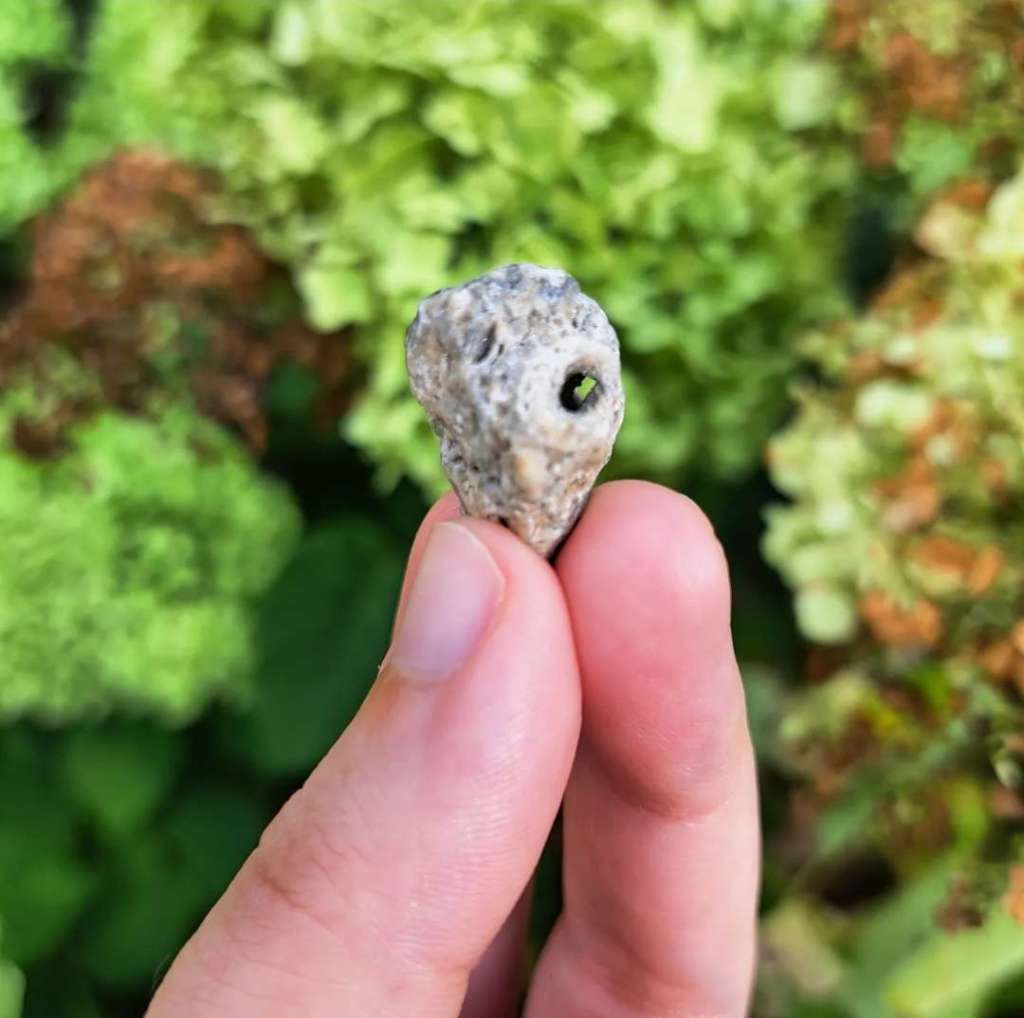
An example collected from a beach.
The uses for holey stones are all but endless. They protect livestock from curses, witches, and being ridden to the point of exhaustion by fairies, heal toothaches, headaches, and all manner of illnesses (in the Balkans, a common technique is to sandwich the afflicted area with a hagstone on either side, and conjure them to pass the pain through them and away, so that they may be disposed of later), ward against nightmares, and allow for the seating and ensoulment of spirits (in my tradition, this is typically done with seven-holed hagstones, which are especially prized). Some cultures recognize classifications of hagstones and their abilities and proclivities based on number of holes (with each having their own uses), whether they are seen as belonging to fire or water (based on their shape and hardness), whether they are male or female (less commonly used, but often having to do with roundness and pointedness), and in which location and weather conditions they were found. I went over a few variations from Slavic speaking countries with regards to these in the episode, though these classifications can become so detailed and so varied that they could take up their own chapbook!
One of our favourite charms that we shared, coming from Reginald Scot’s Discoverie of Witchcraft, is the famous “Man of Might” rhyme:
Tha mon o´ micht, he rade o´nicht wi´ neither swerd ne ferd ne licht. He socht tha mare, he fond tha mare, he bond tha mare wi´ her ain hare. Ond gared her swar by midder-micht she wolde nae mair rid o´ nicht whar ance he rade, thot mon o´ micht.
With the modern English being:
The man of might, he rode all night with neither sword, nor army, nor light. He sought the mare, he found the mare, he bound the mare with her own hair. He made her swear by mothers might that no more would she ride at night where once he, rode that man of might.
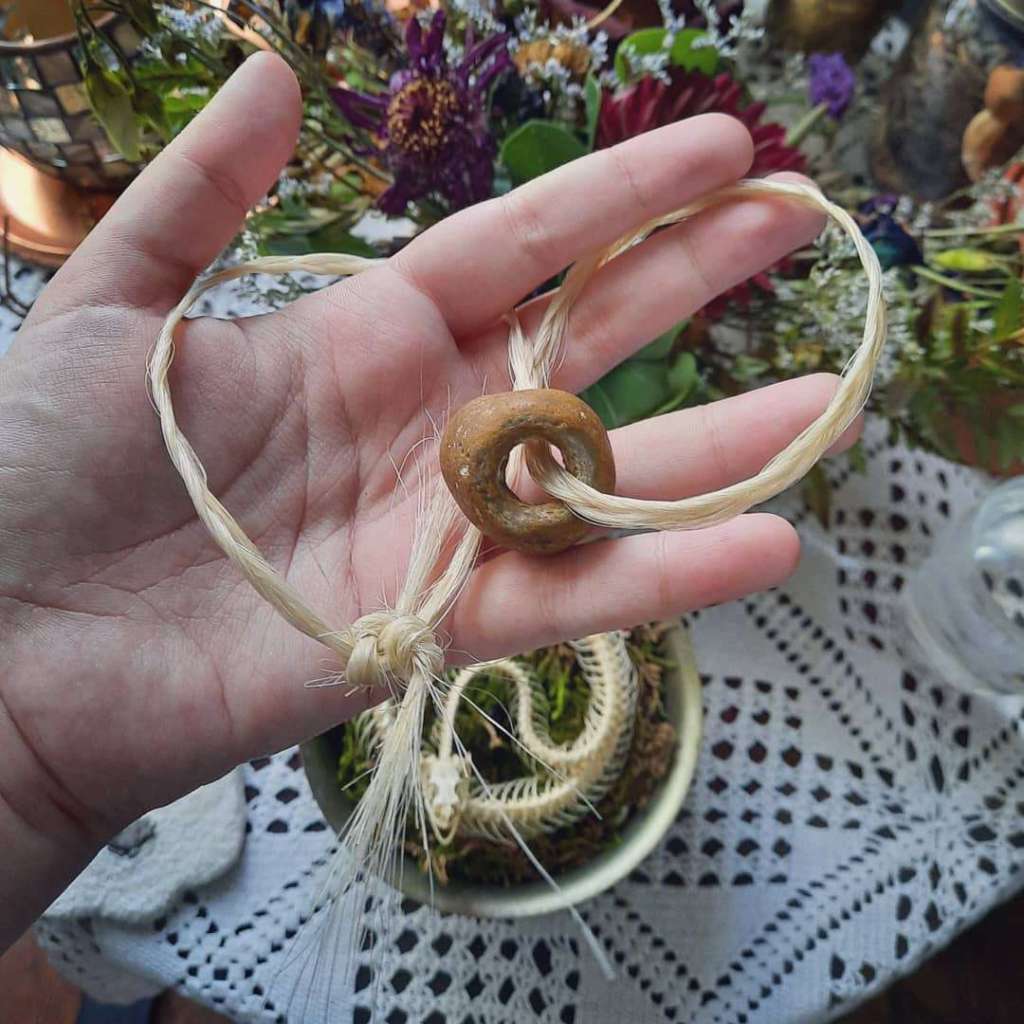
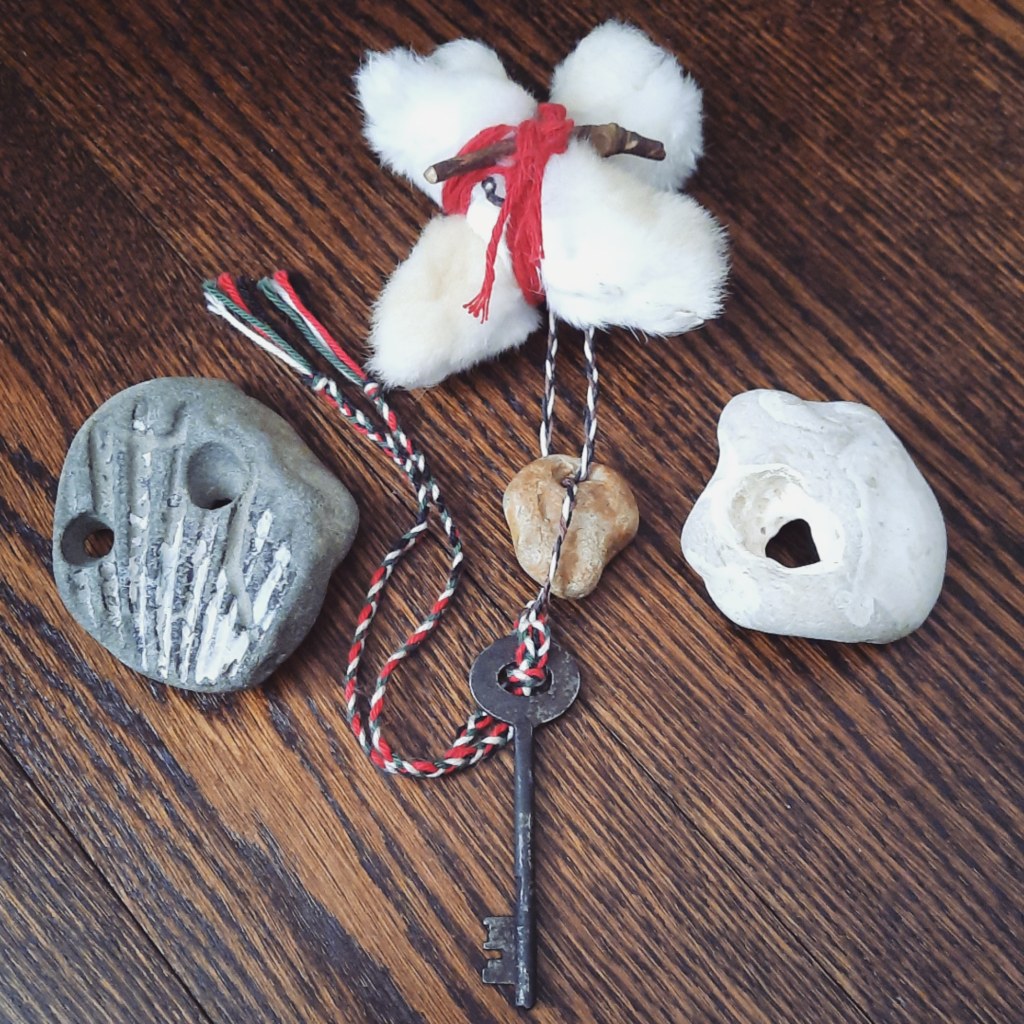
A common charm one can make from this cantrip is to braid horse hair (especially white horse hair, given that the “man of might” is none other than St. George in many understandings) through a hagstone while repeatedly uttering the verse, making an offering to your spirits and the good saint immediately after in thanks to empowering this anti-nightmare ward. I’ve made several of these for friends, family, and especially children’s cribs and found them to be exceptionally useful. The one which hangs over my and Salt’s bed is a two-holed hagstone, with the horsehair looping through the topmost hole, and the other being used to assist me to return to my body in dream and spirit flight.
A charm made in this manner using a hagstone I found while travelling.
Indeed, a very similar charm comes to us from the mid-16th century, as recorded by Thomas Blundeville of Norfolk in his The Order of Curing Horses Diseases (1566):
In nomine patris, &c. —-Patris et Filii et Spiritus Sancti Saint George our Ladyes knight, He walked day so did he night, Until he her founde, He her beate and he her bounde, Till truly her trouth she hym plight, That she would not come with the night, There as Saynt George our Ladyes knight Named was three tymes, Saint George.
Holed flint stones were typically hung, like iron, to ward people and horses alike from being ridden by night-mares—in the case of the latter, they could be placed around the manger or the neck of the animal. Blundeville considered this to be a “foolishe charme” that was to be written down while hanging a “flynte stone that hath a hole of his owne”, which was naught but a silly way to con money out of “playne folks purses”. Yet, much like Reginald Scot, in his very disdain he ultimately preserved for us this oral charm in writing, allowing us to make good use of it even now.
Another dreaming protection amulet, made from a hagstone, an iron key, crossed rabbit’s legs, and mandrake root.
While hagstones require no special ritual to make them “work” or to activate their virtues, there exists plenty of folklore with regards to how they should be acquired. J. Geoffrey Dent’s article “The Holed Stone Amulet and Its Uses” (1965) tells us that there is evidence from the South of England of beliefs that hagstones should be received as gifts, or, even better, stolen. Generational stones, that is, those which had been passed on throughout successive owners within a family, all used for the same purpose, are perhaps the most powerful through their repeated victorious efficacies, and presumably all the more potent if stolen. Yet in the Balkans, we repeatedly encounter the lore that hagstones indeed will only properly “activate” and bond with their owner if they are deliberately found within nature by them. I shared a few charms for how to actually go about and acquire them in this way, both with regards to luring them to you, such that spirits reveal their places and that you stumble upon them naturally, as well as how to seize their fortune once they are found in the episode.
Regardless of what you choose to say out loud (for ultimately many of these “charms” are oral prayers passed on that someone may have at some point invented, or, in the case of bajalice, received from a spirit), a good way to hunt them is to take off your left shoe, and walk barefoot along the shore or river while dropping one millet seed from your closed left fist into the ground at each step and repetition of your prayer. In this way, the spirits of the land are petitioned to receive your blessing of fertility, and accept your alm in exchange for revealing your prize.
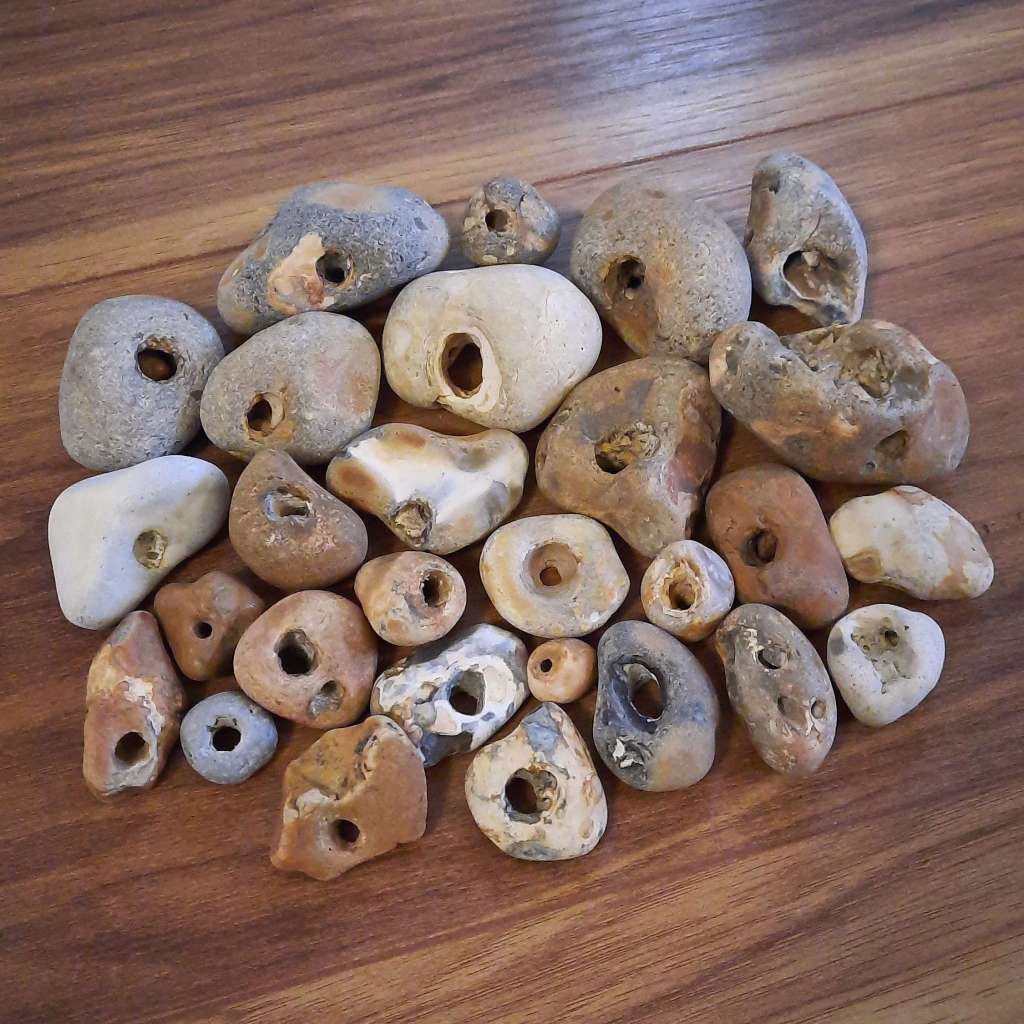
A collection Salt and I brought home from a trip to Brighton Beach together.
Many of the oral charms we shared ultimately serve the purpose of bonding a stone to you, especially if they are not already claimed by one of your spirits. The three of us have often had the shared experience of bringing home a great many hagstones from a hunt only to find that 2/3rds of them had been immediately spoken for by our spirits, who wanted them for their own ends, vessels, and amulets. I’ve often had to string them in groups of seven, nine, thirteen, or twenty-one as soon as I’ve brought them through my door as a saint or house spirit immediately wanted them placed over an important threshold. In cases in which I’ve bought hagstones over Etsy, specifically because I was searching for particular numbers of holes that a spirit requested, I’ve left them before my spirits in small bird’s nests that I’ve collected for them, such that they can incubate, receive the rays of the sun, and lubricate their hissing through the maws of their gates.
If you listen closely for their hissing, the serpents below may even lead you to them by sidewalks in the cities.
While different aspects of lore disagree on whether or not the thread which hagstones are hung on should be knotted or not, the notion that they should be strung up with natural material (such as wool, linen, or hemp) is fairly universal. If I’m about to use mine to scry, I will often make use of a fairly well-known technique across the Balkans to whisper through the whole what I wish to see while moving it around my left palm with my right index finger. Afterwards, I will breathe through the whole, and place it to my right eye while closing the left, and then scry for the augury—or directly at the sky in the morning to witness the rising star, that it may be captured later within that very stone.
There’s so much more that could be said on their collection, uses, and enchantments, such that we’re already planning the next edition of our hagstone episode series. If there’s anything in particular any of our readers are curious about or would like to be included, please feel free to write to us below, and we’ll do our best to include some tips and folklore on each matter in the next installment! For now, happy hunting, and thank you all so deeply for supporting our podcast!
One of the genres of spells present in the PGM that B. Key and I have always found especially intriguing are those categorized as “charms to restrain anger”. There are a handful of these within the papyri, each containing a combination of one or both of the these components: an oral charm said in front of the person whose wrath you are restraining, and a lead lamella or papyrus stele that is either worn, thrown in a river, or deposited near the target. At this point, I’ve been keeping myself stocked on papyrus, clean linen, and sheets of lead to cut shapes out of for a while in my experiments; all I really needed to give these a test was the opportunity.
I have not had the need of using these charms for myself. Instead, my experiences testing them came from friends who approached me in moments of need, as well as from the handful of clients I regularly work with for matters of operative sorcery. (As an aside, while I am now only taking on new clients for divination, not sorcery, please consider contacting our very own incredibly talented B. Key if you are interested in custom talismans and materia to facilitate your own magical goals.) In order to respect their privacy, I will have to speak vaguely on these matters, omitting the majority of the identifying details. However, with the appropriate permissions given, I thought it might be prudent to write a little on my personal experiences with these charms, which were the most efficacious right off the bat, and which were combined with other workings in order to attain the desired results.
An image of the rite as it appears in the Betz translation, page 143.
In no particular order, let us begin with PGM VII. 940–68, being “A charm to restrain anger and a charm to subject”. Out of the entire miscellany, this is by far the one I have used the most frequently, largely owing to its balance of potency and ease of use.
All one needs is a new sheet of papyrus and some myrrh ink, making it especially easily accessible. I’ve found this charm to be highly reliable both on its own and as a compliment to other workings. With regards to the letters and names of power, I have had success with both the English transliterations and the Greek, and have found no changes in potency either way. The main way in which I have deployed this for others is to include the target’s name in the first space and the client’s in the second (“[…] silence, subordinate, enslave him, [target’s name], to him, [client’s name], and cause him to come under [his] feet”), swapping the pronouns as necessary, and then either further modifying the text to include more precise instructions as to how the target ought to be dominated, or including a full length petition with even more details, seals, sigils, and spiraling names of power on the back.
As the PGM does not state whether this charm is to be kept, disposed, or worn on one’s person, I’ve tried out a number of different ways to incorporate the papyrus once it is complete. In one case, I wrote out a spiraling command in a similar fashion to an incantation or demon-trapping bowl, and placed it within a jar I had filled with the target’s tag locks, along with numerous commanding, compelling, and controlling roots and herbs. I would continue to shake this regularly and burn candles anointed in domination oil over it, repeating both the petition on the back and the “come to me, you who are in the everlasting air […]” conjuration from the papyrus. In that circumstance, I incorporated the charm into this structure as this was for a longer-term working to dominate the client’s competitor. Once my client had won indeed won—and the competitor, a notoriously irritable and arrogant sore loser much prone to vengeful slander, did not make any fuss in their workplace—I buried the remains in an appropriate location chosen by my spirits.
Ultimately, what I’m most pleased about with this charm specifically is that, while these additional incorporations certainly boost its power, it still maintains a consistent efficacy when used alone. I have found that for long-term works of suppressing the pride and abuse of a perpetually-bitter and toxic person, it is best used as the driving component or petition of a greater whole that can be continually fed and prayed over. But for targeting temporary states, quelling heat, and ensuring, for example, that one’s boss overlooks and forgives a mistake, simply performing the charm as it is written in the PGM has proved consistently reliable.
Next up are a group of three charms which are entirely oral: PGM IV. 46–668, PGM LXXIX. 1–7, and PGM LXXX. 1–5.
From page 47.
This charm appears twice in the collection, once here and again at PGM IV. 831–32. The next two charms appear grouped together, and as their translator notes, are the same text written by different scribes. Given that they were both copied more than once, we might assume that they were actually found effective and thereby reproduced. After all, they are far from the only PGM spells numbering so few lines. Of course, there are many reasons as to why they might have been copied like this, but given their repetition, I felt more hopeful that they would work like an oral charm, whose power lies in the command of its utterance.
From page 299.
I have primarily tested PGM LXXIX. 1–7 by incorporating it into workings as a repeatable conjuration. In one instance, I stabbed a skull candle with pins anointed with our friend Mahigan’s Chains of the Siren’s Song Ritual Oil, an oil I’ve much tested under the employ of numerous familiars, while reciting this charm over each, seeing the pins as lances boring into the very parts of the target’s psyche most resistant to the sorcery. The bottom of the candle itself was loaded with a matrix of herbs and capped off with a Fourth Pentacle of Mercury, which grants the ability to “to acquire the understanding and knowledge of all things created, and to seek out and penetrate into hidden things”—and what might be so hidden as another’s mind and innermost thoughts? While this setup has proven to be powerful on its own, I did find that the inclusion of the charm provided a particular kick, gathering and commanding additional ambient spirits. I have also made use of this charm with a simpler skull candle working, in which the oil was slowly and hypnotically massaged into the wax (having already been baptized and crossed as the target, with a piece of their spirit conjured into it) while the charm to restrain the anger was repeated 365 times.
I mentioned earlier that I did not really have any need of these charms for myself. Perhaps the closest I have ever come to truly using one in immediate proximity was actually these very oral charms. During an instance of road rage, in which a belligerent driver in the adjacent lane began to blare his horn and drive recklessly, I locked my gaze onto as much of him as I could see and repeated PGM IV. 46–668 (“Will you dare to raise your mighty spear against Zeus?”) three times. When nothing changed, I switched to PGM LXXIX. 1–7 (which at this point I had memorized thanks to the earlier ritual) and was glad to see the driver indeed calm down—or at the very least, stop his fuming. While I do count this as a success of the latter charm working on its own, I reckon that perhaps an even better way to test it would be to mutter it three times in the spur of the moment when it is most crucial, to nullify swelling anger in its heat. Suffice to say, it is indeed a good thing that this opportunity has not yet presented itself to me.
In the highway example, PGM LXXIX. 1–7 had an effect while PGM IV. 46–668 did not. The latter is not only much shorter, but draws on only one name of power, being Zeus. I imagine that it would make for quite a mighty boast in the heat of battle—not just of weapons, but wits. Imagine being in the middle of a debate and whipping out such a flex under your breath! Some nearby spirit may well be spurred to action, or perhaps the charm could weaponize one’s Eye to affix itself upon their target. I have not used it as thoroughly as the other, though I have found it helpful as a mantra in one Jovian work of protecting a client not be fired by their boss. As additional materia and seals of Jupiter were being employed, this charm found itself all the more useful by its invocation of the mighty Zeus.
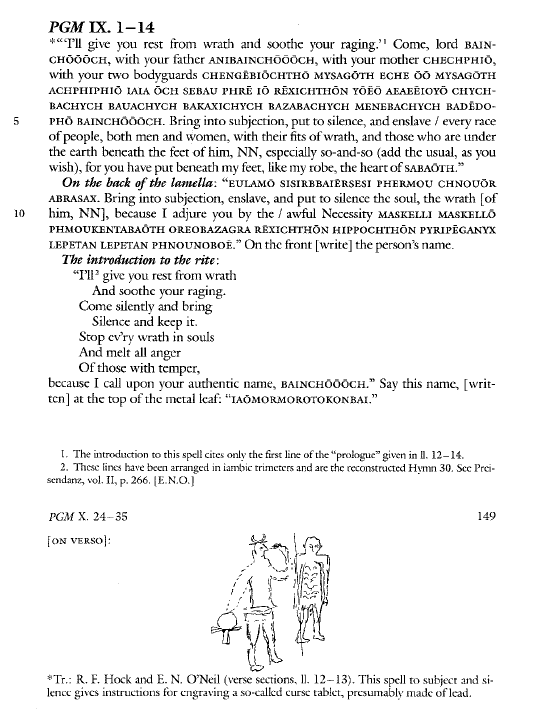
From pages 148–149.
The first of our lamellas is PGM IX. 1–14. While the spell itself only mentions engraving the words, target’s name, and image upon a “metal leaf”, the metal in question is not specified. Much as the translators themselves note, I presumed this would be lead, and my daimons and familiars concurred.
I performed this spell precisely as outlined without including it into other workings. While the PGM doesn’t specify what should be done with the lamella afterwards, I decided to bury it at the workplace of the target. Within a week, my client alerted me that not only was the individual in question far more demure, but that they were no longer making snide comments, sabotaging her efforts, or behaving jealously and with constant venom towards her. This was the only time that I made use of this lamella specifically, though I have plenty of ideas for how it could be used in conjunction with further ritual. Much as in the earlier case, I imagine it could be incorporated into further materia, rolled up like a tube and inserted into wax or clay poppets, sewn into cloth talismans, or wrapped in snakeskin and placed in the claw of an owl to be hung and fumigated—both animals being associated with Ananke, a goddess called upon in the conjuration (“[…] I adjure you by the awful Necessity […]”).
Needless to say, I certainly plan on incorporating it into other methodologies in the future with my spirits and see how it lends its power to additional structures of sorcery. What is essential is that the charm itself worked when I needed it to and is perfectly sufficient for the job on its own. Next time the opportunity for using this arises, I will ask my spirits during our initial divination about the matter if they foresee this charm as being sufficient, or if I should further bolster it. This is really how I proceed with any of these—I first consult with my court about whether it would be appropriate to test out the charm in the situation (as opposed to rely on a more tried and true method between us), and then check if they advise any modifications or to proceed as given.
From page 149.
Speaking of charms which I didn’t change in any way, immediately following our previous example is PGM X. 24–35, a spell which allegedly “works all cases”, and not just against enemies, but phobias and nightmares. I am particularly fond of this one as it has such varied applications, being able to restrain not only the anger of others, but one’s fears and anxieties. While the spell specifies the use of gold or silver, I ended up using a sheet of tin to make four copies. All had varying degrees of success, so I can definitely vouch for the efficacy of tin specifically as a substitute. In fact, a friend even drew this out with a bronze stylus on aluminum foil and had it work, so it’s good to know that there are cheaper alternatives available. I plan on eventually making one out of silver just to have as a personal talisman, but for now tin definitely suffices.
I gave my set out to four friends and asked them to carry it on their persons while “pure” (not bleeding, not having recently had sex, etc.). One used hers to prevent nightmares, placing it under her pillow when not menstruating or having recently had sex, and otherwise by the bedside table. She reported to me that she noticed a marked decrease in regular nightmares, with the only ones that she did have appearing to be relevant as omens or indications of something being spiritually amiss. Another friend used hers to literally restrain her own anxiety and tendencies towards self-sabotage. While this of course did not fully resolve the anxiety in a long-term sense, being no substitute for therapy, it did help to contain it in moments of need, such as an important interview. The other two both used theirs for the primary purpose of restraining anger, albeit in both cases preemptively. They carried it to work around problematic colleagues and bosses and noticed a marked difference in their attitudes towards them specifically, but not towards others. It seems that even though one doesn’t engrave their own name upon the lamella, it is linked by the sympathy of being carried or worn to affect most powerfully its bearer. Wrathful coworkers and superiors still exhibited their usual behaviour to others, but ignored and passed over my friends entirely.
From page 269.
The next two charms are written one after the other in their papyrus. The first is PGM XXXVI. 1–34, which is a personal favourite as it calls upon Set-Typhon. The Kemetic Set is a deeply beloved deity for me, being formative in many of my personal experiences and bearing a place of great prominence in my home alongside the Lord of Wisdom, Djehuty. This spell calls on Set to restrain any subject—it is not specifically for anger, but rather works on “everything”. Inscribed by bronze stylus onto a lead sheet, the magician creates an image of Set (I confess mine was much nicer than the one preserved in the book, as I sketched the God more true to his Egyptian iconography) and inscribes the names of power within and around his body.
While I have only made use of this charm twice, it bore the most powerful and immediate result for me out of all of them. I do not doubt that this is at the very least partially owing to my preexisting relationship with the God. While I’m sure the powers and names of the associations alone will conjure success in the right circumstances (presuming one’s target does not have sufficient protections, and that one does not sabotage or work against the sorcery themselves by provoking them), the sheer intensity of the results I experienced with this were certainly benefitted from the decade of regular offerings and prayers I have made in cultivating my relationship with Set as a patron and Father to my craft. In one of the two instances, I deployed this charm to restrain both overbearing relatives and ancestral spirits alike from interfering with my client’s drastic change in career and lifestyle, and both parties evidenced a drastic change in attitude practically overnight. Out of the entire miscellany, I would recommend this one the most for matters of exorcism and the suppression of the pride and authority of particular spirits, who could not otherwise be bribed or negotiated out of their interference.
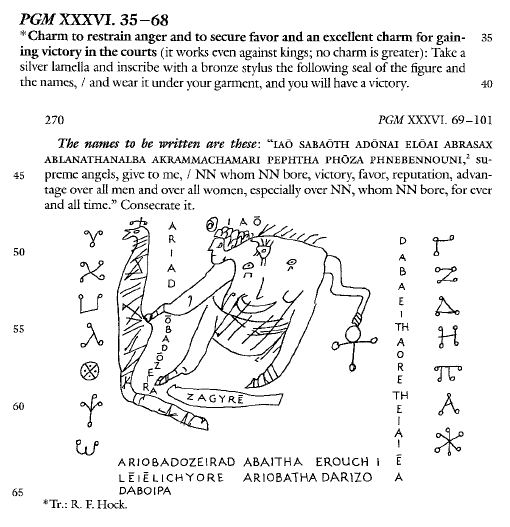
From pages 269–270.
Immediately after we have PGM XXXVI. 35–68, which assures us that it works “even against kings” and that “no charm is greater”. This one is part of a group which aim to not only restrain anger but also to secure and promote success and victory over others. The figure (which looks to me like a deity doing a kick flip on a skateboard while holding a serpent) is drawn on a silver lamella with a bronze stylus. Again, I ended up using tin, and found it to still work in the time that I deployed it. I gave it to a client to wear during an important competition and was much overjoyed to have heard that he had won. According to him, the opposing team was unusually sloppy and distracted, and his own demonstrated extreme confidence and prowess. Emboldened by this, I was going to make the same charm for another friend who was about to apply for a significant award, but was informed by divination that they would not win, even with the help of the lamella. My spirits informed me that this charm is better used in interviews and in direct competitions in which one is confronting their opponents, not in long-term applications with multiple, anonymously peer-reviewed rounds. While I considered the idea of making one anyway and using it as the centerpiece of a larger working, such as placing it under a plate upon which I would inscribe seals, conjure spirits, and burn candles (while having my client wear a matching one on their person), I ultimately was shown a more efficacious way to assist them by my court and proceeded with their guidance. That said, my spirits did agree that it would still work when used in conjunction with other such workings—they just happened to suggest an alternate method for that particular case.
From page 273.
Oh, how I love a charm that has you hold your thumbs. I’m always reminded of Balkan cantrips for invisibility and leaving one’s body as a spirit that have you repeat a phrase while holding the thumbs—which is also the equivalent for crossing one’s fingers for luck where I’m from! PGM XXXVI. 161–77 is a great one when it comes to affordability: it’s an oral charm that offers the potential to “augment the words” with a papyrus amulet. Instead of performing this one myself, I had my friend perform it on her own behalf to stop slander. I particularly like the phrasing of “[…] stop the mouths that speak against me, because I glorify your sacred and honoured names which are in heaven”. The elevation of one’s pure mouth, which speaks the holy names, over profane libel and other such drivel. My friend also wrote the full list of angel names on papyrus and kept it on their person, which assisted in stopping the gossip. This is another one I think can be really easily incorporated into plenty of other workings of folk magic. It provides a buffer of protection and an exaltation of one’s own truth and piety over that of slander, so as such one should ensure that they do not engage in gossip or similar behaviour while seeking the charm’s solace.
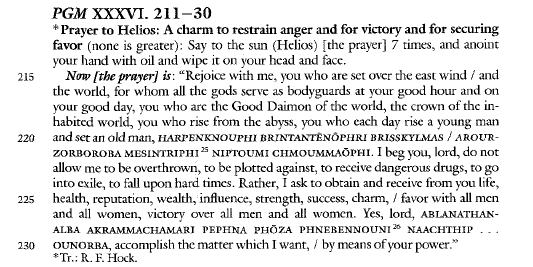
From page 274.
Shortly after we have our final charm which secures victory and favour in addition to restraining anger (by the way, in case you were wondering: none is greater). I just love that each of these makes mention that no charm is better while calling on entirely different gods and holy names; it feels a bit like watching an advertising competitions between cults. PGM XXXVI. 211–30 calls upon Helios, praying to him directly while facing the sun seven times and anointing your hand with oil, wiping it on your face. This one I performed myself to assist with winning a game of pure chance. As the spell does not specify which kind of oil is to be used, I opted for Holy anointing oil, though just frankincense would also do well in a pinch. I literally left my computer, stepped outside into my backyard to recite this, and then returned with the oil smeared on my forehead to resume the game, and promptly won six out of ten rounds of pure numerological chance—not a bad rate in the slightest! I definitely recommend playing around with this one. As it’s a prayer, it can be incorporated into many circumstances for obtaining victory, favour, honour, and fortune, and that’s with just using it on its own. Creativity is surely the limit with the ways this can be used. If you plan on using this for a major undertaking, I would always recommend divining first to see if it would work in your case, and if the answers are negative, using it more as a background boost for more elaborate sorcery.
From page 129.
Finally, there’s PGM VII. 417–22, which to my delight actually does call for tin! This one specifically should be thrown into a flowing body of water at sunrise, being engraved with the names of power and a customizable petition. I’ve done this one three times (making offerings at the riverbank to the local spirits in thanks each time) and it worked in two of the three instances, with the third one revealing under later divination that its magic was not able to sufficiently reach the intended target. In that instance, I went back to the drawing board, sent out a familiar adept at fetching etheric links from a long distance, and conjured more of the target’s presence into a spirit trap before subjugating their abusive behaviour towards my client further. The other two cases were far more local, which I imagine played an important role in how the spirits of the land and waters were able to deliver the potency of the lamella to them. The case in which this charm did not work ultimately involved an exceptionally prideful and stubborn target, so I was not surprised that it did not ultimately help much in the initial stages—though I found that making the charm anyway helped “soften” them up to make the later magic more effective, as it had stripped down some of the initial layers of resistance and protection.
In testing this genre of charm, I was able to verify that each is fully capable of producing its own result, while also easily being combined into other workings. In some cases, a lamella can simply be given over to a spirit on their shrine or laid atop their vessel, so that it becomes as a tool for them to use in your defence. In others, they were worn on the person, disposed of in places of power, or left to accumulate power inside containers and under candles. What strikes me the most about these charms against anger is how diverse they are. While they certainly are excellent to memorize in moments of passion when they would be necessary (especially in the case of the oral charms), they can be used to restrain far more. Pride, anxiety, nightmares, interfering spirits, gossip and slander, and even the very hidden plots and temptations within another to cause harm to oneself and one’s reputation—the diversity of use for these charms make them an excellent corpus to consider experimenting with, and I recommend those interested to not only play around with them with their own spirits, but to use them as a means to consider the applicability of other kinds of sorceries in matters concerning far more than what might initially meet the eye.
Joyous feast of St. Expedite, holy martyr and swift intercessor of our souls! A saint deeply cherished by all three of us at With Cunning & Command, he’s been a continual guide, tutor, and ally in our workings. For his 2023 feast, I am proud to present a fresh take on an old offering, as well as three new rigorously-tested oils available for all who would like to further ingress into the pious soldier’s mysteries, accumulate great fortune and phenomenal luck, and solicit financial blessings, boons, and all manner of opportunities for the generation of wealth.
The intertwined consecration of the first batch of oils.
Oil of St. Expedite: Gold Edition
An oil built at the guiding hand of St. Expedite over many years and just as many iterations, bringing about countless successful workings, manifestations, and results for both myself and others along the way. This edition of the oil serves as a distilled offering to the Saint himself, primarily stirring him and his legions to action and guiding his virtues and sympathies into workings under his auspices. I recommend applying seven drops to the right foot of an image of St. Expedite upon the reception of this oil in order to complete a final personalized consecration.
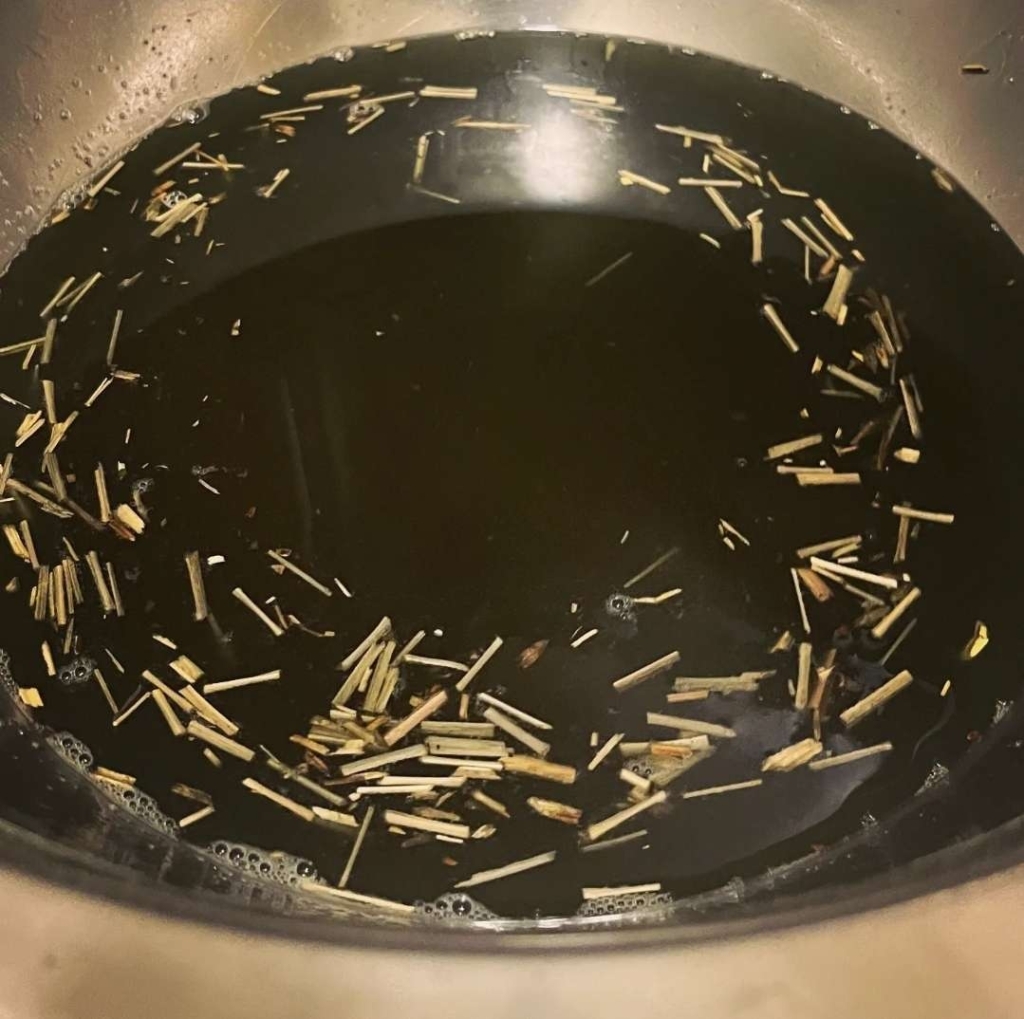
Cinnamon bark, cinquefoil, coconut flesh, coffee beans, dice, eucalyptus, lemongrass, blessed palm fronds from a Catholic church, crumbs from multiple pound cakes offered to St. Expedite in exchange for successful workings in his name, roses fed holy water from three different Catholic churches and offered to St. Expedite on Easter, whole vanilla beans, wintergreen leaves, skeleton keys, scraps of cloth from a cape that adorned a statue of St. Expedite, dirt from various shrines to St. Expedite, gold, silver, a carrier oil kept and fed on St. Expedite’s shrine for one year from feast to feast, and additional vegetable, animal, and mineral components.
1 fluid ounce / 30 milliliter amber glass dropper bottle.
$60.00
The Red Oil in its first stage.
Oil of St. Expedite: Red Edition
An oil that expands on a traditional Hoodoo formula to bring luck in all forms, especially in financial and amatory workings. This edition of the oil was tested through cash bingo games at a local bar, thoroughly satisfying my expectations after winning 4 of the 7 games played, much to the delight, or chagrin, of the bar’s patrons.
Alkanet roots, multiple varieties of cinnamon bark, coconut flesh, blessed palm fronds from a Catholic church, roses fed holy water from three different Catholic churches and offered to St. Expedite on Easter Sunday, whole vanilla beans, scraps of cloth from a cape that adorned a statue of St. Expedite, a carrier oil kept and fed on St. Expedite’s shrine for one year from feast to feast, and additional vegetable, animal, and mineral components.
1 fluid ounce / 30 milliliter amber glass dropper bottle.
$60.00
The Green Oil, having been produced from the bodies of Gold and Red.
Oil of St. Expedite: Green Edition
An oil that expands on a traditional Hoodoo formula to bring monetary, financial, and business success, along with myriad other forms of wealth. This oil’s construction was made possible only after the Gold and Red editions brought the material and financial components included within.
Shredded currency won through gambling using the Red Oil, multiple varieties of cinnamon bark, cinquefoil, hyssop, indigo powder, lemongrass, multiple varieties of mint, coconut oil, sunflower oil, sweet almond oil, wormwood, gold, a carrier oil kept and fed on St. Expedite’s shrine for one year from feast to feast, and additional vegetable, animal, and mineral components.
1 fluid ounce / 30 milliliter amber glass dropper bottle.
$60.00
The three mother bottles receiving their final consecrations.
A Trinity of Oils
For those who wish to purchase a set of of each Gold, Red, and Green editions of Expedite Oil, a discounted rate is available.
Three 1 fluid ounce / 30 milliliter amber glass dropper bottles.
$160.00
A batch of last year’s charms charging.
Mercury in Nutmeg, Third Edition
Back by popular demand, a batch of Mercury in Nutmeg charms are available for the Feast of St. Expedite. As described in a post all their own, these talismans for all manner of luck-enhancement can be petitioned with your desires in mind in order to bring about expedient and radical changes in fortune. Born from a year of continuous experimentation with the aim of refining the ensorcelled components therein, the third edition of the Mercury in Nutmeg charms contain an improved variation of the powdery matrix that fuels the talisman and an improved internal load born of metallurgical and alchemical processes hard won from the various patrons of these arts. As with previous editions of this talisman, a cantrip similar to a “knotting the wind” charm has been included to unleash a brief yet intense boost in luck in a critical moment. In order to use this extra boost in power, untie the red cord affixed to the talisman and burn it, scattering the ashes to the wind.
Those who have purchased previous editions report best results when carrying the talisman with them, or keeping the talisman situated in work spaces, on computer desks, or inside the cash registers of their businesses. As these talismans are very much alive, the spirit should be nourished with offerings of strong, dark liquors such as whiskey, brandy or dark rum, tobacco smoke, red, green, or yellow candles, and praise upon successful completion of tasks.
All Third Edition Mercury in Nutmeg talismans have been sold as of April 19, 2023! Thank you all so much for your support!
The first batch of individual bottles for sale being set over the Kamea of Mercury.
The products herein are made in limited quantity and offered on a first-come, first-serve basis as curios only. Please allow up to one week from the time of purchase to package and ship each order. An email with tracking information, when available, will be sent to the address associated with the PayPal used at purchase.
For those interested in bespoke work or wholesale opportunities, contact us [here]. Stay tuned for more offerings shortly, as well as an exciting new project for the entire blog!















 With Cunning & Command