On the Eastern Orthodox feast of Saints Cyprian and Justina of Antioch, most holy and most powerful intercessors, a clutch of charms in honour of their exorcistic abilities and prowess were born.
I had been intending on making a set of these charms for the two saints inspired by Orthodox folk traditions, drawing from my training in different forms of saint veneration, folk magic, and oral charming in Western Serbia. After my last release for the holy pair, I wanted to make some amulets in their honour that would not only be more affordable, but whose proceeds would also be donated directly back to the teachers and sources of Cyprianic magic that have informed my practice across the traditions I have training in, named and unnamed, acknowledged and hidden. In divining on their ingredients, consecration, and nature, it became quickly apparent that I was to incorporate techniques and lore I learned across their Balkan traditions, most notably Serbian, Greek, and Cypriot. As such, I invited my good friend Maria of Green Dragon Healer to join me in their construction, and lend her Greek herbal training to the various recipes I had picked up on them in my travels.
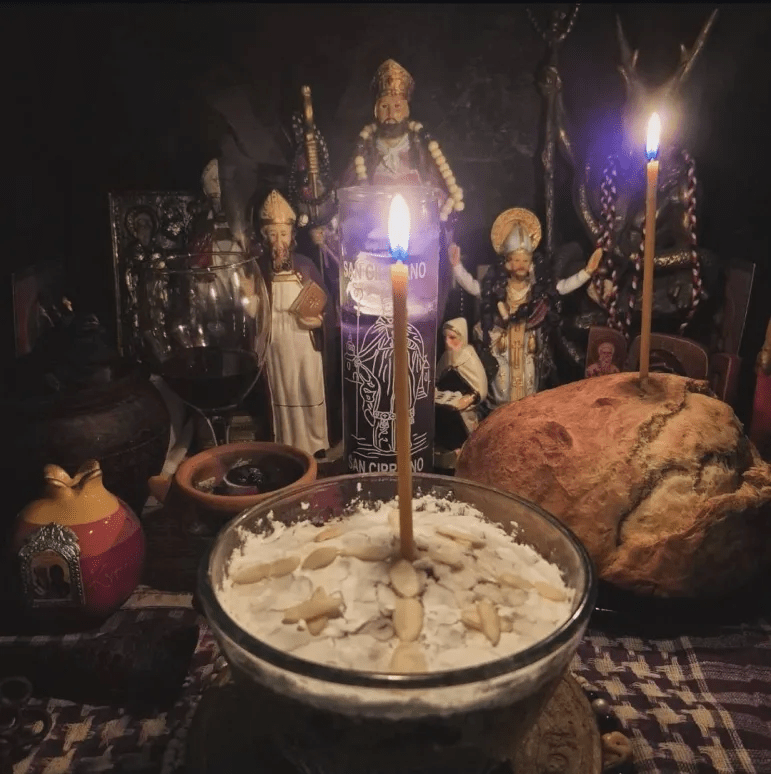
On the 15th of October, I used holy water I collected from a font dedicated to Sts. Cyprian and Justina on their feast in Meniko, Cyprus to bake a bread that was prayed over, charmed, and ensorcelled to grow with particular virtues necessary for the work. Maria brought over a koljivo she made and ornamented with powdered sugar and almond slices to present in offering alongside red wine, spring water, and black Orthodox St. Cyprian incense used for exorcism. We joined in offering a litany of traditional prayers sourced from various Akathists to the holy pair, and fumigated both the forty-one beans that would be used in finalizing the recipe as well as the purple cloth that would serve as their skin and surface of divination. Once set, we laid out the cloth in a large square and cast the beans before the saint, receiving the omen necessary to proceed with the original divined materia list immediately without modification.
Cutting half the bread into twenty-one small squares, we anointed each piece with a trinity of oils—one of Cyprian, one of Justina, and one of a mitigating stellar force that became known to us in the divination to carry forth the energy of Cyprian’s magician disciples and Justina’s pious nuns. Enlivening them once more as the fulfillment of the pact of each individual amulet, we layered all other herbs and materia over these squares, including pieces of incense, herbs associated with Cyprian and Justina across the Balkans, and various mineral and animal ingredients, finally dividing the forty-one beans that approved of the formula between them all. Each amulet bag was then tied up with purple thread, over which was layered white hemp cord that holds together a real freshwater pearl and a small hagstone each.

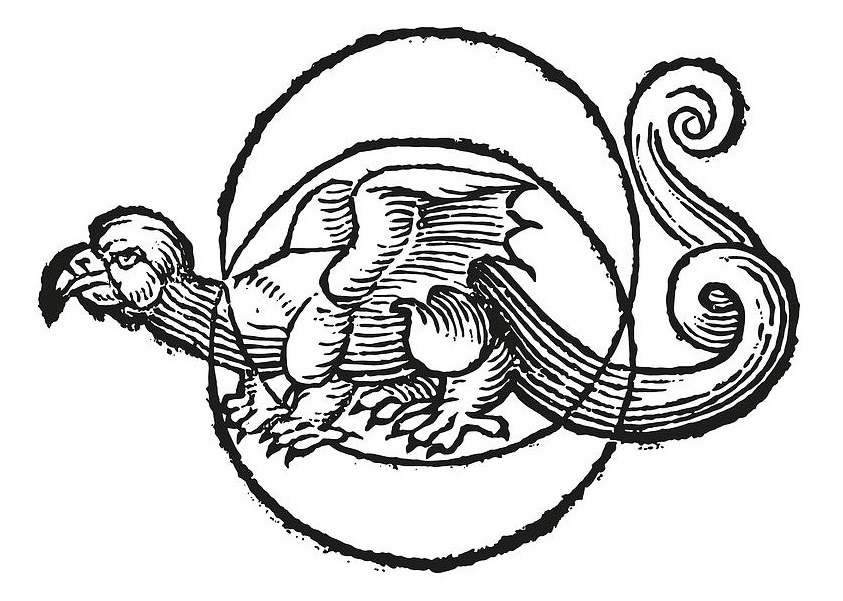
Each hagstone was dragged through dirt, blood, milk, and holy water, the serpent which passed through the hole of its egg vivified from the vespers of his first Orthodox feast on the second of October to the day of the fifteenth, with both the revised and the old Julian calendars being honoured together. Through the amulets, dragon and pearl are married once more, each hagstone being bound to a freshwater pearl anointed with holy water, holy oil, and tears from the icons of Cyprian and Justina in their name. Pearls are especially sacred to St. Justina, and as the holy water and holy oil themselves were either gathered or purchased from monasteries and churches bearing their names on their feast days, so too were the pearls enlivened in honour of the temporal and spatial dimensions of their veneration and faith.

These charms were then prayed over extensively across traditions. Over nine days, Maria recited daily exorcistic prayers intended for lay use from the Greek Orthodox tradition, empowering them to keep away evil spirits, restless dead, vampires, and all manner of malefica. During that same period, I offered a Serbian Orthodox prayer for protection against witchcraft and the familiars and servants of other sorcerers, including those sent to spy in spiritual voyeurism. Finally, they were programmed to benefit their owners in empowering the communicative abilities and oracular manifestations of friendly, allied spirits, thereby acting not only as wards against those unwanted but also granting Cyprian’s saintly cloak of authority and magical prowess to those spirits who follow their sorcerer as closely and dutifully as his own disciples.
The students of Cyprian and the nuns of Justina were supplicated throughout this process, lending their hands and vows to the trinity of bread, pearl, and hagstone to affirm that these charms will continue to empower the ability of their owners to receive recipes, workings, and instructions for the cultivation of different spiritual activities directly through them. Hold in your hands as you meditate with your spirits or place it on a shrine that you wish to communicate better with or boost the powers of. Cleanse your body with it by wiping it down each limb and under the toes to rid yourself of malefica. Carry on your person to neutralize prying eyes and ill intents. Place at the feet of Sts. Cyprian and Justina in prayer and then move by your bedside to incubate magical instructions in dreams. When divining on recipes with your spirits, hold this charm in your hand or have it by your divinatory tools in order to hear the spirits more clearly. Anoint on Saturdays with an oil of St. Cyprian, a holy oil, or an oil of rosemary to keep fresh and empowered.

Sts. Cyprian and Justina’s Charms of Exorcistic Power
One charm bag for keeping away the hungry dead, malefica, and witchcraft, and empowering the protective dead. Shipping included. All proceeds will be donated to different sources that have informed Sfinga’s Cyprianic practice, be they teachers, temples, or churches.
$121.00

 With Cunning & Command